The Professional Guide to Automotive Window Film: Selection & Inventory Strategy (2026)
Your shop's profitability isn't determined by the logo on the box, but by the technical precision of the roll inside. You likely know the frustration of dealing with inconsistent shrink properties or trying to explain the nuances of TSER versus IR rejection to a skeptical client. It's difficult to scale a business when you're constantly battling customer re-dos caused by fluctuating automotive film quality. We understand that managing bulk inventory for a wide range of vehicle types requires more than just a storage room; it requires a strategic approach to performance and durability.
In this guide, you'll master the technical specifications and inventory strategies needed to choose the most profitable and high-performing films for your shop. We've designed this resource to help you secure high-performance rolls with consistent properties that make every installation seamless. You'll learn how to leverage improved heat rejection stats to market your services to premium clients and how to build a reliable partnership with a wholesale provider that supports your professional growth. We'll examine the science of heat rejection, simplify inventory management for diverse fleets, and provide the technical clarity you need to make informed purchasing decisions that protect your bottom line.
Key Takeaways
Identify why Total Solar Energy Rejection (TSER) is the most critical metric for heat management and how to use this data to sell higher-margin services.
Master the technical distinctions between carbon and ceramic automotive film to provide expert recommendations that balance durability with thermal performance.
Structure your inventory using a "Good-Better-Best" model to simplify the customer decision-making process while maintaining stock of essential VLT percentages.
Learn how professional-grade tinting tools and high-quality marketing materials can professionalize your showroom and reduce installation errors.
The Evolution of Automotive Window Film Technology
Automotive window film has moved far beyond simple privacy and darkened glass. Historically, shops sold tint primarily for its visual appeal or "cool factor." Modern installers now prioritize thermal management as the primary selling point for high-end clients. This shift reflects The Evolution of Automotive Window Film from a basic cosmetic accessory to a precision-engineered protection layer. Today's professional-grade rolls must offer color stability as an absolute baseline. Clients expect their investment to look as deep and consistent in year five as it did on day one, making the "purple tint" of the past a relic of amateur installations.
The progression from early dyed films to modern multi-layered technology has changed how shops manage their inventory. Advanced manufacturing allows for the stacking of microscopic layers that target specific wavelengths of the solar spectrum. Nano-technology plays a vital role here. It enables manufacturers to create films that remain nearly transparent while still offering extreme heat rejection. This allows shops to cater to luxury owners who want the benefits of a cool cabin without the "blacked-out" look of traditional films.
Traditional Dyed vs. High-Performance Films
Early dyed films relied almost entirely on heat absorption. The dye particles trapped solar energy within the glass itself, which often led to thermal stress and eventual fading or bubbling. Professionals are moving away from basic 1-ply dyed rolls because they lack the longevity required for high-end client satisfaction. These older technologies also faced significant hurdles as vehicles became more connected. If a film used metallic layers to achieve heat rejection, it often caused signal interference with GPS, cellular, and satellite radio. Modern high-performance automotive film utilizes non-metalized constructions to ensure that all onboard electronics function perfectly in tech-heavy modern vehicles.
The Rise of Nano-Ceramic and Carbon Structures
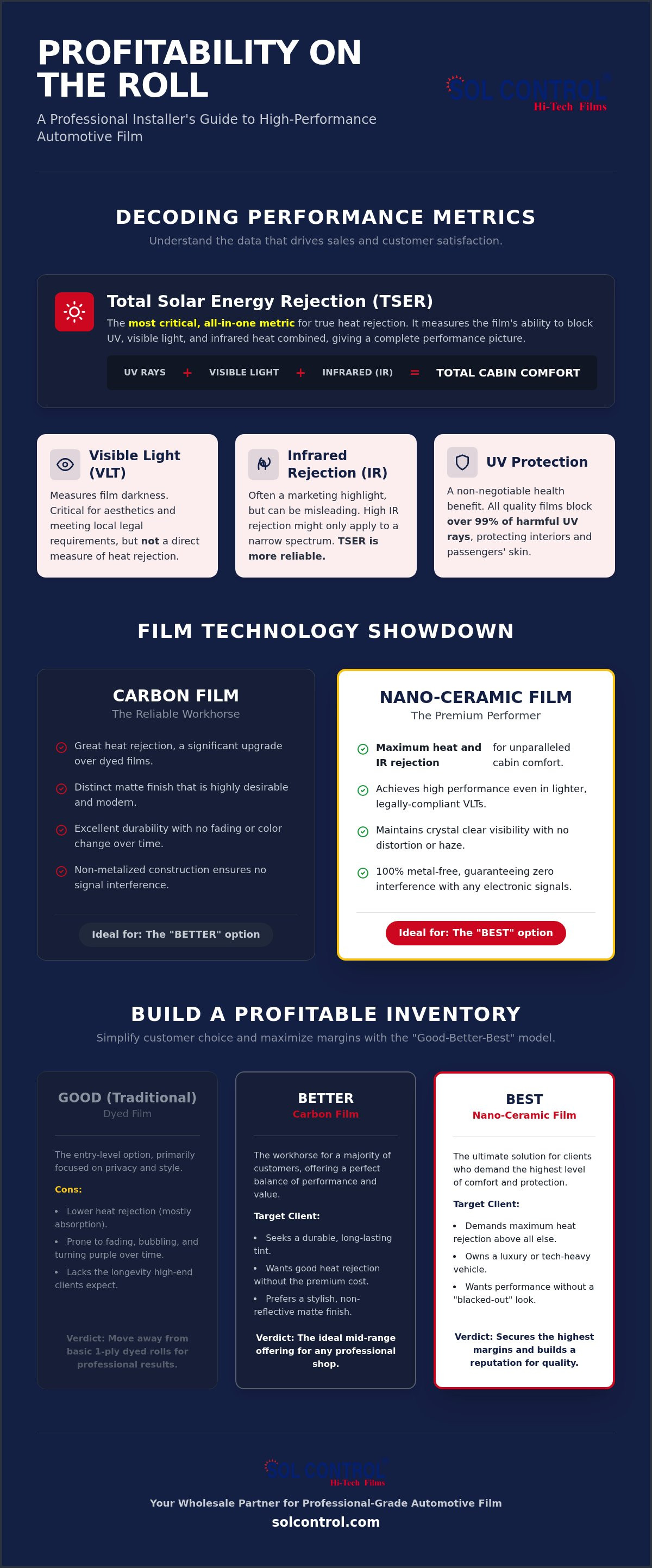
Carbon film has emerged as a reliable mid-range workhorse for many shops. It provides a distinct matte finish that doesn't fade, offering a significant upgrade over traditional dyed products without the premium price point of ceramic. It's the ideal "better" option in a good-better-best sales model. However, for clients demanding maximum comfort, ceramic technology is the clear leader. Ceramic particles are engineered to block a massive portion of infrared radiation, which is the primary cause of heat felt inside the cabin. Nano-ceramic film represents the industry standard for 2026, offering unparalleled heat rejection without compromising cellular or satellite signals. This technology allows for impressive performance even in lighter VLT percentages, giving you more versatility in what you can offer your customers.
Decoding Performance Metrics: TSER, VLT, and IR Rejection
Performance metrics often serve as the bridge between a successful sale and a confused customer. For a professional shop, understanding these numbers is the difference between being a mere installer and an authoritative expert. Total Solar Energy Rejection (TSER) is the most critical metric for any automotive film professional. While many clients focus on how dark a film looks, TSER measures the total amount of solar energy, including UV, visible light, and infrared, that the film actually blocks. A high TSER percentage directly correlates to cabin comfort and is the only metric that provides a complete picture of heat rejection.
Visible Light Transmission (VLT) determines the aesthetic and legal standing of the installation. Balancing a client's desire for privacy with local regulations is a daily task for shops, but it's important to remember that VLT alone doesn't dictate heat rejection. Infrared (IR) rejection is frequently used in marketing, but it can be misleading. A film claiming "99% IR rejection" might only be blocking a specific narrow band of the infrared spectrum. This doesn't mean it blocks 99% of all heat, which is why TSER remains the gold standard for performance comparison.
UV protection is a non-negotiable health benefit that every professional should highlight. High-quality films block 99% of harmful rays, protecting both the vehicle's upholstery and the passengers' skin. The International Window Film Association provides extensive data on how these protective layers serve as a primary defense against interior degradation and solar skin damage.
How to Read a Film Spec Sheet Like a Pro
Professionals distinguish themselves by understanding the Solar Heat Gain Coefficient (SHGC). This number indicates how much solar radiation passes through the window; a lower number means better performance. Glare reduction is another key stat, which typically increases as the film gets darker. Understanding these nuances allows you to compare different tiers of automotive film accurately. You can browse our professional-grade inventory to see how these metrics vary across carbon and ceramic series.
Explaining Value to Your Customers
Technical jargon rarely closes a sale on its own. Instead of quoting percentages, translate TSER into tangible benefits. Tell your client that a high-performance film can make their car feel significantly cooler after sitting in the sun for hours. Use a tint meter during the consultation to demonstrate the film's performance in real-time. This visual proof builds trust and justifies the premium price of ceramic options. Mentioning skin cancer prevention is also a powerful motivator for families and high-end clients who value long-term health and safety.
Carbon vs. Ceramic: Choosing the Right Film for Your Shop
Selecting the right automotive film for your inventory involves more than just comparing price points. You need to understand how different technologies perform under real-world conditions to provide the best advice to your customers. Carbon film has earned its reputation as the reliable workhorse for daily drivers. It utilizes carbon particles to block solar energy without the use of metal, ensuring zero signal interference for mobile devices or GPS. Its primary appeal lies in its durability and its distinct matte finish, which provides a sophisticated look that won't fade or turn purple over time. For many shops, this represents the perfect balance of affordability and long-term performance.
Ceramic film represents the premium tier of window protection. It's engineered for luxury vehicles and clients who prioritize maximum cabin comfort above all else. By utilizing nano-ceramic particles, these films block a significantly higher percentage of infrared radiation compared to carbon. This makes them the ideal choice for high-end projects where performance is the non-negotiable standard. Both types offer excellent longevity, but ceramic often comes with more robust professional warranties that cover everything from color stability to adhesive failure. This gives your shop the confidence to stand behind every job you complete, reducing the risk of costly re-dos.
The Professional’s Choice for Heat Rejection
Ceramic film is the superior choice for electric vehicles (EVs). Since EVs often feature expansive glass roofs and large windshields, managing heat is essential for maintaining battery range by reducing the load on the air conditioning system. While ceramic leads in performance, carbon film maintains a strong advantage for clients seeking a "true black" aesthetic that perfectly matches factory glass. High-performance ceramic films typically offer a 15% to 25% higher Total Solar Energy Rejection (TSER) than standard carbon options. This performance delta is a powerful selling point when moving clients up from a mid-grade service to a premium package.
Installation Efficiency and Shrink Characteristics
The physical properties of the film directly impact your shop's daily output and profitability. Ceramic films are generally thicker than carbon variants, which can influence how they respond to heat during the shrinking process on complex, curved back windows. Installers must manage the adhesive tack carefully to avoid premature sticking or "fingers" during the final lay-down. Choosing a partner like SolControl ensures you receive rolls with consistent shrink properties across every automotive film series you stock. This reliability reduces material waste and helps your team maintain a high installation speed without sacrificing the quality of the professional finish your clients expect.
Building a Profitable Inventory: A Selection Framework
Successful shops don't just buy film; they architect an inventory that maximizes throughput and minimizes waste. A strategic selection framework ensures you have the right automotive film for every vehicle that enters your bay. By structuring your offerings around a "Good-Better-Best" model, you provide clear choices that guide customers toward the performance they need. This model typically features a reliable entry-level option, a mid-range carbon film for durability, and a premium ceramic film for those who demand the highest heat rejection. This approach doesn't just sell film; it sells solutions based on specific client priorities.
Efficiency in the bay starts with stocking the correct VLT percentages. You should maintain a consistent supply of 5%, 20%, 35%, and 50% shades to meet diverse legal requirements and styling preferences. Beyond standard side and rear windows, consider the growth in specialty films. Clear ceramic and windshield protection film are becoming essential for shops targeting the luxury and electric vehicle markets. These products allow you to offer full-vehicle thermal protection without darkening the glass, creating a unique value proposition for high-end clients.
Minimizing scrap is the fastest way to increase your profit margins. Managing roll widths is a critical part of this process. Stocking 20" and 24" rolls for side windows while reserving 36" and 40" widths for larger rear glass prevents unnecessary trimming and waste. Every inch of saved material contributes directly to your bottom line. You can explore our wholesale automotive catalog to find the exact roll sizes and film types your shop needs to stay competitive.
Matching Film Tiers to Local Market Demand
Your inventory should reflect the specific needs of your customer base. Stocking carbon films allows you to capture the segment of the market that seeks a quality, color-stable product without the premium price of ceramic. On the other hand, upselling ceramic to the "comfort-first" luxury and SUV market is a proven way to increase your average ticket price. Windshield protection film serves as an excellent high-margin add-on for these clients. It provides an extra layer of defense against road debris and heat while they're already in your shop for a tint job.
The Logistics of Wholesale Film Sourcing
Sourcing your material from a reliable partner is as important as the quality of the film itself. Buying 100ft rolls generally offers a better price-per-square-foot than smaller quantities, which is vital for high-volume shops. Batch consistency is another major factor; you need to know that a roll ordered today will match the color and performance of a roll ordered next month. Partnering with a national US distributor helps you avoid color-matching issues on multi-car fleets and reduces lead times. This reliability ensures your shelves are never empty when a high-value customer pulls into your parking lot.
Beyond the Roll: Scaling Your Business with SolControl
Scaling a window tinting business involves more than just mastering the art of the install. It requires a comprehensive ecosystem of support that starts with high-performance automotive film and extends to the precision instruments used in every bay. SolControl serves as a dedicated B2B partner, providing the infrastructure you need to grow without ever competing with your installation services. This non-compete model ensures that our success is entirely dependent on yours, allowing us to focus on providing the best possible wholesale pricing and logistical support across the United States.
High-quality film deserves high-quality application. Using the right squeegees, hard cards, and specialized prep solutions reduces the risk of contamination and adhesive failure. Professional-grade heat guns and plotters are essential for increasing shop throughput. A plotter doesn't just speed up the process; it optimizes film usage to reduce the scrap rates mentioned in previous sections. Tint meters are another vital addition to your kit. They allow you to prove performance to skeptical clients and ensure every job stays within legal VLT limits. This transparency builds the professional authority needed to secure high-value contracts and long-term partnerships.
The Essential Installer Tool Kit
Your team's efficiency is limited by the quality of their gear. Investing in high-precision squeegees and hard cards ensures that every corner is tucked and every bubble is removed without damaging the film's surface. Specialized prep solutions are equally important, as they provide the clean surface necessary for maximum adhesive bond. See our range of professional tinting tools to equip your team with the industry standards required for high-volume, high-quality work.
Marketing and Business Support
Your showroom is where the sale happens. Leveraging professional marketing materials, such as film displays and heat demo lamps, allows you to show rather than just tell. When a customer feels the actual heat rejection of a ceramic film compared to a standard roll, the upsell becomes effortless. For those pursuing commercial bids or large multi-car fleets, having access to manufacturer-backed technical data is a significant advantage. It allows you to provide concrete proof of performance that justifies a premium price point.
Diversifying your revenue streams is the final step in scaling your operation. Once you've mastered automotive film, expanding into Paint Protection Film (PPF) and architectural window films allows you to serve a broader client base. Whether it's protecting a luxury car's finish from rock chips or reducing energy costs for a local office building, having a reliable national distributor for all your film and tool needs provides the stability required for long-term expansion. This breadth of catalog ensures you can adapt to changing market demands without switching vendors, and for those moving into residential projects, recommending professional window cleaning services helps ensure the new installation looks its best on pristine glass.
Mastering the technical nuances of TSER and IR rejection transforms your shop from a basic service provider into a high-performance consultancy. Implementing a strategic inventory model and selecting between carbon and ceramic technologies based on specific client needs reduces material waste while increasing your average ticket price. Success in the coming years requires a methodical approach to every roll of automotive film you stock. It's about combining elite technical knowledge with the right professional tools to ensure every installation meets the highest standards of durability and heat rejection.
SolControl is dedicated to being your partner in this growth. We provide an exclusively B2B distribution model with reliable national shipping across the United States. You can browse our wholesale automotive film catalog and stock your shop today to access exclusive professional pricing and our comprehensive inventory of high-performance films and tools. We don't perform installations, so we never compete with your business; we only provide the support you need to lead the market.
Your expertise paired with our premium materials is the ultimate formula for a thriving, high-end tinting business. Let's build something exceptional together.
Frequently Asked Questions
What is the difference between carbon and ceramic automotive film?
Carbon film uses carbon particles to provide a sophisticated matte finish and reliable heat rejection without the risk of fading. Ceramic film utilizes nano-ceramic particles to block much higher levels of infrared radiation, making it the superior choice for heat management. While carbon is a durable and cost-effective workhorse, ceramic is the premium choice for luxury vehicles. Both technologies are non-metallized, ensuring they don't interfere with modern vehicle electronics or cellular signals.
How does TSER affect the price of automotive window film?
Total Solar Energy Rejection (TSER) is the most accurate indicator of a film's performance, and higher TSER ratings typically command a higher price point. Premium ceramic films offer superior TSER because of their advanced multi-layer construction. Shops that stock high-TSER automotive film can justify premium service packages. Investing in high-performance rolls allows you to market comfort as a luxury benefit, increasing your average profit margin per vehicle.
Will automotive window film interfere with my car’s GPS or cell signal?
Professional-grade carbon and ceramic films don't interfere with GPS, cellular, or satellite signals because they are non-metallized. Older metallized films used aluminum or other metals to reflect heat, which often created a signal-blocking effect inside the cabin. Modern nano-technology allows for extreme heat rejection without the use of conductive materials. This ensures that all onboard vehicle technology and mobile devices function perfectly after the installation is complete.
Is it better to stock 36-inch or 40-inch film rolls for most vehicles?
Stocking both 36-inch and 40-inch rolls is the most effective strategy for a high-volume shop to minimize material waste. A 36-inch roll covers the majority of standard passenger car rear windows efficiently. A 40-inch roll is essential for larger SUVs and trucks with expansive glass. Using the appropriate width for the specific vehicle prevents excessive trimming and scrap. Managing your roll inventory this way ensures you're prepared for any vehicle size.
What are the benefits of buying automotive film wholesale vs. retail?
Buying wholesale provides exclusive pricing that isn't available to the general public, directly increasing your shop's profitability. A wholesale partner like SolControl offers bulk 100ft rolls that lower your cost-per-square-foot compared to smaller retail quantities. You also gain access to consistent batches, which prevents color-matching issues. This B2B model ensures you have a reliable supply chain of automotive film and tools without competing with your own supplier for installation jobs.
How long does professional-grade automotive film typically last?
Professional-grade film typically lasts for the lifetime of the vehicle when installed correctly and maintained properly. For those prioritizing professional results, sunnysideglasssolutions.com is a prime example of how expert application maximizes the longevity of high-performance films. High-quality carbon and ceramic films are engineered for color stability, meaning they won't turn purple or bubble over time. Most premium manufacturers offer robust warranties that cover fading, peeling, and delamination. Providing your clients with a product that maintains its performance for many years builds long-term trust and reduces the risk of costly re-dos.
Legality for windshield film varies significantly by state, so you must always check local regulations before installation. Many regions allow a clear ceramic film or a very light VLT on the entire windshield for heat rejection. Others only permit tinting above the manufacturer's AS-1 line. Using a tint meter during the sales process helps you ensure that any film applied to the front glass remains within the legal limits of your area.
What tools are essential for a professional automotive film installation?
A professional installation requires high-precision squeegees, hard cards, and specialized prep solutions to ensure a contamination-free finish. You also need a high-quality heat gun for shrinking the film on curved glass and a tint meter for verifying VLT compliance. Many shops also invest in plotters to automate the cutting process. Having the right tools from a professional distributor ensures your team can maintain high throughput while delivering the elite results that clients expect.