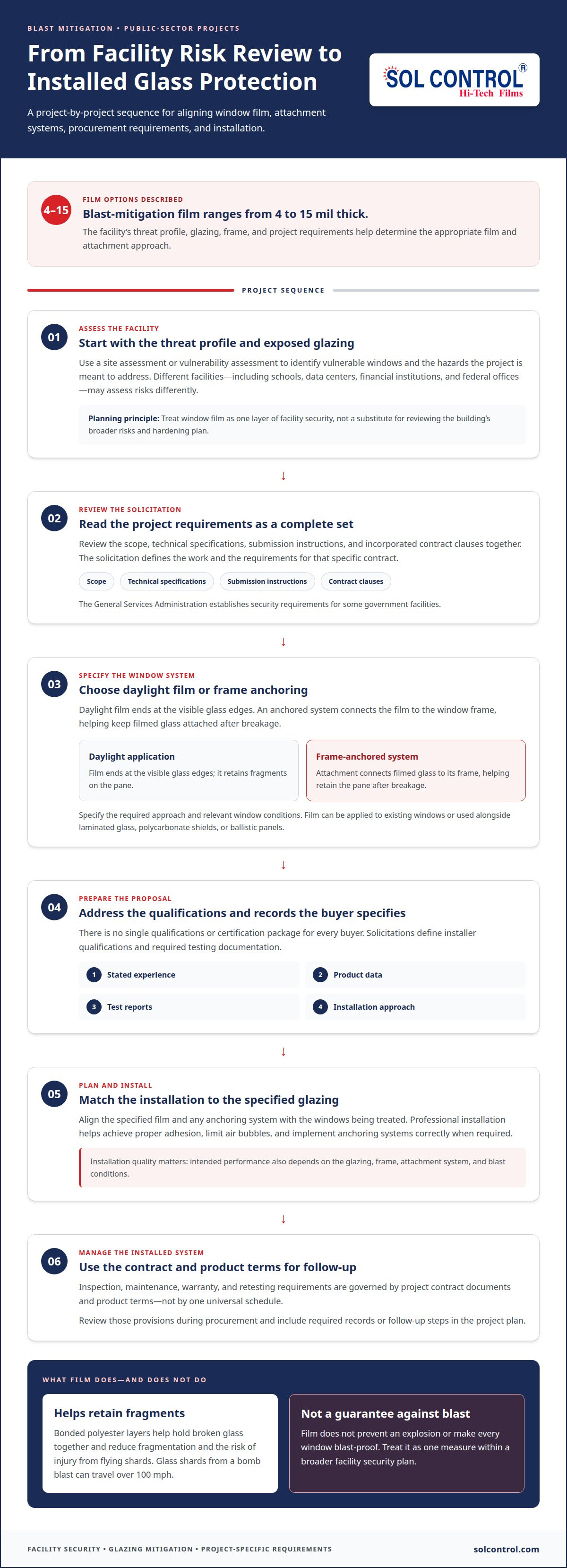
Blast mitigation starts with controlling the glass. Bomb blast window film for government contracts uses polyester layers bonded with strong adhesives and applied to the interior of windows to help hold glass fragments together if the glass breaks. Attachment systems can also connect filmed glass to its frame, helping retain shards after impact.
This added protection is one part of facility security, not a substitute for planning around a building’s specific risks. Selecting film and attachment systems means considering the facility’s threat profile and how window measures fit into its broader hardening plan.
This article explains how blast mitigation film works, what installation involves, and where public-sector window-film bids and subcontracting opportunities may arise. It also covers how these projects can fit into a facility’s security approach and what to consider when reviewing project requirements.
Key Takeaways
Understand how public agencies can incorporate security window film into facility procurement and broader hardening plans.
See what careful installation involves, including adhesion and frame-anchoring considerations.
Learn how film can help retain broken glass and reduce the risk from flying fragments.
Recognize where public bids and subcontracting opportunities for window film projects may arise.
Blast mitigation film is a polyester layer applied to the inside of glass to help retain fragments after breakage. For public agencies, procurement begins by matching the window system to the facility’s security assessment and project specifications.
Federal procurement rules and contract clauses are set out in each solicitation and its incorporated terms. Review the scope, technical specifications, submission instructions, and contract clauses together. The General Services Administration establishes security requirements for some government facilities.
There is no single qualifications or certification package that applies to every buyer. Solicitations define installer qualifications and required testing documentation, so proposals should address the stated experience, product data, test reports, and installation approach directly.
Film and Anchoring Systems
Film options described for blast mitigation range from 4 to 15 mil thick. A site assessment helps determine the threat profile and the appropriate film and attachment system. Daylight film ends at the visible glass edges; an anchored system secures film to the window frame, helping keep filmed glass attached after breakage.
For procurement, specify whether the project calls for daylight application or frame anchoring, and include relevant window conditions. Integrate those details into the building’s broader hardening plan. Film can be applied to existing windows or used alongside laminated glass, polycarbonate shields, or ballistic panels.
Blast Hazard Reduction and Protection Limits
Film helps hold broken glass together, reducing fragmentation and the risk of injury from flying shards. It doesn’t prevent an explosion or make every window blast-proof. Results depend on the glazing, frame, attachment system, installation, and blast conditions, so treat film as one layer of a facility security plan.
During a vulnerability assessment, identify exposed glazing and consider how film fits with other protective measures. Security film may help address glass hazards without replacing every window, but it isn’t a substitute for a complete review of building risks. Set project requirements around the facility’s threat profile and the role each window system must serve.
Shatter-resistant window film installation for a State Department facility
A State Department facility illustrates how security-film work can become a defined public project. A contract for shatter-resistant window film installation had an ultimate completion date of June 15, 2024. Its schedule and requirements belonged to that specific contract, not a universal timeline for government buildings.
Installation planning starts with the solicitation’s scope and the facility’s glazing. The project team must align the specified film and any anchoring system with the windows being treated. Professional installation helps achieve proper adhesion, limit air bubbles, and implement anchoring systems correctly when required. These details matter because intended performance depends on installation.
Government facilities face different security conditions. A school, data center, financial institution, and federal office may each assess risks differently. Site assessments help identify vulnerable glazing and guide decisions about film and attachment systems. The result should fit the facility’s overall security plan, rather than treating every window as an identical opening.
The General Services Administration establishes security requirements for some government facilities. Those requirements can inform project planning, while the solicitation defines the work for a specific contract. Film may be applied to existing windows or integrated with other protective measures. The chosen approach should reflect the facility’s security objectives and glazing conditions.
Retaining broken glass can help reduce injury from flying fragments, but film doesn’t prevent every hazard. Installation quality, glazing, frames, and the selected attachment approach all affect the system. Injury-prevention planning should therefore consider window film alongside other facility safeguards.
Inspection, maintenance, warranty, and retesting requirements are governed by the project’s contract documents and product terms, not by one universal schedule for every facility. Review those provisions during procurement and include any required records or follow-up steps in the project plan. This gives facility teams a clear basis for managing the installed system over time.
How blast mitigation film holds glass fragments together
Blast mitigation manages what happens to glazing when pressure breaks it. The film’s role is to retain fragments, not prevent the glass from cracking.
Fragment Retention by Mitigation Film
Applied to the interior glass surface, bonded polyester layers create a continuous sheet across the pane. When glass cracks, the adhesive helps keep fragments attached to the film instead of separating into loose shards. The film and glass work together as a fragment-retention layer. For a project, key considerations include the existing glazing and whether the film system includes frame anchoring.
Glass Fragmentation and Hazard Mitigation
Blast forces can break glazing and propel fragments into occupied areas. Glass shards from a bomb blast can travel over 100 mph. Film helps reduce fragmentation and retain broken pieces, addressing the hazard created by flying glass. An anchored system can help secure filmed glass to its frame after breakage, adding support beyond film that stops at the visible glass edges.
The distinction matters in public buildings. Film applied only across the pane can retain fragments on the glass, while attachment systems connect the filmed pane to its frame. That connection matters when the project’s mitigation plan addresses both broken glass and the risk of the filmed sheet separating from its opening.
Blast mitigation is a layered measure, not a promise that windows will remain intact. Glass may still break, and film does not stop the blast itself. The intended benefit is to control fragmentation after breakage, reducing the chance that loose shards become secondary hazards for people near the window.
For facility planning, match the system to the threat assessment and window assembly. Consider the glazing, frame, and whether anchoring is needed, then place the film within the wider security plan. This keeps the project focused on specific glass hazards rather than treating every pane as an identical risk.
Window film contracts and subcontracting opportunities
Public window-film opportunities appear in projects for schools, airports, correctional facilities, and federal buildings. Past solicitations show how varied the scopes can be. A Carroll County, Maryland, school bid covered security laminate installation across eight schools, totaling approximately 23,900 square feet.
Other examples show different project types and timelines. Knox County, Tennessee, set March 18, 2025, at 2:00 p.m. as its submission deadline for security window film and installation. Mission Consolidated Independent School District in Texas set April 29, 2024, as the due date for a fencing and window-film project. These dates have passed, but the solicitations illustrate how public buyers define work.
Subcontracting can connect film distributors and installers with larger construction or security projects. A prime contractor may need product supply, installation capacity, or both. Define the role early: supply-only support differs from field installation, and each must align with the solicitation’s scope. For a distributor, this distinction helps identify projects where film supply supports a prime contractor’s bid.
Read each solicitation for the facility type, film scope, quantities, installation duties, schedule, and submission requirements. An airport services opportunity for National and Dulles Airports had a January 5, 2021, bid deadline. A separate Public Buildings Service contract concerned removing and replacing window film tint at U.S. Secret Service headquarters, with completion due September 29, 2023. Together, these examples show that public work can involve security film, routine tint, or replacement.
For contractors pursuing bomb blast window film for government contracts, the practical takeaway is to map project scope to capability before bidding or subcontracting. SolControl supplies architectural window films for contractors sourcing film products for building projects. Review the project’s product and installation requirements, then identify where a supply partner fits the bid team.
SolControl: Windshield Protection Film
SolControl supplies film products and tinting tools for installers and contractors. For public-building projects, Architectural Window Films may suit material sourcing for a window-film scope. Wind Shield Protection Film serves a different application and isn’t a substitute for a specified blast-mitigation system.
Use the project’s solicitation to define the required film, documentation, and installation responsibilities. SolControl supplies film products and tools to support contractors’ work, while installation and project delivery remain governed by the contract scope.
For vehicle-related work, Automotive Window Films and Wind Shield Protection Film are intended for automotive applications, not facility glazing. Contact SolControl to discuss the film products or tools relevant to your project.
Turn project requirements into a clear sourcing plan
Your next step is to translate the solicitation into a practical materials plan. Align the specified application, project scope, and installation responsibilities before developing a bid or subcontracting approach. This keeps product sourcing connected to the facility’s actual requirements.
For teams sourcing bomb blast window film for government contracts, distinguish architectural glazing needs from vehicle applications. SolControl offers Architectural Window Films and Automotive Window Films, as well as Tinting Tools for professional work. Match each offering to the relevant scope rather than treating them as interchangeable.
A focused conversation can help clarify which SolControl products fit your contractor or installer workflow. Bring the project context and product requirements to the discussion, then decide how sourcing fits your next step.
What blast protection standards apply to window film in U.S. government buildings?
Applicable requirements depend on the facility and project solicitation, not on one blanket standard for every government building. The General Services Administration establishes security requirements for some facilities. Agencies can set project-specific criteria based on the building’s security assessment and glazing system. Read the solicitation’s technical specifications and incorporated requirements together to identify the performance basis for the project.
Do government contracts require ASTM F1642 or GSA blast testing for window film?
Neither ASTM F1642 nor GSA blast testing should be assumed as a universal requirement for every contract. A solicitation may name a test method, require supporting test documentation, or set other performance criteria. The practical step is to identify the exact testing language in the bid package and align the proposed film assembly and documentation with those stated requirements.
What are the GSA window film blast-mitigation performance criteria?
GSA requirements apply to some government facilities, but project criteria depend on the facility’s security needs and contract documents. Look for the required system configuration, glazing conditions, attachment details, and any specified test evidence. Treat the solicitation as the controlling project document: a film thickness or product description alone doesn’t establish that an assembly meets the facility’s performance criteria.
What factors affect blast window film performance, including glass type, frame, and attachment system?
Performance depends on how the film, glass, frame, and attachment work together. Existing glazing and frame condition affect the assembly, while an attachment system connects filmed glass to the frame. For example, a project using frame anchoring has different installation requirements from film applied only across the visible pane. Both the specified assembly and installation quality matter.
How do blast-mitigating window films compare with laminated glass and window replacement?
Film is applied to existing glazing to help retain fragments, while laminated glass uses bonded glass layers as part of the glazing itself. Depending on the project’s security goals and existing conditions, film may be an alternative to replacing windows. Compare required performance, glazing and frame compatibility, installation scope, and disruption to building operations before selecting an approach.
How can contractors find and bid on federal window film installation opportunities?
Track public-sector solicitations and review each notice for scope, site, quantities, submission deadline, and installation duties. For bomb blast window film for government contracts, distinguish supply responsibilities from installation work before joining a bid team. Contractors can pursue a prime role or support a prime contractor as a subcontractor, matching their capabilities and proposal materials to the solicitation.