Explaining VLT: A Guide for Window Film Professionals
The darkest-looking film isn’t automatically the best performer. When a customer compares tint by shade alone, a useful conversation can quickly turn confusing. Learning how to explain VLT to customers starts with one distinction: VLT describes how much visible light passes through glass with film applied. It does not describe how much heat or UV the film blocks.
Customers are right to care about appearance and how bright a vehicle or room will feel. A lower VLT number means less visible light passes through, but it doesn’t tell the whole story about heat rejection, UV protection, or overall performance. Clear comparisons separate these measures and connect each specification to the customer’s goals.
This guide explains VLT in everyday language, shows how to compare film options by the results that matter, and offers a simple way to discuss specifications without making unsupported promises.
Key Takeaways
Define VLT in everyday language so customers understand what its percentage describes.
Explain VLT separately from other film performance measures.
Start comparisons with the customer’s priorities, then focus on the specifications that address them.
Use an ask, explain, compare, verify, and summarize sequence to keep conversations clear and accurate.
Use automotive and architectural film information to support product-specific discussions without overpromising.
What VLT Means: A Simple Definition Customers Can Understand
To explain VLT clearly, start with what the number describes. Visible Light Transmission (VLT) is the percentage of visible light that passes through glazing and window film. A higher VLT percentage generally means more visible light gets through the finished glazing; a lower percentage means less does. The figure describes light transmission, not overall film quality.
How to Explain a VLT Percentage Without Jargon
Keep it simple: VLT is the share of visible light that makes it through the glass-and-film combination. It isn’t a darkness score, even though customers may use a film’s appearance to guess the number. You can say, “A higher percentage lets more visible light through, while a lower percentage lets less through.”
An everyday analogy can help: imagine 100 rays of visible light approaching a window. The VLT percentage gives a sense of how much visible light passes through. This is an analogy for conversation, not a test method or a promise that exactly that number of individual rays will pass through. For a broader overview of film and its properties, see Visible Light Transmission (VLT) in window film.
Be precise about what the percentage applies to. Customers experience the finished glazing, and its light transmission depends on the glass and film together. If a customer is considering film for existing glass, don’t present the film’s standalone VLT as the finished result. Use the applicable product information for the glazing combination being discussed.
What Customers Can, and Cannot, Infer from VLT
VLT helps customers compare how much visible light passes through finished glazing. It can inform a conversation about brightness and daylight transmission. On its own, it doesn’t establish how much heat the film rejects, how it performs against infrared energy, or how much UV it blocks. Those questions require their own relevant performance specifications.
Make these limits clear without overcomplicating the explanation. A VLT number alone doesn’t guarantee a particular level of glare reduction, privacy, or comfort. Those outcomes can depend on factors beyond visible-light transmission, so don’t promise them based on VLT alone. Likewise, don’t use the figure by itself to assure a customer that an automotive application meets legal requirements. Applicable rules vary by jurisdiction and application.
Explain what VLT tells the customer, then identify which other specification addresses their remaining questions. This is the foundation of how to explain VLT to customers accurately, without turning one useful measure into a verdict on the film as a whole.
VLT vs. Heat Rejection, UV Protection, and Other Film Metrics
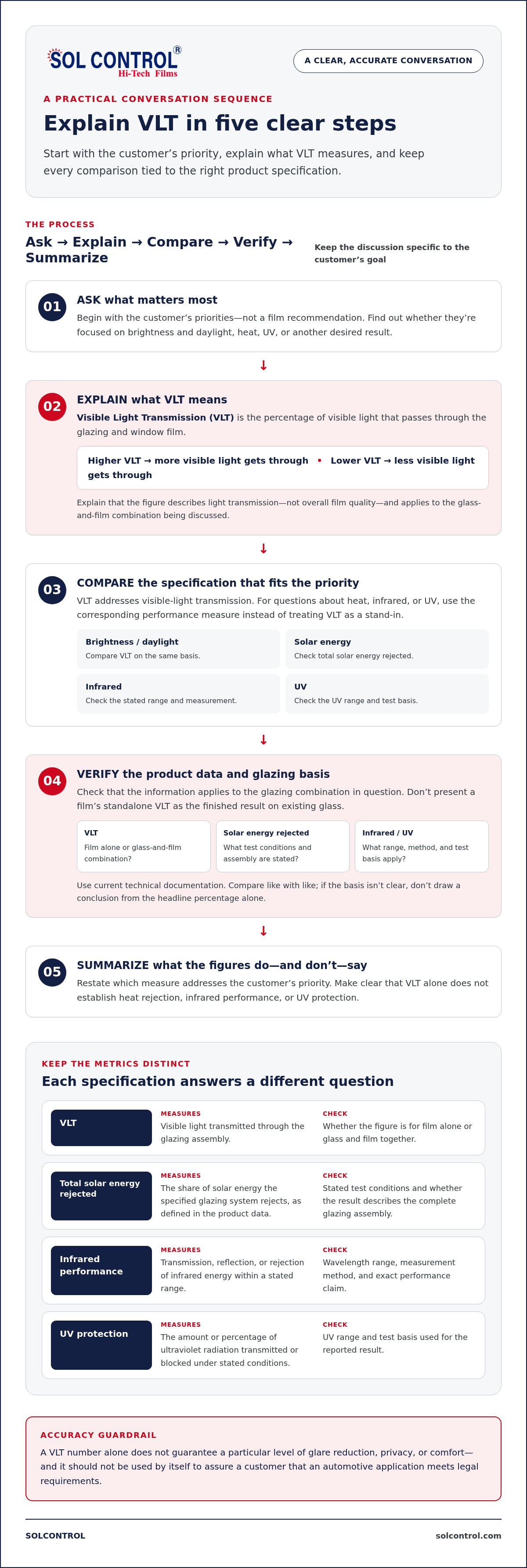
Customers may see several percentages on a film specification sheet and assume they describe the same thing. They don’t. Each metric answers a different question. Start by naming what each one measures, then check which product data applies to the glazing assembly.
VLT is not a stand-in for heat rejection or UV protection; it describes visible-light transmission only. This distinction keeps discussions specific and avoids turning one figure into a broad promise about how a vehicle or room will feel.
Metric
What it measures
What to check
VLT
The percentage of visible light transmitted through the glazing assembly.
Whether the figure applies to film alone or the glass-and-film combination.
Total solar energy rejected
The share of solar energy the specified glazing system rejects, as defined in the product data.
The stated test conditions and whether the result describes the complete glazing assembly.
Infrared performance
A product’s measured transmission, reflection, or rejection of infrared energy within a stated range.
The wavelength range, measurement method, and exact performance claim.
UV protection
The amount or percentage of ultraviolet radiation transmitted or blocked under the stated measurement conditions.
The UV range and test basis used for the reported result.
What VLT Says About Visible Light
VLT is useful for comparing relative visible-light transmission. When two glazing options are measured on the same basis, the one with the higher VLT generally transmits more visible light. That helps frame a brightness comparison, but it doesn’t predict cabin temperature, building energy use, or savings. Those depend on other factors and require relevant data.
Which Metrics Help Explain Heat and UV Performance?
Total solar energy rejected addresses solar energy performance, which is different from how much visible light passes through. Infrared figures focus on a specified part of the solar spectrum, while UV claims concern ultraviolet radiation. These measures aren’t interchangeable, and a result in one category shouldn’t be used to imply a result in another.
Product literature may report different metrics, ranges, or test methods. Compare like with like: identify the measurement, confirm its stated basis, and use current technical documentation for product-specific numbers or claims. If the documentation doesn’t provide enough context for a fair comparison, don’t draw a conclusion from the headline percentage alone. This is a practical way to explain VLT to customers without overpromising.
For installers and contractors comparing film categories for different applications, SolControl’s automotive and architectural window films provide a starting point for product discussions. Keep each comparison anchored to the specifications that address the customer’s priority.
How to Compare VLT Options Around the Customer’s Priorities
Begin with a question, not a film recommendation: “What would you most like to change about the glass?” The answer helps determine which specifications to compare. A customer concerned about brightness needs a different starting point from someone focused on solar heat or UV transmission. If they have several goals, list those priorities and review the relevant measures together.
Match the Conversation to the Customer’s Main Concern
For brightness, compare VLT values on the same basis and explain what the difference indicates about visible-light transmission. For heat or UV concerns, use the corresponding performance data rather than treating VLT as a proxy. If the customer has multiple priorities, lay out the relevant figures side by side so they can see how each option aligns with their needs.
A simple comparison keeps the discussion focused without suggesting that one option is best for everyone:
Customer priority
Compare
Record the source
Brightness
VLT for the finished glazing assembly
Current product technical documentation
Solar heat performance
The stated solar-energy performance measure
Product data sheet, including its revision or date
UV transmission or blocking
The UV measure and range reported
Product documentation and stated measurement context
Several goals
Each relevant specification, in separate columns
The source for each figure
Don’t fill gaps with assumptions. If a specification sheet doesn’t report a measure, note that it isn’t provided in that document rather than estimating it. This keeps the comparison transparent and helps prevent a customer from mistaking a missing figure for a weak or strong result.
Explain Trade-Offs Without Turning Them into Guarantees
Describe a VLT difference narrowly: when two figures use the same basis, a higher reported value generally indicates more visible-light transmission than a lower one. It doesn’t predict the full experience on its own. Avoid saying that a darker option will necessarily reject more heat, reduce glare more, provide greater privacy, or deliver more comfort. Each claim needs evidence relevant to that outcome.
When discussing two candidate films, point to verified figures and name their source. If the VLT values differ, explain the visible-light distinction. If solar or UV measures differ, explain those separately. Don’t imply that one metric guarantees another. For automotive applications, keep compliance claims separate from a product comparison and account for the applicable jurisdiction and vehicle details.
This priority-led approach makes how to explain VLT to customers more practical: identify the change the customer wants, then compare the documented specifications that speak to it. Present trade-offs plainly and let the evidence guide the conversation, not the shade alone.
A Step-by-Step Script for Explaining VLT to Customers
A consistent sequence keeps a technical conversation clear without rushing to a recommendation. Ask what matters, explain the measure, compare documented options, verify the application details, and summarize what each specification tells the customer.
Questions to Ask Before Recommending a VLT
Start with the customer’s goal: “What would you like the film to change?” Then ask which trade-offs matter most, such as visible brightness, appearance, glare, heat, or UV performance. Clarify whether the project involves automotive, residential, or commercial glazing, since the application affects which information is relevant.
Next, ask what might limit the choices. Is there existing glass? Are there project requirements or applicable rules to consider? These questions provide context before you discuss a particular VLT and help avoid recommending a specification before you understand the job.
Customer-Ready Language for a Clear Explanation
Use this sequence as a flexible script. Adapt it to the customer’s answers and the verified information for the film options under discussion.
Ask: “What are you hoping to change, and which matters most: brightness, appearance, heat, or something else?”
Explain: “VLT is the percentage of visible light that passes through the glass and film together. A higher percentage generally means more visible light gets through.”
Compare: “These options have different VLT figures, so they indicate different levels of visible-light transmission. For heat or UV performance, let’s look at those separate specifications too.”
Verify: “Let’s make sure these figures apply to the glazing and application we’re discussing. For a regulatory question, we’ll check the current requirements for this specific vehicle or building and its jurisdiction.”
Summarize: “This measure helps us compare visible light. The separate performance data addresses your other priorities.”
Keep this central sentence ready: “VLT tells us how much visible light passes through the glazing; it doesn’t, by itself, tell us how much heat or UV the film blocks.” It’s accurate, easy to repeat, and doesn’t promise a result that one metric can’t establish.
If two options have verified specifications, describe the difference without declaring a universal winner: “Option A has a higher VLT than Option B, so its reported visible-light transmission is higher. Their heat or UV performance should be compared using the corresponding product data.” Name the documentation used for each figure and make sure both are being compared on a consistent basis. If data isn’t available for one of the customer’s priorities, say so rather than filling the gap with an assumption.
This ask, explain, compare, verify, and summarize routine makes how to explain VLT to customers more straightforward while keeping recommendations tied to their goals. To apply the same approach to SolControl’s window film categories, explore automotive and architectural options.
Support Better VLT Conversations with SolControl’s Professional Resources
Clear VLT explanations are part of professional customer education, not a shortcut to close a sale. Installers and contractors build trust by listening to customer goals, explaining what each metric measures, and grounding comparisons in current product information. That approach also helps teams discuss options consistently without suggesting that one VLT figure captures every aspect of film performance.
Use Product Information to Keep Recommendations Precise
Use current technical documentation when comparing product performance. Keep automotive and architectural examples distinct: the glass, application, and project considerations differ, so a figure from one context shouldn’t be carried over to another. SolControl’s automotive and architectural film categories offer a foundation for product discussions, while the documentation for each film supports specific performance claims.
For broader selection context, teams can also consult a professional automotive window film guide. Use it to organize the conversation around the application and the customer’s priorities, then refer to current product information for exact performance details. Don’t infer a specification from a general category description or use one film’s comparison as a promise about another.
Build a Consistent Customer Education Process
A shared explanation helps make customer conversations clearer across a team. Give staff a consistent, plain-language definition of VLT and a simple distinction between visible-light transmission and separate heat or UV measures. Encourage them to ask about the project, identify the relevant specifications, and summarize what the available data supports. Consistency doesn’t mean using a rigid script; it means explaining technical terms accurately.
For building applications, an architectural window film guide can help teams structure discussions around project context. A solar control window film guide can provide background on related performance measures. Use guides to support education, not to replace current, product-specific documentation. If a customer asks about requirements, verify them for the actual application and jurisdiction before making a compliance claim.
Professional tinting tools and marketing materials are additional business resources for film professionals. They support day-to-day work and customer communication, but they don’t replace accurate specifications or a clear explanation of what those specifications mean. Used together, reliable product information and consistent educational materials help teams present options with confidence and care.
SolControl supports installers and contractors with wholesale automotive and architectural window films, professional tinting tools, and marketing materials. These products help film businesses support their work and customer conversations.
Put Clear VLT Conversations into Practice
Your next customer conversation is an opportunity to make technical information straightforward. Start with the customer’s goal, tie each comparison to the right documentation, and give them room to weigh the trade-offs. Transparency helps customers make informed decisions and gives your team a dependable way to explain options without stretching what the numbers mean.
Make how to explain VLT to customers part of your team’s everyday approach. Review the product information you use, align on plain-language explanations, and adapt the discussion to each application. When your team consistently connects customer priorities with relevant product data, conversations become more useful and clear.
VLT stands for visible light transmission. It describes the portion of visible light that passes through a glass-and-film assembly, so a higher VLT generally corresponds to more light passing through. Treat it as one specification, not a grade for the film as a whole. Use VLT to discuss visible light, then consult separate product data for other performance questions.
Is a lower VLT always better for window film?
No. A lower VLT means less visible light passes through, but that doesn’t automatically make the film better for a customer’s needs. Someone who prioritizes a brighter interior may prefer a different transmission level from someone focused on a darker appearance. Start with the application and customer priorities, then compare relevant specifications. Don’t rank options by VLT alone or imply that one percentage suits every project.
Does VLT measure heat rejection?
No. VLT describes visible-light transmission, while heat-related performance requires a separate measure, such as total solar energy rejected. If a customer asks how a film addresses solar heat, point to the relevant product documentation and explain what the measure covers. Don’t use a low VLT figure as evidence of heat rejection. The figures answer different questions and should be discussed independently.
How do you explain VLT to a customer in simple terms?
Say, “VLT tells us how much visible light passes through the glass and film.” Then ask what the customer wants to change, such as brightness or glare, and choose specifications that address that goal. To explain VLT accurately, separate the measures: use VLT for visible light, and consult the appropriate product data for heat or UV performance.
Can two window films with the same VLT perform differently?
Yes. Matching VLT figures indicate similar visible-light transmission only when they’re reported on a comparable basis. They don’t establish that the films have matching solar, infrared, or UV performance. For a fair comparison, review those measures individually in current product documentation and check whether the figures use the same measurement context. A shared VLT value alone isn’t enough to judge other aspects of film performance.
Does VLT apply to the film alone or the finished window?
It depends on how the figure is reported. Product literature may state a film value under a particular test context, while the customer experiences the film together with the glass. Existing glazing can affect the finished assembly’s light transmission. Before quoting a final-window result, identify what the published specification represents and whether it applies to that glass-and-film combination. Don’t calculate a combined figure without supporting data.
Does VLT tell customers whether window film is legal?
No. VLT is a measurement, not a legal approval. Requirements can differ by jurisdiction and by vehicle or building application, so a percentage shouldn’t be presented as universally permitted. For automotive conversations, identify the specific vehicle and window, then verify the current rules that apply before making a compliance claim. Keep that legal check separate from explaining the product’s documented VLT.