Frosted Privacy Film for Contractors and Commercial Glass
Privacy doesn’t have to mean blocking natural light. Frosted privacy film for contractors can diffuse views through commercial glass while allowing daylight into offices, meeting rooms, and shared spaces. Unlike reflective film, frosted film obscures visibility in both daytime and nighttime lighting.
For commercial spaces, this can make glass partitions more private without replacing the glass. The right choice depends on the level of privacy required, the desired appearance, and how the film will be used throughout the project.
This guide explains where frosted film works well, how it compares with etched or sandblasted glass, and what distinguishes commercial-grade film from DIY alternatives. You’ll also find considerations for selecting film for partitions, doors, and windows, so you can match the material to the space and project requirements.
Key Takeaways
Use frosted film to diffuse views through glass while preserving natural light, and consider glare when choosing a solution for workspaces.
Compare film with etched or sandblasted glass to find an option that delivers a similar visual effect without replacing existing glass.
Match the film’s opacity and placement to the space, whether you’re addressing partitions, meeting rooms, doors, or windows.
Understand how commercial-grade film differs from DIY options, including the importance of careful application for a clean, durable result.
Frosted window film is a translucent layer applied to glass that diffuses views while allowing natural light through. In an office, it adds discretion without turning a glass partition into a solid wall.
Privacy and Light Transmission
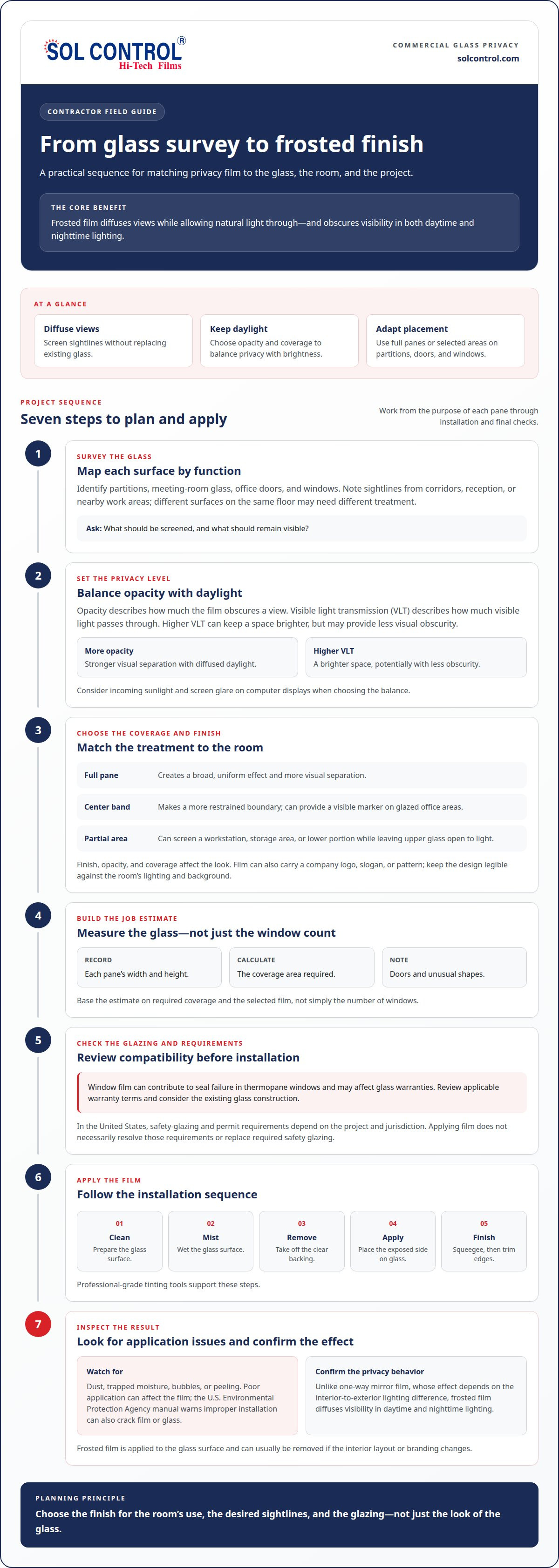
Privacy depends on how strongly the film scatters light, while visible light transmission (VLT) describes how much visible light passes through. A frosted privacy window with higher VLT can keep a space brighter, but it may provide less visual obscurity than a more opaque option. Contractors should match the privacy level to the room’s use, such as screening a meeting room while retaining daylight in an open office.
To estimate a job, record each glass pane’s width and height, calculate the coverage area, and note doors or unusual shapes. For frosted privacy film for contractors, base the estimate on the required coverage and selected film, not just the number of windows.
Opacity and Glare Control
Opacity indicates how much the film obscures a view. Greater opacity generally creates stronger visual separation while still allowing diffused daylight through. Privacy film can also help reduce glare on computer screens. The best balance depends on the glass’s position, incoming sunlight, and the room’s need for daylight.
One-way mirror film works differently: its privacy effect depends on the lighting difference between the interior and exterior. If a room is brighter than outdoors at night, the reflective effect may not conceal the view. Frosted film diffuses visibility in both daytime and nighttime lighting.
Installation typically involves cleaning the glass, misting its surface, removing the clear backing, applying the exposed side to the glass, then squeegeeing and trimming the edges. Professional-grade tinting tools support these steps.
Dust, trapped moisture, or poor application can cause bubbles or peeling. The U.S. Environmental Protection Agency manual warns that improper installation can also crack film or glass. Film may affect thermopane seals or glass warranties, so review applicable warranty terms before installation.
Cost-effective alternatives to etched or sandblasted glass
Frosted film can create an etched or sandblasted effect on existing glass without requiring replacement. In an office, it provides visual screening while keeping the original interior glazing in place. Apply it across a full pane or selected areas, depending on the desired balance of privacy and openness.
Etched glass film and sandblasted vinyl can both suggest textured glass, but the appearance depends on the finish, opacity, and coverage. A full-height application creates a broad, uniform effect; a strip across the center makes a more restrained visual boundary. Frosted film can also carry a company logo, slogan, or pattern on office glass, helping distinguish meeting rooms and reception areas while complementing the space.
A distraction band is a visible marker on glass that helps people notice a pane and avoid walking into it. In a fully glazed office, a frosted strip can act as a visual marker while adding privacy at seated eye level. Its height, coverage, and contrast with the surrounding glass affect how clearly it stands out. Film can be cut or printed with patterns, but the design should remain legible against the room’s lighting and background.
In the United States, safety-glazing and permit requirements depend on the project and jurisdiction. Do not assume that applying film resolves these requirements or replaces required safety glazing.
Film is applied to the glass surface and can usually be removed if the interior layout or branding changes. Compatibility matters: window film can contribute to seal failure in thermopane windows, so glass construction is an important consideration. Assess the existing glass, intended coverage, and expected use before choosing a finish. This connects the aesthetic decision to the glazing assembly, not just the etched look.
Office partitions, meeting rooms, doors, and windows
Commercial window film can adapt existing glass to different privacy needs. Placement and opacity determine how much vision remains through each pane.
Conference Rooms and Office Doors
For a conference room, film can cover a full glass partition or form a privacy band across its center. Full coverage obscures more of the room, while a band preserves a clearer view above and below. On an office door, a smaller frosted area can screen desk activity without concealing the doorway.
Choose coverage based on the room’s use and sightlines from nearby corridors. For example, a meeting room facing a busy hallway may need more screening than a shared-workspace partition. Textured finishes also change the appearance of glass, so consider how the film looks from both sides of the door.
Film for Individual Offices
An individual office may need more privacy than a conference room used for occasional meetings. Opaque privacy film blocks views through an interior window, making it suitable when obscuring the view takes priority over visibility through the glass. Partial coverage can keep the lower portion private while leaving the upper glass open to light.
For commercial partitions, frosted film offers a middle ground: it diffuses vision while allowing natural light through. A full pane suits offices requiring broad visual separation; a smaller section can screen a workstation or storage area. Choose based on how much of the room should remain visible from reception or the corridor.
Map each glass surface by function before selecting film. A conference-room partition, office door, and individual-office window may need different coverage, even on the same floor. This helps create consistent privacy without applying the same treatment everywhere.
Commercial-grade film versus DIY alternatives
A DIY kit may suit a single, straightforward pane where decorative appearance is the main goal. Commercial projects often involve several surfaces, such as partitions, doors, and sidelights, where consistent coverage and repeatable results matter. The key question is not simply professional versus DIY. It is whether the film and installation approach suit the project’s glass, layout, and privacy needs.
Product performance also varies by film type. Some professional window films block up to 99% of harmful UV rays, while a frosted option is selected primarily for diffused vision and light. Those functions aren’t interchangeable. Define whether the priority is privacy, UV protection, glare control, or a decorative finish, then select a solution that matches the space and its comfort needs.
With DIY installation, the installer handles measuring, cutting, surface preparation, application, and edge trimming. This may be manageable on a simple pane, but larger glass areas make alignment and clean edges more demanding. According to the U.S. Environmental Protection Agency, improper installation can cause film to bubble, crack, or peel, and can even cause glass to crack. Careful application and glass compatibility are important.
For a commercial job, plan around the number and shape of panes, access to each surface, and how closely adjacent panels must align. A single office window presents a different challenge from a corridor of matching partitions. Film can usually be removed if needs change, though older film may be harder to remove depending on sun exposure. Consider future updates when choosing coverage and finish.
SolControl supplies Wind Shield Protection Film for contractors and installers working on vehicle-glass protection projects. This is separate from frosted film for commercial interiors, but can complement a broader film-supply plan when a project also involves automotive glass.
For commercial glazing work, SolControl supplies Architectural Window Films and Tinting Tools. These products support film selection and installation across different project types, while Automotive Window Films serve vehicle applications. Choose the category that matches the glass and its purpose rather than treating privacy film and windshield protection as interchangeable.
For a project involving windshield protection film or other film supplies, contact SolControl to discuss your requirements.
Plan Your Next Glass Project with Purpose
A commercial glass plan works best when privacy decisions align with the project layout. Identify which spaces need discretion, where open sightlines matter, and how the treatment should look across adjacent panes. This gives the team a clear basis for selecting coverage and coordinating materials before installation.
Frosted privacy film for contractors can form part of a broader glass specification. Define the purpose of each pane and how employees and visitors will use the finished space. Planning frosted privacy film for contractors around those priorities helps align material choices with the project’s practical needs.
SolControl offers Architectural Window Films, Automotive Window Films, and Tinting Tools for professional film projects. For a next step, contact SolControl about privacy film. Move forward with a clear project direction and the right materials in view.
Frequently Asked Questions
WHY MIGHT YOU WANT TO USE PRIVACY FILM?
Privacy film screens views through glass while retaining a lighter, more open feel than a solid partition. For contractors, frosted privacy film can suit a meeting room where occupants need discretion without losing borrowed daylight. It can also add a visual marker to clear glass. Choose coverage and finish according to room use, sightlines, and how much visibility should remain.
What is frosted privacy window film and how does it work?
Frosted privacy window film is a translucent layer that diffuses light through glass, making people and objects on the other side less distinct. This scattered-light effect provides visual screening without making the glass fully opaque. Unlike reflective film, its privacy does not depend on one side being brighter than the other, so changes in lighting do not reverse the effect.
What types of frosted privacy film are available for contractor projects?
Options include translucent frosted finishes, opaque film for stronger visual blocking, and decorative patterns for partial coverage. A contractor might use a clear central panel with frosted borders on a reception partition, or opaque film where views need to be blocked. Reflective privacy film is another option, but its effect changes with interior and exterior lighting.
How long does frosted window film last, and what maintenance does it require?
Film lifespan varies with the product, glass conditions, exposure, and installation quality. Older film can be harder to remove depending on sun exposure. Clean SolControl film with a soft cloth, water, and mild detergent. Do not use rough or abrasive material on the film-covered side of the glass, or cleaners containing ammonia. Normal cleaning is sufficient; no special care is needed.
How does frosted film compare with etched glass, blinds, and other privacy options?
Frosted film adds a diffused finish to existing glass and can be removed or updated if a layout changes. Etched or sandblasted glass creates a permanent surface treatment, while blinds provide adjustable screening but cover the window when closed. On a shared office partition, film can preserve daylight and a clean glass appearance without adding a movable window covering.
Does frosted privacy film block UV rays or reduce heat and glare?
Those benefits depend on the film’s construction, not simply its frosted appearance. SolControl’s UV-stabilized dyed polyester film cuts up to 98% of UV rays, while its reflective films reject heat up to 80%. Privacy film can help reduce glare, but a frosted finish alone shouldn’t be treated as a guarantee of UV or heat control. Match the film type to the performance goal.