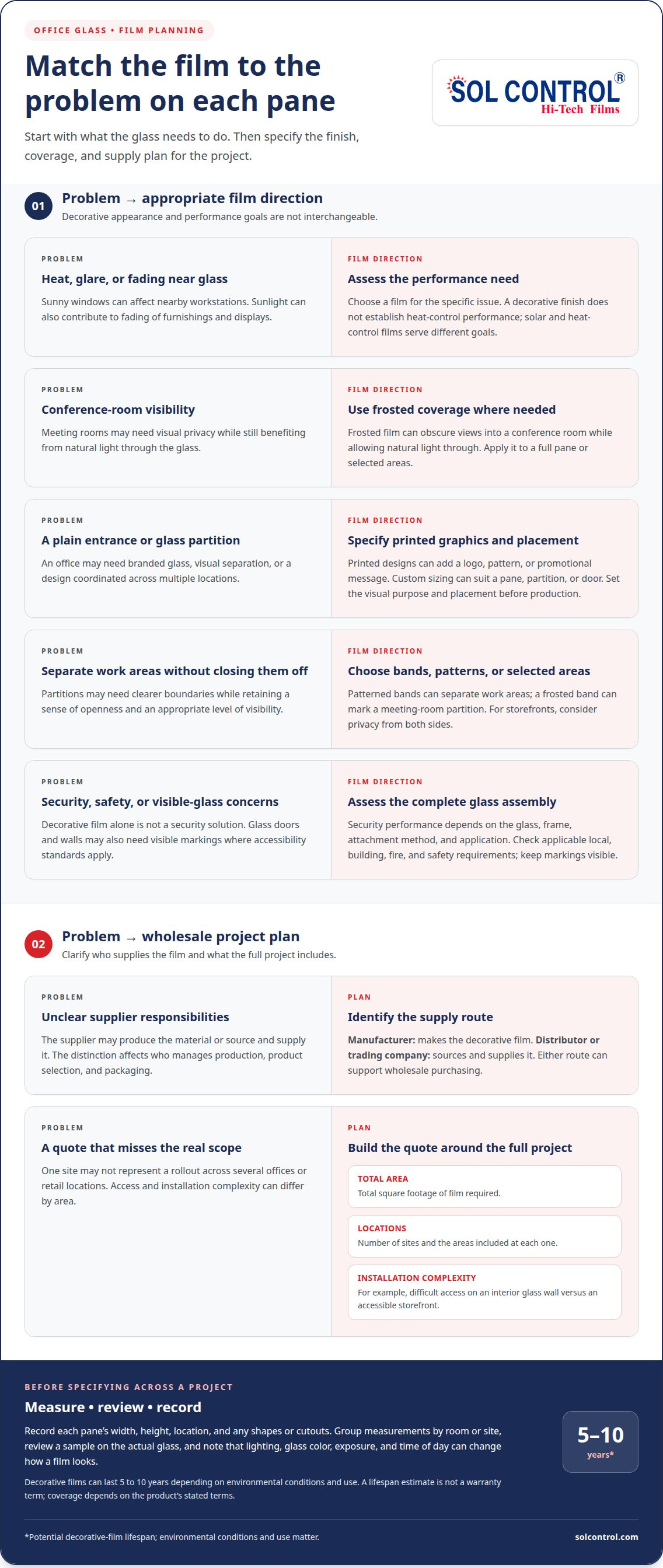
The supplier’s role matters as much as the film. A manufacturer makes the material, while a distributor sources and supplies it; either can support wholesale purchasing. Buying decorative window films for offices wholesale means planning supply around the project, whether the goal is meeting-room privacy, entrance branding, or visual separation that preserves natural light. Match the supply arrangement to the project’s scope.
Match film to the task: decorative options can create privacy and define spaces, while heat, glare, fading, and security needs call for a different assessment. This guide explains how to source decorative window films for offices wholesale, what affects project pricing, and how to compare options for privacy, branding, and performance. It also covers bulk orders for one site or a wider rollout, and the difference between manufacturers and distributors.
Key Takeaways
Match film choices to the office’s priorities, such as reducing glare, creating privacy, or adding entrance branding.
Understand how wholesale supply differs from manufacturing and how a centralized order can support multiple locations.
Build a project-specific quote around the amount of film, number of sites, and installation complexity.
Explore how SolControl’s film and tinting-tool offerings can support contractors’ broader project needs.
Commercial customers’ heat, glare, fading, privacy, and security needs
Office glass can admit daylight, separate work areas, and provide privacy. Choose film according to the issue each pane needs to address, then decide whether appearance or performance is the priority.
Commercial Film Performance Needs
Heat and glare can affect workstations beside sunny windows, while sunlight can contribute to fading of furnishings and displays near glass. Choose film for the specific problem: a decorative finish and a performance-focused film serve different purposes.
Frosted film can obscure views into a conference room while allowing natural light through. Decorative film alone is not a substitute for security film. Security performance depends on the glass, frame, attachment method, and application, so consider all these factors when assessing a reception area or interior partition.
Decorative Film Design Options
Wholesale office options can include frosted, etched-look, patterned, and printed window film. Frosted finishes soften visibility across a full pane or selected areas. Etched-look films create a similar effect, while repeating patterns add detail without covering all the glass. Review the finish on the actual pane, because glass color and lighting can change its appearance.
Custom sizing can suit a particular pane, partition, or door. Printed designs can add a logo, pattern, or promotional message to office glass. Branded graphics may work well at an entrance, while a frosted band can mark a meeting-room partition. For a storefront, consider how much privacy the design provides from both sides. Specify the placement and visual purpose before production, especially when coordinating graphics across locations.
Are you a decorative window film manufacturer, or a trading company?
A manufacturer produces decorative window film; a distributor sources and supplies it. In the United States, wholesale supply can come through either route. The distinction affects who manages production, product selection, and packaging. For an office project, identify whether the priority is a particular design, a consolidated order, or consistent materials across several spaces.
Decorative film can create visual privacy between offices without replacing glass partitions. Frosted panels can screen a conference room, while patterned bands can separate work areas and preserve a sense of openness. Film on glass between a commercial kitchen and dining area can reduce direct views into food-preparation spaces. The result depends on placement and how much visibility the space needs.
Building, fire, and safety requirements depend on the project location, building conditions, and film application. Match the intended use to applicable local and building requirements before specifying a product. Glass doors and walls may also need visible markings where accessibility standards apply, so ensure decorative patterns do not obscure visibility.
Wholesale suppliers in the United States include manufacturers, which make the film, and distributors or trading companies, which source and supply it. Knowing who produces the material does not establish whether a design suits an office. Consider the film specification, order structure, and consistency required across locations.
Measure each pane’s width and height, note its location, and record any shapes or cutouts. Group measurements by room or site before ordering, then match the film dimensions to the intended coverage. Installation planning should identify which partitions or rooms are involved and when those areas need to remain clear.
Durability and warranty are separate considerations. Decorative films can last 5 to 10 years, depending on environmental conditions and use. A lifespan estimate is not a warranty term; warranty coverage depends on the product’s stated terms. Keep the product details and installation records together for future maintenance discussions.
Glass color, interior lighting, exterior exposure, and time of day can all affect a film’s appearance. Review a sample on the actual glass before committing to a repeated design. Security performance also depends on the glass, frame, attachment method, and application, so decorative film alone should not be treated as a security solution.
Private-label branding places a business’s identity on product labels or packaging; it doesn’t mean the business manufactured the film. For a branded order, settle the logo artwork, label wording, and packaging format before production. For related commercial glazing applications, explore architectural window film options.
Wholesale suppliers include manufacturers that produce decorative window film and distributors or trading companies that source and supply it.
Wholesale pricing for contractors and businesses
Wholesale purchasing changes how film is sourced, not necessarily what it is. Decorative film bought wholesale may be the same product available through other purchasing arrangements. A contractor can place one bulk order for several offices or retail sites instead of ordering separately for each location. For decorative window films for offices wholesale, consolidated purchasing can help align product selection and supply across a commercial space.
Project pricing is provided after a quote request. Key factors include total square footage, number of locations, and installation complexity. For example, an interior glass wall with difficult access may affect costs differently from an accessible storefront. A rollout quote should reflect the full scope, including the areas at each site and the work required, rather than assuming one location represents them all.
Film choice also affects project scope. Decorative patterns can add privacy or visual separation, while solar and heat-control films address different performance goals. They are not interchangeable: a decorative film’s appearance does not establish its heat-control performance. Identify whether each pane needs a pattern, solar control, or both, and specify its intended use before ordering.
The right film can preserve natural light while delivering the desired visual effect. For instance, a patterned film on an office partition can soften views without covering the whole surface. A retail space with sun-facing windows may need a separate solution for glare or heat. Review samples on the actual glass, since lighting and glass color affect appearance.
For a useful wholesale quote, group measurements by location, distinguish decorative from solar-control requirements, and note access conditions. Include plans for phased replacement if offices must remain operational. A clear scope helps coordinate material needs and supply across sites without assuming every window has the same dimensions or purpose.
Office entrance branding with logos or graphics
A logo or graphic on entrance glass can help visitors identify an office before they reach reception. Decorative film can also add branding to doors, sidelights, and interior partitions. Choose placement according to sightlines: a logo on a lobby door serves a different purpose from a frosted band across a conference-room wall.
Start with the brand standard and the intended glass locations. Specify the logo, pattern, finish, colors, and positioning before production. A storefront entrance may need a clear business identifier, while an interior partition may use a repeating pattern for visual separation. Contrasting bands can also make clear glass more visible.
Approve the design at full size before cutting. Confirm logo proportions, alignment, and distance from door edges using a drawing or marked layout. Even a small change to a custom logo or stripe can require replacement material. Final approval is therefore a practical production step, not just a design preference.
For multiple offices, coordinate the rollout to keep branding consistent. A practical sequence is brand-specification approval, sample review, bulk ordering, phased installation scheduling, and post-installation quality checks. Review a sample on the actual glass first, since glass color and lighting can affect the finished appearance. Phasing locations can also help manage work across active sites.
Define each graphic’s purpose in the project plan. An entrance logo, for example, identifies the business, while a frosted pattern on nearby glass provides visual screening. Record the approved layout and pane locations so later additions or replacements can follow the same design. Clear specifications help prevent mismatched finishes between offices.
SolControl is a wholesale distributor of window films and professional tools. For contractors whose projects extend beyond office glazing, Wind Shield Protection Film supports windshield protection work, while Automotive Window Films serve automotive film projects.
For commercial glass projects, Architectural Window Films are the relevant category. Tinting Tools support professionals working with film across project types. SolControl supplies related materials to installers and contractors, keeping office-glass choices distinct from vehicle applications.
Choose products according to the glass or vehicle application and the project’s purpose. Contact SolControl to discuss film and tool needs for your next project.
Turn your film plan into the next project step
A wholesale plan for decorative window films for offices can become a practical purchasing brief. Set out the intended application, priorities for each space, and any consistency requirements across locations. This gives your team a clear basis for coordinating materials with project schedules and future additions.
SolControl also supplies Architectural Window Films, Automotive Window Films, and Tinting Tools for contractors sourcing materials for different types of work. Tie each product choice to its application, whether the project involves office glazing or a separate automotive requirement.
When you’re ready to discuss wholesale film needs, contact SolControl about wholesale films. Bring your project priorities and material requirements to the conversation, then take the next step with a clearer plan.
Frequently Asked Questions
How long does a multi-location decorative film rollout typically take?
A multi-location rollout is scheduled in project phases, not according to one fixed duration. The calendar can include brand approval, sample review, bulk ordering, installation scheduling, and final quality checks. Approval timing, site access, and the number of locations handled in each phase shape the schedule. Set milestones for each site and coordinate work around normal office operations.
How much can a wholesale program actually save compared to ordering per location?
Assess potential savings by comparing a rollout-specific bulk quote with separate location quotes for the same scope. Keep film selection and quantities consistent, then account for total square footage, location count, and installation complexity. This is more useful than comparing bulk prices alone, since site conditions can affect the overall project cost.
What are typical wholesale prices per square foot for office window films?
There is no single per-square-foot price for office film. Pricing depends on the project and is provided after a quote request. Relevant factors include film type, total area, number of locations, and installation complexity. Custom printing or a distinct design may also affect the materials required, so define the intended finish and coverage when requesting project pricing.
What minimum order quantities and bulk discounts do window film wholesalers offer?
Minimums vary by supplier and product: market listings include examples of 2,000 square meters and 20 rolls. Bulk discounts also depend on the supplier’s terms and order scope, so don’t assume every wholesaler uses the same threshold or discount structure. For a multi-site project, compare the minimum order with the combined material requirement across locations.
What are the best decorative window films for office privacy and natural light?
Frosted film can screen views while retaining natural light; patterned film offers a more decorative level of coverage. A meeting room, for example, may need more visual screening than a shared office partition. Consider the privacy each space requires, then review the finish in its intended setting before choosing coverage for the full pane.