Growing a tint shop takes more than booking additional vehicles. Demand, installation capacity, and product supply need to work together. If you’re asking how to grow my tint shop, getting more leads may seem like the obvious first move. But unpredictable bookings, stretched crews, or missing inventory can turn growth into pressure instead of progress.
For shop owners, the challenge is turning marketing into booked work and making each customer experience count beyond a single appointment. Sustainable growth starts with a clear view of what your shop can deliver consistently, which services customers want, and where your operations need support.
This practical 2026 plan helps you set priorities, track progress, attract the right customers, and encourage repeat business. You’ll find ways to improve the customer journey, match your product mix and inventory to demand, and prepare operations with dependable access to professional films and tools. The aim is to grow without sacrificing installation quality or customer experience.
Key Takeaways
To understand how to grow my tint shop, track revenue, booked jobs, average job value, and repeat visits to find the real bottleneck.
Standardize customer intake, estimates, scheduling, and quality checks before increasing demand, so growth doesn’t undermine the customer experience.
Choose customer acquisition channels based on intent, service mix, available capacity, and how clearly you can measure results.
Build stronger customer relationships with clear aftercare guidance and relevant follow-up, while choosing a service mix that fits your shop.
Use a measured plan: diagnose the constraint, prepare operations, test one growth action, and review results before deciding what to scale.
How to grow my tint shop starts with finding the real growth bottleneck
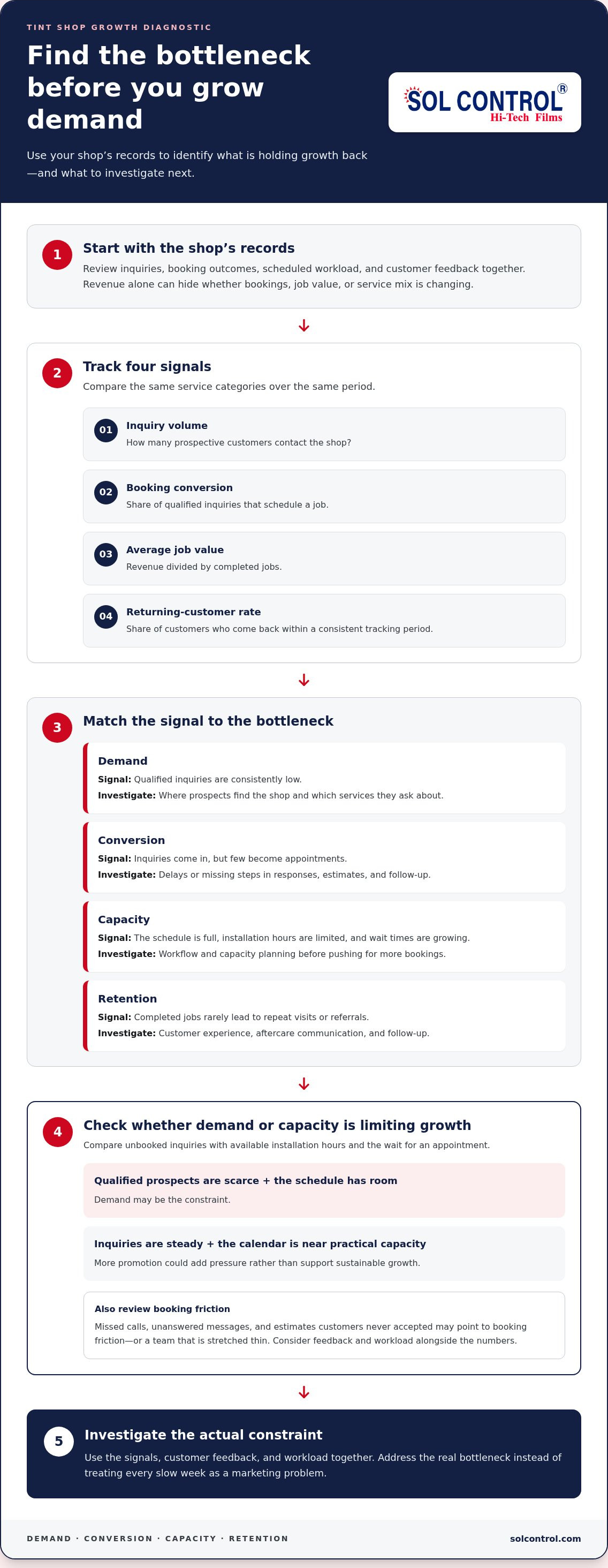
Uneven bookings can make it tempting to launch another promotion or add services. But growth that outpaces your team, scheduling, or quality controls can mean longer waits and a less consistent customer experience. Before deciding how to grow my tint shop, identify where work is getting stuck: attracting inquiries, converting them into bookings, completing jobs efficiently, or bringing customers back.
Start with your shop’s records. Review inquiries, booking outcomes, scheduled workload, and customer feedback together. Revenue alone can hide the cause: it may rise because average job value increased even as bookings fell, or stay flat while the shop handles more lower-value jobs. Operations management principles offer a useful way to examine how people, processes, and resources work together, rather than focusing only on the amount of demand marketing creates.
Use this checklist to decide what to investigate next:
Demand: Are qualified inquiries consistently low? Review where prospects find the shop and which services they ask about.
Conversion: Are inquiries coming in but few becoming appointments? Look for delays or missing steps in responses, estimates, and follow-up.
Capacity: Is the schedule full, with limited installation hours and growing wait times? Improve workflow and capacity planning before pushing for more bookings.
Retention: Do completed jobs rarely lead to repeat visits or referrals? Examine the customer experience, aftercare communication, and follow-up process.
Which tint-shop growth metrics should owners track?
Track inquiry volume, the number of prospective customers who contact the shop; booking conversion, the share of qualified inquiries that schedule a job; average job value, revenue divided by completed jobs; and returning-customer rate, the share of customers who come back within a consistent tracking period. Compare the same service categories over the same period. Low inquiries point toward visibility, weak conversion suggests a sales-process issue, falling job value may signal a shift in service mix, and few return visits can highlight a retention opportunity.
How can you tell whether marketing or capacity is limiting growth?
Compare unbooked inquiries with available installation hours and the wait for an appointment. If qualified prospects are scarce while the schedule has room, demand may be the constraint. If inquiries are steady but the calendar is near practical capacity, more promotion could add pressure rather than support sustainable growth.
Review missed calls, unanswered messages, and estimates customers never accepted. These may point to friction in the booking process, but they can also mean the team is stretched thin. Consider feedback and workload alongside the numbers, then address the actual bottleneck instead of treating every slow week as a marketing problem.
Strengthen tint-shop operations before adding more demand
More inquiries help only if your shop can turn them into well-managed appointments and consistent work. Documenting each step, from the first customer conversation to the final quality check, makes the experience repeatable and helps reveal where time or materials get lost. It also gives the team a shared process instead of relying on memory.
Operational readiness means matching promised work to the people, time, and materials available to complete it well. This is the foundation for growth that protects installation quality and customer confidence. Before expanding your schedule, map each job from inquiry through delivery. Note where information gets missed, handoffs stall, rework occurs, or jobs take longer than expected. Use actual completion times and quality issues to adjust scheduling assumptions instead of filling the calendar based on best-case estimates.
How do you increase shop capacity without sacrificing quality?
Build a consistent intake process that captures the vehicle or project details, requested service, customer expectations, and information the installer needs. Make estimates clear, record the next step, and keep job details connected through the scheduling handoff. A simple quality-check routine before delivery can catch omissions and help the shop learn from recurring issues.
Track delays and rework by job type. If a particular service regularly takes longer than expected, account for that before offering more appointments. Standard processes support capacity, and realistic timing protects it.
How should a tint shop plan film and tool inventory?
Review film use by service category, then compare recent consumption with upcoming bookings and seasonal patterns your shop observes. Organize materials so the team can quickly identify what is on hand and what needs replenishing. A regular inventory review based on actual use is more reliable than ordering from memory or waiting until a roll runs out.
Include tools in the same readiness check. Choose professional tinting tools that suit the film work your team performs, and keep them organized and ready for scheduled jobs. Matching inventory to booked services helps prevent avoidable workflow interruptions. A wholesale partner such as SolControl for professional films and tinting tools can support your supply planning.
Use this practical operating rhythm:
Before scheduling: Capture job requirements and confirm the work fits available installation time.
Before the appointment: Check that the required film and tools are organized and ready.
At handoff: Record job details, customer expectations, and relevant notes for the installer.
Before delivery: Complete the quality check and document issues that may inform future estimates or processes.
During regular reviews: Compare actual completion times, rework, inventory use, and upcoming bookings, then adjust the workflow or replenishment routine.
These steps make operational readiness a routine rather than a last-minute scramble. As you consider how to grow my tint shop, strengthen the process first, then add demand at a pace the shop can serve consistently.
Choose customer-acquisition channels that fit your tint shop
Marketing works best when it reaches customers your shop can serve and gives them a clear next step. A channel that brings attention but few qualified inquiries may be a poor fit. A steady stream of inquiries can also cause problems if your schedule is already full. Choose channels based on your target customer, service mix, available capacity, and ability to track what happens after someone sees your message.
Which marketing channels make sense for a local tint shop?
Referrals can bring prospects who already trust the recommendation, while a Google Business Profile helps people discover services through search. Organic search helps customers find useful website pages that answer questions about your services and process. Paid ads can target active searches, but need clear tracking and room in the schedule. Social content can show workmanship and explain film options. Treat it as education and visibility, not guaranteed bookings.
Your website should make it easy to understand what the shop does and how to inquire. Clear service information and useful answers help customers compare options. Strong film knowledge also helps your team explain choices accurately. The automotive window film professional guide can support informed customer conversations.
How should tint shops compare marketing results?
Compare channels by customer intent, the ongoing effort they require, and whether you can connect activity to qualified inquiries and booked work. The best channel is one your shop can measure and serve consistently. Start with one focused test, set a review period in advance, and record the source of each inquiry and its outcome.
Channel
Audience intent
Owner effort
Measure
Best fit when
Referrals
Often arrives through a trusted recommendation
Maintain a strong customer experience and make referrals easy
Referral inquiries and bookings
Customers are satisfied and the shop can handle relationship-based demand
Google Business Profile
Searchers may be looking for a nearby service
Keep business information and customer-facing updates accurate
Qualified inquiries and booked jobs attributed to profile discovery
Local search is relevant to the shop’s customer base
Organic search
Customers seek answers or compare services
Create and maintain useful website content
Relevant visits, inquiries, and bookings
The shop can explain its services clearly online
Paid ads
Can reach people searching for a specific service
Set up, monitor, and refine campaigns
Qualified inquiries and booked work by campaign
Capacity and tracking are in place for a controlled test
Social content
May include both active prospects and general viewers
Publish examples and helpful educational content
Inquiries and bookings, not impressions alone
The shop can share useful content consistently
For a practical plan for how to grow my tint shop, use a tracking log with the channel, service requested, inquiry date, booking outcome, and reason for lost work when known. Review results at the end of your chosen test period, then continue, adjust, or pause based on inquiry quality and available installation capacity. Professional films and marketing materials from SolControl’s wholesale offerings can support shops as they align customer demand with the services they’re prepared to deliver.
Grow tint-shop revenue through repeat business and a deliberate service mix
Revenue growth doesn’t always require adding another service. A consistent customer experience can strengthen referrals and bring past customers back, while a carefully chosen adjacent offering may serve a real need in your existing customer base. The right move depends on what customers ask for and what your shop can deliver reliably.
Service expansion works best when customer demand and shop capability align. Before changing your service mix, consider the skills and training involved, installation workflow, available space, and added inventory complexity. A new category can broaden your offer, but it requires preparation. Deepening your focus on core tint services may be the better choice if customers already value that work or expansion would strain capacity.
How can a tint shop encourage repeat and referral business?
Start with a dependable delivery experience: explain the completed work, provide clear and accurate aftercare guidance, and make it straightforward for customers to follow that guidance. Consistency matters. Customers should receive the same essential information regardless of who handles the handoff.
Follow up with permission and purpose. For example, ask whether the customer would like a brief check-in, then send a relevant message rather than a sequence of reminders. Invite feedback, and if the customer is satisfied, ask for an honest review without pressure or a promised reward. Use feedback to identify patterns in communication, scheduling, and service delivery. Referrals feel more natural when customers can describe a positive experience in their own words.
When should a shop add paint protection or architectural film?
Treat each adjacent category as a separate business decision, not an automatic revenue upgrade. The paint protection film professional guide can help introduce PPF as a distinct category to evaluate. Architectural film may also fit shops whose customers express relevant needs, but demand alone doesn’t establish readiness.
Compare the opportunity with your current capability. Consider whether the team has the relevant skills and training, whether the workspace and workflow can accommodate the work, and what inventory planning it requires. Assess whether prospective jobs fit around existing commitments without weakening quality in core tint services. If interest is occasional or preparation would disrupt established work, strengthen the core offer first and keep listening to customer requests.
Stay focused: Improve the experience and communication around services the shop already performs well.
Explore an adjacent category: Look for recurring customer interest and assess skills, space, workflow, and material needs before committing.
Review the fit: Evaluate customer response and operational impact after a deliberate trial, then decide whether to continue or adjust.
For shops evaluating film categories and professional tools to support a deliberate service mix, explore SolControl’s wholesale film and tool offerings. Thoughtful expansion and consistent follow-up can make each customer relationship more valuable without pushing the shop beyond what it can deliver well.
Build a tint-shop growth plan that connects demand, capacity, and supply
A practical plan turns “how to grow my tint shop” into a sequence of decisions you can evaluate. Use a 90-day horizon as a planning framework, not a promise of a particular revenue result. The aim is to test one focused improvement while keeping customer demand, installation capacity, and product needs aligned.
What should a 90-day tint-shop growth plan include?
Start with a baseline from your existing records, then choose one constraint to address. Next, improve the process, channel, or retention practice tied to that constraint. In the final phase, compare results with your baseline and decide whether to refine, continue, or stop the test. Keep the review period consistent so your decision is based on useful evidence.
Diagnose: Record current inquiry volume, bookings, average job value, repeat visits, scheduling delays, and relevant customer feedback. Note where the process appears to lose momentum.
Prioritize: Select one constraint with a clear link to the shop’s goals. For example, if inquiries are coming in but estimates are not turning into bookings, focus on the estimate and follow-up process rather than adding another marketing channel.
Prepare operations: Confirm that job intake, scheduling, quality checks, installation hours, and inventory can support the work you intend to attract. Compare materials on hand with upcoming bookings and the services you’ve chosen to offer.
Test one growth action: Make one deliberate change, such as improving a customer follow-up step or testing a relevant acquisition channel. Record the starting point, the outcome you’ll measure, and the review date.
Review and decide: Compare qualified inquiries, booked work, workload, customer feedback, and material use with your baseline. Continue if the test fits the shop’s capacity, refine it if results are mixed, or stop if it creates more strain than value.
How can wholesale supply support a shop's next growth step?
Let your chosen service mix guide supply planning. A shop focused on automotive tint can align its inventory review with automotive window film and the tools used in its workflow. If you deliberately add architectural film, paint protection film, or windshield protection film, plan for those categories as distinct needs. Review actual use alongside bookings rather than assuming every category belongs in every shop.
SolControl is a nationwide wholesale supply partner for professional shops, with automotive, architectural, paint protection, and windshield protection films, professional tinting tools, and marketing materials. This supply relationship supports the product side of a growth plan. Your shop remains responsible for matching customer commitments to its installation capability. Plan inventory as part of preparation, not as an afterthought once demand has already increased.
You don’t need to solve every challenge at once. Choose one practical next step, set a clear way to evaluate it, and use what you learn to guide the next decision. This steady approach can turn the question of how to grow my tint shop into a plan that develops with your customers and your team.
As you put that plan into action, align supply choices with the work you intend to take on. SolControl is a wholesale distributor serving professional installers and contractors across the United States, with automotive, architectural, paint protection, and windshield protection films, professional tinting tools, and marketing materials.
The fastest useful step is to fix the constraint that’s already costing the shop opportunities. If prospects request estimates but don’t book, review how estimates are explained and followed up before spending more to attract inquiries. If the calendar is full, focus on making existing work run smoothly instead of generating more demand. Choose one change, define what success would look like, and assess the results before adding another tactic.
Do I need to run Google Ads to grow my tint shop?
No, Google Ads aren’t a requirement. Paid search can reach people actively looking for tint services, but it works best when the shop can respond to inquiries, explain its services clearly, and measure which inquiries become bookings. A shop with limited capacity may be better served by improving its current customer journey first. Referrals, organic search, customer reviews, and social content are other options to compare against your goals and available time.
How can a tint shop get more customers?
Make it easy for prospects to understand what you offer and how to take the next step. Ensure your online service information answers common questions, include genuine examples of completed work, and provide a clear way to inquire. Keep business details consistent across platforms and record how each prospect found you. That information can show whether new customers come from search, referrals, or another channel, helping you focus effort where it’s useful.
How many Google reviews does a tint shop need?
There’s no universal review count that guarantees customer trust or better search visibility. Focus on earning genuine feedback over time rather than chasing a target number. After a completed job, invite the customer to share an honest review, and respond to feedback professionally. Avoid pressure or incentives that may conflict with platform policies. Review themes can also reveal recurring strengths or service concerns, even when the total count is modest.
Should I add paint protection film to grow my tint shop?
Consider paint protection film if customers show genuine interest and your shop can support the work with suitable skills, workflow, and inventory. Treat it as a separate service decision, not an automatic way to increase revenue. Assess whether the work fits your schedule and whether your team can maintain a consistent customer experience while learning or refining the process. If those conditions aren’t in place, strengthen your current services before expanding.
How can I grow my tint shop without hiring more installers?
Look for unused time and avoidable friction in the work you already handle. Review where appointments leave gaps, where job details need clarification, and whether administrative tasks interrupt installation work. A more consistent intake process or clearer handoff may help existing capacity go further. But if the team is already working near its practical limit, don’t fill every opening by squeezing in more jobs. Protect workmanship and schedule reliability as you improve efficiency.
How can a tint shop increase repeat business?
Give customers a clear, consistent experience and make future communication relevant to their needs. Share accurate aftercare information, then ask permission before sending a follow-up message. Keep a simple record of customer preferences and service questions so future conversations feel useful rather than generic. Invite honest feedback after completed work and use it to improve the experience. Track returning customers and referrals over time without assuming every customer will need another service.