Safety and Security Window Film Suppliers: A Professional Buying Guide
What good is a security film specification if it doesn’t match the risk your project needs to address? For professional installers and contractors, choosing among safety and security window film suppliers means looking beyond thickness claims. Compare the intended application, glazing and attachment requirements, and the information available to support a project-specific decision.
Film can help hold shattered glass together, but it doesn’t make glass unbreakable or guarantee protection against every threat. The right choice depends on the project. Clear product information about performance and limitations helps you set expectations with customers and plan the work accurately.
This guide explains how to compare film specifications with project requirements, assess whether a product suits a safety or security application, and evaluate a wholesale partner’s fit with professional workflows. SolControl is a wholesale distributor serving installers, contractors, tint shops, glass companies, and automotive dealers across the United States, with window films, professional tools, and business materials. Use the criteria below to assess product fit and organize your sourcing process.
Key Takeaways
Match the film’s intended application to the project, accounting for glazing, attachment method, and site conditions.
Set realistic expectations: film can help retain broken glass, but it doesn’t make glass unbreakable or guarantee that entry will be prevented.
Compare safety and security window film suppliers by the clarity of their specifications, product information, and professional distribution focus.
Before sourcing, document glass type, dimensions, exposure, installation side, and the customer’s objectives.
Consider how a wholesale distribution partner’s film, tinting tools, and business materials fit your workflow.
What Safety and Security Window Film Suppliers Should Help You Solve
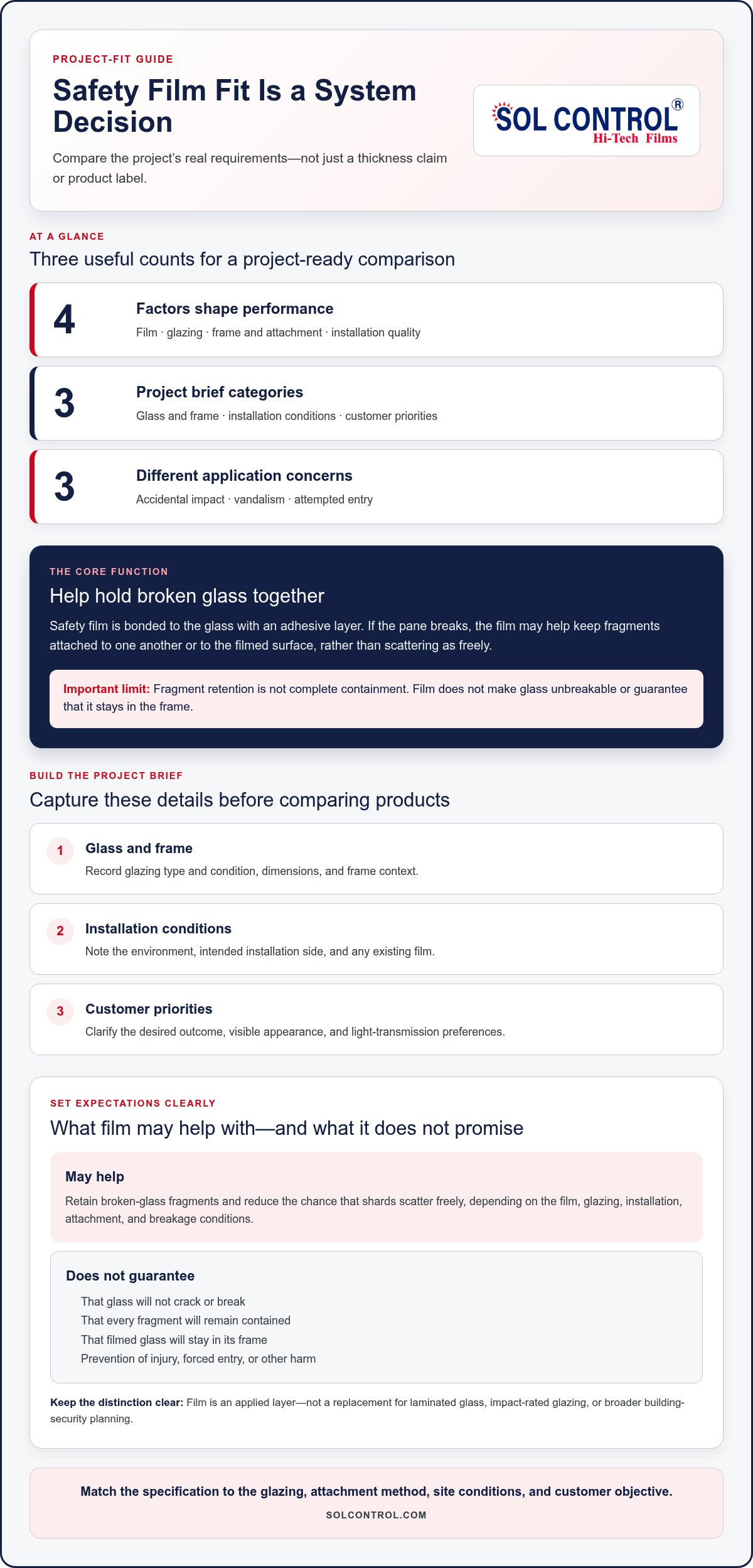
Safety and security window film is an applied layer designed to help hold broken glass together after it fractures. That can matter in different settings, from accidental impacts to concerns about vandalism or attempted entry. But film is only one part of the glazing assembly. Performance depends on the film, the glass and frame, the attachment method, and the conditions of the project.
Start with the customer’s concern, not a thickness or product label. A safety-focused application may aim to retain glass fragments. Privacy, solar control, and decorative films address different objectives, even when they’re relevant to the same window. Separating these goals makes product comparisons clearer and helps keep expectations aligned with the system’s intended purpose.
Which project needs can safety and security film address?
Potential applications include glazing exposed to accidental impacts, locations where vandalism is a concern, and projects where a customer wants to slow access after an attempted entry. These are distinct requirements. Accidental breakage and deliberate attack involve different conditions, so specifications and installation details need to match the objective and existing glazing.
Separate glass-fragment retention from broader building-security planning. Film may help keep fragments together, but it doesn’t make glass unbreakable or guarantee that someone can’t enter. A customer seeking a wider security outcome should consider the whole opening, including the frame and other building measures, rather than treating film as a complete security solution.
What should a supplier clarify before product selection?
Begin with accurate project information. Identify the glazing type and condition, installation environment, and performance objective. Record whether the priority is reducing loose fragments, addressing a security concern, or meeting another requirement. These details let you compare relevant specifications instead of relying on a broad label such as “safety” or “security.”
Glass and frame: Note the glazing type, condition, dimensions, and frame context.
Installation conditions: Record the environment, intended installation side, and any existing film.
Customer priorities: Clarify the desired outcome, visible appearance, and light-transmission preferences.
Existing film and appearance requirements can affect the project specification, so include them early. Before ordering, document assumptions, intended performance, and known limitations. This gives the installer and customer a shared reference and gives safety and security window film suppliers the context for a relevant product comparison. A professional distribution partner can help connect product information to the project, while the installer remains responsible for evaluating the site and explaining the proposed system.
How Safety Film Works, and Where Its Protection Has Limits
Safety film is bonded to the glass surface with an adhesive layer. If the pane breaks, the film can help keep fragments attached to one another or to the filmed surface, reducing the chance that shards scatter freely. That’s the intended benefit, not a promise that every fragment will stay contained or that the glass will remain in place under every impact.
Results depend on more than the film. The glazing’s type, condition, and strength matter, as do the frame, edge attachment, installation quality, and force or conditions involved in a breakage. The same film may behave differently on damaged glazing or in a different assembly. Read specifications in the context of the complete application.
How does film help retain broken glass?
The film and adhesive form a bonded layer over the glass. When the pane fractures, that layer may help hold pieces together rather than letting them fall or scatter as readily. The degree of retention varies with the film, glazing, installation, and whether the edges are attached to the frame. Fragment retention is a performance objective, not complete containment.
This distinction helps installers explain the product accurately. A customer concerned about injury from broken glass should understand that film may reduce the spread of fragments, but results depend on the assembly and breakage conditions. Film doesn’t prevent the glass from cracking, and a filmed pane may still be displaced from its frame if the system doesn’t hold it there.
What safety film does not replace
Film alone isn’t equivalent to laminated glass or impact-rated glazing. Those are different glazing solutions with their own construction and performance considerations. Film should not be described as bulletproof or burglar-proof. It can contribute to a project’s glass-retention goals, but it doesn’t guarantee against breakage, injury, forced entry, or other harm.
Keep the boundaries clear in project discussions:
Film: An applied layer intended to help retain broken glass.
Glazing: The glass type and condition influence how the pane responds to impact.
Frame and attachment: These affect whether filmed glass remains connected to the opening.
Installation: Application quality is part of the system’s performance.
Film selection is separate from broader building-security and life-safety decisions. A project focused on entry resistance should account for the entire opening and the customer’s wider security plan, not rely on a film description alone. Clear product data helps safety and security window film suppliers support realistic specifications, while installers communicate the intended benefit and its limits.
How to Compare Safety and Security Window Film Suppliers
A useful supplier comparison goes beyond the product list. Assess whether the available information helps you match film to the project, understand its limits, and source materials in a way that fits your workflow. Start with the documentation, then consider how relevant the supplier’s broader distribution offering is to the work your business handles.
Product information should make key details easy to interpret, including thickness, appearance, intended application, and installation environment. Look for compatibility guidance that identifies the glazing conditions it covers. Don’t assume one film suits every pane. Performance statements should describe a specific benefit and its boundaries. Broad claims without supporting product information make it harder to explain expectations accurately.
Which product details make a supplier easier to evaluate?
Compare product data against the same project criteria each time. Note what the documentation says about use, appearance, and installation conditions, and whether it identifies relevant glazing considerations. Clear distinctions between intended application and limitations help you assess fit without treating a general claim as a guarantee.
Product documentation covering thickness, appearance, application, and installation environment.
Compatibility information
Helps prevent assumptions across different glazing systems.
Stated glazing guidance and any identified conditions or limitations.
Performance language
Keeps customer expectations realistic.
Defined intended benefits, supporting details, and clear limits.
Distribution relevance
Can simplify sourcing across your professional work.
Relevant film categories, professional tools, and business materials.
How does distribution support affect professional buyers?
A distributor’s range matters when it aligns with the work your business handles. For a professional operation serving different customer types, access to relevant film categories alongside tools and business materials can make sourcing more coherent. Consider how the range fits your workflow, not just whether one film appears suitable for a single job.
SolControl is a wholesale distributor serving professional installers, contractors, tint shops, glass companies, and automotive dealers across the United States. Its offering includes automotive and architectural window films, paint protection films, windshield protection film, tinting tools, and marketing materials. SolControl focuses on distribution, not installation.
When assessing safety and security window film suppliers, weigh product documentation and range relevance alongside how clearly ordering and account support information is communicated. Record what the supplier’s materials establish, what is specific to the project, and what remains an assumption. This makes it easier to choose a wholesale relationship that supports your work while keeping product claims grounded.
A Project-Ready Checklist for Sourcing Safety and Security Film
A consistent project brief makes product comparisons more useful and helps prevent assumptions from carrying into an order. Record the site conditions and customer objective first, then review product documentation against those details.
Define the objective. Write down the customer’s concern, such as retaining fragments after breakage or mitigating vandalism. Keep the goal specific. Don’t turn a broad concern about security into a promise that film will prevent entry.
Identify the glazing. Record the glass construction and visible condition, along with existing coatings or film. Note the frame context and access conditions that may affect the work. If a detail is unknown, mark it as an assumption to resolve rather than treating it as fact.
Capture measurements and exposure. Document approximate pane dimensions, the installation environment, and whether the planned application is interior or exterior. Include the intended installation side. These details help compare product information with the actual opening instead of selecting by category name alone.
Set appearance expectations. Note preferences for visibility, tint, reflectivity, and light transmission. Record existing film that could affect the desired appearance or specification. Separate these preferences from the safety objective so one requirement doesn’t obscure another.
Review documentation and standards. Compare the proposed product information with the recorded glazing and conditions. Review test data carefully, including which components and use cases it covers. Verify current standards and project requirements through authoritative sources, and don’t imply that a test or certification applies beyond its documented scope.
Document the decision before ordering. Record the selected specification, the information it is based on, and any remaining assumptions. Keep the customer’s objective and appearance requirements with the order details so the project team has a consistent reference.
This workflow gives safety and security window film suppliers the information needed for more relevant product discussions, while helping installers retain control of the project specification. It also gives customers a written explanation of the intended benefit and its boundaries.
Before finalizing, state plainly that film may help retain broken glass, but it doesn’t make glass unbreakable or guarantee prevention of entry. Explain that performance depends on the product and project conditions, including glazing and installation details. Clear expectations are part of a sound specification, not an afterthought.
Why Professional Installers Choose a Wholesale Distribution Partner
For professional installers and contractors, sourcing is part of running a consistent operation. A wholesale distribution partner connects professional buyers with film and tools suited to their work, while project assessment and installation remain with the businesses performing them. SolControl distributes products and professional tools; it does not provide installation or glass replacement.
How can a distribution partner support installer operations?
SolControl is a wholesale distributor serving professional installers, contractors, tint shops, glass companies, and automotive dealers across the United States. Its business-to-business focus serves professionals sourcing products and materials for their own operations.
A range spanning automotive and architectural window films, paint protection films, windshield protection film, tinting tools, and marketing materials can help professional buyers organize sourcing across different parts of their business. Not every category applies to every project. A broader offering can be useful when it aligns with the mix of services a professional business provides, while keeping product purchasing separate from installation work.
For safety and security applications, use project information and product documentation to guide selection. A distribution partner provides products and tools; the installer evaluates project conditions, determines the appropriate specification, and communicates intended performance and limitations to the customer. Product supply alone does not determine a project outcome.
Professional buyers can also build sourcing into repeatable processes. Keep project notes and product specifications together, then use them to support consistent review and ordering. Clear documentation helps teams compare requirements across jobs and reduces the chance that a product choice is based only on a broad category label.
Next steps for professional film buyers
Before selecting products, organize the job details: glazing and dimensions, installation conditions, customer objectives, and appearance preferences. Use those inputs to review product information and identify questions to resolve before ordering. This process ties product selection to the actual project rather than assumptions.
SolControl’s wholesale offering supports professional operations with window-film categories, tinting tools, and marketing materials. For adjacent architectural context, the UV-blocking window film wholesale guide discusses solar-control technology and selection, a separate consideration from safety-film performance.
Make supplier criteria part of your project routine. For each opportunity, capture the customer’s needs, identify the information that will shape product selection, and keep the reasoning with the project record. This gives your team a clearer starting point for estimates and customer conversations, while helping prevent assumptions from becoming promises.
A useful relationship with safety and security window film suppliers supports your professional judgment rather than replacing it. Look for a wholesale partner whose products and tools fit your work, and use clear project documentation to guide each decision. A consistent process makes sourcing easier to manage as customer needs evolve.
Does safety and security window film make glass unbreakable?
No. Safety film can help keep some fragments together after glass breaks, but the pane can still crack, and the film can’t guarantee that a person won’t get through the opening. Outcomes vary with the glass, frame, film specification, edge attachment, and installation. Review product documentation for the exact assembly and conditions it covers. Don’t treat broad phrases such as “break-resistant” as proof that film replaces purpose-designed glazing or a complete security plan.
Can security window film stop a break-in?
Not as a guarantee. Film may add resistance or help retain broken glass, but that isn’t the same as preventing entry. A filmed window can still break, and the result depends on the complete window assembly and installation details. For a storefront, for example, consider what the product documentation says about the specific application rather than assuming a general security claim applies. Describe any potential delay or mitigation as limited, not assured.
What thickness of safety window film should I choose?
There isn’t one thickness that suits every project. Thickness alone doesn’t establish whether film is appropriate for a particular pane or objective. Compare the glazing, customer’s stated concern, installation conditions, and the performance described in the product documentation. A specification chosen for one type of glazing shouldn’t automatically be carried over to another. Review technical documents against the job requirements before sourcing, rather than selecting by thickness alone.
Can safety film be installed on the exterior of a window?
Some film may be intended for exterior application, but suitability is product-specific. Check the product documentation for the stated installation side and conditions of use. Exposure and glazing can affect the appropriate choice, so don’t assume that film specified for interior installation can be applied outside, or vice versa. For unusual exposure or glazing conditions, record those details and use them when matching the product’s application information to the job.
Is safety window film the same as laminated glass?
No. They’re different glazing approaches. Safety film is applied to the surface of existing glass, while laminated glass is manufactured with an interlayer between glass panes. Both may relate to retaining glass fragments, but they aren’t interchangeable and don’t have identical performance. For a replacement or retrofit decision, compare the documented performance of the complete glazing system with the project specification. Applying film does not give existing glass the same construction or properties as laminated glass.
What should installers review before ordering safety and security film?
Gather the glazing type, pane dimensions, installation environment, customer objective, and appearance requirements. Then compare those details with product documentation, stated application limits, and any standards relevant to the project. Note assumptions, such as an unverified glass type, rather than treating them as confirmed. When comparing safety and security window film suppliers, prioritize information that supports project-specific selection and helps you explain realistic performance boundaries to the customer.