How to Justify PPF Costs to Customers: A Shop Guide
What does a customer compare a PPF quote with when doing nothing costs nothing upfront? That’s the real challenge in justifying the cost of ppf to customers. Broad claims can sound like a sales pitch, especially when the customer’s driving habits, priorities, and expectations aren’t part of the conversation.
A stronger approach is to connect coverage to how the vehicle is used, then explain what the film can and can’t do. PPF protects the areas it covers, but it doesn’t make a vehicle damage-proof or guarantee a future resale price. Clear scope and honest limitations help customers weigh the investment against their own concerns about paint damage and upkeep.
This guide shows shops how to present protection options consistently, explain the value of different coverage areas, and respond to cost objections without overstating benefits. It also covers how professional film, tools, and customer-facing marketing materials can support a clear, confident sales conversation.
Key Takeaways
Ask about the customer’s driving habits, vehicle use, and priorities before recommending coverage.
Explain PPF’s intended protective role and its limitations without promising damage prevention or resale gains.
Compare coverage by scope, trade-offs, and fit rather than presenting one option as best for everyone.
Use a five-step consultation to uncover concerns, explain options, and check the customer’s understanding.
Close with a clear recap of the recommendation and give customers room to consider their next step.
Why Customers Question the Cost of PPF, and How to Start the Conversation
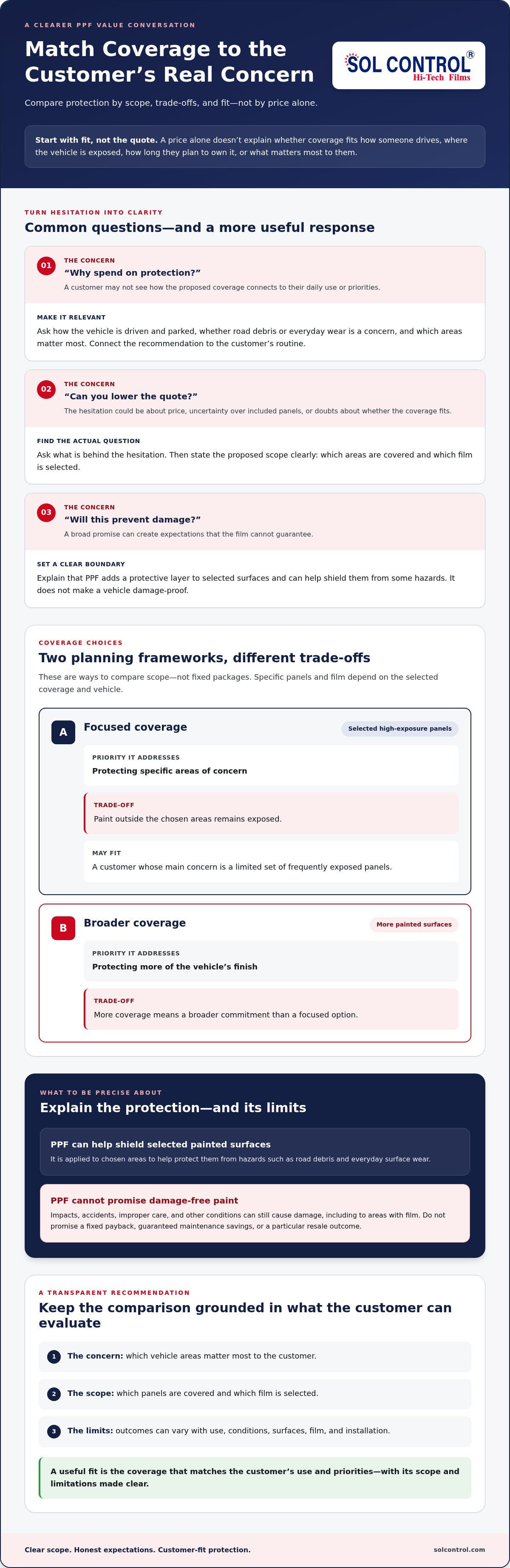
Customers need a clear reason to spend on paint protection beyond appearance. A quote alone doesn’t show whether PPF fits how someone drives, where the vehicle is exposed, how long they plan to own it, or what matters most to them. Justifying the cost of ppf to customers starts with finding out what they want to protect, not defending a price before you understand their concern.
A request for a lower quote can point to several different questions. The customer may be comparing prices, unsure which panels are included, or unconvinced that the proposed coverage fits their needs. Ask what’s behind the hesitation. This helps distinguish a budget limit from uncertainty about value or outcomes, so you can address the actual concern rather than default to a sales pitch.
Identify what the customer is trying to protect
Start with open questions: How is the vehicle driven and parked? Does it regularly encounter road debris or other everyday wear? Is the customer focused on preserving the original paint, maintaining appearance, or reducing the visibility of chips? Ask which areas concern them most before discussing coverage. Someone focused on the front of the vehicle may need a different conversation from someone who parks outdoors or plans to keep the vehicle for years. The aim is to understand the customer’s priorities, not assume them.
Customer-fit value means matching protection to how a vehicle is used, what its owner prioritizes, and the coverage they choose.
Set expectations before explaining the investment
Describe PPF plainly as a protective film applied to selected vehicle surfaces. For a neutral overview of its composition and common applications, see Paint Protection Film (PPF). Then define the proposed scope: name the areas covered and the film selected. How well that protection meets a customer’s expectations depends on use and conditions.
Be clear that PPF isn’t a guarantee against every kind of damage. It doesn’t make a vehicle damage-proof, and your recommendation shouldn’t imply that it will prevent all chips or surface wear. Separate details you can specify, such as covered areas and film selection, from outcomes that can vary.
Some customers may reasonably decide that their exposure or priorities don’t justify coverage. Respect that choice. A transparent explanation of fit, scope, and limitations gives customers a useful basis for deciding, whether they choose to proceed, wait, or decline.
Explain What PPF Protects, and What It Cannot Promise
Paint protection film (PPF) is applied to selected painted surfaces to help shield them from hazards such as road debris and everyday surface wear. In customer-friendly terms, it adds a protective layer where it’s installed. It doesn’t change how the vehicle is used or make the paint invulnerable.
PPF can help reduce exposure to selected paint hazards, but it cannot make paint damage impossible. That distinction is central to justifying the cost of ppf to customers: explain the film’s intended role without presenting protection as a guaranteed outcome.
Translate film benefits into customer-relevant outcomes
Connect the recommendation to the customer’s routine. If they regularly drive where road debris is a concern, discuss which painted areas they want to protect. If preserving appearance matters most, explain how covering selected panels may help shield those surfaces from some exposure. Keep the focus on the chosen coverage, not a general promise that the whole vehicle will stay flawless.
Separate documented film properties from expected results. If a customer asks about self-healing, care, or another performance characteristic, describe it only when current documentation for that specific film supports the claim. The Forbes overview discusses PPF in the context of protecting a vehicle’s value, but don’t turn that framing into a promise of resale value or a guaranteed financial return.
Be clear about PPF limitations
Impacts, accidents, improper care, and other conditions can still damage a vehicle, including areas with film. Don’t promise a fixed payback, guaranteed maintenance savings, or a particular resale outcome. Those results depend on factors beyond the film and the coverage selected.
Be precise about what the customer can evaluate: which panels are covered, which film is selected, and what its current product documentation says. Visible results also depend on the film, the vehicle’s surfaces, and installation. Distinguish these known details from outcomes that can vary.
That clarity gives customers room to make an informed choice without pressure. For shop teams building straightforward PPF conversations, SolControl’s PPF and shop resources can support customer education alongside professional film and tools.
Compare PPF Coverage Options by Customer Need, Not by Price Alone
A lower quote may mean less coverage, not a better fit. Make options easier to compare by stating what each scope covers, which concern it addresses, and what remains exposed. Use these as planning frameworks, not fixed packages. The specific panels and film depend on the selected coverage and vehicle.
Coverage scope
Customer priority
Trade-off
Suitable use case
Focused coverage on selected high-exposure panels
Protecting specific areas of concern
Paint outside the chosen areas remains exposed
A customer whose main concern is a limited set of frequently exposed panels
Broader coverage across more painted surfaces
Protecting more of the vehicle’s finish
More coverage means a broader commitment than a focused option
An owner who prioritizes preserving the appearance of more painted areas
No PPF
Avoiding the cost or choosing to accept the exposure
Paint remains directly exposed to road debris and everyday wear
A customer with lower concern about those risks or other priorities for their budget
Match coverage scope to exposure and priorities
Use the table to guide questions, not to steer every customer toward more film. A driver concerned about a few high-exposure panels may prefer focused coverage, while someone who wants more painted surfaces protected may consider broader coverage. The best scope depends on exposure, priorities, and acceptable trade-offs. This makes justifying the cost of ppf to customers a matter of explaining fit, not ranking options by price.
Compare PPF with alternatives without overstating either
Alternatives address different concerns. Ceramic coating isn’t equivalent to PPF for impact protection; explain its intended benefits using current product information. Paint correction addresses the appearance of existing surface imperfections rather than preventing future exposure. Customers may consider combining approaches, but clarify what each is intended to do and what it cannot promise.
Forbes discusses PPF as an investment in your car’s long-term value. That framing can help customers consider the topic, but it shouldn’t become a guarantee of resale value or a specific return. Keep the conversation anchored in the chosen scope and the customer’s priorities. Doing nothing is also a valid decision: explain the exposure honestly, then let the customer weigh it against their preferences.
Use a Step-by-Step PPF Consultation to Answer Cost Objections
A consistent consultation helps you respond to the concern behind an objection instead of simply repeating the benefits of film. Keep the conversation customer-led and move through five clear steps:
Discover: Ask open questions such as, “What prompted you to consider PPF?” and “What concerns you most about the quote?” Listen for whether the issue is budget, coverage, or uncertainty about results.
Prioritize: Reflect the customer’s stated goals. They may care most about particular panels, preserving the vehicle’s appearance, or limiting how much they spend on protection.
Explain: Describe the proposed film and its intended role in plain language. Use current product documentation for film properties, care guidance, and stated limitations.
Compare: Present coverage options your shop can provide. Clarify which areas each includes and excludes, then explain the trade-offs without labeling one option right for everyone.
Confirm understanding: Ask the customer to describe what they understand the coverage to do. Correct misunderstandings, then provide a written recap they can review alongside their priorities.
Answer common objections with evidence and empathy
If a customer says, “I don’t need it,” avoid creating fear. You might respond, “That may be the right choice. Based on what you’ve told me about how you use the vehicle, here’s the exposure this coverage is intended to address.” If they say, “It won’t stop everything,” agree: “That’s true. It offers protection in selected areas, but it can’t prevent every kind of damage.”
For “I can repaint later,” acknowledge that repair is another option. Explain that choosing PPF is about protecting selected surfaces now, while repainting addresses damage after it occurs. Don’t predict which choice will save money, because future damage and repair needs are uncertain.
Make the recommendation easy to understand
A good-better-broad comparison can help if each option represents a real scope your shop offers. Don’t add tiers just to make one choice look more appealing. For every option, state the covered areas, exclusions, relevant film details, and care expectations in straightforward terms. A concise written summary gives customers something concrete to compare with their original concerns without burying trade-offs in technical language.
A clear process makes justifying the cost of ppf to customers a practical discussion, not a debate. To support consistent product education and shop operations, explore wholesale PPF resources from SolControl, including film, professional installation tools, and marketing materials.
Turn an Honest PPF Value Conversation into a Confident Next Step
A strong consultation ends with clarity, not pressure. Before the customer leaves, recap what matters to them, the coverage scope you recommend, what that scope includes and excludes, and any relevant care expectations. Separate film characteristics supported by current product documentation from general statements about PPF. Then make the next decision clear: proceed with the stated scope, consider another option, or take time to think it over.
Give customers room to decide. Avoid urgency, guaranteed returns, or claims that protection will pay for itself. A calm close might be: “Here’s the coverage we discussed and the areas it includes. Take time to compare it with your priorities, and we can continue from there.” That approach makes justifying the cost of ppf to customers a transparent process rather than a pressure tactic.
Create a consistent customer-facing explanation
Prepare a short explanation staff can adapt to each conversation. Cover the film’s intended role, the selected coverage, limitations, and care guidance. Train the team to distinguish verified attributes of a specific film from broad category-level benefits. Use a simple written comparison or visual coverage map to show what changes between options. Consistent language helps customers understand the recommendation without making every discussion sound scripted.
A useful recap can follow the same structure each time:
Priority: What the customer wants to protect or preserve.
Scope: Which areas the recommendation covers and excludes.
Expectations: Relevant documented film details, limitations, and care guidance.
Next step: The decision the customer wants to make, with no obligation to decide on the spot.
Support the shop with relevant wholesale resources
Customer questions often come down to specifics. Keep current product documentation accessible so staff can answer questions about film characteristics and appropriate use accurately. Professional tools can support consistent shop processes, while clear marketing materials can help explain coverage options before a customer commits to a conversation.
For additional staff education, explore resources on professional PPF installation tools and PPF technology. SolControl supplies paint protection films, professional tools, and marketing materials to installers and contractors as a wholesale partner. Explore SolControl’s professional film and installer resources to support clearer customer education and a more consistent shop experience.
Make Every PPF Recommendation Clear and Customer-Focused
Strong PPF conversations don’t depend on inflated promises. They start with the customer’s priorities, match coverage to real-world use, and explain both the intended protection and its limits. A clear comparison helps customers weigh focused coverage, broader coverage, or no film based on their own needs.
That’s the foundation of justifying the cost of ppf to customers: be specific about scope, use current product information, and give people room to decide. Consistent explanations help your team answer objections with confidence while building trust, even when a customer chooses to wait.
Support customer education with the right wholesale resources. SolControl supplies paint protection films to professional service providers, along with professional installation tools and marketing materials for installer businesses. Explore SolControl’s wholesale PPF and professional resources to support your shop’s next customer conversation.
Frequently Asked Questions
How do you explain the cost of PPF to a customer?
Explain what the quote includes before discussing why the customer might choose it. Connect the film and coverage scope to the vehicle’s use and the owner’s priorities. A PPF installation quote generally reflects more than the film itself: preparation, skilled labor, panel complexity, and the areas covered all matter. Be specific about what’s included, and avoid promising that the film will prevent every kind of damage or produce a financial return.
Is PPF worth the cost for every vehicle owner?
No. PPF can suit owners who prioritize protecting selected painted surfaces from road debris and everyday exposure, but its value depends on the individual vehicle and its use. Consider driving and parking habits, ownership plans, and which areas concern the customer. Someone with lower exposure or different priorities may reasonably decide against coverage. Present the trade-offs clearly so the customer can decide whether the protection fits their needs.
Can PPF prevent all paint chips and scratches?
No. PPF is an applied protective layer intended to help shield the surfaces it covers, but it can’t make paint damage impossible. Impacts, accidents, improper care, and other conditions may still cause damage. The film protects only selected areas, so uncovered paint remains exposed. Describe the scope and any specific film characteristics using current product documentation, and don’t turn a protective benefit into a guarantee.
How much does PPF save customers on paint repairs?
There’s no reliable fixed savings amount to promise. Whether a customer avoids a repair depends on what happens to the vehicle, where it’s damaged, the repair required, and whether the affected panel has film. Explain that PPF may help protect covered areas from some exposure, but don’t guarantee avoided repairs, a predetermined payback, or lower ownership costs. Keep the discussion focused on the customer’s priorities and the coverage being considered.
What happens if a customer says PPF is too expensive?
Ask what’s driving the concern before changing the recommendation. The customer may be focused on budget, unsure what the coverage includes, or uncertain about the outcome. Acknowledge the concern, then clarify the proposed scope and its limitations. If it fits your shop’s offerings, compare a more focused coverage option with broader coverage. Give the customer time to consider the trade-offs without pressure or unsupported claims about future savings.
Is PPF better than ceramic coating for protecting paint?
They’re different products and shouldn’t be presented as interchangeable. PPF is a physical film applied to selected surfaces; ceramic coating serves a different purpose and shouldn’t be described as equivalent impact protection. The right conversation depends on what the customer wants from the vehicle’s finish and which benefits are documented for the specific product. If discussing both, explain each option’s intended role and limitations, and avoid promising results beyond the available product information.
How should a shop compare PPF coverage options?
Compare options by coverage scope, customer priority, trade-off, and suitable use case, not by price alone. State which panels each option includes and which remain uncovered. Focused coverage may suit someone concerned about particular high-exposure areas; broader coverage may appeal to an owner prioritizing more painted surfaces. Include doing nothing as a valid choice, and explain the corresponding exposure honestly. Recommend based on the customer’s needs, not a universal “best” option.