How to Mix Slip Solution for Smooth Window Tint Installation
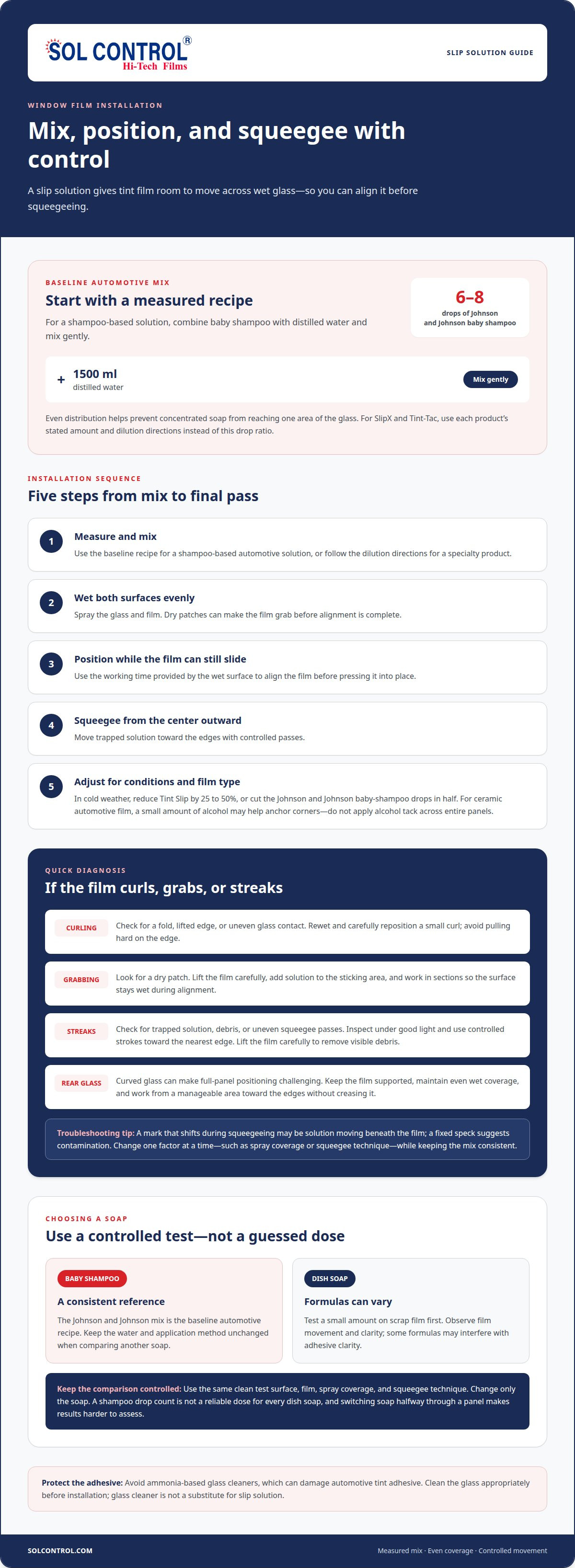
A clean window is only half the job; the film also needs room to move into position. A basic slip solution recipe for tinting uses 6 to 8 drops of Johnson and Johnson baby shampoo in 1500 ml of distilled water. The solution helps the film slide for positioning before you squeegee it into place.
Getting the mix right matters: too much or too little slip can make film harder to handle and position. This guide explains why slip solution matters, how shampoo and dish soap mixtures differ, and how to adapt your approach for automotive and architectural films. You’ll also find practical tips for troubleshooting film that shifts, grabs, or won’t settle smoothly, taking temperature and application area into account.
Key Takeaways
Choose a slip product with the film and installation conditions in mind, and avoid cleaners that can harm tint adhesive.
When film curls, grabs, or leaves streaks, look at solution strength, glass cleanliness, and how the film is being handled.
Dish soap and baby shampoo can behave differently; test an unfamiliar soap on scrap film before using it on a finished installation.
Adapt your approach for automotive and architectural applications, since film size, working conditions, and the need for precise positioning can differ.
Slip solution lets tint film move across wet glass before you position it. This working time helps installers align the film and squeegee out trapped solution.
To mix and apply it, combine the chosen product with water, wet the glass and film evenly, then position and squeegee the film. A baseline automotive mix uses 6 to 8 drops of Johnson and Johnson baby shampoo in 1500 ml of distilled water.
Start with a measured mix. Use the baseline recipe for a shampoo-based automotive solution. Add the drops to distilled water, then mix gently. Even distribution helps prevent concentrated soap from reaching one area of the glass.
Measure specialty products by their directions. For SlipX and Tint-Tac, follow each product’s stated amount and dilution directions. Don’t substitute the Johnson and Johnson drop ratio. Different products may use different concentrations, so measuring one as though it were another can change how the film slides and anchors.
Apply solution across both surfaces. Wet the glass and film with an even spray before positioning. Dry patches can cause film to grab before alignment is complete. Once the film is placed, squeegee from the center outward to move solution toward the edges.
Avoid ammonia-based glass cleaners. They can damage automotive tint adhesive. Clean the glass with a suitable method before installation, then use the slip mix for positioning. Don’t treat a glass cleaner as a substitute for slip solution.
Adjust for cold conditions and film type. In cold weather, reduce Tint Slip by 25 to 50 percent, or cut Johnson and Johnson drops in half. For ceramic automotive film, a small amount of alcohol may help anchor corners. Don’t apply alcohol tack across entire panels.
Troubleshooting curling, sticking, and streaks
Yes. Window tint rules vary by state and locality. Identify the applicable jurisdiction before choosing film or planning a vehicle installation.
Address curling at the edges. Check whether the film has folded, lifted, or met uneven glass contact. For a small curl, rewet the affected area and carefully reposition the film before squeegeeing. Don’t pull hard on a curled edge; tension can make the fold worse.
Respond to film that sticks too soon. A dry patch on the glass or film can cause premature grabbing. Lift the film carefully, apply more solution to the sticking area, and reposition it. Work in sections so the wet surface doesn’t dry before alignment is complete.
Trace streaks before pressing harder. Streaks can come from trapped solution, debris, or uneven squeegee passes. Inspect the area under good light, then make controlled strokes toward the nearest edge. If debris is visible, lift the film enough to remove it rather than trapping it underneath.
Prepare a difficult back window in stages. Curved rear glass makes full-panel positioning challenging. Keep the film supported, maintain even wet coverage, and work from a manageable area toward the edges. Avoid creasing the film while moving it across the curve.
Separate surface marks from trapped moisture. A mark that shifts during squeegeeing may be solution moving beneath the film. A fixed speck suggests contamination. Rewet and reposition for moving marks; lift the film carefully when a particle needs removal.
Change one factor at a time. If the next panel still grabs or streaks, adjust the spray coverage or squeegee technique first. Keep the solution mix consistent during that test. Changing several things together makes it harder to identify why the result improved or worsened.
Dish soap-based versus shampoo-based solutions
Use the baby-shampoo mix as your reference. Johnson and Johnson baby shampoo is the named shampoo option in the baseline automotive recipe. It gives you a consistent starting point for comparing another soap. Keep the water and application method unchanged during a comparison, so you can identify whether the soap affects handling.
Treat dish soap as a variable formula. Dish soap products differ, so a mixture that works with one formulation may not behave the same with another. Don’t assume a familiar household soap will produce the same result as baby shampoo. The key difference is predictability, not a universal rule that one type always performs better.
Test dish soap on scrap film first. Mix a small amount, apply it to scrap, and observe how the film moves and clears. Some dish soap formulas may interfere with adhesive clarity. Testing before a vehicle installation helps reveal a problem without risking a finished panel.
Keep the test controlled. Use the same glass or clean test surface, film, spray coverage, and squeegee technique for both solutions. Change only the soap. If the dish-soap test leaves haze or changes film movement, return to the shampoo mix rather than adjusting several factors at once.
Avoid guessing at dish-soap amounts. A shampoo drop count doesn’t establish a reliable dose for every dish soap. Formulations vary, and a stronger mix may change how the film slides or how clearly the adhesive appears. Add soap cautiously during testing, and record the mixture that behaves well.
Choose based on the test result. If Johnson and Johnson baby shampoo gives predictable positioning, keep using that baseline. If a dish soap test stays clear and allows controlled movement, use the tested mixture consistently. Don’t switch soap halfway through a panel.
Keep the application consistent. Spray both the glass and film evenly, then position and squeegee as usual. Comparing a wet shampoo application with a partly dry dish-soap application won’t show the soap’s effect clearly. Consistency makes the difference easier to assess.
Slip solution use for automotive and architectural films
Choose the application before mixing. Automotive and architectural installations share the need for controlled film movement, but their glass areas and working positions differ. Plan the spray pattern around the pane, so the film stays wet during positioning and doesn’t grab prematurely.
For automotive tint, adjust for heat. Hot conditions can make solution evaporate sooner. Add 1 to 2 ml of Tint Slip to an automotive slip mix in hot weather. Apply evenly, then position the film promptly while the glass remains wet.
Keep automotive panels controlled. Vehicle windows may have curves or tight edges that demand careful alignment. Wet the glass and film, position the material, and squeegee solution outward. Avoid flooding one area while leaving another dry, since uneven coverage can affect movement.
Plan architectural panes by working area. Large windows call for a deliberate sequence. Spray the section you can position while it remains wet, then continue across the pane. This helps maintain control instead of allowing an exposed area to dry before the film reaches it.
Account for vertical glass. On architectural windows, gravity can draw solution downward. Keep the working surface evenly wet and reposition the film before squeegeeing. Use steady strokes that move solution toward an edge, rather than pushing it randomly across the pane.
Match adjustments to conditions. Temperature, pane size, film movement, and installation position all influence handling. Change one factor at a time. If the film grabs, improve wet coverage; if it moves too freely, reassess the mix and application rather than changing several variables together.
Keep the takeaway practical. Automotive work often calls for precision around curves and edges. Architectural work benefits from a planned sequence across broader glass areas. In both settings, consistent coverage and timely squeegeeing matter more than applying extra solution indiscriminately.
SolControl supplies tinting tools to support controlled film handling during installation. They’re a practical addition when refining your workflow for automotive or architectural window film, or sourcing tools alongside paint protection film.
Match your tools to the film and the work surface. A consistent application technique helps you control positioning, squeegee out solution, and work across different glass areas. SolControl also supplies automotive and architectural window films, so installers and contractors can source these categories alongside their tools.
For your next installation supply needs, contact SolControl.
Turn a consistent mix into a repeatable process
Make each installation easier to assess by recording the solution used, working conditions, and how the film handled. This gives you a practical reference for refining your process across different panes and materials. A reliable slip solution recipe for tinting is only one part of consistent work: preparation, even application, and controlled squeegee technique matter too.
For installers building their supplies, SolControl offers Automotive Window Films, Architectural Window Films, and Tinting Tools. These products support vehicle and building applications and help keep your film and installation equipment aligned with your workflow.
A basic slip solution recipe for tinting uses 6 to 8 drops of Johnson and Johnson baby shampoo in 1500 ml of distilled water. Mix it gently in a clean spray bottle, then label the bottle so the contents are clear during installation. This baseline is for automotive tint; keep the mixture consistent while working on a panel.
What ingredients can be used to make slip solution for tinting?
Distilled water and Johnson & Johnson baby shampoo make a basic automotive mixture. Tint Slip is another option, as are SlipX and Tint-Tac. Don’t assume these products use the same proportions: follow the mixing directions for each one. Avoid ammonia-based cleaners when cleaning film-protected glass.
What ratios of water, soap, or other ingredients should I use?
For the baby-shampoo baseline, use 6 to 8 drops in 1500 ml of distilled water. In cold weather, cut the Johnson and Johnson drops in half. For hot weather, add 1 to 2 ml of Tint Slip to an automotive mix. Keep these adjustments tied to the named ingredient; don’t apply one product’s amount to another.
Can I use baby shampoo or dish soap as tinting slip solution?
Yes, baby shampoo can be used, and you can test dish soap on scrap film first. Dish soap formulas vary, and some may affect adhesive clarity. Test the mixture with the film and application method you plan to use, then inspect the result before applying it to a finished window. Johnson & Johnson baby shampoo provides a stated baseline option.
What is the difference between homemade and commercial tint slip solution?
A homemade mixture uses measured household ingredients, such as baby shampoo and distilled water. Commercial options include Tint Slip, SlipX, and Tint-Tac. Use each product’s own mixing directions rather than assuming a shampoo drop count. Compare handling on a test area, keeping the film, surface, and spray technique consistent for a useful assessment.
How much slip solution is needed for a typical window tinting job?
The amount depends on the total glass area, spray coverage, and how often surfaces need re-wetting during positioning. Prepare enough to keep the glass and film evenly wet as you work, rather than using a fixed volume for every job. A larger architectural pane generally needs more solution than a single vehicle window because it has more working area.