The ceramic tint with the biggest heat-rejection claim isn’t automatically the best fit for your shop. If you’re comparing Huper Optik ceramic tint competitors, you already know that brand specifications can be hard to compare when manufacturers emphasize different metrics and product details can change.
A useful comparison goes beyond headline claims. This 2026 guide covers premium ceramic film brands to evaluate alongside Huper Optik and explains how to compare infrared rejection, total solar energy rejection, UV protection, and visible light transmission using current product information. It also covers practical installation considerations, including film handling, training needs, and how well a product fits your shop’s workflow.
The wholesale relationship behind the roll matters, too. Availability, relevant tools, marketing materials, and professional support can all affect your decision. Confirm current product details, inventory, and technical data with suppliers before choosing a film. The best competitor for your shop is one your team can verify, install consistently, and source reliably.
Key Takeaways
Assess Huper Optik ceramic tint competitors by specific film line and shop needs, not brand reputation alone.
Compare specifications at equivalent visible light transmission levels, and record the test method, source, and verification date.
Use performance claims as a starting point, then confirm current line details and specifications before recommending a film.
Evaluate installation fit alongside customer priorities to find options your team can handle consistently.
Include supply and professional support in your sourcing decision. SolControl distributes automotive window films and tinting tools, but does not provide installation services.
Huper Optik Ceramic Tint Competitors: What Should a Shop Compare?
Ceramic window film is a film category, not a brand name. It uses ceramic particles in its construction to influence how the film interacts with solar energy, and is distinct from dyed or metallized film. Materials and construction vary by product, so the term “ceramic” alone doesn’t tell you how a specific film will perform. For a neutral overview of window film materials and construction types, see Window film.
“Competitor” can mean a film made with similar technology, a product aimed at similar customers, or a practical alternative your shop can source and install consistently. These aren’t always the same thing. A brand may compete with Huper Optik in premium positioning without offering a directly equivalent product line. Compare individual automotive film lines, not brands as a whole.
What does ceramic tint mean in a product comparison?
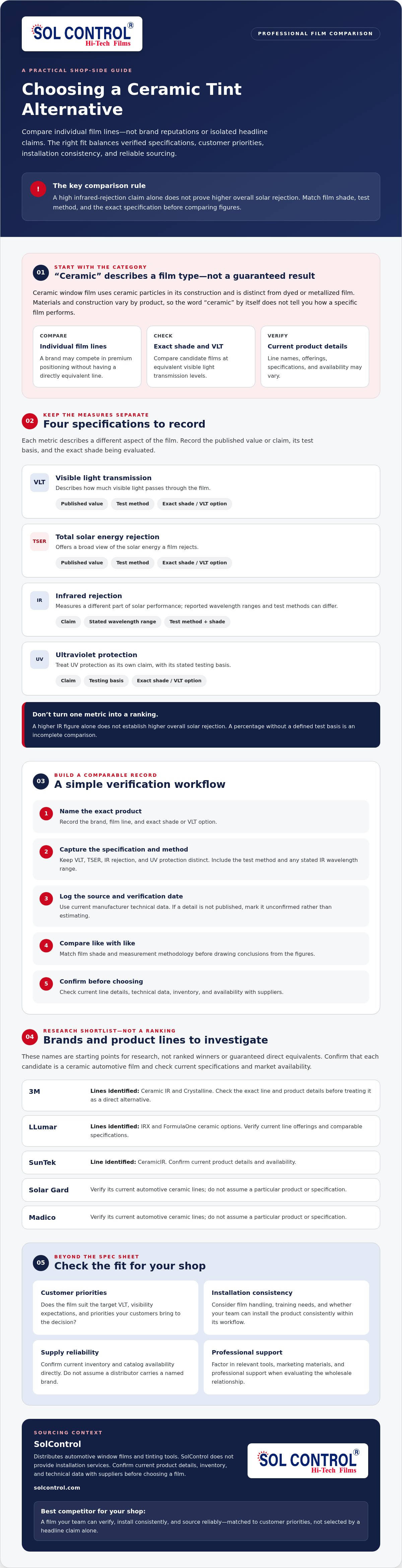
Keep the measurements separate. Visible light transmission (VLT) describes how much visible light passes through the film. Infrared rejection and total solar energy rejection (TSER) describe different aspects of solar performance, while UV protection is a separate claim. A high value in one category doesn’t establish a matching result in another. Check current manufacturer documentation for the exact specification, test method, film shade, and date. Marketing descriptions and installer or driver anecdotes can suggest questions to investigate, but they don’t replace comparable test data.
Which brands belong on a Huper Optik competitor shortlist?
Start with 3M, LLumar, SunTek, Solar Gard, and Madico as brands to investigate, not as ranked winners. Current lines identified for comparison include 3M Ceramic IR and Crystalline, LLumar IRX and FormulaOne ceramic options, and SunTek CeramicIR. Confirm that each line is a ceramic automotive film, and check current specifications and market availability before treating it as a direct alternative. Line names and offerings may vary.
Build your shortlist around customer priorities and shop requirements. Check whether each candidate matches the target VLT, has comparable published performance data, and can be sourced with the support your operation needs. Verify Solar Gard and Madico’s current automotive ceramic lines instead of assuming a particular product or specification. Don’t assume a distributor carries any named brand, either. Confirm current catalog availability directly.
How to Compare Ceramic Tint Performance Without Misreading the Specs
Start with a consistent record, not a collection of headline percentages. For every candidate film, log the exact line and shade, the specification and test method, the source document, and the date you checked it. If a manufacturer doesn’t publish a detail, mark it as unconfirmed rather than filling the gap with an estimate.
Metric
What to record
Film shade
Source and verification date
Visible light transmission (VLT)
Published value and test method
Exact shade or VLT option
Current manufacturer technical data; date checked
Total solar energy rejection (TSER)
Published value and test method
Exact shade or VLT option
Current manufacturer technical data; date checked
Infrared (IR) rejection
Claim, stated wavelength range, and test method
Exact shade or VLT option
Current manufacturer technical data; date checked
Ultraviolet (UV) protection
Claim and stated testing basis
Exact shade or VLT option
Current manufacturer technical data; date checked
Which heat-rejection figures are meaningful to compare?
TSER offers a broad view of the solar energy a film rejects. IR rejection measures a different part of performance, and manufacturers may report it using different wavelength ranges or test methods. A higher IR figure alone doesn’t establish higher overall solar rejection. Match film shade and measurement methodology before comparing figures, or the numbers may describe different conditions.
For Huper Optik ceramic tint competitors, check every brand-specific figure against current technical data for the exact film line and shade. Treat a percentage without a defined test basis as an incomplete comparison, not a definitive ranking.
How should shops assess clarity, UV claims, and signal compatibility?
VLT affects how much visible light passes through the film, so consider the driver’s visibility expectations and the vehicle application. Don’t assume two films with similar product names offer the same VLT or optical experience. Check the testing basis for UV claims before repeating a percentage to customers. Also consult product-specific guidance on compatibility with vehicle electronics and sensor systems. The U.S. Department of Energy’s discussion of advanced smart window films provides context on related window technology, but it isn’t a performance test for automotive ceramic tint.
Keep your comparison sheet with your product notes, and confirm current film availability and professional support with a supplier. Installers evaluating automotive window films and tinting tools can review SolControl’s wholesale resources as part of their sourcing check.
Huper Optik vs. 3M, LLumar, and Other Ceramic Tint Alternatives
There’s no universal winner. Treat Huper Optik, 3M, LLumar, SunTek, Solar Gard, and Madico as candidates to evaluate, not as a ranking or endorsement. Compare confirmed automotive ceramic film lines, then check what the published evidence can and can’t tell you. The reported figures below may change as manufacturers update product data. Confirm each line, shade, test method, and warranty against current official documentation before relying on the numbers.
Brand and line
Reported performance
Warranty reported
What to verify
Huper Optik Ceramic
IR rejection up to 85%; UV protection 99%
Lifetime
Exact shade, test basis, and current terms
3M Ceramic IR
IR rejection up to 97%; TSER up to 66%; UV protection 99.9%
Limited lifetime
Shade-specific data and warranty conditions
3M Crystalline
IR rejection 97%; UV protection 99.9%
Lifetime
Confirm current line classification and comparable test data
LLumar IRX
IR heat rejection up to 95%; UV protection 99%
Limited lifetime
Shade, test method, and applicable warranty terms
SunTek CeramicIR
IR heat rejection up to 86%; UV protection 99%
Lifetime
Shade-specific performance and current terms
Solar Gard and Madico
Not listed here
Not listed here
Verify current ceramic automotive lines and specifications
“Up to” figures may refer to different shades or test conditions, so they aren’t automatically like-for-like. If TSER, VLT, or a test method isn’t available for a line, mark it “not published” or “not confirmed.” Don’t estimate missing values. Industry resources such as the International Window Film Association can provide broader context, while current manufacturer documentation should anchor product-specific claims.
How do brand promises translate into shop-floor performance?
Specifications don’t show how a film fits your shop’s workflow. Review current technical guidance for handling and installation, then evaluate the material through your team’s own process. Look beyond the headline warranty term, too. Check exclusions, claim steps, and regional applicability before describing coverage to customers. Finally, weigh the evidence against customer priorities, installation experience, and confirmed supply and support. The right choice depends on your shop’s needs, not a universal brand ranking.
How Tint Shops Can Choose a Ceramic Film Brand for Their Customers
A film can look compelling on a specification sheet yet be a poor fit for a customer, your installation workflow, or your supply needs. Use the same decision process to evaluate Huper Optik ceramic tint competitors and other options before adding a line to your recommendations.
Define the customer’s priorities. Ask what matters most: heat management, glare reduction, appearance, or clarity. Discuss shade options and visibility expectations for the specific vehicle, and verify current state requirements before advising on a selection.
Compare the evidence. Review current manufacturer data for the exact film line and shade. Note the test method and source. Mark gaps as unconfirmed instead of relying on brand language or unmatched figures.
Assess installation fit. Read product-specific instructions and handling guidance, check recommended tools, and consider how familiar your staff is with the material. Identify training needs before presenting the film as a routine option.
Confirm supply and support. Ask suppliers about current availability, sample options, technical documentation, and ongoing professional support. Consider whether you can reorder the selected film as customer demand develops.
How can a shop match film options to customer priorities?
Make the trade-offs clear. A customer who wants a lighter appearance may prefer a different shade from someone who wants a darker look. Tie expectations for heat management or glare reduction to the selected film’s verified data. Don’t promise identical results across vehicles, since glazing, vehicle design, and other conditions can affect the experience. Before installation, document the chosen film line and shade, the customer’s priorities, and the expectations you discussed. To see an example of how a professional automotive protection and enhancement business presents these options to vehicle owners, check out IR Auto Solutions.
What should installers test before adding a brand?
Review installation instructions and recommended tools, then assess the film through your team’s own workflow. Consider how staff familiarity, handling requirements, and access to product guidance may affect consistency. Ask a supplier whether samples and technical documentation are available, and what professional support accompanies the product. These checks help distinguish an interesting option from a line your shop can confidently offer and source.
Use the same evaluation steps for every candidate, and confirm current availability instead of assuming a particular brand is in stock. For additional selection guidance, explore SolControl’s professional automotive window film guide and review the wholesale support relevant to your shop.
Where SolControl Fits in a Professional Ceramic Tint Sourcing Decision
Film selection is only part of a sourcing decision. Shops also need to know what’s currently available, what documentation comes with a product, and whether the supplier can support day-to-day workflow. SolControl is a U.S.-wide B2B distributor serving installers and contractors with automotive window films and professional tinting tools, along with other film categories and marketing materials. It distributes products and does not provide professional installation services.
That distinction helps set expectations. SolControl can be part of your wholesale sourcing evaluation, but don’t assume it carries Huper Optik or any specific competing brand. Confirm current brands, film lines, specifications, and availability directly before updating recommendations or making commitments to customers. A UV-blocking window film wholesale guide can also help frame supplier questions about product documentation and sourcing needs.
What should professional buyers ask a wholesale distributor?
Use a practical checklist when discussing supply. Specific answers can help you assess whether a distributor’s offering fits your operation, without relying on assumptions about inventory or support.
Which film categories and specific brands or lines are currently available?
What inventory, order requirements, and technical documentation apply to the products under consideration?
What lead times should the shop plan for, and how should ongoing availability be confirmed before promising a product to a customer?
How might professional tinting tools and marketing materials support installation workflow and customer education?
Ask for current information rather than treating an earlier catalog or conversation as a guarantee of future availability. Record what you’ve confirmed, including the date, product details, and any supply conditions relevant to repeat orders.
What are the next steps for comparing film and supply options?
Keep the process consistent: shortlist candidate films using verified technical data, compare them against customer priorities, then confirm sourcing details before changing shop recommendations. If specifications, line names, or stock status are unclear, pause and verify them with the manufacturer or distributor. A sound decision relies on both product evidence and realistic supply planning.
SolControl supports professional buyers with wholesale product categories that include automotive window films, tinting tools, and marketing materials. Qualified trade buyers can explore SolControl’s wholesale offerings and confirm current product details, availability, and support directly.
Make Your Next Film Decision With Confidence
The strongest choice among Huper Optik ceramic tint competitors isn’t determined by a headline claim. Compare current manufacturer data at matching shades and test methods, then consider how each film fits customer priorities and your team’s installation workflow. Before recommending a line, verify product details and supply directly with the manufacturer or distributor.
A sound sourcing decision also looks beyond the film roll. SolControl is a U.S.-wide wholesale distributor serving professional clients with automotive and architectural window films, paint protection films, windshield protection film, and professional tinting tools. It’s a distribution partner, not an installation service. Buyers should confirm current brand availability and product specifications.
Who are the main competitors to Huper Optik ceramic tint?
Brands worth evaluating include 3M, LLumar, SunTek, Solar Gard, and Madico. Compare specific automotive film lines, not entire brands. Examples identified for research include 3M Ceramic IR, LLumar IRX, and SunTek CeramicIR. Confirm each line’s current ceramic classification, availability, shade options, and technical documentation with the manufacturer. These brands are candidates for evaluation, not a ranking of quality or suitability.
Is Huper Optik ceramic tint better than 3M or LLumar?
There isn’t one universally better brand for every shop or customer. A fair assessment compares exact film lines at equivalent shades, using comparable test methods for solar performance, visible light transmission, and UV claims. Then weigh installation fit, warranty terms, product support, and supply. The Huper Optik ceramic tint competitors that make sense for your shop depend on verified product evidence and customer priorities, not a brand name alone.
What should installers compare when choosing ceramic window film?
Compare the exact film line, shade or VLT, TSER, IR and UV claims, and the test basis for each published figure. Also review installation instructions, handling guidance, recommended tools, warranty exclusions and claim steps, and current product availability. Record the source and date for each specification. If a manufacturer doesn’t publish a comparable value, mark it unavailable rather than estimating or treating a marketing phrase as test data.
Does ceramic tint block more heat than carbon tint?
Not necessarily. A material label alone doesn’t establish how much solar energy a specific film rejects. Performance depends on the product’s construction, shade, and test method, so compare current manufacturer data for ceramic and carbon films at similar VLT levels. TSER can help assess total solar energy rejection, while an IR figure describes a different measure. Avoid promising that one category will always outperform the other without comparable evidence.
Can ceramic window tint interfere with vehicle electronics or signals?
Some ceramic films are designed to avoid the signal interference associated with certain metallized films, but don’t assume every product or vehicle setup behaves identically. Check the manufacturer’s guidance for the exact film and ask about compatibility with the vehicle’s electronics, antennas, sensors, GPS, and toll transponders. If a customer relies on a specific device, identify it before choosing a film and confirm any product-specific limitations.
How can a tint shop verify ceramic film performance claims?
Request current technical data from the manufacturer for the exact product line and shade. Check the test method, VLT, and basis for TSER, IR rejection, and UV claims, then compare only equivalent configurations. Record the document source and the date you verified it. If information is missing or unclear, ask the manufacturer or supplier for clarification. Installer anecdotes can flag questions, but they don’t replace documented, comparable performance data.
Does SolControl install Huper Optik ceramic tint?
No. SolControl is a wholesale distributor serving installers and contractors across the United States, not a professional installation service. It supplies product categories that include automotive and architectural window films, paint protection films, windshield protection film, professional tinting tools, and marketing materials. SolControl’s current information does not confirm that it carries Huper Optik, so professional buyers should contact the company directly to verify current brands, specifications, and availability.