The Professional Guide to Carbon Tint: Performance, Benefits, and Wholesale Value
The most expensive film in your shop isn't the one with the highest wholesale price; it's the cheap dyed roll that results in a purple-shifting warranty claim six months later. In 2026, professional shops are increasingly moving away from entry-level films that fail and metallic options that block GPS signals. Instead, carbon tint has become the essential mid-range workhorse, offering color stability and reliable heat rejection without the premium cost of nano-ceramic technology.
We know you're looking for ways to increase your margins while keeping your customers happy with high-quality results. This guide promises to give you the technical knowledge and sales strategies needed to master the mid-range market. You'll learn the exact composition of carbon films, how they compare to ceramic alternatives, and how to effectively upsell clients who want performance on a budget. We will also cover the logistics of sourcing bulk rolls to ensure your shop stays stocked with the industry's most versatile film, helping you balance performance with your bottom line.
Key Takeaways
Understand the multi-layered technology of carbon tint and why its non-reflective finish is superior to metallic films for signal clarity.
Learn to position carbon film as the ideal mid-tier solution for customers who need better heat rejection than dyed films without the ceramic price tag.
Master the use of Total Solar Energy Rejection (TSER) metrics to demonstrate value and justify higher margins to your clients.
Identify the essential tools and heat-shrinking techniques required for a professional finish on complex, curved rear windows.
Discover how to optimize your shop's inventory by sourcing bulk rolls at wholesale prices from a dedicated national distributor.
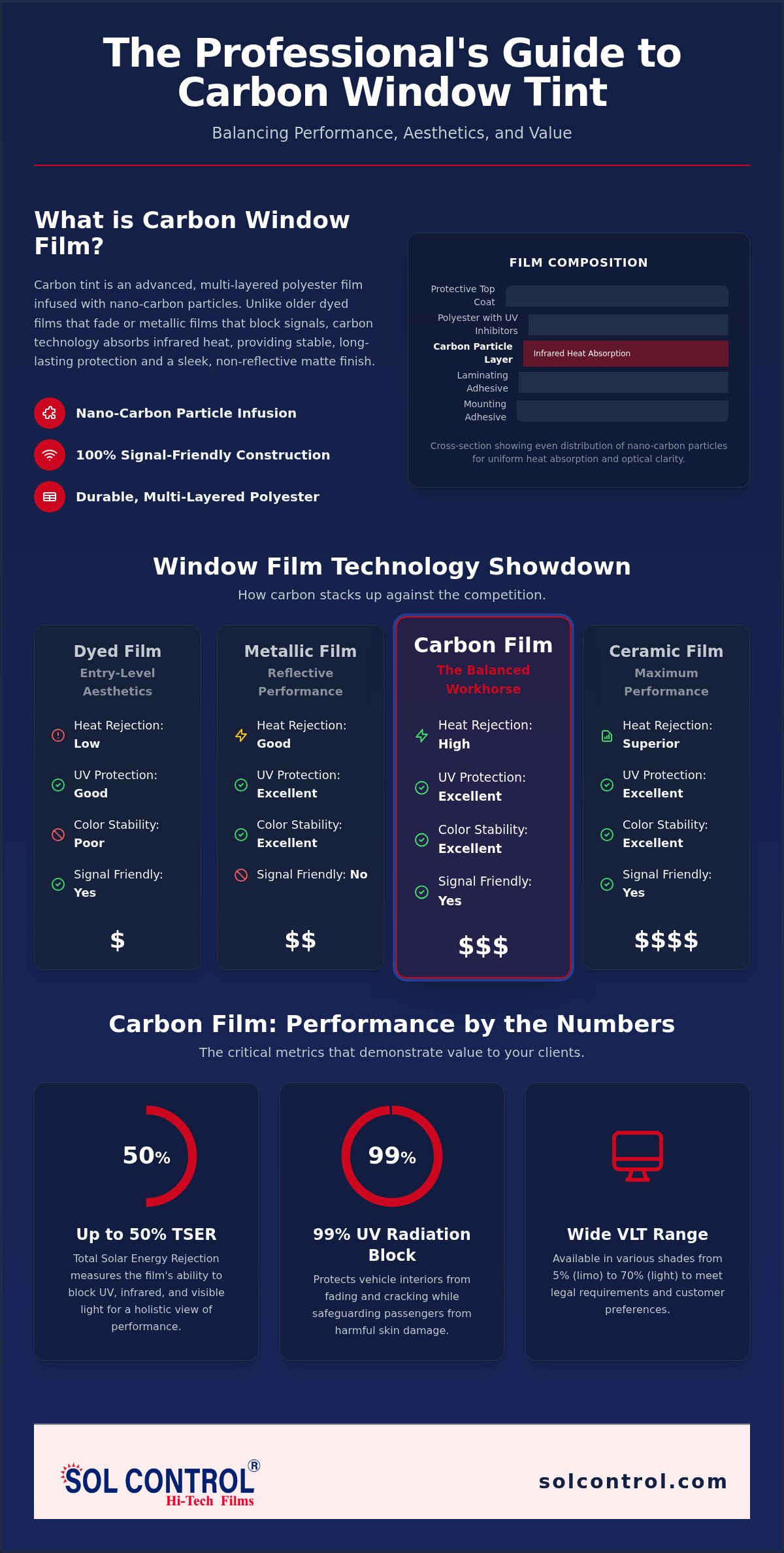
Carbon tint represents a significant leap in window film technology, specifically designed to bridge the gap between basic aesthetics and high-end performance. At its core, this material is a multi-layered polyester film that incorporates nano-carbon particles throughout its structure. Unlike older technologies that rely on unstable dyes, carbon film utilizes these particles to provide both shade and thermal protection. This construction ensures the film remains non-reflective, avoiding the mirror-like appearance often associated with metallic window films. It provides a clean, factory look that doesn't scream for attention but delivers substantial functional benefits.
The Composition of Carbon-Infused Film
The manufacturing process involves suspending microscopic carbon particles within the polyester layers rather than applying a surface coating. These particles are engineered to absorb infrared radiation, effectively trapping heat before it penetrates the vehicle's interior. High-quality automotive film rolls utilize advanced layering techniques to ensure these particles are distributed evenly, which prevents "hot spots" and ensures uniform visibility across the entire pane. Carbon-infused polyester is the durable, long-term alternative to traditional dyed films that rely on organic pigments. By using inorganic carbon, the film maintains its structural integrity even under constant exposure to intense UV radiation. This molecular stability is what allows the film to reject heat effectively year after year without losing its protective properties.
Aesthetics: The Signature Matte Finish
Modern vehicle owners typically prefer a sleek, understated look. Carbon tint delivers a deep black or charcoal appearance that complements contemporary automotive paint finishes. While metallic films often look shiny or industrial, carbon provides a sophisticated matte finish that enhances privacy without drawing unwanted attention. This aesthetic consistency is a major selling point for professional shops that want to avoid customer complaints about mismatched windows or fading. Because carbon is inherently color-stable, it doesn't fade or shift toward a purple hue over time. Your customers can expect the same rich tone on day 1,000 as they saw on day one, which is vital for maintaining the vehicle's resale value and professional appearance.
Electronic connectivity is a non-negotiable requirement for today's drivers. Because carbon films contain zero metal, they are completely signal-friendly. This means your customers won't experience interference with GPS, cellular signals, or satellite radio. It's a reliable solution that addresses the common frustrations of signal-blocking metallic films while providing the longevity that dyed films simply can't match. Choosing a high-quality carbon tint ensures a professional result that stands up to the rigors of daily driving and keeps the driver connected to the world around them.
Key Performance Metrics of Carbon Window Film
When evaluating a film's quality, Total Solar Energy Rejection (TSER) is the most critical metric. Many shops focus solely on heat, but TSER provides a holistic view of performance by measuring the rejection of UV rays, infrared radiation, and visible light. High-performance carbon tint typically offers a TSER between 35% and 50%, depending on the darkness of the shade. This metric is far more accurate than simple "heat rejection" claims because it accounts for the entire solar spectrum. By understanding TSER, installers can better explain to customers why a specific film is superior to a basic dyed alternative.
Beyond heat, protection from ultraviolet rays is a non-negotiable standard in 2026. Professional carbon films block 99% of harmful UV radiation, which prevents interior upholstery from cracking and protects passengers from skin damage. According to the International Window Film Association, this level of protection is essential for long-term vehicle maintenance and occupant health. You'll also need to consider Visible Light Transmission (VLT). Carbon films are available in a wide range of VLT percentages, from a dark 5% "limo" tint to a lighter 50% or 70% film. This variety allows shops to meet strict state legal requirements while still providing the performance benefits their customers demand.
Infrared Heat Absorption vs. Reflection
Carbon particles function differently than the ceramic particles found in premium films. While ceramic reflects IR radiation, carbon particles are designed to absorb it. Modern nano-carbon technology utilizes particles significantly smaller than traditional carbon films. These smaller particles allow for greater heat absorption density without sacrificing optical clarity. This technology effectively traps solar energy within the film itself, preventing it from radiating into the cabin. This absorption creates a noticeable cooling effect during peak summer months. By managing the IR spectrum, carbon films reduce the load on a vehicle's air conditioning system, improving fuel efficiency and passenger comfort.
Durability and Warranty Expectations
One reason carbon has become an industry staple is its resilience. It sits at a mid-grade price point but offers high-grade durability that rivals more expensive options. Because it doesn't contain metal or unstable organic dyes, it's naturally resistant to bubbling, peeling, and delamination. Most professional-grade rolls come with a 5-year to lifetime warranty, giving installers peace of mind. If you want to offer your clients this level of reliability, you can stock up on wholesale automotive film rolls that deliver consistent performance across every installation. This stability ensures that your shop spends less time on warranty re-dos and more time on profitable new jobs.
Carbon vs. Ceramic vs. Dyed: The Professional Comparison
Success in the window film industry requires a balanced inventory. Most shops categorize their offerings into three distinct tiers: dyed film for entry-level budgets, carbon tint for mid-range performance, and ceramic for premium protection. While dyed films typically offer a Total Solar Energy Rejection (TSER) of only 20% to 30%, ceramic films can push past 60%. Carbon film sits comfortably in the middle, delivering a TSER of 35% to 50%. For wholesale buyers, the price gap between carbon and ceramic rolls is significant, often allowing you to offer a high-performance product without the steep overhead of premium ceramic inventory.
Why Carbon Wins Over Dyed Film
Installing entry-level dyed film carries a high risk to your professional reputation. These films rely on organic dyes that inevitably break down, leading to the dreaded purple-shifting and bubbling that triggers warranty claims. Carbon film is inherently color-stable because it uses inorganic carbon particles to provide shade. According to the International Window Film Association, high-quality films provide consistent solar control and UV protection, which dyed films struggle to maintain over time. For a marginal increase in wholesale cost, carbon film eliminates the risk of fading. This makes it the most effective "upsell" in your shop. You can confidently promise a lifetime of color consistency for just a small step up in price.
Carbon vs. Ceramic: When to Choose Which?
Ceramic film remains the king of heat rejection. It's the necessary choice for clients in extreme desert climates or those driving luxury vehicles with massive glass surface areas. However, carbon tint provides approximately 70% to 80% of the performance of ceramic at a much lower price point. It's the ideal solution for the average daily driver who wants a cool cabin and a matte finish without spending premium rates. When a customer is hesitant about the cost of ceramic, carbon acts as the perfect middle ground. You provide them with a signal-friendly, durable product while maintaining a healthy profit margin. This strategy ensures you don't lose a sale to a competitor who only offers "cheap" or "expensive" options.
Technical Installation and Shop Inventory Planning
Carbon tint is known for its forgiving nature during the installation process, making it a favorite for high-volume shops. Its heat-shrink properties are particularly impressive when dealing with the complex curvatures of modern rear windows. Unlike some ceramic films that can be rigid or dyed films that melt too quickly, carbon strikes a reliable balance. It responds predictably to heat, allowing for a tight, bubble-free fit that stays put once the mounting solution is squeegeed out. This predictability reduces the time spent on every vehicle, allowing your team to increase their daily output without sacrificing quality.
Handling and Shrinking Carbon Film
When handling carbon film, you'll notice a distinct "tack" or adhesive feel. This initial grab is firm enough to hold the film in place during positioning but remains adjustable for several minutes. To avoid creases during the heat-shrinking process, it's best to use a dry-shrink method. Keep your heat gun moving constantly to ensure uniform shrinkage across the entire surface. This technique prevents the material from overheating in one spot, which is a common cause of failure in lower-quality films.
Precision is everything in a professional shop. You should always use sharp snap-off blades for every cut to prevent jagged edges or accidental tearing. High-quality squeegees are also essential to evacuate all mounting solution without scratching the carbon surface. To ensure your team has everything they need for a flawless result, check out our professional tinting tools designed specifically for high-performance films. Using the right equipment reduces physical strain on the installer and ensures the long-term durability of the bond.
Optimizing Your Wholesale Inventory
Effective inventory planning is what separates profitable shops from those that struggle with overhead. Calculating the ROI of a 100ft carbon roll is straightforward; you can typically tint 12 to 15 full sedans per roll. While pre-cut kits might seem convenient for beginners, buying bulk rolls offers much higher margins and the flexibility to handle custom glass sizes or oversized windows. It also allows you to quickly fix an error without waiting for a new kit to arrive in the mail.
To minimize waste, your shop should stock a variety of roll widths. Having 20", 36", and 40" rolls on hand ensures you aren't cutting down a 40" roll for a small side window. You'll also want to prioritize high-turnover VLT percentages to keep your cash flow moving. In most markets, stocking 5%, 20%, and 35% covers the majority of customer requests and helps you stay within legal limits for front-side windows. By focusing on these core sizes and shades, you reduce dead stock and keep your installation bays moving efficiently. If you're ready to upgrade your shop's offerings, you can source wholesale automotive film rolls in the most popular widths and VLTs to maximize your quarterly profits.
Sourcing Quality Carbon Tint: The SolControl Advantage
Choosing a high-performance film is only the first step in building a successful shop. To maintain healthy margins, you need a distribution partner that understands the specific needs of professional installers. SolControl has established itself as the premier national distributor for those who demand consistency and professional-grade standards. We operate as a silent partner to your business, providing the inventory you need without ever competing with you for installation jobs. This B2B focus ensures that our resources are entirely dedicated to supporting your growth through competitive wholesale pricing and reliable logistics.
Reliability is the backbone of any high-volume shop. We provide US-wide shipping for our entire inventory, ensuring that your bulk automotive film rolls arrive on time regardless of your location. In the fast-paced market of 2026, waiting for backordered stock is not an option. We maintain a comprehensive inventory of carbon tint in widths ranging from 20" to 60", allowing you to fulfill any customer request immediately. Beyond the film itself, we offer professional marketing materials designed to help you communicate the benefits of carbon technology to your clients. These tools make it easier to explain TSER and UV rejection, turning technical specs into closed sales.
Wholesale Solutions for Growing Tint Shops
As your business scales, your inventory needs become more complex. SolControl supports high-volume contractors by offering consistent stock levels that prevent project delays. We understand that your reputation depends on the quality of the materials you use. That's why we only distribute films that meet rigorous industry standards for color stability and adhesive strength. We invite professional installers to create a wholesale account to access exclusive pricing structures and streamlined ordering. This partnership allows you to focus on the craft of installation while we handle the complexities of global sourcing and national distribution.
Beyond Film: The Complete Installer Kit
Efficiency in a modern shop often comes down to one-stop-shop convenience. While carbon rolls are a core part of your business, we also provide a full suite of protection products to increase your average ticket size. Our inventory includes high-quality Paint Protection Film (PPF), windshield protection, and architectural window films for residential or commercial projects. By sourcing your films and professional tools from a single trusted distributor, you reduce shipping costs and simplify your accounting. Whether you are tinting a single sedan or a large commercial office building, we have the specialized materials required for a flawless result. You can browse our full catalog of carbon tint rolls and professional accessories to see how we can support your shop's specific needs this year.
Elevate Your Shop’s Performance with Professional Carbon Solutions
Success in the competitive window film market of 2026 requires a commitment to materials that deliver long-term value. By integrating carbon tint into your standard offerings, you provide a high-performance, signal-friendly solution that consistently outperforms entry-level dyed films. This strategic choice not only enhances your shop's reputation for quality but also minimizes the risk of costly warranty re-dos. Efficient inventory management, supported by a variety of roll widths and VLT percentages, ensures your installation bays remain productive and profitable year-round.
SolControl is dedicated to serving as your silent partner in growth. We offer national US distribution, exclusive wholesale pricing, and a comprehensive selection of professional-grade tools and films to help your business thrive. Whether you're stocking up on bulk rolls or upgrading your installation equipment, we provide the reliable support you need to lead the market. Take the next step in optimizing your business today. Shop Wholesale Carbon Tint Rolls at SolControl and experience the advantage of working with a distributor that values your success as much as you do. We look forward to helping you reach your next milestone.
Frequently Asked Questions
Does carbon tint interfere with GPS or mobile phone signals?
No, carbon tint is completely signal-friendly because it contains zero metal particles. This ensures that GPS, cellular signals, and satellite radio function perfectly without interference. Drivers in 2026 rely heavily on mobile connectivity and navigation. Choosing a non-metallic film prevents the common connectivity issues associated with older metallic films, making it a reliable choice for modern vehicles equipped with advanced electronics.
How long does carbon window film typically last?
Professional-grade carbon film is designed for long-term durability, often lasting five years to the lifetime of the vehicle when installed correctly. Because the carbon particles are inorganic, they don't break down like organic dyes. This stability prevents common failures such as bubbling or peeling. High-quality rolls from a reputable distributor ensure the adhesive remains strong even under constant exposure to intense solar heat and UV radiation.
Is carbon tint better than ceramic tint for heat rejection?
While carbon offers excellent performance, ceramic tint generally provides higher Total Solar Energy Rejection (TSER). Carbon film typically rejects 35% to 50% of solar energy, whereas premium ceramic can exceed 60%. However, carbon is often the better value for customers who want significant heat rejection without the premium ceramic price. It effectively bridges the performance gap between entry-level dyed films and high-end options for daily drivers.
Will carbon tint turn purple after a few years in the sun?
No, high-quality carbon film is inherently color-stable and won't turn purple over time. The purple shift seen in cheap films is caused by the breakdown of organic dyes under UV exposure. Carbon particles are inorganic and resistant to UV degradation, ensuring the film maintains its original black or charcoal hue. This color consistency is a major selling point for shops that want to avoid warranty claims and maintain a professional reputation.
What is the best VLT percentage for carbon film in the US?
The best VLT depends entirely on your specific state laws, as regulations vary significantly across the country. Most professional shops stock 5%, 20%, and 35% VLT rolls to cover the most common customer needs. A 35% VLT is a popular choice for front-side windows where legal limits are stricter, while 5% is often preferred for rear windows. Always consult the International Window Film Association for up-to-date state-by-state regulations.
Can carbon tint be used for residential or commercial windows?
Yes, carbon technology is highly effective for architectural applications in both residential and commercial settings. It provides excellent privacy and heat reduction without the reflective, mirrored look of traditional metallic architectural films. This makes it ideal for modern buildings where a neutral, matte appearance is preferred. Using carbon-based architectural window films helps building owners reduce energy costs while protecting interior furnishings from UV-related fading and heat damage.
How does carbon film compare to metallic film in terms of appearance?
Carbon film offers a sophisticated matte finish that many vehicle owners prefer over the shiny, reflective look of metallic films. It provides a deep black or charcoal aesthetic that mimics factory privacy glass. Metallic films often have a mirrored or glittery appearance that can look dated or overly industrial. Carbon's non-reflective nature ensures a clean, understated look that enhances the vehicle's style without creating excessive glare for other drivers on the road.
What tools are required for a professional carbon tint installation?
A flawless installation requires a set of professional-grade tools designed for high-performance films. Essential items include industrial heat guns for precise shrinking, high-quality squeegees for mounting solution removal, and stainless steel snap-off blades for clean edges. You'll also need hard cards for tucking edges into gaskets and professional-grade mounting solutions. Using the right tools for carbon tint reduces the risk of creasing or scratching the film during the application process.