The Professional Guide to High Performance Automotive Film in 2026
With the global automotive film market projected to reach $13.9 billion in 2026, the pressure to deliver both high margins and elite results has never been greater. You likely find yourself caught between customers demanding maximum heat rejection and the reality of shrinking profit margins on premium ceramic lines. It’s a common struggle to find that "Goldilocks" solution; a product that offers superior cooling without the prohibitive wholesale costs of top-tier ceramics. When inconsistent film quality leads to customer returns or difficult heat-shrinking, your shop's efficiency and reputation take the hit.
We understand that your success depends on sourcing a durable, color-stable high performance automotive film that performs as well on the heat gun as it does on the road. This guide will help you master the technical specifications and business advantages of hybrid film technologies to elevate your service tier. You’ll learn how to balance heat rejection metrics like TSER with installation ease to maximize your daily output. We will break down the nuances of modern film constructions, from sputter-metalized layers to advanced UV inhibitors, ensuring you can provide a lifetime-warranty product that keeps your clients coming back.
Key Takeaways
Understand how hybrid high performance automotive film combines dyed polyester with metalized layers to provide color stability and glare reduction without a mirror finish.
Learn why Total Solar Energy Rejection (TSER) is the most critical metric for customer comfort, with high-performance films delivering significantly higher rejection than standard dyed options.
Discover how to increase your shop's net profit per job by leveraging the lower wholesale acquisition cost of hybrid films compared to premium ceramic lines.
Master professional heat-shrinking techniques tailored for metalized layers, including a technical breakdown of the dry versus wet shrink debate.
Explore the strategic advantages of a wholesale-only supply model that protects your business from direct competition while providing national access to premium inventory.
Defining High Performance Automotive Film Technology
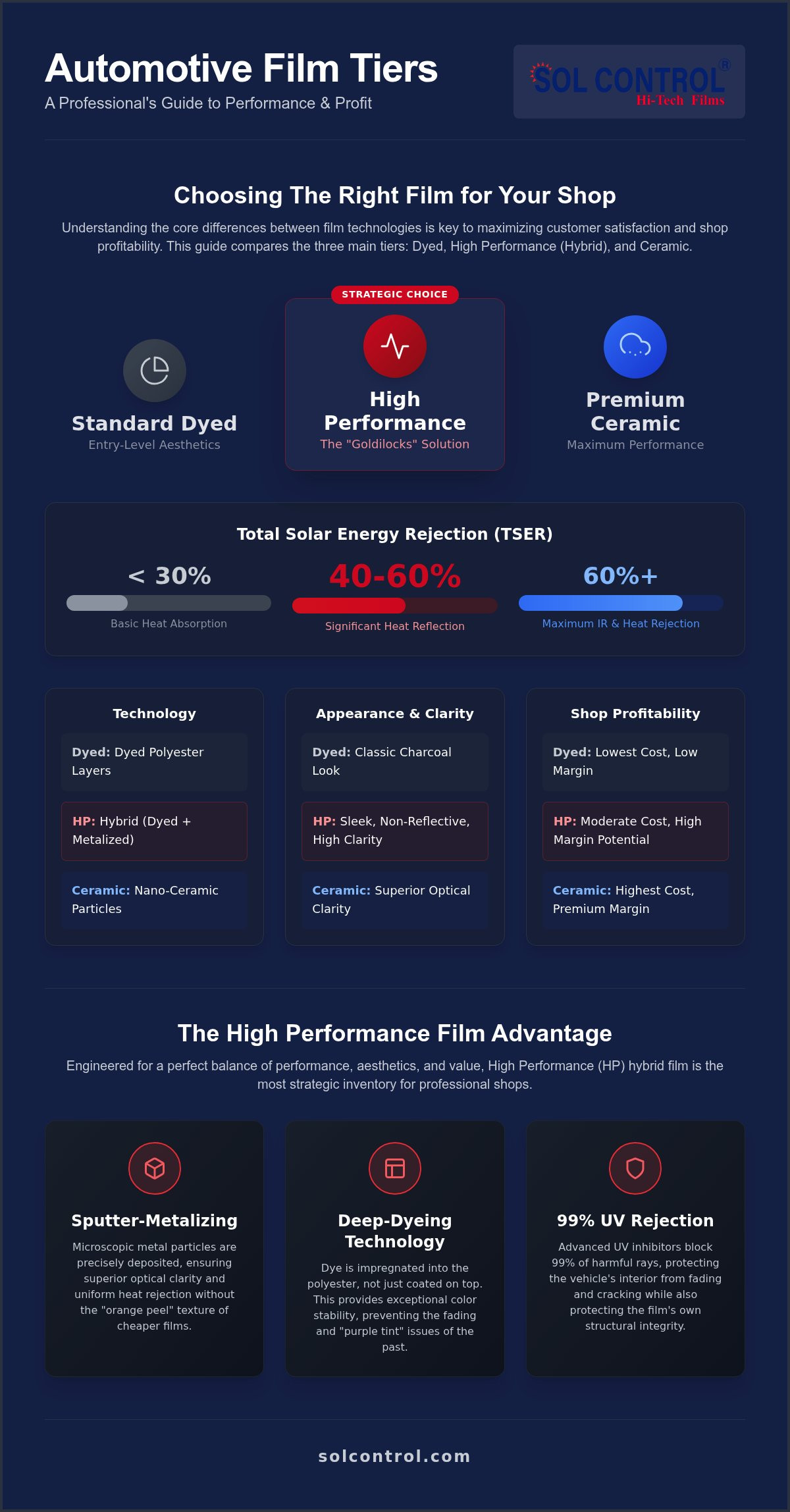
High performance automotive film isn't just a marketing label. It's a specific engineering category. In 2026, professionals use the term "Hybrid" to describe this construction. It merges a dyed polyester layer with a thin metalized layer. This combination solves the weaknesses of each material when used alone. The dyed layer absorbs light to reduce glare and provide color. Meanwhile, the metalized layer reflects heat away from the glass.
Why use both? Dyed films look great but often struggle with significant heat rejection. Metalized films reject heat well but can look like a mirror, which many customers dislike. Hybrid films give you the best of both worlds. You get the sleek, non-reflective look of a dyed film with the thermal performance of metal. It's the most balanced choice for daily drivers who want comfort without a flashy appearance.
The Sputter-Metalizing Process Explained
The metalized layer in modern HP film is created through vacuum sputtering. Unlike older evaporation methods that often resulted in uneven coating, sputtering uses a vacuum chamber to deposit microscopic metal particles onto the film base. This precision results in superior optical clarity. It ensures a uniform heat rejection profile across the entire roll, giving you consistent performance on every window you tint. Key benefits of this process include:
Optical Clarity: Sputtering avoids the "orange peel" texture found in cheaper films.
Uniform Performance: Every square inch of the film provides the same level of protection.
Heat Management: Metals like aluminum or titanium are deposited with atomic-level precision.
Color Stability and the Evolution of HP Films
Many customers still fear the "turning purple" effect seen on cheap tints from decades ago. Modern high-performance films have solved this through deep-dyeing technology. Instead of a surface coating, the dye is impregnated into the polyester itself. This prevents fading and bubbling over time. UV inhibitors are another critical component. They block 99% of harmful rays, protecting both the film's structure and the vehicle's interior surfaces.
While window films manage solar energy, many professional shops also install Paint Protection Film (PPF) to offer full-vehicle solutions. Understanding these different layers of protection helps you position your shop as a true expert in automotive care. Modern high performance automotive film maintains that classic charcoal look while adding technical performance that standard dyed rolls simply can't match. It's an essential inventory item for any shop looking to provide long-term value to their clients.
TSER and Performance Metrics: Comparing HP to Other Tints
Understanding performance metrics separates a professional installer from a hobbyist. Total Solar Energy Rejection (TSER) is the primary metric you should use to communicate value to your customers. It's a comprehensive measurement that accounts for visible light, ultraviolet rays, and infrared radiation. While a standard dyed film might offer a TSER below 30%, a high performance automotive film typically achieves between 40% and 60% rejection. This significant leap in performance occurs because the metalized layer reflects heat away from the cabin rather than simply absorbing it into the glass.
Infrared rejection (IRR) is another critical factor. The microscopic metal particles in a hybrid film act as a thermal shield. This allows the film to block the heat you feel on your skin without needing to be excessively dark. It's the ideal balance for clients who want maximum comfort without the "limo tint" look. If you're looking to upgrade your shop's offerings, you can browse our full range of high-performance window films to find the perfect spec for your market.
Dyed vs. High Performance vs. Ceramic
Choosing the right inventory requires understanding the three main tiers of film technology. Dyed films are your entry-level option. They're focused on aesthetics and glare reduction but offer the lowest heat rejection. High performance films represent the mid-tier "Goldilocks" solution. They use hybrid technology to provide excellent heat rejection and high durability at a manageable price point. Ceramic films sit at the premium tier. They're non-conductive and offer the highest TSER, but they come with a much higher wholesale cost that isn't always necessary for every customer's budget.
Understanding VLT and Legal Compliance
Visible Light Transmission (VLT) determines the darkness of the tint. A common misconception is that a darker film always rejects more heat. With hybrid films, the metalized layer does the heavy lifting. This means a 50% VLT high-performance film can often outperform a 5% VLT dyed film in thermal rejection. Shops must carry a wide range of shades, typically from 5% to 50%, to meet varying customer preferences and state laws.
Compliance is a serious responsibility for any professional shop. You should always refer to the NHTSA guidance on window tinting regarding federal standards and the "render inoperative" provision. Using a calibrated tint meter after every installation is the only way to verify the final VLT. Remember that factory glass often has a slight tint already. Adding a 35% film to a window that is already at 75% VLT will result in a final reading that could be lower than the legal limit in your area.
Why High Performance Film is a Shop’s Most Strategic Inventory
Successful shop owners know that inventory selection is a financial decision, not just a technical one. While basic dyed films are affordable, they often lead to dissatisfied customers who return when the film fades. On the other end, premium ceramic options have high wholesale costs that can squeeze your margins. This is where high performance automotive film becomes your most strategic asset. It offers the ideal balance for both the installer and the vehicle owner by delivering significant heat rejection at a price point that supports healthy business growth.
Lower wholesale acquisition costs compared to ceramic films mean you can increase your net profit per job. You aren't just selling a product; you're selling a solution that fits the majority of your clients' budgets. Most drivers want more than basic aesthetics but aren't ready to pay the premium for nano-ceramic technology. By stocking HP film as your primary offering, you capture the widest part of the market while maintaining a higher margin than entry-level jobs allow. If you're ready to optimize your inventory, you can find wholesale high-performance film rolls that protect your bottom line.
Tiered Pricing Strategies for Tint Shops
Positioning is everything in a service environment. You should present a three-tier menu where high performance automotive film is the "Best Value" or "Professional Choice." This middle tier is where most customers naturally land. To prove the value, use a heat-box demonstration. When a customer feels the immediate difference in solar rejection between a standard dyed sample and an HP hybrid sample, the upsell happens naturally. We recommend stocking HP charcoal in bulk rolls. It's the most versatile color for matching factory glass, ensuring you're always ready for the next vehicle in the bay.
Reducing Comebacks with Color-Stable Technology
A re-tint is the most expensive job you'll ever do. It costs you labor and material while preventing you from taking a new, paying customer. Cheap films are more expensive in the long run because of these potential failures. Modern HP films utilize advanced adhesive systems and deep-dyeing processes to prevent bubbling, peeling, and the dreaded purple fade. When you install a film with a proven record of color stability, you can market a "Lifetime Warranty" with confidence. This builds long-term trust with high-end clients and ensures your reputation remains spotless in a competitive market. Leading service providers like performanceautogroupllc.com demonstrate how combining these technical standards with expert installation creates a premium experience for every vehicle owner.
Professional Installation and Heat Shrinking Best Practices
Installing high performance automotive film requires a more disciplined approach than working with basic dyed products. The metalized layer within hybrid films acts as a thermal conductor, meaning the film absorbs and distributes heat differently than pure polyester. If you apply too much heat too quickly, you risk "ghosting" the sputter-metalized layer. This occurs when the microscopic metal particles are disturbed, creating a permanent haze. To avoid this, you must maintain constant motion with your heat gun and keep a safe distance from the glass surface.
The debate between "dry shrink" and "wet shrink" techniques is particularly relevant for hybrid films. Most professional installers prefer the dry shrink method for complex rear windows. By using a dryer sheet or talc as a barrier, the film can slide more freely over the glass during the shrinking process. This reduces the tension on the metalized structure and prevents the "fingers" from bunching or creasing. If you've primarily worked with dyed films, you'll find that hybrid films require a lighter touch and more patience to achieve a seamless finish.
Mastering the Heat Gun with Metalized Films
Optimal heat management is the secret to a perfect install. Metalized layers react faster to temperature changes than standard polyester, so you should start with a lower heat setting and gradually increase it as needed. If you're working on compound rear windows, focus on shrinking the film in small sections rather than tackling the entire glass at once. This prevents the edges from curling or lifting before the center is set.
Snap-shrinking is a high-speed technique where the installer uses intense, localized heat to quickly collapse a finger, allowing for rapid processing of side windows. While efficient for high-output shops, it requires precise timing to avoid burning the top coat. Always test the film's reaction on a scrap piece if you're switching to a new high performance automotive film supplier to understand its specific thermal limits.
The Importance of Professional-Grade Tinting Tools
Your choice of tools is just as critical as your film selection. A standard squeegee often lacks the rigidity needed to push out the thicker adhesive sets found in high-performance products. Using specialized tools like the Fusion series allows for edge-to-edge precision and consistent pressure. You also need to select hard cards with a smooth finish to avoid scratching the scratch-resistant coating during the final tuck.
A clean environment is mandatory. Because sputtered films are so optically clear, even the smallest speck of dust will be magnified once the adhesive cures. Maintaining a pressurized spray bottle and a dedicated "clean zone" for peeling the liner will prevent contamination bubbles. Equip your shop with professional-grade tinting tools to ensure every high-performance roll is installed with the precision your customers expect.
Sourcing Premium Automotive Film: The SolControl Advantage
Choosing a supplier is as critical as choosing the film itself. Many distributors operate their own installation bays, effectively competing with the very shops they supply. SolControl operates on a strict "Wholesale Only" model. This ensures we never compete with our customers for installation jobs. Our dedication to B2B supply means your growth is our only priority. By sourcing your high performance automotive film from a dedicated wholesaler, you protect your local market share while gaining access to professional-grade inventory.
We maintain a comprehensive inventory designed to meet every shop's needs. This includes high-volume bulk rolls of color-stable films and specialized products like windshield protection film. Our sputter-metalized layers provide the consistency you need to maintain a high service tier. When every roll performs exactly like the last, you reduce waste and improve your installation speed. This reliability is what allows you to offer long-term warranties that build customer trust with every vehicle that leaves your bay.
Streamlining Your Supply Chain with National Distribution
Managing multiple vendors for film, tools, and paint protection film is inefficient. SolControl simplifies your operations by acting as a single-source supplier for your entire shop. With national distribution across the United States, we ensure you receive your rolls exactly when you need them. This logistical reliability prevents downtime and allows you to keep your schedule full. Consistency is the hallmark of our supply chain. Every shipment of automotive film undergoes rigorous quality checks to ensure it meets industry standards for clarity and heat rejection.
Beyond Film: Professional Tools and Marketing Support
A high-performance shop needs more than just high-performance film. You need the right technology to install it perfectly every time. We provide access to the latest tinting tools, from precision squeegees to advanced heat guns. This ensures your team has the equipment necessary to handle the unique thermal properties of hybrid films. Beyond the bay, we provide marketing materials that help you educate your clients. These resources make it easy to explain complex metrics like TSER and UV protection, turning a simple inquiry into a high-value sale.
Success in 2026 requires a focus on both technical precision and business efficiency. High performance automotive film provides the ideal middle ground for your inventory, offering elite heat rejection at a price point that protects your profit margins. By mastering the installation nuances of sputter-metalized layers and using TSER to educate your clients, you establish your shop as a premium destination. Reliability is built on the quality of your materials and the strength of your partnerships.
SolControl is here to be that partner. As a wholesale-only distributor, we don't compete with your shop; we empower it. With national US distribution for fast, reliable supply and a comprehensive range of professional tinting tools in stock, we ensure you have everything needed to succeed. Browse our wholesale inventory of high performance automotive films today to find the right solutions for your next job. We're dedicated to your success and look forward to helping you elevate your service standards.
Frequently Asked Questions
Does high performance automotive film interfere with GPS or cell signals?
Modern high performance automotive film is engineered to minimize electronic interference. While older metalized films sometimes caused issues, the microscopic sputter-metalized layers in hybrid films are designed to block heat without creating a Faraday cage effect. Most vehicles using standard GPS and cellular frequencies won't experience connectivity problems. For cars with sensitive internal antennas, ceramic options remain an alternative, but hybrid films are generally signal-friendly in 2026.
How long does high performance window film typically last?
High-performance films are designed to last for the entire lifespan of the vehicle when installed by a professional. Because they utilize deep-dyeing and sputter-metalizing processes, they're highly resistant to bubbling, peeling, and color fading. Most professional shops offer a lifetime warranty on these products. The advanced adhesive systems and UV inhibitors ensure the film can withstand extreme thermal cycling and intense sun exposure for over a decade.
What is the difference between high performance and standard charcoal tint?
Standard charcoal tint is typically a basic dyed film that focuses on aesthetics and glare reduction. In contrast, high-performance film is a hybrid construction that adds a metalized layer to the dyed polyester. This addition significantly increases heat rejection capabilities. While both may look similar from the outside, the high-performance version provides superior thermal comfort and better long-term color stability than its entry-level dyed counterparts.
Can I install high performance film on a vehicle with a rear window defroster?
Yes, you can safely install high-performance film over rear window defroster lines. The adhesive is engineered to bond around the raised heating elements without failing or peeling. Installers must be careful during the heat-shrinking and squeegeeing phases to avoid damaging the grid. Using a professional-grade hard card ensures the film tucks tightly against the lines. This prevents the "white lines" or air pockets that can sometimes form.
Is high performance film more difficult to heat shrink than dyed film?
High-performance film requires a slightly different technique because the metalized layer acts as a thermal conductor. It reacts more quickly to heat, which can lead to "ghosting" if the heat gun is held too close for too long. While it isn't necessarily more difficult, it demands better heat management and constant motion. Many installers prefer the dry shrink method for these hybrid films to ensure uniform tension across compound curves.
What does TSER stand for and why is it important for car window film?
TSER stands for Total Solar Energy Rejection. It's the most accurate metric for measuring a film's cooling performance because it accounts for ultraviolet, visible light, and infrared radiation. Unlike VLT, which only measures darkness, TSER tells the customer how much actual heat is being kept out of the cabin. High-performance films generally offer a TSER between 40% and 60%, providing a significant comfort upgrade over basic dyed rolls.
Does SolControl offer installation services for their automotive films?
SolControl does not offer installation services. We operate exclusively as a B2B wholesale distributor of window films and professional tools. This business model ensures that we never compete with our customers for installation jobs in their local markets. Our goal is to serve as a reliable supply partner. We provide the high-quality materials and professional marketing support that shops need to grow their own installation businesses.
What shades of high performance film are most popular for professional shops?
The most popular shades for professional shops are 5%, 20%, and 35% VLT. These shades allow installers to match factory privacy glass on trucks and SUVs or meet specific state legal requirements for front side windows. Many shops also stock 50% or 70% VLT for clients who want the heat rejection of a high performance automotive film without significantly darkening the appearance of their vehicle glass.