VLT in Window Tint: How Darkness and Visibility Change
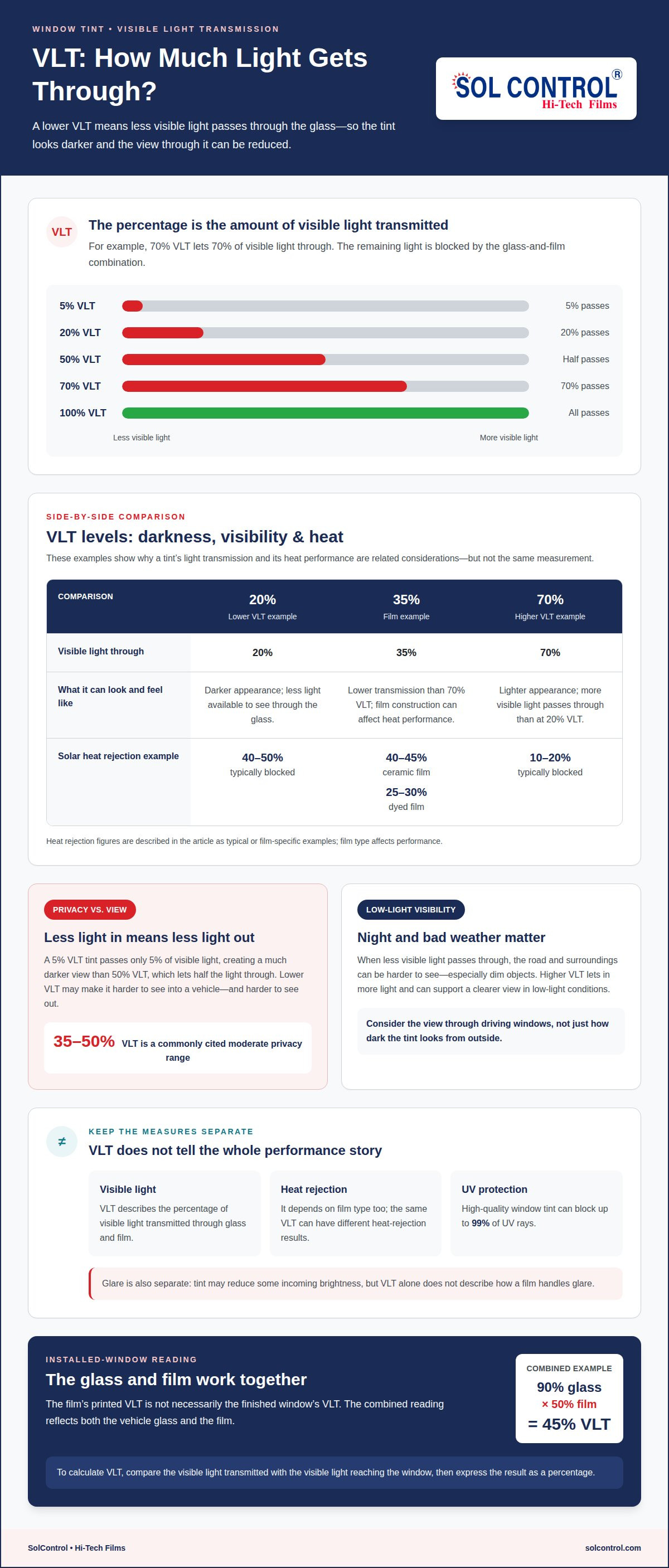
A darker-looking tint isn’t always the better choice for visibility. If you’re asking what VLT in window tint means, it’s the percentage of visible light that passes through the glass and film: 70% VLT lets 70% through, while 5% lets only 5% through. The calculation compares transmitted visible light with the light reaching the window, then expresses the result as a percentage.
That number helps you understand how dark a tint may look, but it doesn’t tell the whole story by itself. The vehicle’s glass and the film work together, so an 80% VLT window paired with 50% VLT film has an overall VLT of 40%. This guide explains how VLT is calculated, how percentages affect darkness and visibility, and how to compare tint levels for different vehicle windows. You’ll also see why the film’s VLT rating is useful when weighing privacy against a clear view through the glass.
Key Takeaways
Use the VLT percentage to compare how much visible light different tint levels let through, and anticipate how dark they may appear.
Consider visibility as well as privacy: lower-transmission films can make it harder to see outside, especially when choosing tint for driving windows.
Compare tint choices by vehicle window, since visibility needs and applicable tint rules can differ across the windshield, front side windows, and rear glass.
Look beyond darkness when assessing a film. Its performance also depends on the film itself, so VLT alone does not describe every benefit.
How VLT percentages affect tint darkness and visibility
VLT shows how much visible light passes through glass and film. A lower percentage lets in less light, making the tint look darker and reducing the view through the glass.
Tint Darkness and Visible Light
VLT measures the percentage of visible light transmitted through a window, so a lower rating generally looks darker. A 70% VLT tint lets 70% of visible light through, while 20% VLT passes 20% and blocks 80%. That difference can shape the cabin’s brightness and how clearly drivers see through the glass. Film construction also matters: a 35% VLT ceramic film may reject 40-45% of solar heat, while a dyed film at the same VLT might reject 25-30%.
Privacy and Visibility Tradeoffs
Lower VLT can make it harder to see into a vehicle, but it also reduces the light available to see out. A 5% VLT tint passes only 5% of visible light, creating a much darker view than 50% VLT, which lets half the light through. Moderate privacy tint commonly falls within 35-50% VLT. Consider the balance between privacy, cabin brightness, and clear sightlines rather than choosing darkness alone. Tint appearance from outside can also vary with lighting and the vehicle’s glass.
Night and Bad-Weather Visibility
At night or in bad weather, lower VLT can make the road and surroundings harder to see because less visible light passes through the windows. This matters especially when viewing dim objects through tinted glass. Higher VLT lets in more light, which can support a clearer view in low-light conditions. Glare is a separate factor: tint may reduce some incoming brightness, but VLT alone does not describe how a film handles glare.
Heat rejection also isn’t determined by VLT alone. A 70% VLT tint typically blocks 10-20% of solar heat, while a 20% VLT tint typically blocks 40-50%; film type affects performance. UV protection is another separate consideration. High-quality window tint can block up to 99% of UV rays, helping mitigate fading to furniture and flooring and reducing UV exposure that contributes to skin damage.
What does VLT Mean for Window Tint?
VLT is the percentage of visible light transmitted through glass and film. It describes light transmission, not every aspect of a tint’s performance.
Visible Light Transmission Meaning
Visible light transmission is the percentage of visible light that passes through a window. It matters because the rating helps compare how much daylight reaches the vehicle cabin. Clear glass generally lets more visible light through than tinted glass, while lighter tint preserves more daylight than darker tint. A window at 100% VLT transmits all visible light and has no tint.
The basic calculation divides transmitted visible light by the light reaching the window, then converts the result to a percentage. For example, if 90 units of light reach the glass and 45 pass through, the combined VLT is 50%. The glass and film contribute together, so a film’s printed rating alone may not represent the finished window’s transmission.
This distinction matters when comparing film with a completed installation. A film rated at 50% VLT applied to glass rated at 90% produces a combined reading of 45%, using the multiplication method. That result describes the glass-and-film combination, not the film by itself. VLT also measures visible light only; it doesn’t directly state heat rejection or UV protection.
Tint Meter Measurements
A tint meter measures visible light passing through glass to estimate the window’s VLT. Professional-grade meters assess visible-light wavelengths from 380 to 780 nanometers. This measurement helps distinguish a film’s nominal rating from the transmission of the finished glass-and-film combination.
For a reading, the meter’s components are positioned on opposite sides of the window, allowing the instrument to evaluate transmitted light. High-quality tint meters are described as accurate to within ±2-3% of true VLT values. That tolerance means readings may vary slightly, so the displayed percentage is a measurement rather than an exact description of every lighting condition.
For instance, a meter reading near 60% indicates that roughly 60% of measured visible light passes through the window. The result can differ from the film’s standalone specification because the vehicle glass also affects transmission. Comparing the meter reading with a film rating therefore requires distinguishing the installed window’s combined VLT from the film’s individual VLT.
VLT recommendations by vehicle window
U.S. tint rules and practical VLT choices depend on the window, vehicle, and state. A film’s rating alone may not determine the finished window’s measured transmission.
No single VLT percentage makes car tint legal in every U.S. state. Rules differ by window, and enforcement may measure the combined VLT of factory glass and film.
For example, California allows 70% VLT or darker on front side windows. It permits any VLT percentage on rear side windows and rear windshields. California also permits non-reflective windshield tint on the upper six inches, while requiring more than 70% light transmission below that area.
Front, rear, and windshield requirements can differ within the same state. Some northeastern states require at least 50% VLT on front side windows, while California’s rules distinguish front side glass from rear glass and the windshield. Factory tint also affects the final reading: it reduces rear-window VLT by 3-8% on most vehicles. This makes combined transmission important when evaluating a film and the glass beneath it.
For visibility, a front windshield VLT of 70% or higher is recommended to maintain an adequate driving view. Federal regulations also prevent vehicle manufacturers from reducing windshield VLT below 70%. Many jurisdictions allow a non-reflective windshield visor strip up to the AS-1 line or a specified inch measurement. Some places allow darker rear-window tint when the vehicle has dual side mirrors.
For privacy, visibility, and cabin comfort, choose a balance rather than the darkest available film. Moderate privacy tint commonly falls within 35-50% VLT, while higher transmission keeps more visible light passing through. A darker rear-window choice may suit privacy goals, but front-side and windshield decisions should prioritize a clear view and the rules for that state. Comfort also depends on the film’s heat-rejection performance, not VLT alone.
Legal VLT limits vary by state and window, so there is no single percentage that applies nationwide. California allows 70% VLT or darker on front side windows and any VLT on rear side windows and the rear windshield; some northeastern states require at least 50% VLT on front side windows.
Common tint darkness levels
Automotive window films typically range from 5% to 70% VLT. That span includes very dark films, moderate options, and lighter choices that preserve more visible light.
These ranges describe appearance, but VLT is the more useful comparison: the lower the percentage, the less visible light passes through. Common categories include:
Low VLT: 5-20%, a dark range that blocks 80%-95% of visible light.
Medium VLT: 25-40%, a middle range for comparing darker choices with lighter ones.
High VLT: 50-70%, a lighter range that allows more visible light through.
For a more specific appearance, 15-30% VLT is a typical range for darker tint. At 5% VLT, often called limo tint, only a small amount of visible light passes through. The result is a much darker window than a 50% VLT film, which sits higher on the transmission scale. These labels describe light transmission, not a universal visual standard for every vehicle.
A useful comparison is to place candidate ratings in order from lowest to highest. For example, 20% VLT is darker than 35% VLT, while 70% VLT is lighter than both. This makes it easier to compare options without relying only on names such as “medium” or “dark.” For vehicle glass, the installed window’s combined VLT can differ from the film’s standalone rating.
Color can also affect how tint looks. A green-tinted window labeled “green 45” provides an example of a shade identified by its VLT rating. The number remains a measure of visible light transmission, while the color describes a separate visual quality.
Choose a level by balancing the darkness you want with the amount of light you need through each window. Explore film options for different tint levels to compare choices for automotive applications.
SolControl: Automotive Window Films
SolControl supplies Automotive Window Films to installers and contractors choosing tint options for different vehicle windows. After comparing VLT levels with visibility needs and applicable state rules, select film suited to the intended application.
SolControl also supplies Tinting Tools for professional film work. Businesses serving customers with broader vehicle protection needs can also source Paint Protection Films. These products help trade professionals obtain film and related tools through a wholesale distributor.
Contact SolControl to discuss Automotive Window Films and Tinting Tools for your business.
Make Your Next Tint Decision with Confidence
Understanding what VLT in window tint means gives you a useful starting point, but choosing film also depends on the vehicle, intended use, and installer’s needs. Treat the VLT rating as one part of the decision, then consider how the material suits the job and the customer’s expectations.
For professionals planning their next project, SolControl offers Automotive Window Films, Architectural Window Films, and Tinting Tools. These product categories support work across vehicle and building applications, with tools available for tinting workflows. Matching the right film to each project starts with a clear understanding of its purpose and the desired outcome.
Explore the options that fit your work, then take the next step when you’re ready. Contact SolControl for tint advice and move forward with confidence.
Frequently Asked Questions
How is VLT Tint Calculated?
VLT is calculated by dividing the visible light transmitted through a window by the visible light reaching it, then expressing the result as a percentage. For installed tint, the glass and film both affect transmission. For example, glass at 80% VLT combined with film at 50% VLT produces an overall VLT of 40%. This calculation distinguishes the film rating from the finished window reading.
What does VLT mean in window tint?
VLT means visible light transmission: the share of visible light that passes through glass and film. If you’re asking what VLT in window tint means for a vehicle, it helps compare how much daylight reaches the cabin. A higher rating means more light passes through; a lower rating means less. This measurement describes visible light, not the film’s full performance.
How is window tint VLT percentage measured?
A tint meter measures the visible light passing through a window and reports a VLT percentage. For a useful reading, the meter assesses the actual glass-and-film combination rather than relying only on the film’s product rating. Professional-grade meters measure visible wavelengths from 380 to 780 nanometers. High-quality meters are described as accurate within ±2-3% of true VLT, so small reading differences can occur.
What do different window tint VLT percentages look like?
Lower VLT ratings look darker because less visible light passes through. A 5% film creates a very dark appearance, while 50% allows half of visible light through and usually looks noticeably lighter. A 70% rating is lighter still. These examples help compare transmission, but the final appearance also depends on the vehicle’s glass and the lighting around it.
Does lower VLT mean darker window tint?
Yes. Lower VLT means less visible light passes through the window, so the tint generally appears darker from inside and outside. For example, 20% VLT transmits less light than 50% VLT. That darker look can reduce how easily people see into the cabin, but it also reduces available light for viewing through the glass. Consider both effects when selecting a level.
How does VLT compare with heat rejection and UV protection?
VLT measures visible light transmission, while heat rejection and UV protection describe different aspects of film performance. A lower VLT does not automatically mean stronger performance in both areas. For example, a 35% ceramic film may reject 40-45% of solar heat, while a dyed film at the same VLT might reject 25-30%. Compare these specifications separately when evaluating a film.