Benefits of infrared rejecting film for indoor comfort
A darker window isn’t automatically a cooler one. The benefits of infrared rejecting film come from limiting solar heat gain while preserving the daylight you want, so shade alone doesn’t show how comfortable a room will feel.
Infrared-rejecting film helps limit heat entering through glass, which can make sunny spaces more comfortable and reduce reliance on air conditioning. But infrared rejection is only part of the picture: Total Solar Energy Rejected (TSER) measures a broader range of solar energy, Solar Heat Gain Coefficient (SHGC) indicates how much solar heat passes through, and Visible Light Transmission (VLT) shows how much visible light gets through. These measures help explain how film performance relates to indoor comfort. Comparing infrared rejection and TSER at your preferred VLT gives a more useful picture than relying on a single rating.
Key Takeaways
Learn how SHGC, TSER, and VLT describe different aspects of window-film performance.
Understand what to consider when choosing heat-rejection film for a home or commercial building.
Compare infrared rejection and overall solar-energy performance at the light-transmission level you prefer.
See how reducing solar heat gain can support indoor comfort, and where architectural or automotive films fit.
Solar Heat Gain Coefficient (SHGC), TSER, and Visible Light Transmission (VLT)
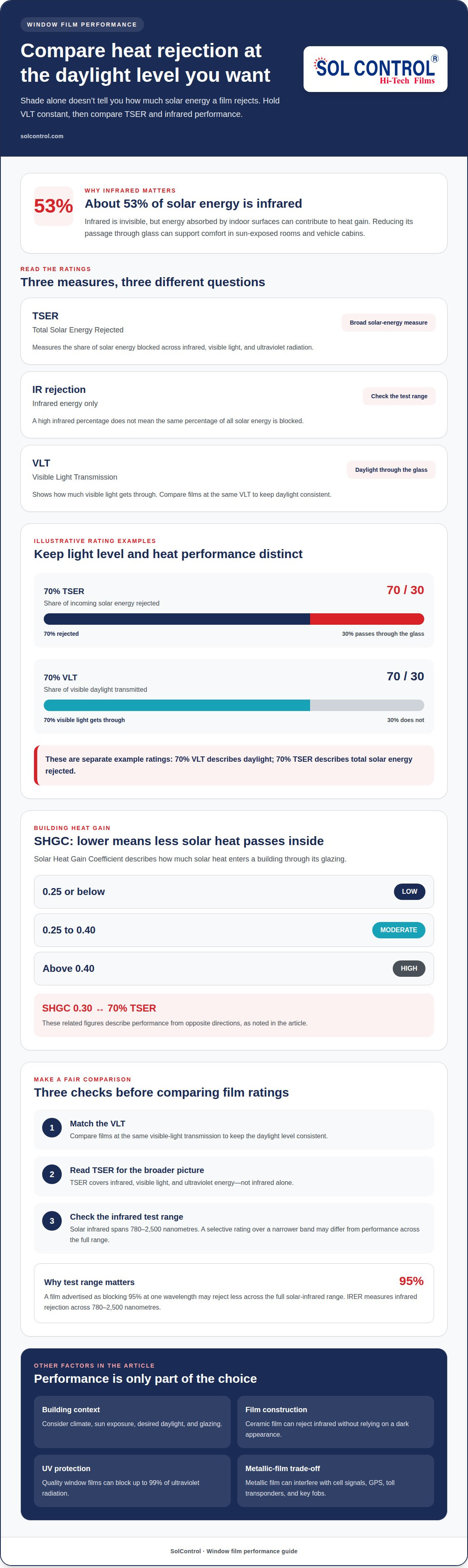
In homes and cars, infrared-rejecting film limits solar heat entering through glass, supporting comfort and cooling. Infrared radiation accounts for approximately 53% of solar energy, so reducing its passage can matter in sun-exposed rooms and vehicle cabins. Offices and retail stores can also use window film to manage heat through large glazed areas.
SHGC describes how much solar heat enters a building through its glazing. A lower SHGC means less solar heat passes inside. For example, an SHGC of 0.25 or below is categorized as low, while values from 0.25 to 0.40 are moderate. Values above 0.40 are high and may suit buildings where retaining passive solar warmth is useful. These categories help connect a window’s heat gain to a building’s climate and orientation.
TSER, or Total Solar Energy Rejected, measures the share of solar energy blocked across infrared, visible light, and ultraviolet radiation. A film with 70% TSER rejects 70% of incoming solar energy, while the remaining 30% passes through the glass. VLT measures visible light transmission: a 70% VLT film lets 70% of visible daylight through. Since visible light also carries energy, a film’s TSER can be more modest even when its infrared rejection is high.
Window film filters infrared radiation through reflection or absorption. Ceramic film can use tiny particles to block infrared rays, while some heat-rejection films absorb part of the energy and gradually release it back outside. Solar infrared radiation spans wavelengths from 780 to 2,500 nanometres. It is invisible, but energy absorbed by indoor surfaces can contribute to heat gain. In a bright office, shop, or home, reducing that energy through a window can support cooling without relying only on a darker window tint. The same principle applies to vehicle glass, though the preferred balance of daylight and heat control can differ by use.
What is heat-rejection (infrared blocking) film?
Heat-rejecting window film uses materials such as ceramic particles or metal layers to manage solar radiation passing through glass. Ceramic films are designed to reject infrared energy without relying on a dark appearance. Some films absorb part of that energy and release it back outside. The technology and test range matter: an infrared rating measured over a narrow wavelength band may differ from one covering the full solar-infrared range.
For homes and commercial buildings, consider climate, sun exposure, desired daylight, and glazing. In hot, sunny locations, a low SHGC and high TSER can help limit solar heat gain. A sun-facing office or retail window may call for stronger heat control, while a building that benefits from passive solar warmth may suit a more balanced choice. Compare VLT with heat-rejection performance instead of choosing by shade alone. Ceramic film is one option when maintaining a lighter appearance matters.
U.S. window-tint laws vary by state and can depend on the vehicle and window being tinted. Permitted visible light transmission and other requirements depend on the applicable state rules, so there is no single nationwide limit.
Infrared-rejecting film doesn’t necessarily block UV to the same degree as infrared. Quality window films can block up to 99% of ultraviolet radiation, which can help reduce fading of furnishings, carpets, and vehicle interiors.
Film lifespan depends on its construction, sunlight exposure, and installation quality; no single lifespan applies to every product. Follow the film’s care guidance and clean it gently to avoid damaging its surface.
Metallic film can interfere with cell signals, GPS, toll transponders, and key fobs. Ceramic technology avoids this specific concern associated with metallic layers.
Potential drawbacks include reduced daylight with darker film and installation problems such as bubbles or gaps, which can affect clarity and performance. Match the film to the building’s climate and desired light level, then consider architectural window films for building glazing.
Comparing IR rejection and TSER at a chosen VLT
Compare window films at the same VLT to keep daylight consistent. For example, compare two films rated at 70% VLT, then assess their heat rejection separately. IR rejection measures infrared energy, while TSER covers total solar energy across infrared, visible light, and ultraviolet radiation. A high infrared percentage alone doesn’t show how much total solar energy the film blocks.
How much heat can infrared-rejecting film block? The answer depends on the rating: TSER of 70% means the film rejects 70% of incoming solar energy, while 30% passes through the glass. An IR rejection percentage describes infrared energy only, not that same share of all solar energy. The benefits of infrared rejecting film are clearer when both ratings are considered at the VLT you want.
Check how the infrared figure was measured. Solar infrared spans 780 to 2,500 nanometres, but a selective test may report performance at a narrower wavelength. A film advertised as blocking 95% at one wavelength may reject less across the full solar-infrared range. IRER measures infrared rejection across 780 to 2,500 nanometres, making the stated test range important for a fair comparison.
SHGC offers another way to understand heat entering a building: lower values mean less solar heat gain. A SHGC of 0.30 corresponds to 70% TSER, so both figures can describe related performance from opposite directions. To compare options, hold VLT constant, review TSER as the broad heat-rejection measure, then use the IR or IRER rating to assess infrared performance. Also note the stated test range. This approach helps distinguish a film that blocks infrared effectively from one that rejects more total solar energy and may keep an interior cooler.
Comfort benefits of infrared-rejecting film
Infrared-rejecting film can support comfort by reducing solar heat entering through glass. On a sunny afternoon, a sun-facing room can feel warmer near its windows than elsewhere. Limiting heat gain can help make temperatures more even across a home, office, or retail space. It may also reduce cooling demand, though building orientation, glazing, and indoor conditions affect the result.
In vehicles, solar radiation can heat the cabin and seats while the car is parked. High infrared-rejection films can lower a parked car’s interior temperature by 20-30°F on a sunny day. A cooler cabin can also reduce the cooling demand on an electric vehicle’s climate-control system, leaving more battery capacity for driving. The practical comfort difference is most noticeable after sun exposure.
For buildings, heat-rejection films may reduce indoor temperatures by 5-10 degrees Fahrenheit. Film can also help reduce hot spots near bright windows, where occupants otherwise move away from direct sunlight. Some films absorb part of the infrared energy and gradually release it back outside. The way a film reflects or absorbs energy affects how it manages heat, so infrared rejection is only one part of its performance.
Does infrared-rejecting film reduce glare while preserving visible light? Yes. Film can reduce glare while still transmitting visible light, but the balance depends on its VLT. A higher-VLT option preserves more daylight, while a darker choice cuts more visible light. Match the level to the room’s daylight needs and screen use, for example, at a bright office workstation near a window.
For comfort, compare heat-rejection performance at the VLT that suits the space, rather than choosing by shade alone. Film can also provide protection from UV exposure, but heat control and glare reduction are separate performance considerations. To explore film options for a building or vehicle, review window film options suited to the application.
SolControl: Windshield Protection Film
SolControl supplies Wind Shield Protection Film for professionals seeking a film option for vehicle windshields. This is separate from infrared-rejecting film: windshield protection focuses on the windshield, while heat-control choices address solar energy and cabin comfort. Automotive Window Films are another relevant category for vehicle glazing.
For building projects, Architectural Window Films give installers and contractors options for residential or commercial glass. Tinting Tools support film professionals’ work. These product categories help trade buyers choose for their project needs without confusing windshield protection with heat rejection.
If you’re selecting film products for a vehicle or building project, contact SolControl to discuss the relevant offering.
Make your next film decision with confidence
The benefits of infrared rejecting film depend on how well its performance matches the space and its priorities. Before choosing, decide what matters most: preserving daylight, managing heat, or balancing both. Use those priorities to guide your choice of film performance and intended use. A clear project brief helps narrow the options to those that suit how people use the space, rather than selecting by appearance alone.
For your next step, bring the project type and preferred light level into the conversation. SolControl can help you explore relevant window-film options for your application. Contact SolControl about window film to discuss what you’re working toward. A considered choice can make your project decisions clearer from the start.
Frequently Asked Questions
What Is IR Rejection and Why Does It Matter?
IR rejection describes how effectively a film limits infrared energy passing through glass. It matters because sunlight entering a room or vehicle can contribute to unwanted heat, especially near sunlit windows. The rating needs context: infrared test ranges differ, so a narrow-band result may not reflect performance across the full solar-infrared range. Consider it alongside broader heat-rejection measures when assessing comfort.
Keeping Cool with Heat Rejection Films: Fact or Fiction?
Reducing solar heat entering through glass can help keep indoor spaces and vehicle cabins more comfortable. The practical effect depends on sunlight exposure, glazing, building conditions, and film performance. Film can help limit heat gain, but it doesn’t replace air conditioning or address other sources of heat entering a space.
Sun's Sneaky Heat Gain Trick: How Traditional Windows Fall Short?
Sunlight passing through unfilmed windows can warm floors, furniture, and other interior surfaces. Those warmed surfaces add to the room’s heat load, making a sun-facing desk or seating area feel uncomfortable. Film changes how solar energy passes through the glass, giving building owners another way to manage heat without replacing existing windows. For properties where a complete replacement is preferred instead, manufacturers such as Windows Outlet provide made-to-measure options to help improve overall thermal performance.
What Is Total Solar Energy Rejected (TSER)?
TSER measures how much incoming solar energy a window film rejects across infrared, visible light, and ultraviolet radiation. It offers a broader view than an infrared-only figure, but it doesn’t directly predict a room’s temperature or energy bill. Room orientation, window area, and the cooling system also affect comfort.
How does infrared rejecting window film work?
Infrared-rejecting film uses materials that reflect or absorb infrared radiation before it contributes to heat passing through glass. Ceramic films use ceramic particles, while reflective products can include metallic layers. Some films absorb part of the infrared energy and release it back outside over time. The film material and measured wavelength range help explain its stated performance.
Does infrared rejecting film reduce air conditioning costs?
By limiting solar heat entering through windows, film can reduce cooling demand and how often an air-conditioning system needs to remove that heat. The effect on costs depends on the building, local sunlight, existing windows, cooling equipment, and how occupants use the space. Treat film as one part of a broader approach to managing indoor heat, not as a guaranteed bill reduction.