High IR Rejection Window Film Wholesale: How VLT Affects Heat Rejection
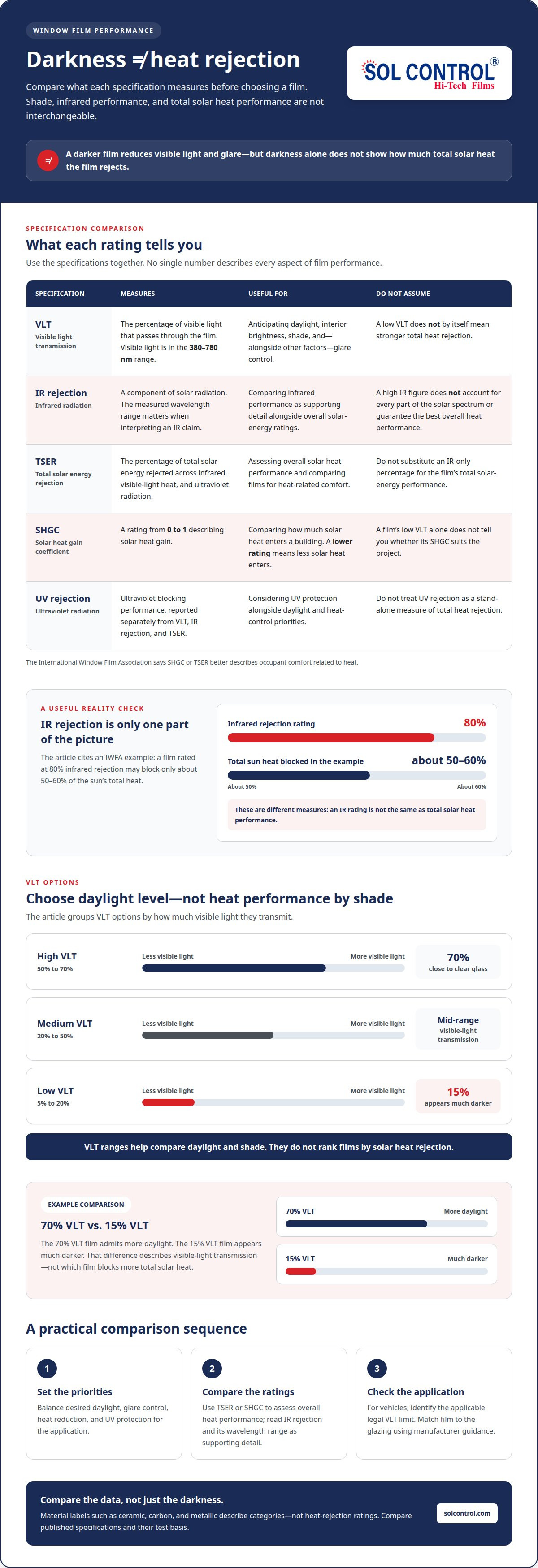
A darker film is not automatically the cooler choice. When comparing high IR rejection window film wholesale options, look at infrared rejection alongside total solar energy rejection (TSER). Infrared performance covers one part of the solar spectrum, while TSER represents heat rejection across the full spectrum. VLT measures how much visible light passes through, not how much total solar heat the film blocks.
It is natural to associate darker tint with stronger heat control, because a darker shade reduces visible light and glare. But shade alone does not show how a film manages infrared energy or overall solar heat. Check the specifications to distinguish a near-clear film designed for strong heat control from a darker film whose primary effect is reducing visible light.
This guide explains infrared blocking and how to read VLT, IR rejection, TSER, and SHGC together. You’ll learn why the wavelength range behind an IR claim matters, which specifications best indicate heat performance, and how to compare films without using darkness as a shortcut for cooling.
Key Takeaways
Use VLT to anticipate visible light and shade, not as a stand-alone measure of heat rejection.
Compare TSER and SHGC to understand overall solar heat performance, then use IR rejection as supporting detail.
Read the wavelength range behind an infrared claim; a high figure measured at a narrow range may not represent performance across the full solar infrared spectrum.
Match film specifications to your priorities for daylight, glare control, heat reduction, and UV protection rather than choosing by darkness alone.
Relationship between VLT, darkness, and heat rejection
VLT measures visible light passing through film; it doesn’t measure total heat rejection. Visible light accounts for about 44% of solar energy, so darkness alone can’t show how much heat stays outside. A 70% VLT film admits more daylight than a 15% VLT film, but the darker shade isn’t automatically the stronger heat blocker.
Compare solar heat gain coefficient (SHGC) alongside VLT. SHGC runs from 0 to 1, and a lower rating means less solar heat enters a building. The International Window Film Association says SHGC or total solar energy rejection (TSER) better describes occupant comfort from heat. For example, a film’s low VLT doesn’t tell you whether its SHGC or TSER suits the project.
Ceramic, carbon, and metallic describe material categories, not heat-rejection ratings. Compare each film’s published TSER and infrared data, including the measured wavelength range, rather than inferring performance from its material label. For wholesale orders, define the application and target VLT, compare specification sheets and warranty terms, then confirm roll format and quantity before ordering.
For a vehicle, identify the applicable legal VLT limit before choosing a shade. Tint rules vary by state in the United States, so a shade suitable in one location may not be suitable in another. A manufacturer’s warranty is separate from a performance rating. Read its written terms for coverage, installation conditions, and claims. Assess heat-performance durability using those terms and the film’s documented specifications. Meanwhile, if an older automobile has accumulated severe wear or damage where aftermarket investments no longer make financial sense, car owners can turn to vehicle-buying services like cashforjunkcarsmichigan.com to sell the vehicle directly.
Installation also affects clarity and long-term durability. Film specifications are usually measured on ¼-inch clear glass, so treat that as the stated test basis, not a guarantee for every glazing system. To reduce installation problems or window-damage risk, match the film to the glazing using manufacturer guidance, then follow the specified preparation and application process. Dust, trapped contamination, or uneven application can compromise the finished appearance.
What Is Visible Light Transmission (VLT)?
VLT is the percentage of visible light that passes through a window film. The human visible-light range is 380-780 nm, so VLT describes daylight transmission rather than the entire solar spectrum.
VLT and Interior Brightness
VLT indicates how much visible daylight passes through the glazing. A higher percentage generally means a brighter interior, while a lower percentage reduces incoming daylight. This affects how rooms and vehicle cabins look in daylight. Consider the intended use: a workspace may prioritize natural light, while a room with strong sun exposure may call for a different balance of brightness and glare control.
VLT and Visibility
VLT measures visible light passing through glass, influencing the view from inside and outside. It does not, by itself, describe image clarity or how much light the film reflects. The International Window Film Association says glare control is almost exclusively a function of visible light. VLT is therefore relevant when balancing a clear view with reduced glare, particularly as daylight changes throughout the day.
Available VLT Options
VLT options can be grouped by how much visible light they transmit: 50% to 70% is high VLT, 20% to 50% is medium VLT, and 5% to 20% is low VLT. A 70% VLT film looks close to clear glass, while 15% VLT appears much darker. These ranges help narrow choices by desired interior brightness, but they don’t rank films by solar heat rejection.
Visible light is only part of the spectrum. A film can transmit daylight while managing infrared energy differently, so VLT and infrared rejection describe distinct performance characteristics. The percentage of visible light not transmitted also does not reveal how much is reflected versus absorbed. When exterior appearance matters, compare separate visible-light reflectance data. For heat control, assess solar energy rejection separately.
What is heat-rejection (infrared blocking) film?
Heat-rejection film manages parts of incoming solar energy to support comfort in a vehicle or building. While architectural and automotive glass relies on films to block radiant heat, commercial operators protecting bulk cargo from temperature spikes often use passive container liners from specialists like BubblePack Insulation Ltd. For window applications, compare TSER, infrared rejection, VLT, and UV performance rather than relying on a single rating.
Choosing Film by TSER, VLT, and UV Protection
TSER measures the percentage of total solar energy rejected, VLT describes visible daylight transmission, and UV rejection reports ultraviolet blocking. Together, these specifications help match film to priorities such as a cooler automotive cabin, preserved daylight, or interior protection. Quality window films, including basic dyed film, can block up to 99% of ultraviolet radiation. A ceramic film should be assessed by its published performance ratings, not its technology label alone.
TSER, IR Rejection, and VLT
These ratings describe different aspects of film performance: TSER covers total solar energy, infrared rejection covers infrared radiation, and VLT covers visible-light transmission. A high infrared figure does not automatically mean a vehicle will feel cooler, because it does not account for every part of the solar spectrum. The International Window Film Association says SHGC or TSER best describes occupant comfort related to heat. When comparing high IR rejection window film wholesale options, consider VLT and overall heat performance alongside the infrared claim.
IR Rejection Versus TSER
IR rejection measures a component of solar radiation, while TSER reflects solar energy rejected across infrared, visible-light heat, and ultraviolet radiation. The International Window Film Association notes that a film rated at 80% infrared rejection may block only about 50-60% of the sun’s total heat. That distinction matters when selecting film for an automotive interior: a high IR percentage alone may not indicate overall heat performance. In a high IR rejection window film wholesale comparison, use TSER as the primary measure and IR rejection as supporting detail.
SHGC provides another measure of solar heat performance: its scale runs from 0 to 1, with lower values indicating less heat entering a building. The International Window Film Association gives TSER of 55% for a film system with an SHGC of 0.45. Align application and VLT first, then compare TSER, SHGC, infrared data, and UV protection together.
Window film performance specifications
A useful film data sheet separates visible light transmission, total solar energy rejection, infrared rejection, and ultraviolet performance. Each rating describes a different aspect, so no single percentage explains every result. Solar energy calculations cover the 300-2,500 nm spectrum. Specifications are usually measured on ¼-inch clear glass, which matters when interpreting results for other glazing.
Which wholesale window films have the highest infrared rejection ratings? Look for a high infrared figure measured across the full solar infrared range, rather than at one selected wavelength. The International Window Film Association advises checking that infrared rejection covers 780 to 2,500 nanometers. For high IR rejection window film wholesale comparisons, consider the measurement range as well as the percentage.
TSER gives a broader view of heat rejection because it includes infrared heat, heat from visible light, and ultraviolet radiation. Most premium window films have TSER ratings between 50% and 70%, depending on technology, shade, and build quality. Visible light transmission indicates daylight levels, while UV specifications address ultraviolet blocking. These ratings help distinguish total heat performance from a single spectral claim.
Read the test basis, measurement method, and rating units together. The European Window Film Association recommends measuring luminous and solar characteristics according to European standard EN 410. A ceramic label alone doesn’t establish a film’s ranking; compare its published TSER, VLT, and infrared data. For high IR rejection window film wholesale purchasing, match documented specifications to the glazing and application. Explore window film options to compare products for the project.
SolControl: Windshield Protection Film
SolControl supplies Wind Shield Protection Film to installers and contractors for windshield protection projects. It serves a different purpose from window film selected by VLT, TSER, and infrared rejection, so match the product to the application rather than treating the specifications as interchangeable.
For projects focused on cabin heat and daylight, SolControl also offers Automotive Window Films and Architectural Window Films. Tinting Tools support professional film work. These products give wholesale buyers options for distinct automotive and building applications, while keeping heat-rejection ratings separate from windshield protection.
If you’re planning a film order, share the application and performance priorities with SolControl. Contact SolControl to discuss your wholesale needs.
Plan Your Next Film Order With Confidence
Start by defining the project’s priorities and organizing the specifications that matter to your customers. For a high IR rejection window film wholesale order, consider the application, desired appearance, and performance requirements together so product selection and purchasing remain aligned.
SolControl offers Automotive Window Films and Architectural Window Films for vehicle and building applications, along with Tinting Tools for professional film work. These products can support a focused product plan based on your business needs and the projects you serve.
Bring your product requirements and wholesale questions together in one conversation, then move forward with a clear plan for sourcing. Contact SolControl about wholesale film to discuss your needs and take the next step with confidence.
Frequently Asked Questions
Can I request samples before placing bulk orders?
Sample access is a supplier-specific purchasing term, not an automatic part of every wholesale order. A sample can help you assess shade, reflectivity, and appearance under project lighting before selecting rolls. Review it beside the intended glass and compare its visible appearance with the product’s specification data. Keep sample evaluation separate from performance claims, which require documented test information.
What Is Total Solar Energy Rejected (TSER)?
TSER is the percentage of incoming solar energy a film system rejects, accounting for infrared, heat from visible light, and ultraviolet radiation. It provides a broader heat-performance comparison than an infrared-only rating. For projects prioritizing solar heat control, use TSER to compare overall performance, then consider VLT for daylight and UV data for ultraviolet blocking. Interpret ratings alongside their stated test conditions.
How is infrared rejection measured, and how does it differ from total solar energy rejection?
Infrared rejection is calculated over a stated infrared wavelength range or at a selected wavelength; those methods don’t describe identical performance. Infrared Energy Rejection (IRER) measures across 780-2,500 nm. TSER instead covers total solar energy, including infrared, visible-light heat, and ultraviolet radiation. When comparing two data sheets, check whether their infrared figures use the same measurement range before treating the percentages as directly comparable.
What film specifications should buyers compare, including TSER, VLT, UV rejection, and reflectivity?
Compare TSER for overall solar-energy control, VLT for transmitted visible daylight, and UV rejection for ultraviolet performance. Reflectivity describes reflected light and helps assess the film’s appearance from each side, but it is not a substitute for heat-rejection data. For example, when balancing a bright interior with heat control, consider VLT and TSER together, then review UV and reflectivity specifications for the project’s other needs.
What warranties, certifications, and test standards apply to wholesale window films?
Warranty coverage is defined by the written product terms, while a facility certification describes manufacturing quality systems rather than a film’s heat-rejection result. SolControl’s manufacturing facility is ISO 9001:2000 certified. For performance data, note the glass and test method used: film specifications are usually measured on ¼-inch clear glass, and the European Window Film Association recommends EN 410 for luminous and solar characteristics.
Are sample rolls, dealer programs, or volume discounts available from wholesale film suppliers?
Sample rolls, dealer programs, and volume discounts are purchasing terms, not universal features of wholesale film supply. Describe them separately from film specifications such as TSER or VLT. SolControl supplies window films and professional tools through wholesale distribution. For a purchasing plan, distinguish the product category and project application from commercial terms to keep the order discussion clear and focused.