Clear PPF for Gloss and Clarity: Film or Installation Quality
The best PPF for gloss and clarity isn’t chosen by brand name alone. Premium films can use heat to reduce the appearance of light swirl marks, but performance differences among top-tier brands have narrowed over time. The film’s clear finish, how well it maintains that clarity, and installation precision all shape the result.
Clarity and self-healing matter when you want paint protection without losing a high-shine look. But premium material can’t compensate for poor fit or visible installation flaws. This guide compares gloss and matte finishes, explains what film quality and self-healing can tell you, and shows how installation affects the finished appearance. Use these practical criteria to compare clear PPF against your priorities.
Key Takeaways
Match the finish to the look you want: gloss emphasizes shine, while matte and stealth create a more subdued appearance.
Installation precision plays a major role in how clean and seamless the film looks on your vehicle.
Self-healing can help reduce the appearance of light swirl marks, but performance varies across films.
Compare clarity, durability, finish, and warranty together to make a more informed film choice.
Matte PPF vs Gloss PPF: Which One Makes More Sense?
Gloss, matte, and stealth PPF change the paint’s appearance, so your finish preference is a useful starting point. There is no single measured gloss level for popular films: readings depend on the film and measurement conditions.
Gloss PPF Finish
Gloss PPF maintains a high-shine appearance, with reflections that emphasize paint depth and clarity. Its smooth, clear finish suits drivers who want protection from rock chips without changing the vehicle’s original color. Unlike matte or stealth film, gloss preserves the reflective look of factory paint.
That shine can also make swirl marks and existing imperfections more noticeable. For example, wash marks on a dark hood may stand out more under gloss film. A ceramic coating can be applied over gloss PPF to improve water behavior, simplify cleaning, and add chemical resistance.
Finish Options and Relative Costs
Gloss PPF is often the lowest-cost finish, matte sits in the mid-to-high range, and stealth is often the highest-cost option. Matte film gives paint a satin-like appearance, reducing reflections and muting a glossy finish. Stealth PPF offers a similar effect, though the result depends on the film and the paint beneath it.
Color finishes offer another way to change a vehicle’s appearance, unlike clear gloss film, which preserves the original paint color. Matte surfaces need different care: waxes and gloss enhancers can leave uneven shiny spots. Ceramic coating can also be applied to matte and stealth film to improve water behavior, simplify cleaning, and add chemical resistance.
Finish
Relative cost
Appearance
Gloss
Lowest
High shine and strong reflections
Matte
Mid to high
Subdued, non-glossy look
Stealth
Highest
Muted appearance
Choose gloss to retain shine, or matte and stealth to reduce reflections and change the finish.
Installer experience and installation quality
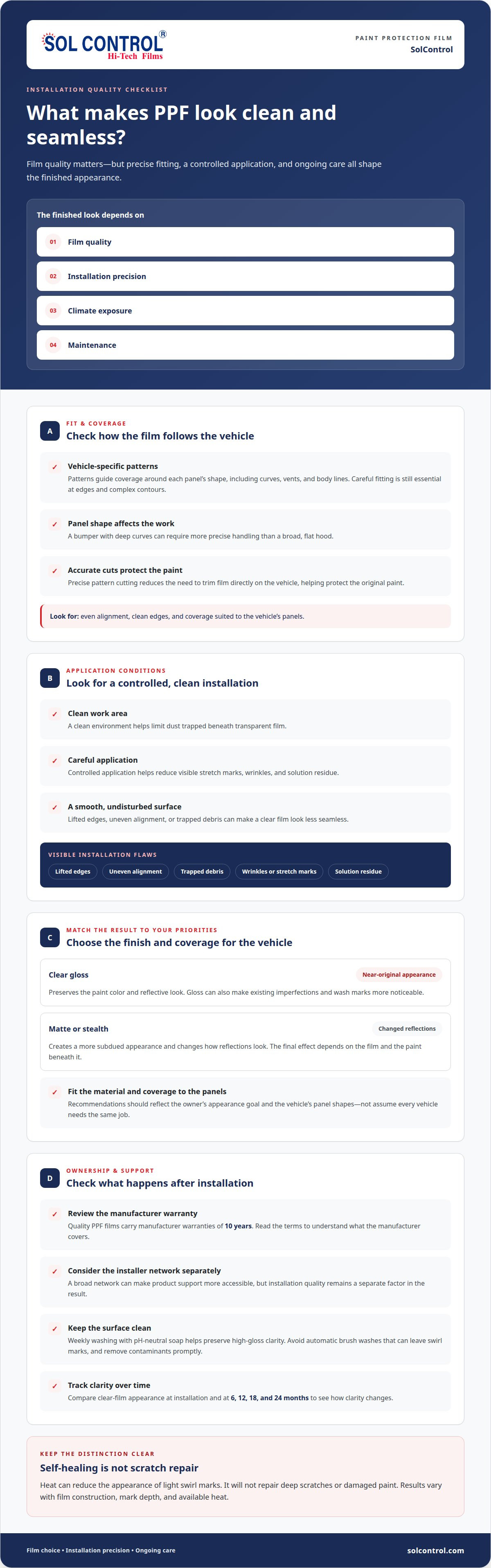
PPF gloss and clarity after installation depend on film quality, installation precision, climate exposure, and maintenance. Across premium finishes, installation and care can affect lifespan more than whether the film is gloss, matte, or stealth. A clear film may look less seamless if edges lift, alignment is uneven, or trapped debris interrupts the surface.
Vehicle-specific patterns help match film to each panel’s shape. Pattern-cutting software guides coverage around curves, vents, and body lines, but careful fitting still matters at edges and complex contours. A bumper with deep curves, for example, can require more precise handling than a broad, flat hood. Accurate cuts also reduce the need to trim film directly on the vehicle, helping protect the original paint.
Installer skill shows in the finished surface, not just in the film selected. A clean work area helps limit dust beneath transparent material, and controlled application reduces visible stretch marks, wrinkles, and solution residue. These details affect clarity and appearance. Proper coverage also helps the film perform its intended role against rock chips, chemical stains, and road debris.
Recommendations should reflect the owner’s goal. Clear gloss film preserves paint color for a near-original appearance; matte or stealth changes reflections for a different look. Coverage and material should suit the vehicle’s panels and the owner’s priorities, rather than treating every vehicle as the same job. Maintenance matters too: contaminants left on the surface can affect its appearance over time.
Compare the manufacturer warranty and installer network together. Quality PPF films carry manufacturer warranties of 10 years, while installation quality remains a separate factor in the result. A broad installer network can help make product support more accessible, but the warranty terms explain what the manufacturer covers. Review both before choosing a film system, especially if chemical resistance or long-term clarity is central to the decision.
Quality clear gloss PPF suits drivers who want to preserve a near-original appearance. Its clarity over time depends on film quality, installation precision, climate exposure, and maintenance.
Does PPF brand affect self-healing performance?
Premium brands can differ, but performance gaps among top-tier PPF brands have narrowed over the past five years. Self-healing technology uses heat to reduce the appearance of light swirl marks; it won’t repair deep scratches or damaged paint. Keep that distinction in mind when comparing protection claims with the damage a film can address.
Self-healing speed depends on the film’s construction, the mark’s depth, and available heat. Testing at 60°C and 90°C provides different conditions for observing how quickly marks fade, but those temperatures alone don’t establish a universal ranking. A light surface swirl may respond differently from a deeper scratch, even on the same film.
For the least yellow or hazy appearance over time, compare clear-film clarity across follow-up measurements, not just the fresh roll. Measurements at installation and 6, 12, 18, and 24 months can show how appearance changes. Premium-film differences may become more apparent after three years, so clarity retention matters alongside initial transparency.
PPF also helps protect paint from UV exposure, road debris, and other surface contaminants. Some premium films combine a self-healing top layer with hydrophobic properties, which can help water bead and make cleaning easier. A ceramic coating over PPF can further improve water behavior, simplify cleaning, and add chemical resistance, but it doesn’t replace the film’s protective role.
To preserve high-gloss clarity, wash the film weekly with pH-neutral soap and avoid automatic brush washes that can leave swirl marks. Remove contaminants promptly, since residues can affect the surface appearance. For example, bird droppings left on the film may become harder to clean after baking in sunlight.
Compare clarity retention, self-healing behavior, UV resistance, finish, warranty, and support together. The paint’s condition and how the vehicle is maintained also shape the result, so choose a film whose texture and topcoat suit the vehicle and its use.
Clear paint protection film for gloss and clarity
Compare clear films by their reflections, transparency, and visible orange-peel texture rather than relying on brand name alone. Clear PPF, often called a clear bra, is a protective urethane film; ceramic coating is a surface layer, not an equivalent physical shield.
Gloss and Clarity Across Leading Brands
Leading brands are best compared through consistent criteria: how clearly the original paint shows through, how evenly the surface reflects light, and how well clarity holds over time. Premium-film differences may become more apparent after three years, so an immediate showroom appearance tells only part of the story. Compare clarity alongside self-healing, thickness, TPU quality, warranty, and support.
Orange Peel Across Leading Brands
Orange peel is a slightly pebbled surface texture that can make reflections look less uniform than smooth factory paint. Its visibility depends on the film’s surface and the viewing angle, especially across broad panels such as a hood. Don’t assume one brand has the least texture: assess the finished appearance under consistent lighting and from different angles. Clarity and orange peel are related, but they are not the same measure.
Clear PPF Versus Clear Bra
Clear bra is another name for clear paint protection film, not a separate coating alternative. The transparent urethane film helps shield paint from rock chips, road debris, bug splatter, bird droppings, and UV exposure. Ceramic coating serves a different purpose: applied over PPF, it can improve water behavior, simplify cleaning, and add chemical resistance. It does not replace the film’s physical barrier against impacts and scratches.
For owners prioritizing paint protection with minimal appearance change, compare clear-film clarity, surface texture, and long-term appearance together. Explore clear paint protection film options to assess film choices for your goals.
SolControl
SolControl supplies installers and contractors with film and tools for projects where finish, clarity, and protection matter. Its Paint Protection Films give professionals options to match vehicle appearance and protection goals, while Tinting Tools support their work. SolControl also supplies Automotive Window Films and Architectural Window Films for other applications.
For a PPF decision, use the criteria covered here to focus on what matters most: clear appearance, finish, self-healing performance, and product support. SolControl supplies Paint Protection Films and related tools to industry professionals. Contact SolControl to discuss your film needs.
Make Your Next Film Choice With Confidence
Start with your preferred finish and create a clear product brief. Note the vehicle’s original appearance, the desired level of protection, and your customers’ priorities. This gives installers a consistent framework for evaluating the best PPF for gloss and clarity against real project needs, rather than choosing by shine alone.
For installers and contractors sourcing film and tools, SolControl offers Paint Protection Films, Automotive Window Films, Architectural Window Films, and Tinting Tools. Compare these products against your applications and customers’ needs.
A considered choice helps set clear expectations before a project begins. If you’re ready to discuss paint protection film for your needs, contact SolControl about PPF. Take the next step with a product decision shaped around the finish and performance your work requires.
Frequently Asked Questions
Does Gloss PPF change the look of the paint?
Gloss PPF can enhance shine and reflections while keeping the paint’s color visible. It may slightly change how light reflects, so a metallic finish, for example, can look glossier beneath the film. The final appearance also depends on the paint’s condition before application. Clear film won’t make existing marks disappear.
What Is Paint Protection Film?
Paint protection film is a transparent urethane layer applied to painted vehicle surfaces. It helps protect the finish from everyday impacts and contaminants. Coverage can focus on exposed areas, such as a front bumper, or extend across more panels. The right coverage depends on how the vehicle is used and which areas the owner wants to protect.
What about budget PPF brands?
Budget films can be worth considering, but weigh upfront savings against clarity retention, warranty, and support. Some cheaper films may develop problems after 12-18 months, so compare samples under consistent lighting before choosing. Review warranty duration and terms, too. A low initial cost matters less if the film’s appearance or performance no longer suits your needs.
What is the best PPF brand overall?
There isn’t one best PPF brand for every vehicle or owner. The best PPF for gloss and clarity depends on priorities such as long-term transparency, self-healing behavior, finish, and product support. Compare films against those goals rather than relying on one headline feature. For a daily-driven vehicle, durability and support may matter more than maximum shine alone.
Which paint protection films have the best gloss and optical clarity?
The best PPF for gloss and clarity combines a clear appearance with consistent reflections and minimal visible texture. Compare samples over the same paint color and under similar lighting, since sunlight and indoor light can reveal different surface details. Consider how clarity holds as the film ages, not just how it looks when new. Installation quality also affects the result.
How much does professional installation of high-gloss PPF cost in the United States?
Installation costs depend on the vehicle, selected coverage, panel complexity, surface preparation, and labor. A partial-front application and full-vehicle coverage involve different amounts of film and work, so they shouldn’t be treated as equivalent. Request a project-specific quote that separates coverage and installation details. SolControl distributes paint protection films but does not provide installation services.