Hydrophobic PPF Properties and How Water Beading Helps Protect Paint
Water beading can help keep a vehicle cleaner, but it doesn’t make the paint self-cleaning. Hydrophobic PPF properties cause water to bead and roll off, which may carry away some grime and help reduce water spots and mineral deposits. The film also helps protect paint from debris and minor abrasions.
That water-shedding effect is useful when you want routine washing to be easier. But grime still needs to be washed off, and water left to dry can leave minerals or dirt behind. Drying the film after rain or washing helps limit spotting.
This article explains how hydrophobic paint protection film works, how beading can help with vehicle care, and what it can’t do on its own. You’ll also learn how to maintain the film and understand its protective role, so you can make informed choices about caring for your paint.
Key Takeaways
Learn how PPF’s flexible polyurethane layer and surface design contribute to paint protection.
Recognize that water beading can diminish with use, so the film’s surface behavior may change over time.
Understand why washing remains important and why unapproved coatings can affect PPF.
See how water repellency can make grime easier to rinse away without replacing careful vehicle care.
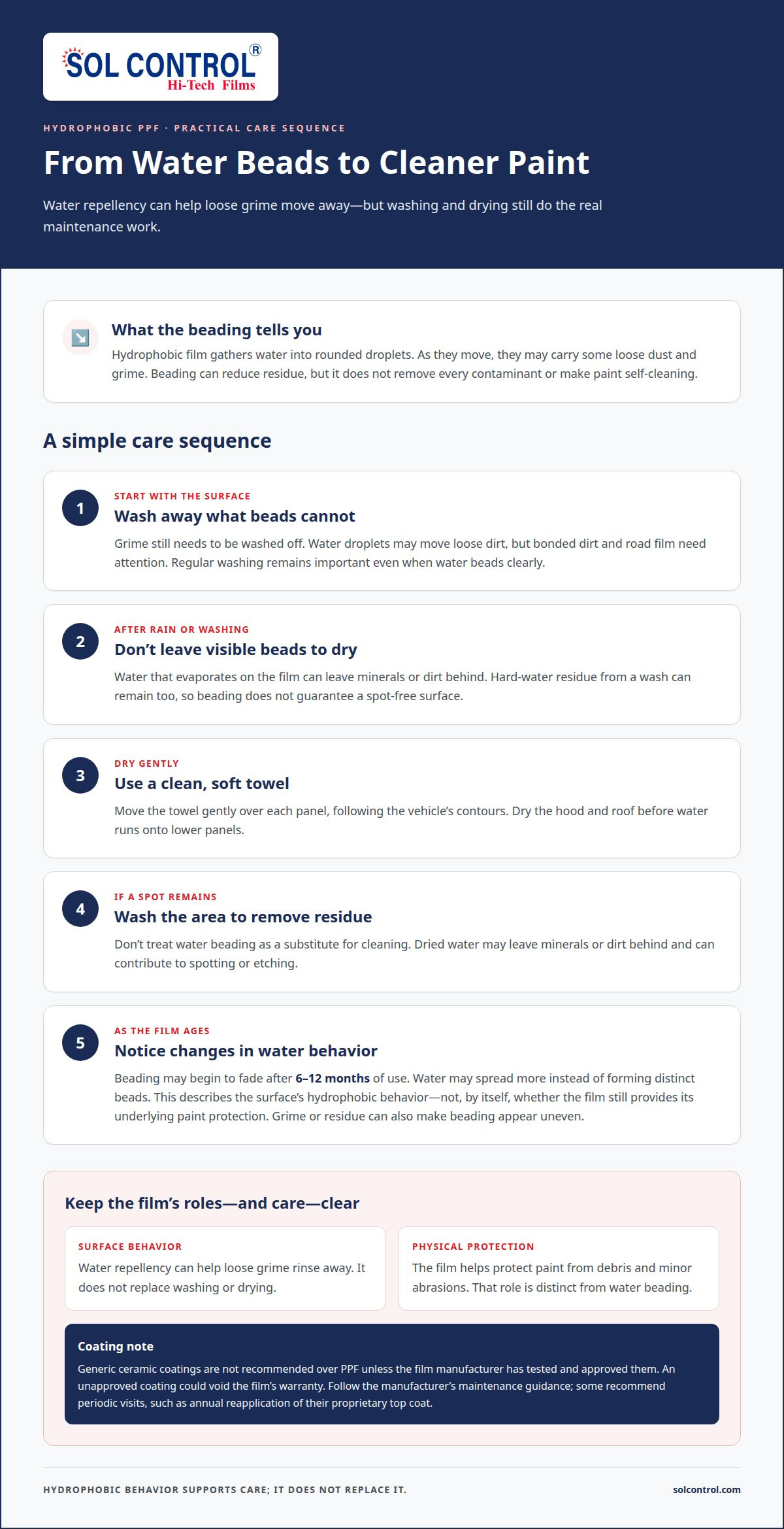
Hydrophobic PPF properties describe how the film repels water at the vehicle’s surface. Rather than spreading into a continuous layer, water gathers into rounded droplets. On a hood, beads may roll toward the edge as the vehicle moves or the surface slopes. As they travel, droplets can carry some loose dust and grime with them. This can reduce residue on the surface, but it won’t remove every contaminant.
Beading can also help reduce water spots and mineral deposits because less water may remain spread across the film. It doesn’t guarantee a spot-free surface. Rainwater that collects on a level panel, for example, can still evaporate and leave minerals or dirt behind. Hard-water residue from a wash can also remain if droplets dry in place. Both the water’s contents and whether it dries on the surface matter.
The beading effect can change with use. It may begin to fade after 6-12 months, so water might spread more instead of forming distinct beads. That change concerns the film’s surface behavior; it doesn’t by itself show whether the film still provides its underlying paint protection. Observe how water behaves across panels, since grime or residue can make beading appear uneven.
Water repellency can diminish over time, and it won’t prevent spots if droplets dry on the film. Dried water can leave minerals or dirt behind and may contribute to spotting or etching.
After rain or washing, dry the film instead of leaving visible beads to evaporate. Use a clean, soft drying towel and move it gently over each panel, following the vehicle’s contours. For example, dry the hood and roof before water runs onto lower panels. If a spot remains, wash the area to remove residue rather than treating beading as a substitute for cleaning. Regular washing still matters: droplets can move loose grime, but bonded dirt and road film need attention.
What is Paint Protection Film (PPF)?
Paint protection film is a layer used to help protect vehicle paint. Before applying it, clean the vehicle and remove contaminants so the paint is ready for installation.
Protective Film Layers and Their Roles
Typical PPF uses functional layers that work together to cover and protect painted panels. Its polyurethane layer provides flexibility and impact resistance, helping the film absorb contact from road debris. The top coat acts as a barrier against UV rays and is designed to resist yellowing. An adhesive layer holds the film to the paint and is designed to avoid paint damage during application or removal. These roles explain what each layer contributes.
Core Paint Protection Functions
PPF’s core function is to absorb impacts from debris and minor abrasions before they reach the vehicle’s paint. Film on a painted panel, for example, creates a protective layer between the finish and small pieces of road debris. The polyurethane’s flexibility supports impact resistance, while the top coat adds a barrier against UV rays. Together, these functions support paint care, but the film doesn’t make a vehicle immune to damage.
Hydrophobic behavior is a surface property, distinct from the film’s impact-absorbing role. Water beading can help carry away some loose grime, while the TPU layer provides flexibility and impact resistance. Keeping these functions separate sets realistic expectations: water repellency supports washing, while the film’s structure creates a physical layer over the paint.
Application also depends on preparing the surface. Cleaning the vehicle and removing contaminants helps create a suitable surface for the film. Dirt trapped beneath PPF can affect the finished appearance, so preparation matters before installation begins. A slip solution allows the film to be repositioned during installation.
Explore paint protection film materials as you consider how a film’s surface and protective layers fit your vehicle-care priorities.
Vehicle maintenance and paint preservation
Hydrophobic PPF supports paint care by limiting contaminant bonding and shedding water. The surface still needs appropriate washing and maintenance.
Hydrophobic Film Care
Hydrophobic PPF maintenance combines regular washing with care suited to the film’s surface. Water repellency doesn’t remove grime, so wash the vehicle to clear accumulated contaminants. Some manufacturers recommend periodic maintenance visits, such as annual reapplication of their proprietary top coat. TPU is naturally resistant to oil and grease, but that property doesn’t replace cleaning or protect against every residue.
Generic ceramic coatings aren’t recommended over PPF unless the film manufacturer has tested and approved them. Some top coats can interfere with waxes or coatings bonding to the film, and an unapproved coating could void the film’s warranty. Follow the film manufacturer’s maintenance guidance rather than applying a coating by default.
Duration of Hydrophobic Properties
The water-beading effect may begin to fade after 6-12 months of use. That period describes the hydrophobic behavior, not the full lifespan of the film or its paint-protection function. Beading can become less distinct, while the film continues serving its separate physical role. Watch for water spreading differently across the surface as the film ages.
Compared with standard PPF, hydrophobic PPF adds water-repellent behavior to a film designed to protect paint from debris and minor abrasions. Ceramic coating is a separate surface treatment, not a substitute for PPF’s impact-absorbing layer. Use a generic ceramic coating on PPF only if the film manufacturer has tested and approved it.
Paint preservation also depends on removing contaminants before they bond with the finish. Washing clears grime that water repellency alone leaves behind. After rain or washing, dry the film to limit residue from evaporating droplets. If the hydrophobic effect changes, maintain the film according to its manufacturer’s instructions. This keeps care decisions aligned with the specific top coat and helps avoid incompatible products. For vehicle owners seeking broader protection against dust and environmental exposure during storage, dedicated vehicle shields from inthegarage.com provide an effective solution alongside protective film and routine washing.
How hydrophobic film helps dirt and grime wash away
Hydrophobic film changes how water sits on a vehicle’s surface. Instead of spreading evenly, water gathers into droplets and can move across sloped panels. As runoff travels down a door or hood, it may carry loose dust and grime with it. That’s the practical cleaning advantage: water can lift and move some surface dirt, making rinsing easier. The film doesn’t dissolve contaminants or remove every particle on contact.
Consider a light layer of road dust on a sloped hood. During rinsing, water can gather into moving beads and carry some loose particles toward the panel edge. The result depends on the residue: loose dust can move with runoff, while oily or dried-on grime may remain. TPU is naturally resistant to oil and grease, but that doesn’t mean every oily deposit will rinse away without washing.
Hydrophobic behavior can help limit how long water and loose contaminants sit across the paint’s surface. PPF can help prevent contaminants from bonding with the vehicle’s paint, while its water-repellent surface supports runoff. These functions work together, but they aren’t interchangeable. A bead rolling off a fender doesn’t prove the panel is clean, and any remaining dirt still needs washing.
For a practical wash, rinse the vehicle to move loose debris before cleaning. Then wash to remove remaining grime, and rinse again to clear loosened residue. If a lower door still looks dirty after runoff, for example, don’t rely on beading alone. Hydrophobic behavior supports the wash; it doesn’t replace it. Dry the vehicle after washing, since droplets left to evaporate can leave minerals or dirt behind.
SolControl helps installers and contractors source film and tools for vehicle care and protection projects. If you’re weighing water repellency alongside paint protection, explore SolControl’s Paint Protection Films. The right choice depends on the vehicle’s protection needs and the surface-care priorities you’ve identified.
SolControl also offers Automotive Window Films, Architectural Window Films, and Tinting Tools. These products support a range of film-related projects without changing the central takeaway: hydrophobic behavior can assist washing, but it doesn’t replace regular vehicle care. Consider how the film fits your application and maintenance approach.
Your next step is to match the film choice to the vehicle’s protection priorities and the care routine you can maintain. Understanding hydrophobic PPF properties can help you weigh surface behavior alongside the film’s broader role in paint protection. Keep those goals distinct, and consider how the vehicle is used and maintained before choosing an approach.
For installers and contractors, product selection is part of delivering a suitable solution for each project. Explore SolControl’s Paint Protection Films for vehicle applications, alongside products for other film-related work. Share the application and priorities you’re working with to start a practical conversation about your needs.
How does hydrophobic paint protection film repel water?
The outer surface causes water to gather into droplets rather than spread evenly across the film. This behavior comes from the film’s surface, not the polyurethane layer’s impact-absorbing role. On a nearly level panel, droplets can remain in place instead of rolling off, so a beaded appearance alone doesn’t mean the surface is dry or free of residue.
What are the key properties of hydrophobic PPF?
The key properties combine water repellency with PPF’s physical paint-protection role. The surface encourages water to bead, while the flexible polyurethane film helps absorb impacts from debris and minor abrasions. The top coat acts as a UV barrier and is designed to resist yellowing. Treat these as distinct functions: beading describes water behavior, not the film’s full protective performance.
Does hydrophobic PPF resist scratches, stains, UV, and chemicals?
PPF is designed to absorb impacts from debris and minor abrasions, and its top coat acts as a UV barrier. That doesn’t mean it’s scratch-proof or immune to stains. TPU is naturally resistant to oil and grease, but that doesn’t establish resistance to every chemical. Don’t assume a film tolerates a particular cleaner or chemical unless its manufacturer says so.
How do you clean and maintain hydrophobic PPF?
Wash the vehicle to remove grime, then dry the film rather than letting droplets evaporate. If water behavior becomes uneven, surface residue can affect how beading appears; clean the affected panel and assess it again. For added coatings or top-coat care, follow the film manufacturer’s instructions. Some manufacturers recommend periodic maintenance, including annual reapplication of their proprietary top coat.