Professional Guide: Choosing a Heat Gun for Window Tinting
A heat gun is a precision thermal management instrument, not just a simple air blower. Many installers treat it as an afterthought, yet the wrong tool is often the silent culprit behind creased film fingers and melted door panels. If you've ever felt the frustration of a cheap unit burning out during a high-volume afternoon, you understand that reliability is the foundation of a profitable shop. Choosing the right heat gun for window tinting requires a deep dive into how consistent airflow and temperature control affect the molecular structure of modern ceramic and carbon films.
We recognize that your tools are an extension of your hands. They must be balanced to prevent fatigue while delivering the exact heat required for complex glass curves. This guide provides the technical insight you need to master thermal shrinking and select a high-performance tool that ensures flawless results every time. We'll examine the critical features of professional-grade equipment, from precise digital displays to motor durability. This knowledge helps you protect your client's vehicle and your own bottom line during every installation.
Key Takeaways
Understand why airflow volume is just as critical as temperature control when shrinking high-end ceramic films to prevent surface hazing.
Identify the ergonomic features and weight distribution patterns that reduce hand fatigue during long shifts in high-volume tint shops.
Learn how to select the ideal heat gun for window tinting by matching tool specifications to the unique shrink rates of different film materials.
Discover why industrial-grade durability is essential for preventing tool burnout and maintaining consistent thermal output across multiple installations.
Master the technical nuances of heat management to protect vehicle interiors while achieving flawless results on complex glass curves.
Beyond the Basics: Why Professional Tinting Requires a Specialized Heat Gun
A professional installation relies on the precise manipulation of material properties. While a standard Heat gun might look like a simple air blower, it is actually a sophisticated thermal management instrument. For a tint shop, the primary goal is "shrinking" the film to match the compound curves of automotive glass. Without this step, flat film would never sit flush against a curved rear windshield or a complex side window. The difference between a clean, factory-look install and a "burned" film often comes down to the consistency of your tool's thermal output.
The Science of Film Shrinking
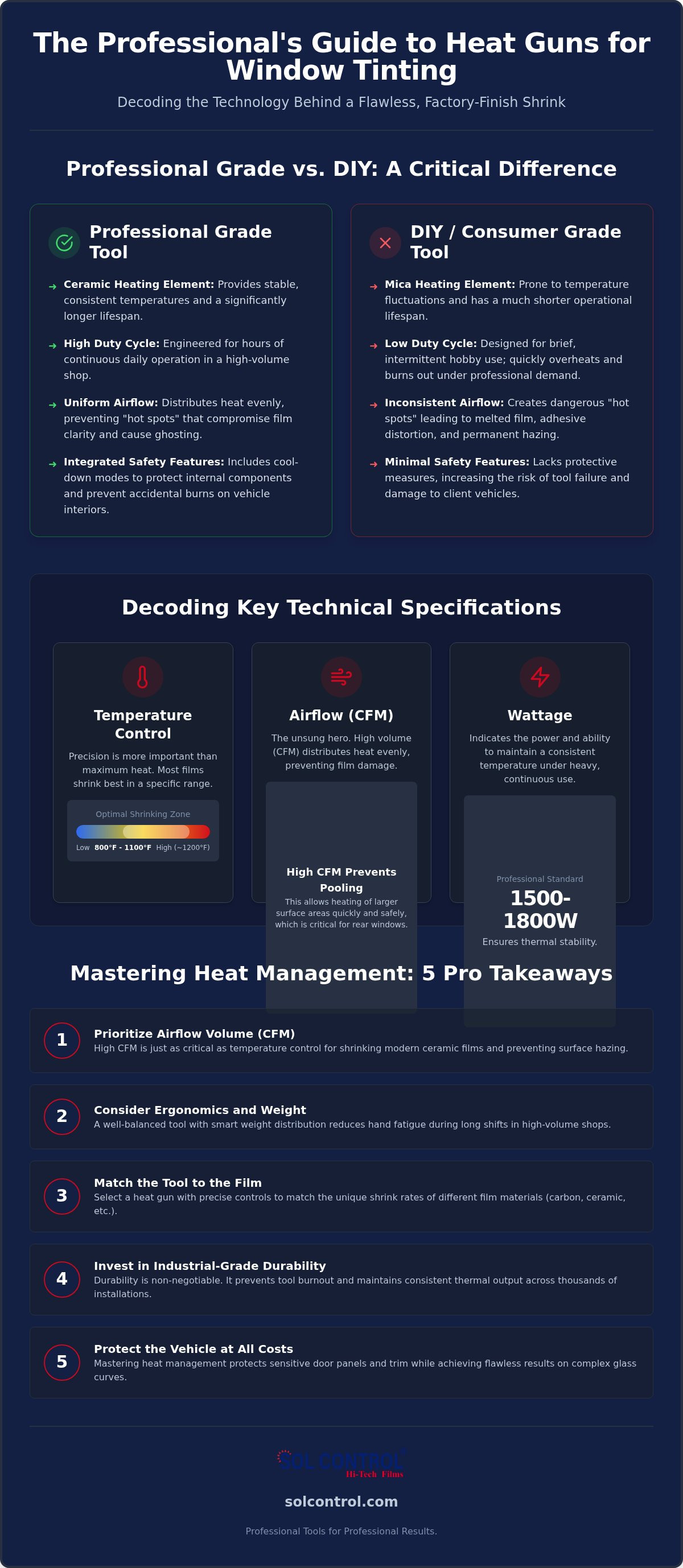
Thermal shrinking is the controlled contraction of automotive window film to match glass curvature. This process relies on what technicians call "film memory." When you apply heat, the polyester molecules relax and then tighten as they cool, allowing the material to take the shape of the substrate. Lower-end tools often create "hot spots" because their airflow isn't uniform across the nozzle. These concentrated spikes in temperature can lead to ghosting, where the film’s clarity is permanently compromised by uneven melting or adhesive distortion. A specialized heat gun for window tinting ensures that the heat is distributed evenly, allowing the film to shrink without compromising the adhesive integrity or the hard coat.
Professional vs. DIY Heat Guns
The most significant difference between a professional heat gun for window tinting and a consumer-grade craft gun is the duty cycle. High-volume shops might keep a tool running for several hours every day. Professional units are engineered for this level of continuous use, whereas DIY tools often overheat and burn out under the same pressure. The internal components define this longevity:
Ceramic vs. Mica: Professional heat guns typically utilize ceramic heating elements. These provide more stable temperatures and have a significantly longer lifespan than the mica elements found in budget versions.
Duty Cycle: Industrial-grade tools are rated for hours of operation. Cheap guns are designed for intermittent hobby use and will lose temperature accuracy as they wear down.
Safety and Protection: Professional models often include integrated cool-down modes. This feature allows the fan to run while the heating element is off, which protects the internal components from residual heat damage and ensures the nozzle isn't dangerously hot when you set it down near a vehicle's interior.
Consistent heat management isn't just about speed; it's about reliability. When a tool provides a steady, predictable stream of air, you can work closer to the film with confidence. This precision is what allows a master installer to tackle complex curves without the risk of melting the film or damaging the vehicle's sensitive trim panels.
Key Technical Specifications: Decoding Temperature, Airflow, and Control
Many installers focus solely on the maximum temperature rating. This is a mistake. A high-quality heat gun for window tinting provides a broad temperature range, usually peaking around 1100°F or 1200°F. In practice, you'll rarely use the maximum setting. Most professional films react best between 800°F and 1100°F. Pushing beyond this range increases the risk of damaging the film's hard coat or melting the adhesive. Consistent wattage, typically around 1500 to 1800 watts, ensures the tool maintains its target temperature even under heavy load. This stability is vital for high-volume shops where equipment runs for hours on end.
Why Airflow (CFM) Matters More Than Peak Heat
Airflow, measured in Cubic Feet per Minute (CFM), is the unsung hero of efficient shrinking. High CFM prevents heat from pooling in a single spot. This pooling is the primary cause of film ghosting and uneven shrinkage. When shrinking large rear windows, high airflow allows you to heat a larger surface area simultaneously. This speeds up the process without requiring dangerous temperature spikes. You must balance air volume with air speed, though. If the velocity is too high, it can blow the film off the glass during dry shrinking. This makes the installation unnecessarily difficult and increases the chance of contamination. To learn more about maintaining a clean workspace and why professional cleaning solutions are preferred over household soaps, visit J Racenstein.
The choice between analog and digital controls often depends on your shop's workflow. Digital displays provide surgical precision. They allow you to dial in the exact temperature required for a specific nano-ceramic film. This ensures repeatable results across different installers in your shop. Some high-end models even offer programmable presets. You can switch between settings for carbon and ceramic films with a single button press. Analog dials offer a tactile feel that many veteran tinters prefer. They allow for rapid, manual adjustments without looking at a screen.
Whether you prefer the accuracy of digital or the speed of analog, a tool with variable settings offers a much better ROI than a basic dual-temp model. It allows you to adapt to different film thicknesses and glass types without switching equipment mid-job. You can explore our curated selection of professional tinting tools to find the control style that fits your technique.
Evaluating Durability and Ergonomics for High-Volume Shops
In a high-volume installation environment, the physical build of your equipment is just as critical as its internal electronics. A professional installer might handle a heat gun for window tinting for several hours each day, making weight distribution a primary concern. A poorly balanced tool that is front-heavy puts unnecessary strain on the wrist and forearm. Over months of consistent use, this imbalance can contribute to repetitive strain injuries like carpal tunnel syndrome. Choosing a tool with a centered gravity point allows for more precise movements with less muscular effort, which is essential when navigating the tight corners of a vehicle's interior.
Durability also extends to the shop floor realities. Tools eventually fall, and impact resistance is a non-negotiable feature for professional-grade gear. Look for housings made from high-impact polymers that can survive a drop onto a concrete floor without cracking the internal heating element. Additionally, cord length and flexibility play a major role in shop efficiency. A ten or twelve-foot cord made from high-flex rubber allows you to move around a vehicle without the cord becoming a tripping hazard or snagging on tires. Standardizing your shop’s accessories with universal nozzle compatibility also ensures that your team can share specialized tips for different glass shapes without needing multiple tool platforms.
Ergonomics for the All-Day Installer
One-handed operation is a hallmark of an efficient workflow. The placement of triggers and slide switches should allow you to adjust settings or toggle power without using your second hand, which is often busy positioning the film or using a squeegee. Rubberized grips provide better traction when your hands are wet from mounting solution, while integrated heat shields protect your fingers from the high temperatures radiating near the nozzle. Another vital feature is the stand design. A stable, integrated rear stand allows the tool to sit safely in an upright position on your work table. This prevents the hot nozzle from touching sensitive surfaces and facilitates a faster cool-down period between windows.
The Cordless Debate: Pros and Cons in 2026
As we move through 2026, cordless technology has reached a point where it is a viable option for many technicians. The primary benefit is absolute mobility; you can move from the back glass to the side windows without managing a power lead. This is particularly useful for mobile installers working in tight residential garages. However, there are trade-offs to consider. High-capacity batteries required for a full day of shrinking can significantly increase the tool's total weight, potentially leading to faster wrist fatigue. While battery life has improved, a corded heat gun for window tinting remains the industry standard for stationary shop bays where consistent, unlimited power is required for back-to-back installations. You can find both high-performance corded and cordless options in our professional tinting tools collection.
Heat Management Strategies: Matching Your Tool to the Film Type
A master installer knows that the thermal profile of a nano-ceramic film is fundamentally different from a standard dyed product. Using a high-performance heat gun for window tinting allows you to modulate your approach based on the material's specific construction. If you apply the same heat to every roll, you'll eventually face material failure or aesthetic defects. Success in 2026 relies on understanding how different chemical compositions react to thermal stress.
Ceramic Film: The High-Tech Challenge
Ceramic particles are designed to absorb and dissipate heat, which means they retain thermal energy much longer than carbon or dyed films. Ceramic films require precise heat to avoid disrupting the IR-rejection layers. If you apply too much heat too quickly, you risk creating a permanent haze or "ghosting" effect that ruins the clarity of the glass. We recommend the "snap" method for these materials. This involves using quick, controlled bursts of heat followed by immediate smoothing. This technique prevents the film's internal structure from reaching a critical melting point while still achieving the necessary contraction for a tight fit.
Carbon and Dyed Films
Carbon and dyed films generally offer faster shrink rates than their ceramic counterparts. They respond quickly to thermal changes, which is excellent for shop efficiency but leaves very little room for error. Without a reliable heat gun for window tinting that provides consistent airflow, it's easy to over-shrink these materials. Over-shrinking causes the film to curl or melt at the edges, often requiring a complete recut of the pattern. You'll find that carbon films require a steady, rhythmic motion to keep the heat moving across the surface.
Thick Films and Security Tints
Architectural and security films, often ranging from 4-mil to 8-mil in thickness, present a different set of challenges. These heavy-duty materials require significantly higher dwell times to reach their relaxation point. Using a wide-nozzle attachment is essential here. It distributes the heat over a larger surface area, which prevents adhesive "blistering" that often occurs when heat is concentrated too intensely on thick architectural glass. When working with these films, focus on slow, deliberate passes to ensure the heat penetrates through the entire thickness of the polyester.
Your technique must also shift between dry and wet shrinking. Dry shrinking requires lower temperatures and higher airflow to keep the film from sticking to the glass prematurely. Wet shrinking allows for slightly higher heat because the moisture acts as a thermal buffer, though you must be careful not to boil the mounting solution. You can equip your shop with the right gear for any material by browsing our professional-grade heat guns and accessories.
Professional Recommendations: Selecting Your Next Heat Gun at SolControl
Selecting the right equipment is the final step in elevating your shop's output. At SolControl, we curate our heat gun for window tinting selection to meet the rigorous demands of full-time installers. We understand that a tool is an investment in your shop's reputation. Our inventory includes the Milwaukee Heat Gun, a name synonymous with industrial-grade durability. These units are built to withstand the daily grind of a high-volume bay. For those working with advanced materials, we prioritize variable temperature models. These provide the ultimate precision control needed to avoid the "ghosting" issues discussed earlier in this guide. Having the ability to fine-tune your thermal output ensures you can handle any film type that comes through your door.
Standout Features of Our Professional Collection
Our professional collection stands out because we focus on the long-term ROI of your tools. We offer models with impact-resistant heating elements that won't shatter after an accidental drop on a concrete floor. We also prioritize high-CFM designs. As established, high airflow is essential for managing heat distribution on complex automotive glass curves. Choosing to buy through a national wholesale distributor like SolControl ensures you receive professional support and access to equipment that supports shop growth. We don't just sell tools; we provide the high-performance gear that helps your business maintain its standards of excellence, a quality also seen in the work of home improvement specialists like Long Island Windows and Siding.
A heat gun is only one part of an efficient shrinking station. You must use a high-quality window tint squeegee in tandem with heat to smooth out fingers and ensure a perfect bond. Safety is equally important. We recommend using dash protectors and heat-resistant gloves to protect both the vehicle's interior and your own hands from thermal stress. These accessories prevent costly damage to sensitive leather or plastic trim during the shrinking process. Ensuring you have a complete setup reduces risks and improves your installation speed, allowing you to move through jobs with confidence.
Investing in professional-grade equipment is the best way to reduce hand fatigue and tool burnout. When your tools are reliable, you can focus on the artistry of the install rather than the limitations of your gear. Browse our full range of professional tinting tools and heat guns here.
Elevating Your Shop's Installation Standards for 2026
Mastering the technical nuances of thermal shrinking is what separates an average installer from a high-performance shop leader. Selecting the right heat gun for window tinting isn't just about reaching a specific temperature; it's about managing airflow and heat distribution to protect the integrity of advanced ceramic and carbon films. By prioritizing ergonomics and industrial durability, you ensure your team remains productive without the risk of hand fatigue or tool failure during peak hours.
SolControl is dedicated to being your expert partner in the industry. We provide wholesale pricing for professional installers and offer a curated selection of 40+ high-performance tools designed for the modern shop. With national US shipping on all distributor orders, getting the gear you need is efficient and reliable. We focus on providing the equipment that supports your shop's growth and maintains the high standards your clients expect.
We're here to support your journey and help you deliver flawless installations on every vehicle that enters your bay. Your success is our priority, and we look forward to providing the tools you need to excel.
Frequently Asked Questions
What temperature should I use for shrinking window tint?
The ideal temperature for shrinking window tint generally falls between 800°F and 1100°F. Most professional films react best within this range, though you should always start at a lower setting and increase heat gradually. Ceramic films often require higher precision toward the lower end of the spectrum to avoid hazing. Carbon and dyed films can handle higher heat but will shrink much faster, leaving less room for error during the process.
Can I use a hair dryer instead of a heat gun for window tinting?
No, a hair dryer isn't a suitable substitute for a professional heat gun for window tinting. Hair dryers typically reach a maximum of 140°F, which is insufficient to trigger the molecular memory of automotive window film. Professional shrinking requires temperatures exceeding 800°F to conform the polyester to the glass. Attempting to use a hair dryer will result in incomplete shrinking and fingers that won't stay down during the final installation.
How far should I hold the heat gun from the window film?
You should maintain a distance of approximately 6 to 8 inches from the film surface. This distance allows the heat to dissipate slightly before contact, which prevents localized hot spots. Keep the tool in constant, fluid motion using circular or sweeping patterns across the glass. Holding the nozzle too close or staying in one spot for too long is the most common cause of melted film and damaged adhesive layers.
What is the difference between a ceramic and a mica heating element?
Ceramic heating elements are the industry standard for professional shops because they offer superior thermal stability and a longer lifespan. Mica elements are typically found in budget tools and are prone to cracking if the tool is dropped or handled roughly. Ceramic elements provide more consistent heat output over hours of continuous use. This reliability is essential for high-volume environments where tool downtime directly impacts your shop's daily revenue.
Do I need a digital display on my tinting heat gun?
A digital display is highly recommended for installers who work with various film types, such as nano-ceramic and carbon. It allows you to dial in exact temperatures for repeatable results across different projects. While veteran tinters can often feel the heat on analog tools, a digital readout removes the guesswork for the rest of the team. This precision is vital for training new staff and ensuring consistent quality across every bay.
How do I prevent burning the film while shrinking?
Preventing burns requires a combination of proper distance, constant movement, and correct temperature settings. Never point the nozzle directly at a single spot for more than a second. If you see the film begin to haze or distort, pull the gun away immediately. Using a tool with a high CFM rating also helps by distributing heat more evenly across the film surface rather than concentrating it in a dangerous hot spot.
What airflow (CFM) is best for automotive window tinting?
High airflow is generally better for automotive applications, so look for a tool that offers at least 14 to 18 CFM. Higher airflow prevents heat from pooling, which is the primary cause of ghosting on ceramic films. It also allows you to heat a larger area of the rear glass simultaneously. This efficiency speeds up the shrinking process while reducing the risk of localized overheating that can damage the film's hard coat.
Is a cordless heat gun powerful enough for a professional tint shop?
Modern cordless options are powerful enough for specific tasks, but they have limitations in a shop environment. They're excellent for mobile installs or quick touch-ups where dragging a power cord is inconvenient. However, for a full day of back-to-back shrinking on rear windshields, a corded heat gun for window tinting remains the more reliable choice. Battery life often struggles under the heavy duty cycle required for a busy professional schedule.