A high-end ceramic film is only as good as the tool used to install it; choosing the wrong blade can turn a profitable afternoon into a costly series of re-works. You've likely felt the familiar ache in your wrist after a long shift or the frustration of spotting a hidden water pocket just as the customer arrives. It's a common hurdle in the industry, but it doesn't have to be your standard. Selecting the right window tint squeegee is the most effective way to protect your physical health while ensuring a flawless, professional finish that lasts.
This guide will help you master the art of tool selection to eliminate bubbles and significantly reduce installer fatigue. We'll explore how different durometer ratings impact water extraction and why specific handle ergonomics are vital for both architectural and automotive projects. You'll learn how to choose tools that last through hundreds of linear feet of film, ensuring faster installation times and zero-bubble results every time you step into the shop.
Key Takeaways
Learn how modular handle and channel systems provide the versatility needed for high-volume shops to switch between automotive and architectural tasks quickly.
Understand the durometer scale to match your window tint squeegee blade stiffness perfectly with the mil thickness of your film for maximum water extraction.
Discover how specialty squeegee shapes can solve "tight gap" issues in modern rear windows and improve access to hard-to-reach corners.
Identify the specific grip materials and handle designs that reduce installer fatigue and prevent costly errors during long shifts.
Explore the logistical advantages of sourcing professional tools and premium film from a single wholesale partner to streamline your inventory management.
Anatomy of a Professional Window Tint Squeegee
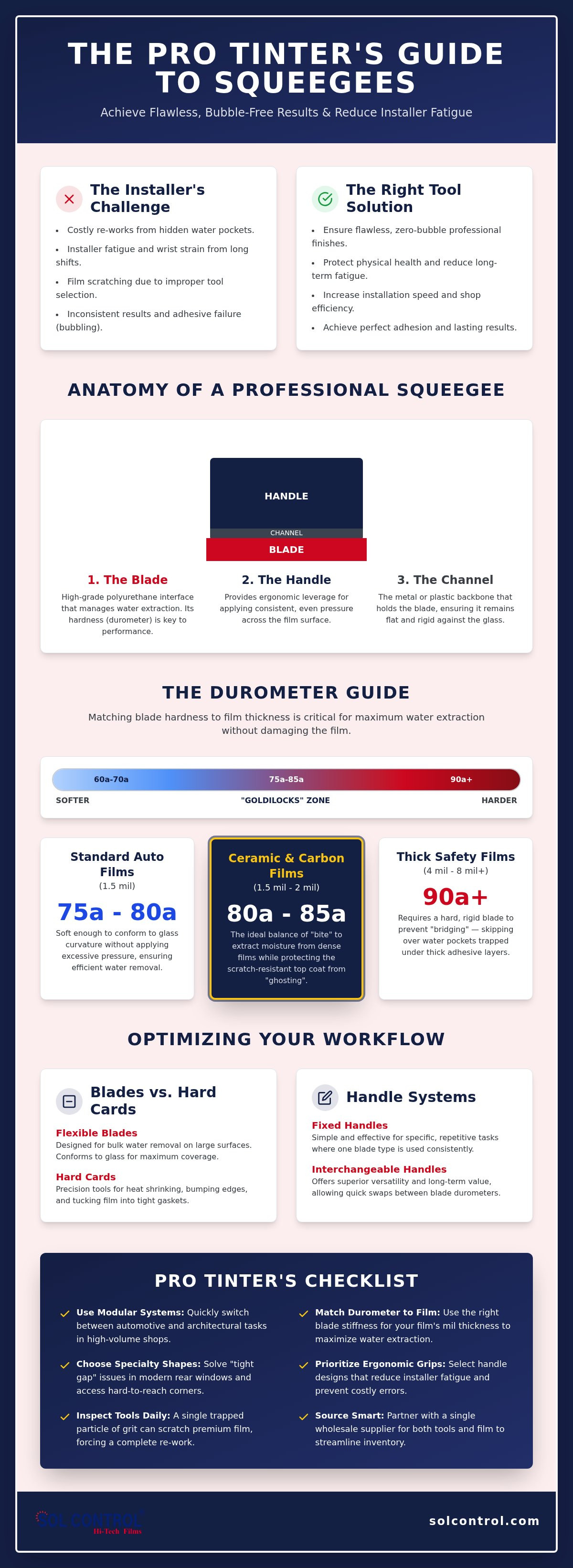
The effectiveness of a professional installation relies on the mechanical bond between the film and the glass. While many people ask, "What is a Squeegee?" and view it as a basic cleaning tool, a professional window tint squeegee is a highly engineered assembly. It consists of three primary parts: the blade, the handle, and the channel. Each component serves a technical purpose. The blade is the interface that manages water extraction. The handle provides the leverage necessary for consistent pressure. The channel acts as the backbone, ensuring the blade remains flat and rigid against the glass surface.
In high-volume shops, modular systems are the industry standard. These systems allow installers to swap components based on the specific film type or glass curvature. This flexibility is vital because the tool does more than move water; it activates the pressure-sensitive adhesive (PSA) on the film. Without the right material—usually high-grade polyurethane—you risk leaving residual moisture that causes bubbling or adhesive failure. Polyurethane offers superior abrasion resistance compared to standard rubber. Some specialized plastics are also used for finish-specific blades, providing a balance between glide and grip that prevents surface marring during the final pass.
Blades vs. Hard Cards: Knowing the Difference
Understanding when to reach for a flexible blade versus a hard card is a hallmark of an expert tinter. Flexible blades are designed for bulk water removal across large surfaces like windshields or side windows. They conform to the glass to ensure maximum coverage and efficient extraction. Conversely, hard cards are precision tools. They are essential for heat shrinking film and tucking edges into tight gaskets where a standard blade is too bulky. To maintain a flawless finish, always inspect your tools for grit. A single trapped particle can scratch a premium ceramic film, leading to expensive re-work and wasted material.
Fixed vs. Interchangeable Handle Systems
Efficiency in a professional environment often comes down to tool maintenance and versatility. Fixed squeegees are useful for specific, repetitive tasks, but interchangeable handle systems offer better long-term value. These systems feature quick-release mechanisms that let you switch between different durometers in seconds. This is particularly helpful when moving from a soft automotive film to a thicker architectural security film. When building your window tint squeegee kit, verify that your channels and handles are compatible. Most professional brands use standardized sizing, but a secure fit is necessary to prevent the blade from slipping under high pressure.
Choosing Squeegee Hardness: The Durometer Guide
Selecting the right window tint squeegee involves more than picking a comfortable handle; it requires a technical understanding of durometer. The durometer scale measures the hardness of the polyurethane blade, typically ranging from 60a (soft) to 95a (hard). Choosing the correct level is a balancing act. Finding the "Goldilocks" zone means selecting a blade that is soft enough to avoid marring the film's surface but hard enough to ensure 100% water removal. If the blade is too soft, it will flex over water pockets. If it's too hard, you risk scratching the film or leaving "ghosting" marks where the adhesive hasn't fully bonded.
A critical factor often overlooked is how film thickness dictates your tool choice. Standard 1.5 mil automotive films generally perform best with a medium-soft blade, typically around 75a to 80a. This allows the tool to conform to the glass without applying excessive localized pressure. However, as you move toward 4 mil or 8 mil safety films, the material's resistance increases. Using a soft blade on thick film results in "bridging," a phenomenon where the squeegee skips over water pockets because it lacks the rigidity to push liquid through the heavier adhesive layer.
Climate control in your shop also dictates tool performance. In cooler environments, a 90a blade may become too brittle to provide a clean sweep. Conversely, in a high-temperature bay, a soft 70a blade can become overly pliable, losing the edge-control needed for precision work. Professional installers often keep a variety of wholesale window tint squeegee blades on hand to adjust to these environmental shifts throughout the day.
The Best Squeegees for Ceramic and Carbon Films
Ceramic films are prized for heat rejection, but their dense construction makes them prone to ghosting if the pressure isn't uniform. For standard 1.5 mil and 2 mil automotive ceramic films, a 80a to 85a durometer is usually the ideal balance. This hardness provides enough "bite" to extract moisture while protecting the delicate scratch-resistant top coat. High-quality blades ensure you aren't fighting the material during the final pass, which is essential for maintaining the clarity customers expect from premium films.
Heavy-Duty Tools for PPF and Safety Films
Installing Paint Protection Film (PPF) or thick architectural safety films requires maximum water displacement. PPF is significantly thicker than standard tint, often reaching 8 mil. This thickness demands a stiffer blade, usually 90a or higher, to overcome the high surface tension of the slip solution. Because these installations require more physical force, understanding Ergonomic Hand Tool Design is essential for maintaining shop productivity without risking repetitive strain injuries. Stiffer blades ensure total water removal in a single pass, which is vital for the heavy-duty adhesives used in security applications.
Specialty Squeegees for Complex Installations
Most installers start with a standard 5-inch blade, but professional success often depends on having the right specialty window tint squeegee for non-standard glass. Modern vehicle designs and large-scale commercial projects present unique obstacles that a basic tool simply cannot overcome. For instance, the choice between a beveled and a square edge might seem minor, but it's the difference between a dry corner and a trapped water pocket. Beveled edges allow you to get closer to the gasket, while square edges provide the maximum surface contact needed for flat glass efficiency. Having a diverse kit ensures you can handle any geometry without compromising the film's integrity.
Reach Tools and Swipers for Automotive Glass
Modern cars frequently feature deep rear decks and steep glass angles that make the bottom edge nearly inaccessible. Tools like the "Bulldozer" or "Side Swiper" are engineered specifically to solve this "tight gap" problem. These elongated handles allow you to apply consistent pressure to the bottom of a rear window without straining your back or risking a crease in the film. Using these slim, specialized tools also reduces the need for door panel removal, saving time and minimizing the risk of breaking plastic clips on a customer's vehicle. When managing the complex curvature of a windshield, matching the tool's flex to the glass is vital for a bubble-free finish.
Architectural Flat Glass Squeegees
Architectural projects demand a different strategy focused on scale and volume. When you're installing solar control film on a commercial energy-efficiency project, a small automotive blade is inefficient. Professionals use wide-format channels, often 12 inches or wider, to handle the massive water volume involved in residential and commercial settings. These wide tools ensure that you cover more surface area with each pass, which is critical when working with fast-drying mounting solutions. Pairing these heavy-duty tools with architectural window film ensures that the adhesive bonds quickly and evenly across the entire pane. This efficiency doesn't just save time; it ensures the longevity and performance of the film, which is essential for maintaining manufacturer warranties on large-scale installations.
Ergonomics and Handle Systems: Optimizing Workflow
The hidden cost of a high-volume shop isn't just film waste; it's the physical toll on the installer. Repetitive motion during a ten-car shift leads to muscle fatigue, which inevitably causes slowed production and inconsistent finishes. A professional window tint squeegee handle is engineered to mitigate these risks by shifting the workload from the small muscles in the wrist to the larger muscle groups in the arm and shoulder. When you select a handle, the grip material is your first line of defense. Rubberized grips offer superior traction in wet environments, whereas standard textured plastic can become slick when saturated with slip solution, forcing the installer to grip harder and increasing strain.
Weight distribution is another critical factor in tool performance. A handle that's too light requires the installer to provide all the downward force, while a handle with a balanced, weighted head uses gravity to assist in water extraction. This balance allows for better control during the final pass. For automotive work, hand-held blocks provide the tactile feedback needed for side windows. In contrast, long-reach handles are essential for architectural projects or deep automotive rear decks, allowing you to maintain consistent pressure across different glass heights without overextending your reach. To upgrade your shop's efficiency and protect your crew, invest in professional window tint squeegee handles that prioritize ergonomic design.
Reducing Repetitive Strain in the Tint Shop
Preventing wrist and elbow injuries starts with proper hand positioning. Installers should maintain a neutral wrist angle, avoiding the "cocked" position that leads to carpal tunnel issues over time. Power handles are specifically designed for this purpose, featuring angled grips that maximize leverage. Training your staff to use their body weight to drive the tool, rather than relying on pure muscle force, ensures they stay productive throughout the week. This technique is especially important when working with thicker films that require high-pressure water extraction to activate the adhesive bond.
Fusion and High-Performance Handle Tech
Professional-grade handles provide superior blade stabilization, which is vital for preventing "blade chatter." Chatter occurs when a blade skips across the glass, leaving behind microscopic streaks of water that can turn into bubbles. High-performance systems often feature quick-change mechanisms, allowing you to swap durometers for multi-stage installations in seconds. Durability is also a key consideration; professional handles are constructed from materials that resist chemical breakdown. Cheap handles often become brittle or "gummy" after prolonged exposure to the surfactants found in professional slip solutions, whereas high-end handles maintain their structural integrity for years.
Sourcing Professional Tinting Tools at Wholesale
Efficiency in a professional shop depends on a streamlined supply chain. Buying your tools and film from a single wholesale partner ensures that your equipment is perfectly matched to the materials you install. Retail "off-the-shelf" hardware store tools are designed for general cleaning; they lack the precision durometer ratings required for film application. Using the wrong tool can void film warranties or lead to surface marring that isn't visible until the adhesive cures. SolControl supports shop growth by providing a one-stop shop for high-performance film rolls and the professional window tint squeegee systems needed to apply them correctly.
Inventory management is a critical but often overlooked aspect of shop profitability. You must keep your crew stocked with fresh blades to avoid the "nicked blade" trap. A single microscopic nick in a polyurethane edge can scratch an entire window's worth of premium ceramic film. By sourcing at wholesale, you can afford to maintain a deep stock of replacement blades, ensuring that your installers never hesitate to retire a worn tool. This proactive approach reduces re-work and maintains the high standards your customers expect. It's a small investment that protects your most expensive inventory: your film rolls.
Building a Comprehensive Installer Kit
A new automotive tint bay requires a specific set of tools to be fully operational, starting with a high-quality window tint squeegee kit. Your essential checklist should include a variety of blades in different durometers to handle various film thicknesses. You'll also need interchangeable ergonomic handles for different glass angles and reach tools for deep rear decks. Architectural contractors need a different setup. They should prioritize wide-format channels and long-reach handles to manage large commercial glass panes effectively. Knowing when to retire a tool is just as important as knowing which one to buy. If you notice uneven water extraction, it's time for a fresh blade.
Partnering with a National Distributor
For multi-location shops, national wholesale access is a game-changer. It provides consistency across all your bays, ensuring every installer uses the same high-quality equipment. Partnering with a national distributor like SolControl allows you to streamline your supply chain and benefit from competitive wholesale pricing. This partnership turns a faceless vendor relationship into a strategic advantage for your business. When you're ready to upgrade your workflow, you can equip your shop with professional tinting tools from SolControl to ensure every project meets the highest industry standards.
Elevate Your Installation Standards
Selecting the right equipment is a strategic investment in your shop's reputation and your team's long-term health. By matching the correct durometer to your film thickness and utilizing specialty reach tools for complex automotive curves, you ensure every project leaves your bay with a flawless, bubble-free finish. Remember that a professional window tint squeegee is more than just a piece of plastic; it's a precision instrument that activates adhesives while protecting expensive scratch-resistant coatings. High-quality tools don't just improve the final look; they define the efficiency of your entire workflow.
As a national wholesale distributor, SolControl is dedicated to providing the specialized tools and professional-grade durability required for all film types, including automotive, architectural, and PPF. Streamlining your supply chain with a reliable partner allows you to focus on what matters most: delivering excellence to your clients. We're proud to support shops across the country with the equipment they need to succeed.
Browse SolControl’s Wholesale Professional Tinting Tools to equip your business with the industry's most reliable installation equipment. We look forward to supporting your growth and helping you achieve a perfect finish on every project.
Frequently Asked Questions
How often should I replace my window tint squeegee blade?
Replace the blade immediately if you detect any nicks, rough edges, or uneven water extraction. In a high-volume shop, professional installers typically swap blades every few weeks to maintain peak performance. A single microscopic defect can scratch expensive ceramic film, leading to costly re-works. Regularly inspecting the polyurethane edge against a light source helps identify wear before it ruins an installation. Fresh blades are a small investment compared to the cost of wasted film.
Can I use the same squeegee for automotive and architectural film?
While you can technically use the same handle, the blades should differ based on the film's mil thickness and the glass surface. Automotive glass often requires more flexible blades to navigate complex curves, whereas architectural projects benefit from stiffer, wider blades for flat glass efficiency. Using an automotive-specific window tint squeegee on large commercial panes is inefficient and may result in residual water pockets due to insufficient pressure distribution across the wider surface.
What is the best squeegee for installing ceramic window tint?
The best option for ceramic film is a medium-hard blade with a durometer rating between 80a and 90a. Ceramic films are denser than standard dyed films and require consistent, firm pressure to activate the adhesive without causing ghosting. A high-quality polyurethane blade ensures maximum water extraction while protecting the delicate scratch-resistant coating. Pair this with a weighted handle to maintain steady leverage during the final pass for a flawless finish.
How do I prevent my squeegee from scratching the film?
Scratch prevention starts with keeping your tools grit-free and lubricated with a proper slip solution. Always store your blades in a clean, dedicated pouch and avoid setting them on dusty surfaces. If a blade becomes nicked, replace it immediately. Many professionals also use specialized lubricants to help the window tint squeegee glide smoothly over the film's surface, reducing friction and the risk of marring the top coat during high-pressure passes.
What durometer squeegee should I use for Paint Protection Film (PPF)?
PPF installation requires a stiffer blade, typically in the 90a to 95a durometer range. Because PPF is significantly thicker than window film, it demands higher pressure to displace the mounting solution and ensure a secure bond. A softer blade will often skip over the thicker material, leaving behind trapped liquid. Using a rigid, high-performance squeegee allows for the aggressive water removal necessary for high-tension automotive surfaces and the thick adhesives used in paint protection.
Do I need a special handle for reach tools like the Bulldozer?
Reach tools like the Bulldozer are specialized, all-in-one instruments designed with integrated long-reach handles. You don't need a separate handle for these, as their fixed design provides the specific leverage required for deep rear decks and steep windshield angles. These tools are engineered to reach gaps where a standard hand-held block cannot fit, ensuring the bottom edge of the film is fully bonded without needing to remove interior door panels or rear decks.
What is the difference between a Blue Max and an Orange Crush squeegee?
The primary difference lies in their durometer and intended application. The Blue Max is an industry-standard blade known for its balance of flexibility and firmness, making it ideal for bulk water removal on automotive glass. The Orange Crush is typically stiffer and designed for maximum extraction on flat glass or thicker films. Both are essential in a professional kit; the choice depends on whether you're prioritizing curvature conformity or raw pressure for thick architectural films.
How do I clean and maintain my squeegee blades for longevity?
Clean your blades after every shift using a mild soap and water solution to remove any residual adhesive or slip solution. Avoid using harsh chemicals that can degrade the polyurethane material over time. Once clean, dry them with a lint-free cloth and store them flat to prevent the edges from warping. Regular maintenance ensures the blade maintains its factory edge, extending its life through hundreds of linear feet of film while preventing cross-contamination between projects.