The Evolution of PPF Film: 2026 Professional Technology and Market Trends
Could the very material you install to protect a vehicle actually be the thing that compromises its finish just a few years later? Every professional installer knows the frustration of ppf film yellowing or adhesive failure in extreme climates. You've likely spent hours fighting a rigid film against the complex curves of a modern vehicle, only to face the headache of rework when the edges lift. These technical failures don't just waste your shop's time; they impact the long-term satisfaction of your most loyal customers.
We believe your craftsmanship deserves a product that matches your high standards. This article details how 2026 technology, including advanced aliphatic TPU and ceramic-infused topcoats, is solving these legacy issues. You'll discover how to identify high-margin film technologies that simplify the installation process and improve your bottom line. We will also preview the rise of color-change films and shifting market demands, ensuring you have the expertise to lead your market as a high-performing innovator and reliable partner to your clients.
Key Takeaways
Understand the critical shift from outdated PVC to Aliphatic TPU to ensure your installations remain clear and free from yellowing over time.
Learn how modern self-healing topcoats and ceramic infusions combine physical armor with superior hydrophobicity for long-term paint protection.
Capitalize on the 2026 demand for satin and colored ppf film to offer high-margin customization services that outperform traditional vinyl wraps.
Identify the specific technical markers of film quality, such as optical clarity and adhesive tack, to minimize installation rework and improve efficiency.
Discover how sourcing bulk rolls through a dedicated wholesale partner can streamline your inventory and significantly increase shop profitability.
The Evolution of Paint Protection: From Vinyl to Advanced PPF Film
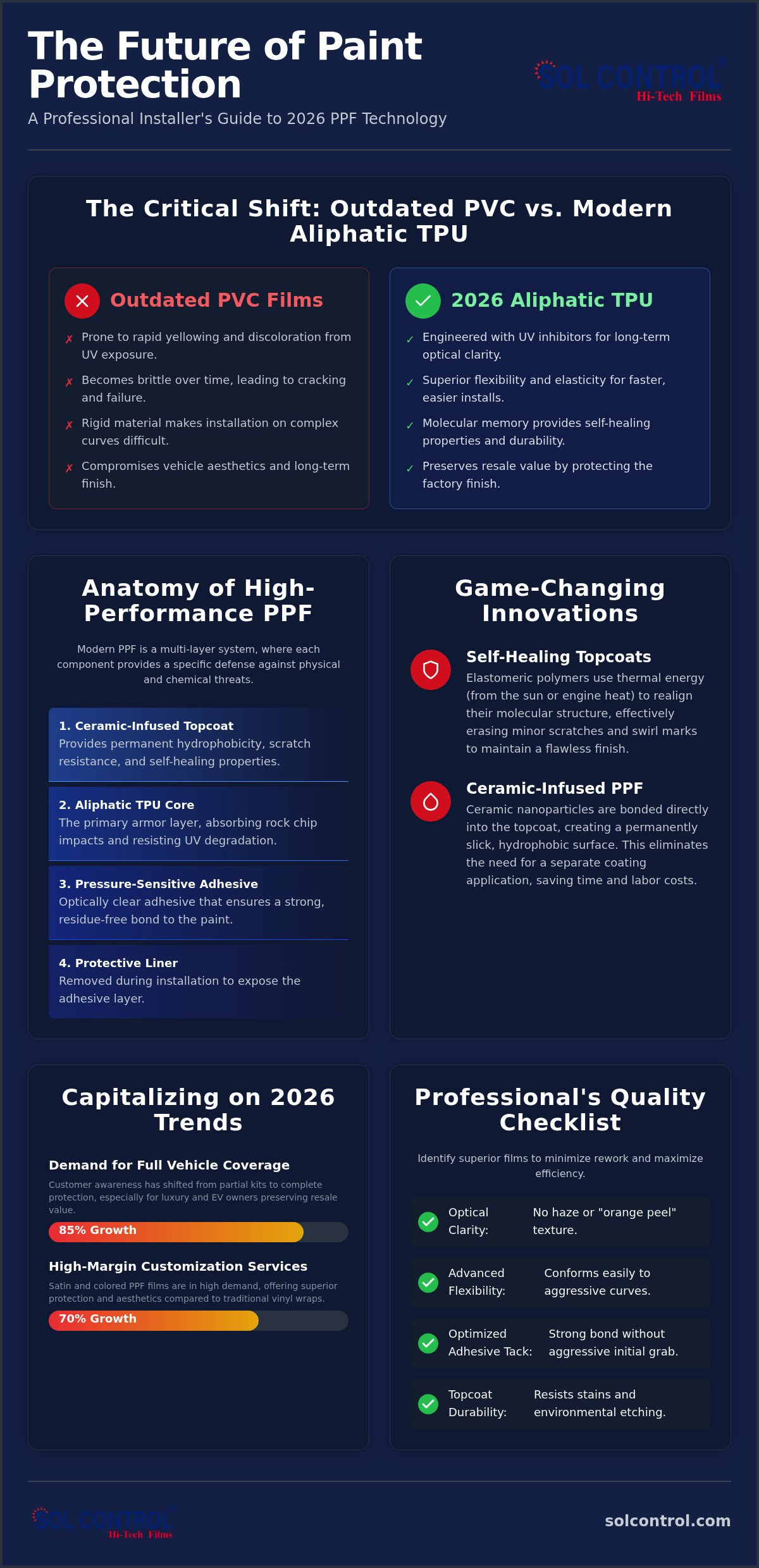
Modern ppf film has moved far beyond its origins as a simple sacrificial layer. While the history of paint protection film began with military applications, today's professional market relies on high-impact Thermoplastic Polyurethane (TPU) as a sophisticated barrier. Unlike early PVC "clear bras" that were prone to cracking and rapid discoloration, modern TPU is engineered for optical clarity and extreme durability. This material shift was necessary to meet the demands of a high-end automotive market that doesn't tolerate compromised aesthetics.
In 2026, multi-layer constructions are the standard because environmental factors have become more aggressive. A typical high-performance roll now features a specialized topcoat, a central TPU core, and a pressure-sensitive adhesive layer. Each layer serves a specific purpose, from repelling water to absorbing the kinetic energy of a stone chip. Professionals now demand films that offer a dual-threat defense: physical impact protection and advanced chemical resistance against modern road treatments and pollutants.
Why TPU Became the Professional Standard
Installers shifted to TPU primarily because of its superior material flexibility. This elasticity allows the film to conform to the aggressive aerodynamic curves found on modern supercars and electric vehicles, significantly increasing installation speed and reducing the risk of edge lift. High-quality TPU also incorporates advanced UV inhibitors within the film's structure. These chemical stabilizers prevent the oxidation process that causes cheaper films to turn yellow over time. TPU utilizes molecular memory to return to its original shape after deformation, providing a durable surface that resists permanent indentation.
The Shift in Consumer Awareness and Demand
The market for paint protection has expanded rapidly due to the visual nature of social media platforms. Platforms like Instagram and TikTok have educated vehicle owners on the benefits of "new car protection" before they even leave the dealership. As your partner in the film industry, we've observed a clear transition from partial front-end kits toward full-vehicle coverage as owners seek to preserve the resale value of their investments. This is especially true for the growing demographic of luxury EV owners who view their vehicles as high-tech assets and want to keep the factory finish pristine for years.
2026 Material Science: Self-Healing and Ceramic Infusion
The performance of modern ppf film is no longer defined solely by its thickness. In 2026, the focus has shifted toward active surface management through advanced material science. Professional installers now work with films that don't just sit on the paint; they react to the environment. This evolution is driven by the integration of elastomeric polymers and ceramic nanoparticles that provide a level of protection previously impossible with standard TPU alone.
A primary advancement in 2026 is the refinement of the "self-healing" topcoat. This technology relies on molecular realignment. When the surface receives minor scratches or swirl marks, the topcoat's polymer chains are disrupted. By applying heat from the sun or the vehicle's engine, these chains return to their original, uniform state. While "instant-heal" films that work at room temperature have gained some traction, many high-volume shops still prefer heat-activated technology. Heat-activated films often provide a denser molecular structure, offering better long-term resistance against deep scoring and environmental etchings.
The Mechanics of Self-Healing Technology
Understanding the layers is crucial for a successful installation. The base TPU layer provides the "armor" against rock chips, while the thinner elastomeric topcoat handles the aesthetics and healing. Professional installers often demonstrate this to customers using a brass wire brush. By intentionally scuffing a sample and then applying a heat gun, you can show how the film repairs itself in seconds. This healing capability remains active for years, though its efficiency can vary based on regional climates. In high-UV environments, the constant thermal cycles actually help keep the topcoat "active" and clear.
Ceramic-Infused Topcoats: A Two-in-One Solution
The emergence of ceramic-infused ppf film has changed the workflow for modern shops. By bonding ceramic nanoparticles directly into the topcoat during the manufacturing process, these films offer permanent hydrophobicity. This eliminates the need for installers to apply a separate ceramic coating after the film is set. The resulting surface is incredibly slick, making it difficult for bird droppings, road salt, or industrial fallout to bond to the material.
Just as Why Premium Window Film Matters for Modern Vehicles by providing essential heat rejection, ceramic-infused PPF provides a comprehensive chemical defense. It reduces maintenance for the end-user and ensures the vehicle maintains a "just-waxed" look without additional labor. When you're looking to streamline your shop's offerings, our wholesale paint protection films provide the high-performance materials needed to satisfy these modern consumer demands.
Clear vs. Satin vs. Color PPF Film: Analyzing 2026 Trends
The visual landscape of automotive protection has changed. While clear films remain the foundation of the industry, the 2026 market is increasingly driven by aesthetic transformations. Customers are no longer asking if they should protect their paint; they're asking how they can change its appearance while doing so. This shift has placed satin and color films at the forefront of professional shop offerings.
For a deeper look at the core science behind these materials, see our guide on Mastering Paint Protection Film: The Professional’s Guide to PPF Technology. Understanding these fundamentals helps you explain the value gap between traditional wraps and high-performance TPU to your clients. A critical distinction in 2026 is the physical composition of these materials. Traditional vinyl wraps generally range from 3 to 4 mils in thickness, offering minimal protection against road debris. Professional-grade ppf film, however, maintains an 8 to 10 mil profile even when pigmented. This added mass provides the genuine impact resistance that vinyl simply cannot match.
The Professional Case for Color PPF
Color PPF is rapidly replacing vinyl for high-end color changes. The durability advantage is staggering. While vinyl often reaches the end of its life in 3 years, a quality TPU-based color film can last 7 to 10 years without significant degradation. The finish is also far more convincing. Because the material is thicker and higher quality, it eliminates the "orange peel" texture often associated with thin vinyl films, resulting in a deep, paint-like luster. Transitioning from vinyl to color PPF enables your shop to justify premium labor rates while delivering a finished product that outlasts traditional alternatives by nearly triple the lifespan.
Satin and Matte Finishes for Modern Aesthetics
The demand for "Stealth" looks on performance vehicles continues to grow. Satin PPF allows you to transform a standard gloss finish into a sophisticated, frozen aesthetic without the permanent commitment of a matte paint job. It's a practical choice for the end-user too. Matte paint is notoriously difficult to maintain and impossible to repair without a full respray. Satin ppf film provides that same look but remains easy to clean and offers self-healing properties. To achieve the best results, prioritize wrapping every possible edge. This ensures no gloss is visible at the panel gaps, providing the seamless, factory-style finish that premium customers demand.
Evaluating Film Quality: What Professionals Look For
Identifying high-tier material requires a critical eye for optical precision. Professionals look for a finish that mirrors the factory clear coat. High-quality ppf film should be nearly invisible once cured. If you see "orange peel" texture, it's often a sign of a lower-quality release liner. Using a PET liner instead of a paper one ensures the adhesive remains perfectly smooth before installation. This preserves the high-gloss finish your customers expect on their luxury vehicles.
The adhesive is the engine of the film. A professional-grade tack allows for easy repositioning during the initial layout. You need enough "slip" to move the film but enough "bite" to lock the edges. This prevents "silvering" or lift lines when you apply pressure with a squeegee. Modern 2026 adhesives are also breathable. This allows moisture from the installation solution to evaporate quickly. It prevents unsightly water traps during the curing phase. Long-term reliability is equally important. The adhesive must maintain its bond for years. It must also release cleanly without damaging the underlying paint when it's finally time for removal.
Thickness vs. Conformability
Finding the balance between protection and workability is a primary challenge for any shop. Most professionals prefer the 8-mil standard. It's thick enough to stop a high-velocity rock chip. It's also flexible enough to stretch around a complex front bumper. In 2026, manufacturing advancements have made these films more pliable without sacrificing their tensile strength. This reduces the physical strain on the installer. It also minimizes the need for excessive heat or relief cuts on aggressive body lines. Achieving a "hidden" installation also relies on using the right professional-grade installation tools to ensure every edge is tucked and every bubble is purged. By choosing materials that prioritize both protection and labor efficiency, your shop can reduce rework and increase daily throughput.
Scaling Your Shop with Professional Wholesale PPF Solutions
Expanding a paint protection business in 2026 requires more than just installation skill. It demands a strategic approach to procurement and inventory management. Transitioning from a per-job kit model to a professional wholesale workflow is the most effective way to increase your shop's throughput. By sourcing bulk rolls of high-performance ppf film, you gain the flexibility to handle custom installations while significantly lowering your material costs. This shift allows you to capture higher margins on every vehicle that enters your bay.
SolControl serves as a dedicated partner for professional shops across the country. We focus exclusively on wholesale distribution, which means we never compete with our customers in the installation market. Our commitment is to provide the reliable supply chain you need to grow your brand. By partnering with a distributor that understands the technical nuances of the industry, you can reduce overhead and ensure you always have access to the latest film technologies and professional tools.
Wholesale vs. Retail: The Margin Advantage
The financial logic of bulk purchasing is clear. When you calculate the cost-per-square-foot of a 60-inch bulk roll compared to a pre-cut kit, the savings are substantial. These savings represent the difference between a shop that merely survives and one that scales. Managing your inventory effectively means keeping the right widths in stock to minimize waste. A well-stocked shop can respond to walk-in clients immediately, providing a level of service that smaller competitors cannot match. This readiness is a hallmark of a mature, high-volume operation.
Equipping the Modern PPF Installer
High-end film tech requires high-end tools. To achieve the "hidden" installations discussed earlier, you need precision cutting tools and high-performance plotters. Relying on generic equipment often leads to jagged edges or wasted material, which erodes your profitability. Your shop should maintain a consistent stock of professional squeegees, specialty prep chemicals, and high-tack adhesive promoters. These items aren't just accessories; they're essential components of a premium service offering.
Marketing your business as a top-tier provider becomes much easier when you can prove you use industry-leading materials. When you're ready to elevate your shop's performance, you can Explore SolControl’s Professional PPF and Tool Inventory to find the exact specifications your team needs. We're here to provide the expertise and inventory that helps you lead your local market with confidence.
Future-Proofing Your Paint Protection Business
The landscape of automotive protection in 2026 is defined by rapid innovation and shifting consumer expectations. Success for the modern installer depends on mastering advanced material science; this includes everything from self-healing topcoats to the high-margin opportunities of color-change ppf film. By prioritizing optical clarity and adhesive reliability, you can reduce rework and build a reputation for excellence that secures long-term customer loyalty.
Scaling your operations requires more than just technical skill. It requires a supply partner that understands your business model. SolControl supports your growth with dedicated B2B wholesale support and an extensive inventory of high-performance films. With our national US shipping and professional-grade tools, you'll ensure your shop remains equipped for the most demanding projects. Partner with SolControl for Wholesale PPF and Professional Tools to secure your place at the forefront of the industry. We're invested in your success and look forward to helping you thrive in this evolving market.
Frequently Asked Questions
How long does professional PPF film typically last?
Professional grade ppf film typically lasts between seven and ten years when properly maintained. This longevity depends heavily on the quality of the TPU used and the environmental conditions the vehicle faces. High-end films are engineered with UV stabilizers that prevent cracking and discoloration over this period. While cheaper alternatives may degrade in three years, premium wholesale films provide the long-term reliability required for high-end professional shop warranties.
Is PPF better than a ceramic coating for rock chip protection?
Paint protection film is significantly better for rock chip protection because it is a physical, high-impact barrier. Ceramic coatings provide a thin, sacrificial layer that repels water and prevents chemical etching but lacks the mass to absorb the kinetic energy of road debris. For comprehensive defense, many professionals recommend installing the film on high-impact areas and then applying a coating or using ceramic-infused films for total surface management.
Can you install PPF film over a car that has already been ceramic coated?
You cannot install film directly over a ceramic coating because the coating's hydrophobic properties prevent the adhesive from bonding. If a vehicle has already been coated, the surface must be mechanically polished to remove the ceramic layer before the installation begins. Failing to do this results in edge lifting and immediate adhesive failure. Always verify the vehicle's history during the intake process to ensure a secure and permanent bond.
What is the difference between TPU and TPH in paint protection films?
Thermoplastic Polyurethane (TPU) is the professional industry standard due to its extreme flexibility and resistance to yellowing. TPH is a more affordable alternative that often blends PVC with plasticizers. While TPH is easier on the budget, it lacks the molecular memory and long-term durability of pure TPU. Professionals typically avoid TPH for full vehicle coverage because it becomes brittle and discolors much faster than high-performance TPU-based materials.
How do I maintain my PPF film to prevent it from staining?
Maintaining ppf film requires regular washing using pH-neutral soaps and microfiber mitts. You should avoid using high-pressure sprayers directly at the edges to prevent lifting. It is crucial to remove organic contaminants like bird droppings and tree sap immediately, as their acidic nature can eventually etch the topcoat if left in direct sunlight. Using a dedicated sealant or a ceramic-infused maintenance spray will help preserve the film's hydrophobic properties and gloss.
Can PPF film be removed without damaging the original factory paint?
Professional film can be removed without damaging factory paint if the correct techniques are utilized. Using a steamer or a controlled heat source softens the adhesive, allowing the film to pull away cleanly. It is important to note that this applies to original equipment manufacturer (OEM) paint. Repainted panels may have weaker bonds, so installers should always use caution and perform a patch test on non-factory finishes before proceeding with a full removal.
Is color PPF as durable as clear paint protection film?
Modern color-change films are just as durable as their clear counterparts. In 2026, these products utilize the same 8 to 10 mil TPU construction, providing identical impact resistance and self-healing capabilities. Unlike traditional vinyl wraps that are thin and prone to tearing, color-infused protection films offer a paint-like finish that lasts for seven to ten years. This makes them a superior choice for customers seeking both aesthetic customization and heavy-duty protection.
What tools are essential for a professional PPF installation?
A professional installation requires a specific set of high-performance tools to ensure a seamless finish. Essential items include a variety of squeegees with different durometers for varying curves, precision cutting blades, and a digital plotter for accurate pattern cutting. You also need professional-grade slip solutions and adhesive promoters to manage the tack during the layout. Having a reliable heat gun is critical for complex bumpers and final edge wrapping to prevent lifting over time.