The Professional Guide to Security Window Film Wholesale: Selection and Performance
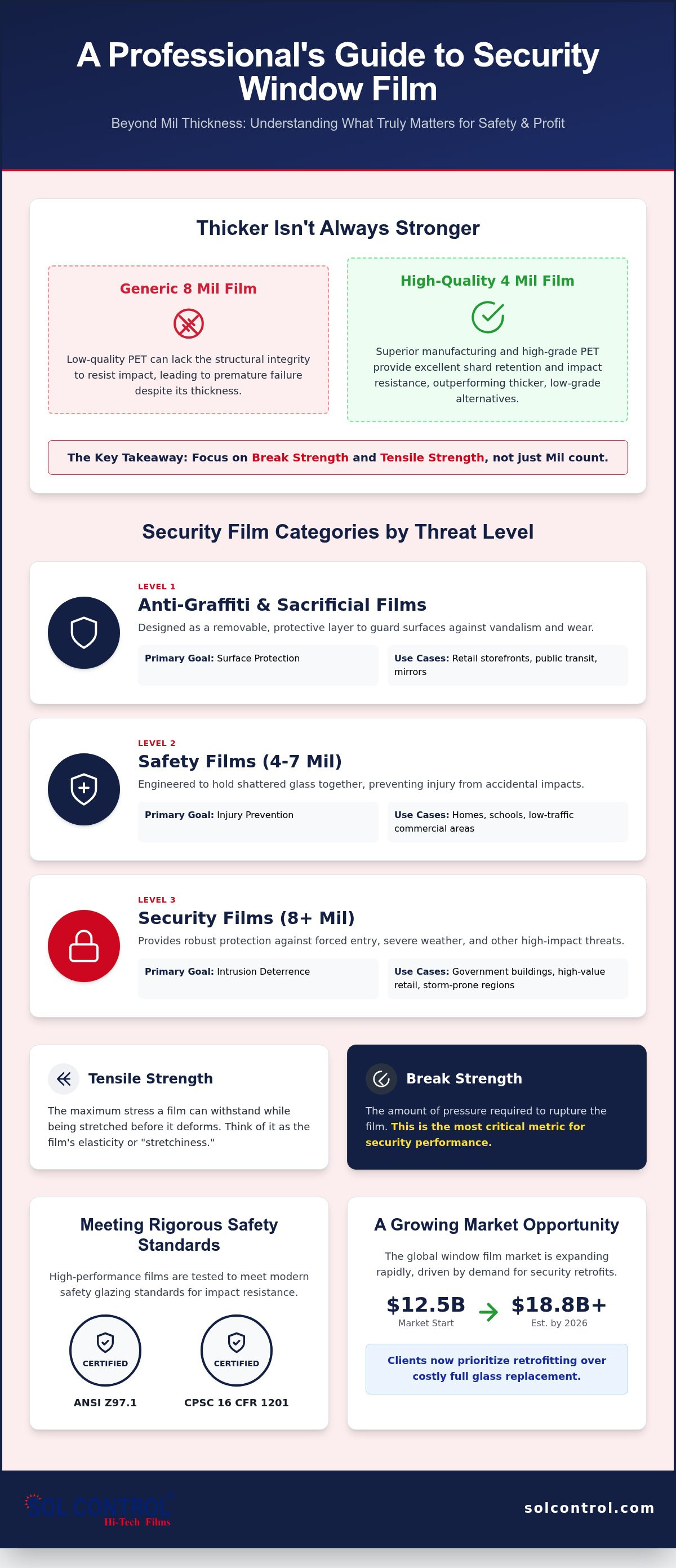
Is a thicker film always a safer film? Many professional installers assume that a higher mil count automatically equates to better protection, but the reality of security window film wholesale is far more nuanced. You likely already know that balancing inventory costs with client expectations is a constant challenge. It is frustrating when you have to explain to a customer why a high quality 4 mil film might outperform a generic 8 mil alternative in specific impact tests. Choosing the wrong roll doesn't just compromise safety; it eats into your margins and complicates project management.
This guide helps you cut through the technical noise to master the specifications that actually matter for your bottom line. We will demystify the relationship between tensile strength and break strength while exploring how to meet rigorous ANSI Z97.1 and CPSC 16 CFR 1201 safety standards. You'll learn how to identify the ideal wholesale partner for bulk architectural rolls and how to tailor your selection for different threats, from smash and grab burglaries to severe storm protection. By the end, you will have the expertise to select the most profitable and protective films for every architectural project you undertake.
Key Takeaways
Analyze the growing shift toward functional security upgrades and why commercial facility managers now prioritize retrofitting over costly glass replacement.
Master the technical distinction between mil thickness and actual break strength to optimize your security window film wholesale selection for every job.
Categorize film types based on specific performance needs, ranging from sacrificial anti-graffiti layers to high-security films designed for intrusion prevention.
Use a structured assessment process to match film specifications with unique threat profiles and glass substrates such as annealed or tempered panes.
Partner with a dedicated B2B distributor that supports your growth with bulk architectural inventory and professional tools without competing for your installation contracts.
The Rising Demand for Security Window Film Wholesale
The global window film market is entering a phase of rapid expansion. Experts estimate the market size will reach between $12.51 billion and $18.81 billion by 2026. This surge isn't just about solar control; it's fueled by a massive shift toward functional security upgrades. Commercial facility managers are increasingly prioritizing retrofit security over full glass replacement. Retrofitting is less disruptive to daily operations and significantly more budget-friendly for large properties. It allows for a rapid security hardening of the building envelope without the structural changes required for new glazing.
For the professional installer, this trend represents a significant opportunity to scale. By utilizing security window film wholesale sources, you can bid on massive contracts that require hundreds of feet of material. It's about moving from small residential jobs to becoming a critical partner for commercial safety. Adding high-performance security films to your service portfolio doesn't just increase your average ticket size. It establishes your business as a technical expert capable of solving complex safety challenges for high-stakes clients.
Safety vs. Security: Defining the Categories
Understanding the technical distinction between these two categories is vital for client communication. Solar tint is designed for heat and UV rejection, but Safety and security window film is engineered to hold glass together under extreme pressure. The primary goals are glass shard retention, burglary deterrence, and impact resistance. These products turn standard glass into a resilient barrier that remains in the frame even after it breaks.
You'll typically find that safety films are 4 mil thick. These are excellent for preventing injury from accidental impact in homes or low-traffic areas. However, true security film usually starts at 7 or 8 mil. These thicker laminates provide the structural integrity needed to resist intentional intrusion or severe weather events. Explaining this difference helps your clients understand why a specific thickness is required to meet their actual threat profile.
Market Drivers for Wholesale Buyers
Public demand for safer environments is at an all-time high. We're seeing an increased focus on school safety and government building retrofits across the country. These institutions need scalable solutions that don't require the extreme cost and downtime of a full window replacement. High-performance PET films provide a durable barrier that meets modern safety glazing standards like ANSI Z97.1 and CPSC 16 CFR 1201.
Installers are moving toward bulk roll procurement to stay competitive. Buying security window film wholesale ensures you have the inventory ready for immediate deployment when a large project lands. Accessing a wide range of architectural window films in bulk allows you to offer custom solutions for every threat profile, from basic safety to high-level security. This proactive inventory management is the hallmark of a successful, professional installation business.
Understanding Technical Specifications: Mils, Tensile Strength, and Safety Standards
In the security window film wholesale market, the "mil" is the standard unit of measurement for thickness. One mil represents 1/1000th of an inch. While installers often use this as a shorthand for strength, the actual protection level depends on the quality of the polyethylene terephthalate (PET) used in the manufacturing process. High-grade PET offers superior optical clarity and dimensional stability. Low-quality wholesale films might meet thickness requirements but lack the structural integrity needed to pass rigorous safety tests over the long term.
You must distinguish between tensile strength and break strength to choose the right product for your project. Tensile strength refers to the maximum stress a film can withstand while being stretched before it begins to deform. Break Strength is the amount of pressure required to rupture the film. For architectural projects, a high break strength is non-negotiable. It ensures the film doesn't fail the moment an intruder applies force or a storm-blown object hits the pane. When you source your architectural window films from a dedicated wholesaler, you ensure every roll meets these rigorous technical benchmarks.
Safety Certifications Every Pro Should Know
ANSI Z97.1 is the benchmark for safety glazing materials in the United States. This standard tests for human impact to ensure the glass breaks safely into small pieces or stays bonded within the frame. CPSC 16 CFR 1201 is a federal safety standard specifically for impact resistance in architectural glass used in doors and large windows. If you're working on global projects, you'll also encounter EN 12600. This European standard uses a pendulum impact test to classify glass safety levels. Understanding these codes allows you to provide documented proof of performance to your clients, justifying the cost of a professional installation over a DIY alternative.
The Role of Multi-Layer Construction
Modern high-performance films often utilize micro-layering technology. This process stacks dozens of thin layers to create a laminate that is far more tear-resistant than a single-layer film of the same thickness. It's similar to the difference between a single thick sheet of paper and a stack of thinner sheets bonded together; the stack is much harder to rip. This technology allows for thinner films that offer the protection levels of much bulkier traditional products.
The adhesive system is just as critical as the film itself. Pressure-sensitive adhesives (PSA) create a powerful, permanent bond between the film and the glass surface. This bond ensures that even when the glass shatters, the fragments remain attached to the film rather than becoming dangerous projectiles. Most professional-grade films also include UV rejection capabilities. This protects interior furnishings from fading while the film performs its primary security function, adding another layer of value for the end-user.
Comparing Security Film Categories: From Anti-Graffiti to High-Security
Not all threats are created equal, and your inventory should reflect that reality. When sourcing security window film wholesale, you must distinguish between sacrificial layers and structural laminates. A common mistake in the industry is treating 4 mil anti-graffiti film as a high-security solution. While both offer glass shard retention, their engineering targets different outcomes. Standard 4 mil safety film is the baseline for residential and light commercial use. It provides excellent protection against accidental impacts and serves as a deterrent for "smash and grab" crimes by increasing the time and effort required to gain entry.
High-security laminates ranging from 8 to 14 mils are designed for extreme environments. These thicker PET layers are engineered to resist sustained manual attacks and high-velocity wind events. They don't just hold glass together; they maintain the integrity of the building envelope under intense duress. These heavy-duty films often require specialized attachment systems to bond the film to the window frame. For installers, these rolls represent high-value contracts where technical performance is the primary selling point. They are the go-to choice for government buildings, jewelry stores, and coastal properties prone to storms.
Clear Security Film: The Invisible Shield
Clear security film remains the industry standard for retail storefronts and historic properties. It provides an invisible shield that doesn't alter the building's aesthetic or block natural light. High-quality wholesale rolls must maintain perfect optical clarity even at 12 or 14 mil thicknesses. A premium scratch-resistant coating is essential here. It ensures the film stays clear despite regular cleaning and high-traffic exposure, maintaining the professional appearance of the facility for years.
Anti-Graffiti Film: The Sacrificial Solution
Anti-graffiti film acts as a sacrificial barrier for glass surfaces. These 4 mil or 6 mil films protect expensive glass from etching, spray paint, and general vandalism. For public transit authorities and urban retailers, these films are a financial necessity. The economics are simple. Replacing a roll of wholesale anti-graffiti film is significantly cheaper than replacing a large tempered glass pane. It creates a recurring revenue stream for installers who offer maintenance and replacement services to their B2B clients.
Solar Security Hybrid Films
Solar security hybrid films provide a dual-purpose solution for modern buildings. They merge Total Solar Energy Rejection (TSER) with the impact resistance of a safety laminate. These are ideal for schools and corporate offices that need to meet energy efficiency goals while hardening their security. You can find a variety of these specialized architectural window films that balance visible light transmission with physical protection. It's an efficient way to solve two problems with a single installation, providing both safety and comfort.
The Professional’s Buying Guide: Selecting the Right Security Film
Selecting the right roll from a security window film wholesale catalog requires a methodical approach that balances technical performance with project profitability. First, assess the threat profile. You must determine if the goal is preventing injury from accidental glass breakage or stopping a determined intruder. Second, identify the glass type. Annealed glass requires a different adhesion strategy than tempered glass because of how the substrate shatters. Once technical needs are met, focus on your bottom line. Calculate your roll yield to minimize scrap. Every inch of wasted film is lost revenue. Choosing the correct width, such as 36, 60, or 72 inches, for commercial panes ensures you aren't paying for material that ends up in the trash. Finally, ensure your team has specialized tinting tools designed for high-mil applications. Standard automotive squeegees won't provide the necessary pressure for thick safety laminates.
Roll Size and Inventory Management
Standard 100-foot rolls are the backbone of the wholesale industry. When you're bidding on large-scale projects, calculate your costs by the linear foot rather than square footage. This provides a more accurate picture of your actual overhead and potential waste. Store your rolls vertically in a climate-controlled environment to maintain product integrity. This prevents "tunneling," which is a common issue where the film separates from the liner due to the weight and thickness of the PET layers in 8 mil or 12 mil products.
The Importance of Attachment Systems
Even the strongest film can fail if a heavy impact pushes the entire broken pane out of the frame. Many installers overlook the frame, but it's a critical point of failure. An attachment system bonds the filmed glass to the window frame itself, creating a unified barrier. Wet-glaze systems use high-strength structural silicone, while mechanical systems use metal profiles to clamp the film in place. Offering these systems as an upsell provides a comprehensive security package that protects against extreme impact events and manual intrusion.
Common Installation Mistakes to Avoid
Security film is far less forgiving than solar tint. Even tiny dust particles can create visible "white light" gaps under thick 8 mil or 12 mil film. You must use high-pressure squeegees to evacuate all mounting solution during the install. Without enough pressure, the adhesive won't bond correctly to the glass. Always manage client expectations regarding curing times. Thick films can take several weeks to fully dry. Small water bubbles are a normal part of the drying process, and they'll eventually disappear as the film cures. To ensure project success, source your bulk architectural window films from a distributor that understands the specific needs of the professional installer.
Scaling Your Business with SolControl Architectural Security Films
SolControl serves as more than a vendor; we act as a national distribution partner for professionals looking to dominate the high-security market. Scaling your operation requires a reliable supply chain that understands the unique demands of large-scale commercial bids. By focusing exclusively on security window film wholesale distribution, we ensure our interests never conflict with yours. We don't compete for installation contracts. Instead, we provide the high-performance PET films and professional-grade tools you need to deliver exceptional results for your clients. This installer-first approach allows us to focus entirely on empowering your growth through superior product availability and technical support.
Our inventory is designed to meet the technical requirements of modern safety standards while maintaining the margins necessary for business success. We understand that architectural projects often require a diverse range of specifications. Whether you're hardening a school's entry points or protecting a retail corridor from vandalism, having bulk access to premium materials is the key to winning and executing high-ticket contracts. Leveraging our national reach means you can bid on projects across the country with the confidence that your materials will arrive on time and as specified.
Standout Security Solutions from Our Collection
Building a versatile inventory starts with the fundamentals. Our clear 4 mil and 8 mil safety films are the foundation of any professional security kit. These films provide the essential shard retention and impact resistance required for standard safety glazing compliance. For urban environments where property damage is a frequent concern, our sacrificial anti-graffiti films offer a cost-effective way to protect expensive glass surfaces from etching and paint. These films are engineered for easy removal and replacement, ensuring the glass underneath remains pristine.
Many commercial clients now demand multi-functional solutions. We offer high-performance architectural film options that combine solar control with physical protection. These hybrid films allow you to solve energy efficiency issues while simultaneously upgrading the building's security profile. This dual-purpose approach is a powerful selling point when pitching to facility managers who need to maximize their retrofit budgets. By offering a single product that reduces glare and heat while preventing forced entry, you provide a value proposition that is difficult for competitors to match.
The SolControl Advantage
Reliability is the cornerstone of a successful partnership. We maintain consistent stock levels and offer efficient national shipping to ensure your project timelines stay on track. Our wholesale pricing structure is built specifically for the professional installer, allowing you to remain competitive without sacrificing quality. Beyond the film itself, we empower your business with professional tools and marketing materials that help you communicate the value of security upgrades to end-users. We believe that your success is our success. We invite you to browse our full architectural collection for your next project.
Elevate Your Installation Standards with High-Performance Security Solutions
The transition from basic tinting to high-level security hardening is a significant step for any installation business. You now understand that mastering the technical nuances of break strength and safety certifications is what separates a generalist from a true security professional. By accurately profiling threats and selecting the correct mil thickness for every substrate, you ensure the safety of your clients while protecting your own reputation. Success in this field depends on more than just skill; it requires a reliable supply chain that provides the right materials exactly when you need them.
Accessing security window film wholesale through a dedicated B2B partner gives you the edge in a competitive market. Our professional-grade PET construction ensures long-term durability, while our wholesale pricing for full rolls helps you maintain healthy margins on every bid. With national shipping across the US, you can confidently scale your operations to handle large-scale commercial retrofits. We are here to support your journey as you provide essential protection to schools, businesses, and government facilities.
What is the difference between 4 mil and 8 mil security film?
The primary difference lies in protection levels and break strength. A 4 mil film is typically used for safety applications, such as preventing injury from accidental glass breakage. In contrast, 8 mil film is a standard choice for security window film wholesale buyers targeting burglary deterrence and storm protection. Thicker 8 mil construction offers higher resistance to manual attacks and impacts, making it the preferred specification for commercial hardening projects.
Can security window film stop a bullet?
Security window film is not bulletproof. While it is engineered to be shatter-resistant and hold glass fragments together upon impact, it cannot stop a bullet from penetrating the surface. Its purpose is to delay forced entry and reduce the secondary hazard of flying glass shards during an event. Professional installers must clarify this distinction to end-users to ensure they understand the film is a deterrent rather than a ballistic barrier.
Is security window film installed on the inside or outside of the glass?
Most security films are installed on the interior surface of the glass to protect the polyester layers from environmental degradation and weathering. This placement ensures the longest possible lifespan for the adhesive bond and the scratch-resistant coating. While specialized exterior films exist for anti-graffiti or specific architectural needs, interior installation remains the industry standard for structural security. This approach keeps the film shielded from UV exposure and temperature fluctuations.
How long does security window film last on commercial properties?
High-performance security films typically last between 10 and 15 years on commercial properties when maintained correctly. Factors such as UV exposure levels, climate, and cleaning habits influence this duration. Professional-grade PET films with advanced scratch-resistant coatings are designed to withstand the rigors of high-traffic environments without yellowing or peeling. Choosing quality security window film wholesale rolls ensures that the adhesive remains stable and the optical clarity stays consistent throughout the product service life.
Does security film make glass unbreakable?
No film can make glass completely unbreakable. Instead, security film is designed to change the way glass behaves when it fails. Upon impact, the glass will still shatter, but the powerful pressure-sensitive adhesive keeps the fragments bonded to the film and within the window frame. This creates a resilient barrier that makes unauthorized entry difficult and time-consuming. It effectively turns a standard window into a safety laminate that resists collapsing even after multiple strikes.
What tools are required for installing thick security films?
Installing thick security films requires specialized tools that can apply significantly more pressure than standard automotive tinting equipment. You'll need heavy-duty squeegees with reinforced handles to evacuate the mounting solution from beneath 8 mil or 12 mil PET layers. High-quality stainless steel blades are also essential for clean edges on these tougher materials. Using the right professional-grade tools prevents water pockets and ensures the adhesive achieves a full, permanent bond with the glass substrate.
How do I maintain and clean security window film?
Maintenance should only begin after the film has fully cured, which can take 30 to 60 days depending on thickness and climate. Use a soft, non-abrasive cloth or synthetic sponge paired with a mild, ammonia-free cleaning solution. Avoid using paper towels or bristled brushes that could scratch the film surface over time. Regular, gentle cleaning removes surface contaminants and preserves the optical clarity of the installation, ensuring the security upgrade remains an invisible barrier.
Is security film compatible with tempered glass?
Security film is fully compatible with tempered glass, though it functions differently than on annealed panes. Because tempered glass shatters into small, pebble-like fragments, the film acts as a safety net to keep those pieces together. For high-security applications involving tempered glass, we often recommend using a wet-glaze or mechanical attachment system. These systems bond the filmed glass to the frame, preventing the entire sheet of shattered pebbles from being pushed out.