The Professional’s Guide to Reflective Window Film: Performance, Selection, and Wholesale Supply
High-performance reflective window film is the most efficient tool in a professional's arsenal for solar control, yet miscalculating the glass type can lead to a catastrophic thermal crack before the job is even finished. You know that balancing maximum heat rejection with aesthetic appeal is a delicate act. It's frustrating when a client loves the daytime privacy but calls with complaints the moment the sun goes down and their windows turn into giant interior mirrors. These technical hurdles don't just hurt your reputation; they eat into your margins through callbacks and replacements.
This guide helps you master the technical nuances of reflective technologies so you can provide superior heat rejection and privacy solutions without the common pitfalls of thermal stress or poor visibility. You'll learn the critical differences between single and dual reflective films, how to select the optimal VLT for specific climate zones, and how to secure a reliable wholesale partner for bulk rolls to keep your projects moving. By understanding these performance metrics, you'll transition from a simple installer to an authoritative expert who delivers lasting value to every commercial and residential client.
Key Takeaways
Learn why reflective window film remains the industry standard for achieving the highest Total Solar Energy Rejection (TSER) in extreme heat environments.
Understand the critical balance between exterior and interior Visible Light Reflectance (VLR) to manage client expectations regarding aesthetics and visibility.
Discover how dual-reflective technology eliminates the nighttime mirror effect, preserving interior views while maintaining daytime privacy.
Identify the signs of thermal stress and learn how to select film-to-glass combinations that prevent cracks in annealed or dual-pane units.
Optimize your shop's profitability by sourcing consistent bulk rolls from a dedicated wholesale partner to ensure color-matching across large commercial projects.
Understanding Reflective Window Film: The Installer’s Solution for Solar Control
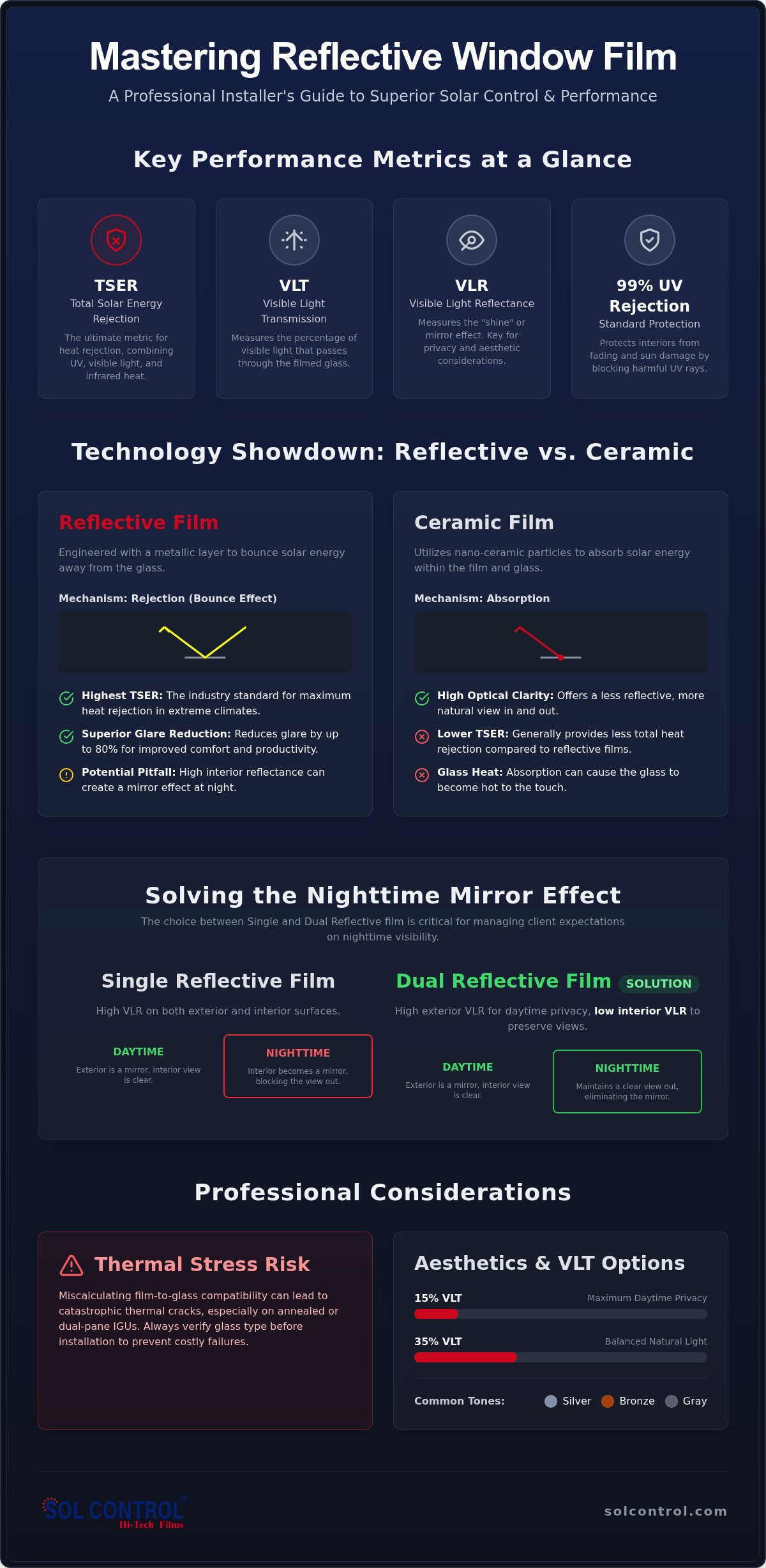
Reflective window film is engineered with a high-performance metallic layer designed to intercept solar radiation before it penetrates the glass. Unlike dyed films that simply darken the view, these metallized layers act as a shield, bouncing energy back toward the exterior. This process provides the highest Total Solar Energy Rejection (TSER) available in the architectural market. For a comprehensive overview of window film technologies, professionals often look at how these layers interact with different types of PET and adhesives to ensure long-term durability. In 2026, building owners prioritize this technology because it offers a direct solution to rising energy costs by significantly lowering interior temperatures.
The popular "one-way" privacy effect isn't a fixed property of the film; it's a result of physics and lighting ratios. The side of the glass with the higher light intensity becomes the mirrored surface. During the day, the exterior reflects the sun while the interior remains clear for the occupants. At night, if interior lights are on and it's dark outside, the effect reverses. It's vital to explain this dynamic to clients during the selection process to ensure their privacy expectations align with how reflective window film actually functions in real-world environments.
The Science of Solar Energy Rejection
Traditional ceramic films work primarily by absorbing heat, which can cause the glass itself to become quite hot. In contrast, reflective films utilize a "bounce" effect to reject energy before it's even absorbed. Total Solar Energy Rejection (TSER) is the ultimate metric for film performance because it accounts for UV, visible light, and infrared heat. By reflecting this energy away, these films reduce the peak demand on HVAC systems in large commercial buildings. This reduction doesn't just save money on monthly bills; it extends the operational lifespan of expensive cooling equipment by preventing constant cycling.
Aesthetic Varieties: From Silver Mirror to Subtle Bronze
While silver mirror films are the classic choice for high-rise office towers, modern manufacturing allows for more subtle options that suit residential and boutique commercial settings. Bronze and gray tones provide excellent performance while meeting strict neighborhood HOA requirements or specific architectural guidelines. Choosing the right aesthetic is about balancing performance with the desired visual impact, especially when working with luxury glass systems from Hawaii Architectural Sales.
Silver Reflective: Offers the highest TSER and a bold, modern look for maximum heat rejection.
Bronze and Gray: Provides a more neutral exterior appearance while still maintaining professional-grade solar control.
VLT Ranges: A 15% VLT is ideal for maximum daytime privacy, whereas a 35% VLT offers a balanced flow of natural light for retail spaces.
Successful installers don't just sell a product; they sell a technical solution. By matching the specific VLT and tone to the building's orientation and usage, you ensure the client gets the best possible return on their investment.
Technical Performance Metrics: Comparing Reflective vs. Ceramic Film
TSER is the primary benchmark for any professional installation. While ceramic films are celebrated for their optical clarity, high-performance reflective window film often provides superior heat rejection in extreme climates. This is because metallic layers physically block a broader spectrum of solar energy before it can pass through the glass. Visible Light Reflectance (VLR) measures the "shine" factor of the film. Installers must distinguish between exterior VLR, which creates the daytime mirror effect, and interior VLR, which affects the view from inside during the evening. Professional rolls also standardize 99% UV rejection, protecting furniture, flooring, and artwork from long-term sun damage.
Glare reduction is a major selling point for commercial clients. In a modern office, sunlight hitting a computer monitor can render a workstation unusable. Reflective films can reduce glare by up to 80% or more, depending on the Visible Light Transmission (VLT). This isn't just about comfort; it's about productivity. When you combine this with the 99% UV protection that comes standard on professional-grade reflective window film, you're offering a comprehensive health and wellness solution for the building's occupants.
Reflective vs. Ceramic: A Performance Deep-Dive
Reflective films reject heat through external "bounce," while ceramics rely on internal absorption. This fundamental difference makes reflective options particularly effective for large-scale architectural window film projects where cost-to-performance ratios are critical. In modern manufacturing, sputtered metal coatings provide enhanced durability compared to older evaporated methods. These sputtered layers are thinner and more precise, ensuring the film doesn't bubble or peel under intense sun exposure. Because reflective films are often more cost-effective to produce than multi-layered nano-ceramics, they offer better margins for the installer on massive commercial bids.
Understanding the Shading Coefficient
Shading coefficient and Solar Heat Gain Coefficient (SHGC) are vital for meeting 2026 building codes. Reflective film improves the U-value of existing glass units by providing an additional layer of thermal resistance. This is essential for compliance with evolving technical performance and energy efficiency standards set by regulatory bodies. The SHGC specifically measures how much solar heat passes through the window; a lower SHGC means less heat enters the building. By selecting a high-quality wholesale solar control film, you ensure that every roll meets these rigorous NFRC testing requirements. If you're looking to stock up for the upcoming season, you can browse our professional inventory to find the perfect match for your clients' needs.
Single Reflective vs. Dual Reflective Film: Solving the Nighttime Mirror Effect
The "mirror effect" is the most frequent source of customer dissatisfaction in residential tinting. Standard reflective window film works on a simple principle of light ratios. The side with the most light becomes the mirrored surface. While this provides excellent daytime privacy, it creates a frustrating visual barrier for homeowners once the sun sets. When interior lights are switched on, the glass reflects the room back at the occupants. This effectively blinds them to the outside world and creates a "fishbowl" feeling that many find uncomfortable.
To solve this, professional installers rely on dual-reflective technology. This specific type of reflective window film maintains a high exterior reflectance to block heat and provide privacy, but it utilizes a different metallic composition on the interior layer. By keeping the internal Visible Light Reflectance (VLR) under 15%, these films allow for clear views of the night sky or city lights even when the interior is illuminated. It's the professional answer to a common physics problem.
Pros and Cons of Single Reflective Films
Single reflective films remain a staple in the industry due to their straightforward performance and economics. They are generally the most affordable option per roll, making them a high-margin choice for specific environments where aesthetic subtlety is less of a concern than raw performance.
Pros: Lower wholesale cost; maximum heat rejection; consistent one-way privacy during peak daylight hours.
Cons: Intense internal mirroring at night; can appear too industrial for high-end residential neighborhoods.
Best Use Cases: Industrial warehouses, high-security facilities, and commercial storage units where nighttime visibility from the inside is not a priority.
The Dual Reflective Advantage for Installers
The International Window Film Association emphasizes the importance of matching film technology to the specific architectural application to ensure long-term satisfaction. Dual-reflective films are constructed by marrying two distinct layers. The exterior layer is typically a sputtered metal for maximum energy rejection. The interior layer is a more neutral, non-reflective material that mimics the appearance of clear glass.
This construction offers a powerful value proposition: "Privacy by day, views by night." For professional tint shops, this is a significant upsell opportunity. Clients who might hesitate at the "closed-in" feel of a standard silver film are often willing to invest more in a dual-reflective solution that preserves their evening views. Mastering the explanation of these lighting dynamics positions you as a consultant. It builds trust and ensures your clients receive a solution that works 24 hours a day without unexpected compromises.
Professional Considerations: Glass Compatibility and Thermal Stress
Thermal stress isn't just a technical theory; it's a significant liability for professional installers. When reflective window film is applied to annealed glass, the center of the pane reflects or absorbs solar energy while the edges remain shaded by the window frame. This temperature differential causes the center to expand faster than the edges. If the resulting tension exceeds the glass's breaking strength, an edge crack occurs. Professionals must evaluate glass type, frame condition, and external shading patterns before every installation to mitigate this risk.
Safety assessments are non-negotiable for high-end projects. Using a professional film-to-glass compatibility chart allows you to determine if a specific film is safe for the existing glazing. Dual-pane Integrated Glass Units (IGUs) are particularly sensitive. Trapping too much heat between the glass layers can cause the seal to fail or the inner pane to shatter. Interestingly, highly reflective films are often safer for IGUs than high-absorption dark films because they bounce energy away rather than allowing it to build up within the glass unit itself.
Identifying Glass Types Before Installation
Field testing is the first step in a successful risk management strategy. Always check for the etched "bug" in the corner of the pane to confirm if the glass is tempered. Tempered glass is far more resistant to thermal stress than standard annealed glass. You also need to identify Low-E coatings. Applying film to a "soft coat" Low-E surface can damage the coating or negate its energy-saving properties. Use a digital Low-E detector to identify which surface the coating is on before you begin your application. This ensures your reflective window film works in harmony with the existing window technology rather than fighting against it.
The Role of Professional Tinting Tools
Precision is your best defense against glass failure. Even a tiny nick or jagged edge on the film can create a stress point that encourages a crack to form under heat. Utilizing high-quality tinting tools, such as stainless steel trimmers and specialized edge guides, ensures a clean and consistent border. The mounting solution you choose is equally critical. On large reflective panes, a professional-grade slip solution prevents premature tacking and adhesive distortion. This allows you to achieve a bubble-free, mirror-perfect finish that maintains its integrity for years.
Avoid the risk of thermal breakage by stocking the right materials for every glass type. Shop our wholesale architectural film inventory to find glass-safe options for your next commercial project.
Optimizing Your Inventory: Why Wholesale Reflective Film is a Shop Staple
Managing a profitable tint shop isn't just about technical precision; it demands strategic inventory management. Reflective window film is a foundational component of this strategy because of its consistent demand in the commercial and high-end residential sectors. By stocking bulk rolls, you maximize your material yield and significantly reduce the scrap that often comes with smaller orders. Master rolls in 60-inch and 72-inch widths allow you to cover large architectural panes with a single drop. This reduces the need for visible seams and improves the overall quality of the installation.
Consistency across your supply chain is the hallmark of a professional contractor. When you're working on a multi-story office complex, even a slight shift in the metallic hue of the film can ruin the building's uniformity. Sourcing your reflective window film from a dedicated national distributor like SolControl prevents these color-matching headaches. We maintain rigorous quality control standards across our entire inventory to ensure that a roll ordered today matches the one you purchased for a previous phase of the project. It's this reliability that allows you to scale your business and take on larger, more complex contracts with confidence.
Scaling for Commercial Contracts
Large-scale installations require 100-foot rolls to maintain professional efficiency. These industry-standard lengths allow your team to plan their cuts with mathematical precision, ensuring that waste is kept to an absolute minimum. Handling these heavy architectural rolls safely requires specialized equipment, such as heavy-duty vertical dispensers and precision cutting tables. As a partner, you also gain access to marketing materials and technical data sheets that help you communicate value to your B2B clients. Balancing your stock between silver, bronze, and dual-reflective options ensures you're ready for any project, regardless of the season or architectural style.
Final Selection Checklist for Pros
Before you finalize your next bulk order, run through this professional checklist to ensure the product matches the specific job requirements. This step prevents costly callbacks and ensures long-term performance.
Confirm TSER: Match the film's heat rejection metrics against the client's specific energy efficiency goals.
Verify Orientation: Check glass compatibility for the specific window orientation, as south-facing panes often face higher thermal stress.
Check VLT: Ensure the visible light transmission meets local building codes or neighborhood HOA restrictions.
Secure Supply: Order through SolControl to leverage our national distribution network for reliable, on-time delivery to your shop.
By treating your inventory as a strategic asset, you don't just save money; you build a reputation for reliability. Having the right roll on the rack means you can respond to commercial bids faster than the competition.
Master Your Next Commercial Installation
Mastering the technical nuances of reflective window film allows you to transition from a standard installer to a trusted architectural consultant. By prioritizing glass safety assessments and selecting the right dual-reflective layers, you eliminate the risks of thermal stress and nighttime visibility complaints. Success on large-scale commercial contracts depends on this technical precision paired with a robust inventory strategy that minimizes waste and ensures color uniformity across every pane.
SolControl supports your growth with wholesale pricing for licensed contractors and high-performance TSER ratings that meet the most demanding building codes. Our national distribution network ensures you never face project delays due to inventory gaps. Shop Bulk Rolls of Professional Reflective Window Film at SolControl to secure the reliable supply your business deserves. You're ready to take on bigger challenges, and we're dedicated to helping you deliver a mirror-perfect finish every time.
Frequently Asked Questions
Does reflective window film provide privacy at night?
Reflective window film doesn't provide privacy at night when interior lights are switched on. Because the mirror effect depends on the side with the higher light intensity, the transparency reverses after sunset. Occupants will see their own reflection while outsiders can see into the building quite clearly. To mitigate this effect, dual-reflective films are used to lower interior reflectance, though they still don't provide absolute nighttime privacy for the occupants.
Can reflective film cause my windows to crack?
Reflective film can cause glass to crack if the thermal stress exceeds the strength of the pane. This usually happens on annealed glass where the center gets significantly hotter than the shaded edges. However, because reflective films bounce energy away rather than absorbing it, they often pose a lower risk to certain glass types than dark, high-absorption dyed films. Professionals should always consult a compatibility chart before starting the application.
Is reflective film better than ceramic film for heat rejection?
Reflective window film often outperforms ceramic film in terms of Total Solar Energy Rejection (TSER) in high-heat environments. While ceramic films are excellent at blocking infrared light without a mirrored look, the metallic layers in reflective films physically bounce a broader spectrum of solar energy away from the glass. This makes them the superior choice for large commercial structures facing intense, direct sunlight throughout the day where energy efficiency is the priority.
Can I install reflective film on dual-pane (IGU) windows?
You can install reflective window film on dual-pane (IGU) windows, provided the film is rated for such use. Standard silver reflective films are frequently safer for IGUs than high-absorption films because they reflect heat outward rather than trapping it between the glass layers. However, applying the wrong film can cause seal failure or glass breakage, so verifying the film-to-glass compatibility chart is a critical safety step for any professional installer.
What is the difference between silver and dual-reflective film?
The primary difference lies in the interior reflectance level. Silver reflective film has a mirrored appearance on both the exterior and interior surfaces, which can be visually distracting at night. Dual-reflective film utilizes a sputtered metal exterior for heat rejection but a neutral, non-reflective interior layer. This design preserves the view from the inside looking out while maintaining high performance and daytime privacy on the outside for the building's occupants.
How long does professional-grade reflective film typically last?
Professional-grade reflective film typically lasts between 10 and 15 years when installed correctly on vertical architectural glass. The actual lifespan depends on the film's exposure to direct sunlight, local climate conditions, and the quality of the initial application. Sputtered metallic films are particularly durable because the metals are deeply embedded in the polyester layers, which prevents the peeling or bubbling often seen in lower-quality, DIY alternatives found in retail stores.
Will reflective film interfere with cell phone signals?
Reflective films can interfere with cell phone and Wi-Fi signals because they contain metallic layers that act as a partial barrier to radio frequencies. In buildings with already weak reception, this may lead to dropped calls or slower data speeds. If signal transparency is a primary concern for your client, a high-performance ceramic film is often a better recommendation as it contains no metal components that would disrupt electronic communications.
Is reflective film legal for residential use in all states?
Reflective film is generally legal for residential use in all states, though specific neighborhood HOAs may have restrictions on highly mirrored aesthetics. Unlike automotive tinting, which is strictly regulated by Visible Light Transmission (VLT) and reflectance percentages for road safety, architectural applications are mostly governed by energy codes. Always check local building ordinances or historical society rules if you're working on a property with unique zoning requirements to avoid potential compliance issues.