The Professional Guide to Glare Reducing Window Film: Selection and Wholesale Procurement
Why do so many professionals still believe that a darker tint is the only effective solution for blinding sunlight? It is a common misconception that often forces your clients to choose between a cave-like interior and unbearable screen reflections. You have likely experienced the frustration of trying to balance natural light with high heat rejection, only to have a customer complain about eyestrain or lost views. Selecting the right glare reducing window film is a precision science of light filtration rather than just adding layers of darkness.
We agree that delivering visual comfort without compromising aesthetics is one of the toughest parts of the job. This guide will help you master the technical specifications and selection criteria for glare-reducing films to deliver superior visual comfort for any automotive or architectural project. We will show you how to identify high-VLT films that kill glare, compare the performance of carbon versus ceramic materials, and secure your wholesale supply for 2026. You will learn to navigate NFRC standards and VLT requirements to ensure every installation provides the clarity and protection your clients demand. From reducing dashboard reflections to optimizing commercial workstations, this technical deep dive prepares you for the high-performance demands of the modern market.
Key Takeaways
Learn the science of light filtration to reduce visual discomfort and improve contrast without sacrificing natural light levels in residential or commercial spaces.
Master the technical formulas used to justify specific film choices and understand how dual-reflective technology eliminates distracting interior reflections at night.
Compare the performance and cost-efficiency of ceramic, carbon, and sputtered materials to select the ideal glare reducing window film for any project requirement.
Identify application-specific strategies for solving office "hot spots" and reducing driver eyestrain through targeted automotive and architectural film placement.
Discover the benefits of wholesale procurement and how securing high-performance rolls at bulk pricing can significantly increase your shop's profit margins in 2026.
Understanding the Mechanics of Glare Reducing Window Film
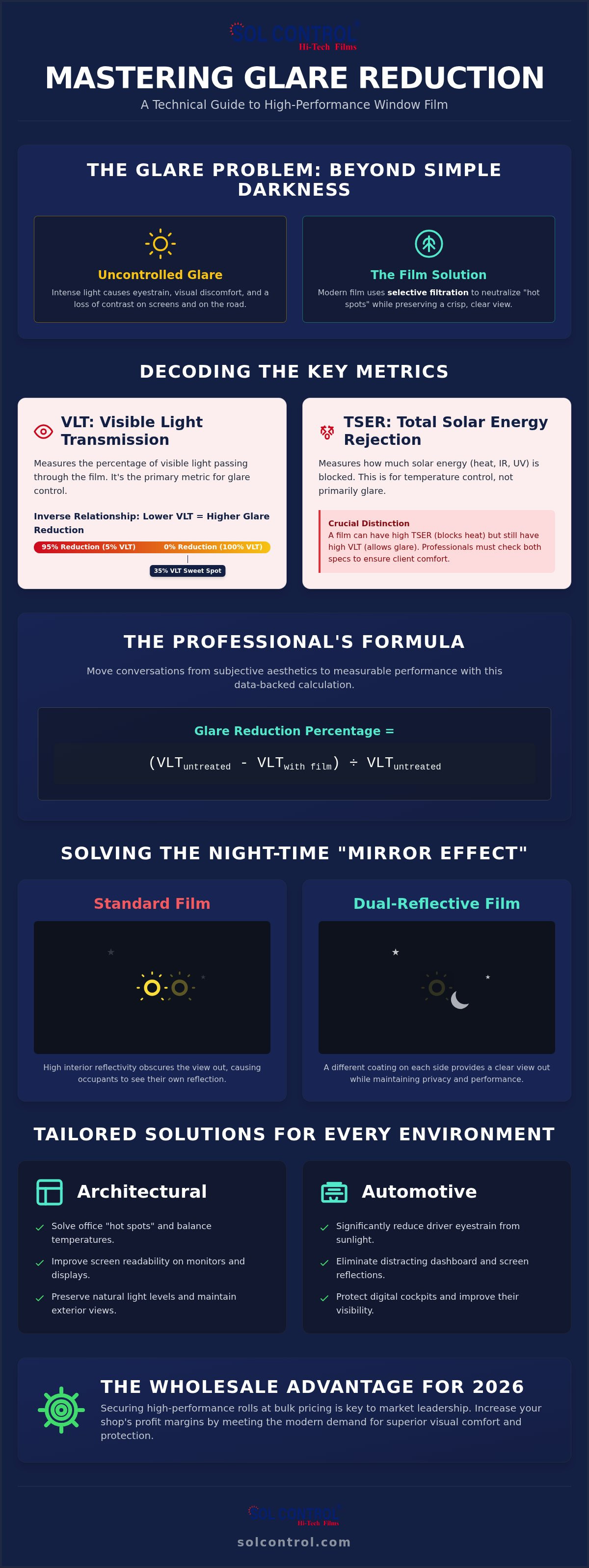
Glare is a physiological challenge that occurs when the intensity of light in the field of vision is significantly greater than the light the eyes are adapted to. This disparity causes a loss of contrast, making it difficult to distinguish details on a screen or a road. Professional glare reducing window film doesn't just "shade" a window. While shading implies a general reduction in all light, true glare control involves selective filtration. Modern window film uses sophisticated ceramic particles or micro-layers to absorb and reflect specific wavelengths. This allows for a crisp view while neutralizing the "hot spots" that cause eyestrain.
In 2026, industry standards have evolved to prioritize digital visibility and long-term eye health. Whether it's a vehicle with a digital cockpit or a glass-walled office, the prevalence of backlit screens means that light management is a functional requirement. Professionals now select films based on how they improve the "readability" of an environment, focusing on the specific way light interacts with the retina.
The Science of Visible Light Transmission (VLT)
VLT is the primary metric for measuring glare control. There's a direct inverse relationship between VLT percentage and glare reduction. If a film has a 5% VLT, it blocks 95% of visible light, providing extreme glare relief. However, for most architectural settings, a 35% VLT is considered the professional "sweet spot." It strikes a balance by killing enough light to stop monitor glare while preserving a natural feel. When VLT is too high, the eye's pupil constricts, making it harder to see the lower-intensity light coming from a computer screen.
Total Solar Energy Rejection (TSER) vs. Glare Control
It's vital to distinguish between heat and light. TSER measures the total amount of solar energy, including infrared and ultraviolet rays, that a film rejects. A film can have a high TSER by blocking 99% of infrared heat but still have a high VLT that fails to stop glare. Professionals must look at both specs to ensure client satisfaction. High-performance ceramic films are popular because they offer high TSER for heat rejection without needing to be "limo dark" to manage light. TSER and VLT work together to create a balanced cabin or office environment where heat is rejected and visible light is tuned for maximum ocular comfort.
Technical Selection Criteria for Professional Installers
Choosing the right glare reducing window film requires more than a visual estimate. Professionals use a specific formula to justify their recommendations: Glare Reduction Percentage = (VLT of untreated glass - VLT of glass with film) / VLT of untreated glass. This calculation provides a data-backed argument for clients who are hesitant about darker tints. When you provide a concrete figure, such as a 60% reduction in visible glare, you move the conversation from subjective aesthetics to measurable performance. This level of precision is what separates a professional installer from a hobbyist, and it aligns with the high standards supported by the International Window Film Association.
Durability is another critical factor in wholesale procurement. Lower-grade films often suffer from delamination or "orange peel" textures that compromise optical clarity over time. High-quality rolls feature advanced scratch-resistant coatings that protect the light-filtering layers during cleaning and daily wear. If the scratch-resistant layer fails, the resulting micro-abrasions actually scatter light, which creates a secondary source of glare. For a deeper look at specific product standards, our guide to architectural window film details the performance metrics required for large-scale commercial projects.
Reflectivity: Interior vs. Exterior Ratings
One of the most common client complaints is the "mirror effect" that occurs at night. This happens when a film has high interior reflectivity, causing occupants to see their own reflection rather than the view outside. Dual-reflective technology solves this by utilizing a different coating on each side of the film. The exterior side remains highly reflective to reject solar energy, while the interior side maintains a low reflectance rating. This is essential for retail storefronts and high-end residential projects where maintaining a clear view after sunset is a non-negotiable requirement. Selecting a film with an interior reflectivity rating below 15% ensures the glass remains transparent even when interior lights are on.
Color Neutrality and Optical Clarity
Optical clarity is the hallmark of a premium installation. Budget-tier films frequently exhibit a purple or blue hue because of unstable dyes that break down under UV exposure. Professional installers prefer neutral gray or charcoal tones because they don't distort the color of interior lighting or the natural landscape. This color neutrality is particularly important in offices where color-accurate work is performed. Additionally, you should verify that high-VLT ceramic options remain haze-free. Some ceramic films can appear "cloudy" when facing direct sunlight, so testing for low-haze performance is vital before committing to a bulk order. If you're ready to upgrade your inventory with these professional-grade specs, you can browse our current wholesale inventory to find rolls that meet these rigorous standards.
Material Comparison: Ceramic vs. Carbon vs. Sputtered Films
The material composition of a film is the pivot point for its performance, longevity, and price. While many consumers assume that any dark tint will solve their problems, professionals know that the underlying technology dictates how a glare reducing window film handles the solar spectrum. In 2026, the market has moved toward specialized solutions that address specific environmental challenges, from signal interference in high-tech vehicles to extreme heat loads in commercial skyscrapers. Choosing the right material ensures you aren't just selling a look; you're selling a functional solution that lasts.
Ceramic film remains the gold standard for projects that demand high performance without excessive darkness. Unlike traditional dyed films that rely on pigment to block light, ceramic options use nano-scale particles to selectively filter solar energy. This allows for superior clarity and heat rejection even at higher VLT levels. For installers working on large-scale commercial contracts where energy efficiency is a primary metric, our guide to wholesale solar control film provides deeper insights into these high-performance options.
The Ceramic Advantage in 2026
Modern nano-ceramic technology has revolutionized the way we approach light management. These films allow for high VLT percentages while maintaining massive glare and infrared (IR) rejection. This makes ceramic the top choice for electric vehicles and premium office spaces where digital screen visibility is a priority. One of the most significant benefits for installers is the non-conductive nature of ceramic. It offers zero interference with GPS, cellular signals, or Wi-Fi, which is a critical requirement for modern "connected" environments. You won't have to worry about client callbacks regarding dropped calls or navigation errors.
When to Specify Carbon or Reflective Films
Carbon film occupies a vital middle ground in the wholesale market. It is a cost-effective option for automotive projects where a deep, matte-black aesthetic is the goal. Carbon won't fade or turn purple like budget dyed films, making it a reliable choice for shops that want to offer a quality product at a lower price point. It provides excellent glare reduction and a "blacked out" look that many enthusiasts prefer for their vehicles.
Reflective or sputtered films are still highly relevant for industrial glare control. These films use a process that deposits fine metal particles onto the polyester base, creating a highly durable and efficient barrier. They are ideal for industrial settings where privacy and heat rejection are the main goals. If your client is focused on privacy-driven glare solutions for a warehouse or a street-level office, you should consult the technical specs in our guide to reflective window film. Understanding these material trade-offs allows you to build a versatile inventory that meets every budget and performance requirement.
Practical Buying Guide: Automotive vs. Architectural Applications
Selecting the ideal glare reducing window film requires a clear understanding of the environment where the glass resides. The physics of light filtration stay constant, but the application varies between curved tempered glass and flat, dual-pane units. You've got to account for different adhesive requirements, thermal stress, and regulatory constraints to ensure a successful job. Each project demands a tailored approach to maximize visual comfort without compromising the integrity of the glass.
Automotive Glare Solutions
Drivers face distinct challenges, especially those on the road for long hours dealing with low-angle sun. Modern automotive window film addresses these issues by targeting specific cabin areas. Windshield protection films are becoming popular for preventing dashboard reflections that obscure a driver's view. It's a powerful safety benefit to market; reducing oncoming headlight glare decreases nighttime eyestrain and improves reaction times.
Compliance is the most critical factor in the automotive sector. As of August 2026, you must balance light control with various state-level VLT laws. While some jurisdictions require a 70% VLT for front windows, others allow for a much darker 20% VLT. Staying within these legal bounds while maximizing glare rejection is where premium ceramic films excel. They offer high clarity without violating darkness regulations, ensuring the driver remains safe and compliant on any road.
Commercial and Residential Architectural Needs
Architectural projects often focus on "TV glare" in homes or "hot spots" in open-plan offices. Floor-to-ceiling glass is a staple of modern design, but it can make computer screens unusable for nearly half the workday if left untreated. Improving office productivity is a major driver for commercial film sales. By installing a neutral, high-performance film, you eliminate reflections on monitors without needing heavy blinds that block the view and increase lighting costs.
When working with large-scale glass, consider thermal stress. Applying a highly restrictive film to certain dual-pane units can cause heat buildup between the panes, potentially leading to seal failure. Always verify that your chosen film is compatible with the specific glass type, such as annealed or tempered. This technical due diligence protects your business and ensures the client's investment remains secure.
A flawless installation is impossible without the right equipment. Even high-quality film will fail if it isn't seated correctly. Professional-grade squeegees and precision blades are vital for removing every drop of mounting solution. This prevents the micro-bubbles that cause light distortion and secondary glare. To ensure your shop is equipped for these high-precision projects, you can order professional tinting tools and wholesale film rolls directly from our inventory to maintain the highest installation standards.
The Wholesale Advantage: Procuring Glare-Reducing Film in Bulk
Success in the window film industry depends on more than just installation skill; it requires a robust supply chain that supports your business growth. When you transition from per-job purchasing to bulk procurement, you stabilize your overhead and ensure that you always have the right glare reducing window film on hand for high-value clients. SolControl has established itself as the preferred national distributor for professional installers by focusing exclusively on the needs of tint shops and contractors. By providing high-performance rolls with consistent quality, we help you build a reputation for reliability in both the automotive and architectural sectors.
The primary benefit of wholesale pricing is the immediate impact on your profit margins. Premium ceramic installations are high-ticket items, and securing these materials at bulk rates allows you to remain competitive while increasing your take-home pay. Beyond the film itself, a wholesale partnership provides access to a full ecosystem of support. This includes ordering specialized tinting tools alongside your rolls, ensuring your team has everything they need for a flawless finish without managing multiple vendors. For large-scale 2026 commercial contracts, inventory consistency is non-negotiable. Having a reliable national partner ensures that the film you install on the first floor matches the specifications of the film on the fiftieth floor.
Streamlining Your Shop’s Inventory
Implementing a "good-better-best" inventory strategy is a proven way to improve your closing rates. By stocking a range of glare films, from cost-effective carbon rolls to top-tier nano-ceramics, you can provide options that fit every budget. SolControl’s national shipping infrastructure ensures that these materials reach your shop quickly, helping you avoid the local delays that can derail a project timeline. Our business model is designed to support your growth rather than hinder it. SolControl’s wholesale-only focus ensures that we never compete with our own customers for installation contracts, allowing us to remain a dedicated partner in your success.
Partnering for Success in 2026
As the market for anti-glare solutions continues to grow, having access to professional marketing materials becomes a significant advantage. These resources help you effectively communicate the technical benefits of glare reduction to end-users, making it easier to upsell premium products. Complex architectural glass specifications often require a deeper level of technical insight. Our team provides the support necessary to navigate thermal stress concerns and VLT requirements for specialized projects. Whether you are outfitting a fleet of new electric vehicles or a modern glass office complex, the right procurement strategy is your foundation for excellence. To take the next step in scaling your business, browse SolControl’s full wholesale inventory and tools to find the high-performance solutions your clients deserve.
Elevating Your Installation Standards for 2026
Mastering the science of light filtration allows you to move beyond basic tinting and become a specialized consultant for your clients. By balancing VLT requirements with specific material performance, you can eliminate blinding reflections without sacrificing the natural light that makes modern spaces beautiful. Whether you're solving screen visibility issues in an open-plan office or enhancing road safety for long-haul drivers, the right glare reducing window film is a functional tool that transforms the environment. This technical expertise ensures your shop stays ahead of market trends while providing measurable value to every customer.
Scaling your business for the year ahead requires a reliable partner who understands your unique operational needs. As a wholesale-only distributor, SolControl provides national US shipping and a complete professional tool inventory to keep your team efficient and your projects on schedule. Partner with SolControl for Wholesale Glare-Reducing Film and Professional Tools to secure the high-quality rolls and technical support your business needs to excel. We're dedicated to helping you build a reputation for excellence through superior products and industry-leading expertise.
Frequently Asked Questions
Does glare reducing window film make my windows look like mirrors?
Not all films create a mirror effect. While some older metallic films are highly reflective, modern dual-reflective technology and ceramic options prioritize a natural view. These advanced films maintain low interior reflectivity ratings, often below 15%, to prevent the "mirror effect" at night. This ensures that occupants can see through the glass clearly even when interior lights are on, making them ideal for high-end residential and retail projects.
Can I use the same glare reducing film for both cars and homes?
It's best to use films specifically engineered for their intended environment. Automotive films are designed for curved, tempered glass and must comply with strict state VLT laws. Architectural films are formulated for flat glass and must account for thermal stress on dual-pane units. Using automotive film on home windows can lead to glass breakage or seal failure because the heat absorption rates differ significantly between these specialized product categories.
How much VLT do I need to effectively stop TV and computer screen glare?
For most residential and office settings, a 35% Visible Light Transmission (VLT) is the professional standard for stopping screen glare. This level of glare reducing window film filters enough light to eliminate reflections on monitors and televisions while keeping the room feeling bright and open. If the environment faces extreme, direct sunlight for most of the day, moving down to a 15% or 20% VLT may be necessary to ensure complete visual comfort.
Will glare reducing film interfere with my Wi-Fi or cell signal?
Interference depends entirely on the film's material composition. Ceramic and carbon films are non-conductive and non-metallic, meaning they have zero impact on Wi-Fi, GPS, or cellular signals. This makes them the preferred choice for modern "connected" vehicles and offices. Sputtered or traditional metallic films contain fine metal particles that can occasionally disrupt signals, so it's vital to verify the material type before starting an installation in a tech-heavy environment.
Is ceramic window film significantly better for glare than standard carbon film?
Ceramic film provides superior performance because it uses nano-technology to selectively filter the solar spectrum. While carbon film is an excellent, cost-effective choice for achieving a matte-black look, ceramic offers higher Total Solar Energy Rejection (TSER) and better optical clarity. This allows you to achieve significant glare reduction without needing to go as dark as you would with carbon, which is a major advantage for clients who prioritize natural light.
How do I clean windows after glare reduction film has been installed?
You should wait at least 30 days for the film to fully cure before the first cleaning. Once cured, use a soft microfiber cloth or a clean synthetic sponge with a mild, ammonia-free detergent. Ammonia can eventually degrade the scratch-resistant coating and the adhesives used in high-quality glare reducing window film. Avoid using abrasive brushes or paper towels, as these can create micro-scratches that scatter light and reduce the film's effectiveness over time.
What is the typical lifespan of a professional-grade glare reducing film roll?
Professional-grade rolls from a reputable wholesale distributor typically last between 10 and 15 years. The actual lifespan depends on the film's material and the intensity of UV exposure. Ceramic and carbon films are particularly durable because they don't rely on unstable dyes that fade or turn purple over time. High-quality manufacturing processes ensure the layers remain bonded and the scratch-resistant coating stays intact, providing consistent performance for the life of the installation.
Do I need special tools to install high-performance ceramic glare films?
While the basic installation process is similar to other films, high-performance ceramics benefit from professional-grade tools. Because ceramic films can be slightly thicker, using a high-durometer squeegee ensures you remove all mounting solution for a haze-free finish. Precision stainless steel blades are also essential to prevent glass scoring during the trimming process. Investing in a complete professional tool kit ensures that the film's premium optical clarity isn't compromised by poor installation technique.