What if the best way to sell ceramic tint is to stop trying to sell it to everyone? For tint shops, upselling clients to ceramic tint works best when the recommendation reflects what each customer values. The higher upfront price can be a sticking point, especially when the benefits are explained with technical language or a one-size-fits-all pitch.
That hesitation is understandable. Customers deserve a clear comparison, not pressure or promises a particular film can’t support. Start by asking what they want to improve, such as managing heat, reducing glare, or maintaining electronic signal reception. Then explain how the specific films being considered compare on those priorities.
This guide shows you how to identify a good-fit customer, explain ceramic film’s performance distinctions in plain language, and address price concerns with a consistent, customer-first approach. You’ll also learn how to make the upgrade conversation more informative and repeatable across your team, so customers can choose based on their needs and budget.
Key Takeaways
Match ceramic film recommendations to customer priorities instead of treating every consultation as an upgrade opportunity.
Make upselling clients to ceramic tint clearer by distinguishing infrared rejection, total solar energy rejection, and visible light transmission.
Use open questions to understand a customer’s concerns before comparing suitable film options.
Address price objections with transparent, relevant comparisons and give customers room to decide.
Build a simple staff playbook with discovery questions, verified specifications, and consistent explanations.
Why offer ceramic tint as an upgrade, and which customers may value it?
A shop’s challenge isn’t simply explaining why ceramic tint sits at a higher tier. It’s showing where the option may fit without implying every customer needs it. Upselling clients to ceramic tint means connecting the upgrade to a concern the customer has actually raised, not defaulting to the most expensive film.
Start with the result the customer wants, then connect that priority to relevant film information. A customer focused on cabin heat may want to compare heat-related performance specifications. Someone bothered by glare may want to discuss visible light transmission and suitable tint choices. Film types differ in construction and properties; a neutral overview of how window films are constructed can help staff build foundational knowledge. Keep the conversation focused on verified details for the specific films being discussed, rather than broad claims about ceramic film as a category.
Which customer priorities can make ceramic tint worth discussing?
Ask what the customer would most like to improve. Then explore how they use the vehicle: their typical driving patterns, where they usually sit, and which windows matter most. A driver who spends long periods in the vehicle may prioritize cabin comfort, while someone bothered by sunlight through a particular window may want to focus the discussion there. These answers help guide a comparison, but they don’t prove ceramic is automatically the right choice.
Before comparing options, use this quick customer-fit checklist:
Stated concern: What does the customer want to improve?
Decision criteria: Which factors matter most, such as comfort, glare management, appearance, or a particular film specification?
Budget sensitivity: Is the customer open to considering a higher-tier option, or is staying within a set budget the priority?
These answers help staff make a relevant recommendation and explain why an upgrade is part of the conversation. They also help avoid a generic pitch that could undermine trust.
When should a shop avoid pushing the upgrade?
If the customer’s preferred option meets their stated needs and fits their budget, respect that decision. Don’t present premium film as essential when the customer hasn’t raised a concern that makes its specifications relevant. Explain the options clearly, answer questions, and leave the choice with the customer.
Be measured about expected results. The experience can vary with the film’s verified specifications, the vehicle’s glazing, the vehicle itself, installation quality, and real-world conditions. Avoid promising a particular cabin temperature or outcome based on film category alone. A transparent conversation gives customers room to choose and gives staff a sound basis for recommending an upgrade when it genuinely fits.
How to explain ceramic tint performance in terms customers understand
Keep the explanation simple: ceramic window film is a category of film that uses ceramic materials in its construction. The category alone doesn’t guarantee a specific result in every vehicle. For upselling clients to ceramic tint, translate verified specifications into information that speaks to the customer’s concern, without promising a particular cabin temperature or experience.
Which film specifications matter in a ceramic tint conversation?
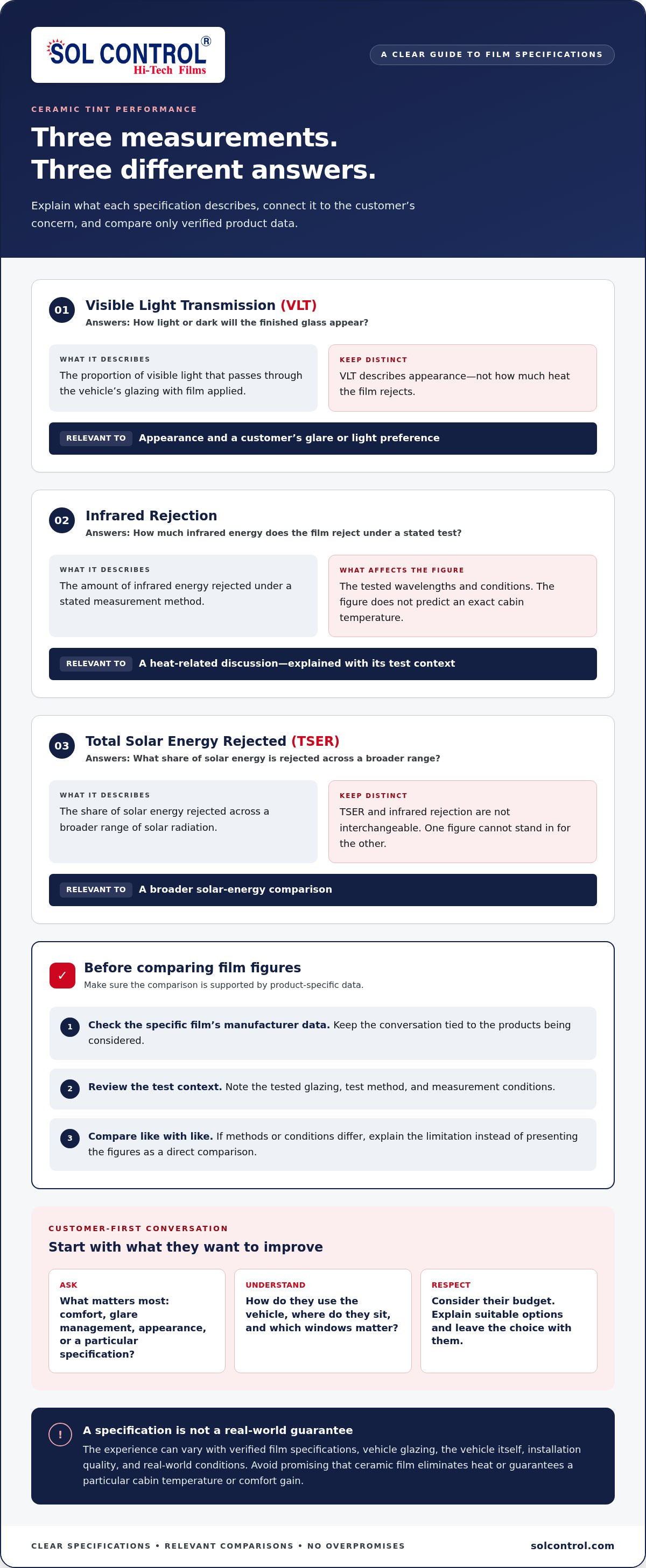
Three measurements often come up, and they describe different things:
Visible light transmission (VLT) is the proportion of visible light that passes through the vehicle’s glazing with film applied. It helps describe how light or dark the finished glass appears, not how much heat the film rejects.
Infrared rejection describes how much infrared energy a film rejects under a stated measurement method. It’s relevant to a heat discussion, but the result depends on the wavelengths and conditions used for testing.
Total solar energy rejected (TSER) describes the share of solar energy rejected across a broader range of solar radiation. It isn’t interchangeable with infrared rejection, so one figure shouldn’t stand in for the other.
Compare figures only when the products were tested using meaningfully comparable methods and conditions. Check the manufacturer’s data for the specific film, including the tested glazing, test method, and measurement conditions. Without that context, numbers can sound more definitive than they are. When two specifications use different methods, explain the limitation rather than presenting the figures as a direct comparison.
How can staff explain performance without overpromising?
Connect a specification to the customer’s stated concern, then qualify what it can tell them. For example: “This film’s published infrared-rejection figure describes its performance in the manufacturer’s test. It doesn’t predict an exact temperature inside your vehicle.” That distinction keeps a measured specification separate from a real-world promise.
Vehicle glass, existing tint, installation, weather, and individual perception can all affect the experience. Avoid saying that ceramic film eliminates heat or guarantees a universal comfort gain. If UV protection comes up, point customers to The Skin Cancer Foundation’s guidance on UV-blocking window film, while keeping any product-specific claim tied to verified manufacturer data.
How to qualify a customer and introduce ceramic tint naturally
A consistent consultation helps staff recommend film based on what the customer values, not on a preset sales script. Use the same sequence each time: ask, listen, summarize, compare suitable options, and invite a decision. This makes upselling clients to ceramic tint feel like a considered recommendation rather than a pitch.
What questions uncover a genuine need for an upgrade?
Begin with open questions that let the customer describe the problem in their own words:
“What prompted you to look into window tint?”
“What would you most like the film to change?”
“How do you usually use the vehicle, and where do you notice the issue most?”
“How do appearance, light transmission, comfort, and budget rank for you?”
“Are there trade-offs you’d rather avoid?”
Listen for priorities rather than jumping to a product category. Then summarize what you heard: “You’d like to reduce the sun’s impact on your daily commute, but you want to keep the glass fairly light and stay within your budget. Is that right?” This gives the customer a chance to clarify before film options enter the conversation.
How should staff present the ceramic option?
Use a short, neutral transition from the customer’s stated concern to an option: “Since comfort is your main priority, ceramic is one option we can compare. I can show you its verified performance specifications alongside another film that may fit your budget.” Tie each specification to the customer’s concern, explain what it measures, and avoid implying a guaranteed result. A consumer overview that explains the benefits of ceramic tint can also help staff understand the questions customers may bring to the counter.
Present a suitable alternative without dismissing it. The customer may value appearance or budget more than a particular performance distinction. Share comparable, product-specific information where available, answer questions, and let the customer choose without artificial urgency.
Example conversation:
Customer: “I’m mostly bothered by the sun during my commute, but I don’t want a dark look.”
Staff: “Understood. We can compare a lighter option and ceramic film using their verified specifications, including visible light transmission and heat-related measurements. Would you like to review both?”
Customer: “I’m not sure yet.”
Staff: “That’s fine. Take a look, and I’m happy to explain any of the figures. There’s no need to decide before you’re ready.”
The approach is straightforward: connect the recommendation to the customer’s stated priority, make the comparison clear, then give them room to decide.
How to handle ceramic tint objections with transparent comparisons
A customer who questions the added value may simply be weighing the upgrade against what matters most to them. Different film categories can suit different preferences and budgets. Return to the concern they raised and explain only the relevant distinctions supported by product data. The goal of upselling clients to ceramic tint isn’t to win an argument. It’s to help them make an informed comparison.
A simple response can keep the conversation open: “That’s fair. Let’s look at the specifications related to your main concern, compare them with another option, and see whether the difference matters to you.” If the customer decides the distinction isn’t worth prioritizing, accept their choice. Don’t manufacture urgency or suggest that another film category is inherently inadequate.
How can shops make film comparisons fair and accurate?
Use a comparison table to keep the discussion focused. Fill it with verified, product-specific information, and explain when figures can’t be compared directly because test methods or conditions differ. Keep performance measurements separate from appearance, installation considerations, and personal preference.
Customer priority
Relevant information to compare
Question to clarify
Heat-related comfort
Verified infrared rejection and total solar energy rejected, with test conditions
“Is reducing the sun’s heat your main reason for considering tint?”
Light or darker appearance
Visible light transmission for the specific film and glazing
“How light or dark would you like the glass to look?”
Budget
Available film options and their relevant specifications
“Which matters most: staying within your budget or comparing a particular performance feature?”
Overall value
Only comparable, verified specifications tied to stated priorities
“Which difference would make an upgrade worthwhile for you?”
Keep the principle simple: Recommend only differences supported by relevant product data and the customer’s needs. Avoid unsupported savings claims, universal rankings, or disparaging descriptions of dyed, carbon, ceramic, or other film types. If test conditions aren’t comparable, say so rather than implying one figure proves a better result.
For example, if a customer says, “I’m not sure I’d notice enough difference,” staff can respond, “That makes sense. We can compare the verified figures tied to your comfort concern, and you can decide whether they matter enough to choose the upgrade.” That’s a clear comparison, not a close.
How to make ceramic tint upgrades consistent across your shop
A reliable customer conversation shouldn’t depend on which team member happens to be at the counter. A short playbook gives staff a shared process for learning what customers value, explaining relevant film differences, and letting each person decide without pressure. It also helps keep upselling clients to ceramic tint grounded in accurate product knowledge rather than inconsistent claims.
What should a repeatable ceramic tint sales playbook include?
Keep the guide practical and easy to use during a consultation. Include open discovery questions, a comparison template, approved example explanations, and calm responses to common concerns. Maintain current, product-specific specifications with their test methods and conditions, so staff can explain what each figure does and doesn’t show. Use approved visual aids to make film differences easier to discuss, not to imply results that the data can’t support.
After consultations, track a few useful details: the customer’s main priorities, options presented, selection, and questions that came up. Review these patterns to spot where explanations need work or staff need product training. Treat the records as a learning tool, not a sales quota. If customers repeatedly misunderstand a specification, refine the script or display material. If a question reveals a knowledge gap, update the team’s reference notes.
How can a wholesale partner support the shop’s process?
Consistent recommendations rely on dependable film knowledge and professional tools that support the shop’s own workflow. For broader selection context, staff can review this professional automotive window film guide. For customer conversations about UV-related concerns, refer to guidance on UV-blocking window film, and keep product-specific statements tied to verified data.
SolControl supports professional installers as a wholesale distributor of automotive and architectural films, protection films, tinting tools, and marketing materials. These resources can help shops build staff familiarity and support clear customer education without turning every consultation into a pitch. Use customer feedback to keep the playbook useful, the specifications current, and the conversation focused on fit.
Strong ceramic tint recommendations start with the customer, not a sales target. Ask what they want to improve, explain relevant film specifications in plain language, and compare suitable options using verified data. A consistent team approach helps every customer make an informed choice, whether or not they select the upgrade.
That’s the foundation of upselling clients to ceramic tint: connect the option to a real priority, address questions transparently, and respect the customer’s budget and decision. A practical staff playbook and clear educational materials can help your shop deliver that experience consistently.
SolControl supports professional installers across the United States with automotive and architectural films, professional tinting tools, and marketing materials. Its wholesale, distribution-focused model supports shops without competing for installation work. Explore SolControl’s professional film and tool resources to support your team’s product knowledge and customer conversations.
With accurate information and a customer-first process, your team can make every recommendation more useful and build trust one consultation at a time.
Frequently Asked Questions
How do you upsell a customer to ceramic tint without being pushy?
Start by asking what the customer wants to improve, then recommend an option only if its verified specifications relate to that priority. For upselling clients to ceramic tint, summarize the concern, compare ceramic with a suitable alternative, and explain what the data measures. For example, if the customer prioritizes comfort, discuss relevant heat-related specifications without promising a specific cabin temperature. Invite questions, respect budget concerns, and let the customer decide without urgency.
What should you say when a customer asks why ceramic tint is different?
Explain that ceramic tint is a film category made with ceramic materials, and that specific performance depends on the film. You might say, “We can compare this film’s published specifications with another option, including the measurements relevant to your priorities.” Clarify terms such as infrared rejection, total solar energy rejected, and visible light transmission rather than treating them as interchangeable. Use product-specific data, and explain the test conditions behind the figures.
Is ceramic tint worth the upgrade for every customer?
No. Ceramic tint may be worth discussing when its verified specifications connect to what a customer wants, but it isn’t automatically the best fit for everyone. A customer may prioritize appearance, a particular level of visible light transmission, or staying within a budget. Ask what matters most, compare options that suit those preferences, and let the customer weigh the differences. Avoid presenting a premium film as essential if it doesn’t address a stated concern.
How can a tint shop explain infrared rejection accurately?
Describe infrared rejection as a measured specification showing how much infrared energy a particular film rejects under stated test conditions. It can inform a discussion about heat-related performance, but it doesn’t predict an exact cabin temperature or guarantee a particular comfort experience. Check the product’s test method, tested glazing, and measurement conditions before sharing a figure. Compare specifications only when their measurement methods and conditions are meaningfully similar.
What objections do customers commonly have about ceramic window tint?
Customers may question whether the performance difference justifies choosing a higher-tier film, whether they’ll notice the difference, or whether the film’s appearance and light transmission suit their preferences. Budget can also shape the decision. Acknowledge the concern, return to the customer’s priorities, and show only relevant, verified comparisons. If the customer doesn’t see enough value in the upgrade, respect that choice rather than making unsupported promises or creating urgency.
How can tint shops train staff to sell ceramic tint consistently?
Give staff a concise playbook with discovery questions, verified product specifications and test conditions, clear explanations, and responses to common objections. Practice consultations so team members can explain film differences in plain language and offer a suitable alternative without disparaging it. Track customer priorities, options presented, selections, and recurring questions to identify training needs. Use this information to improve explanations and educational materials, not to pressure employees toward a particular sales outcome.