What if the roll with the most film isn’t the best wholesale buy for your shop? Choosing windshield protection film wholesale takes more than comparing roll size or one specification. The right fit depends on the vehicles you handle, how you cut and install film, and how consistently the material fits your workflow.
It’s easy to overestimate usable coverage if you don’t account for vehicle variation, pattern layout, offcuts, and installation needs. A product that looks suitable on paper still needs to meet the optical quality and finish your customers expect. Evaluating these details helps you balance inventory with dependable service.
This guide explains how to compare relevant film specifications, estimate practical roll usage, and align purchasing volume with shop demand. It also covers what to look for in a wholesale distribution partner. SolControl distributes windshield protection film and professional tinting tools to installers and contractors across the United States, supporting professional product supply needs.
Key Takeaways
Distinguish windshield protection film from cabin window tint and paint protection film to compare products for the right application.
Evaluate documented construction, thickness, clarity, roll format, and intended use together rather than relying on a single specification.
Plan windshield protection film wholesale purchases around shop demand, expected material use, and actual roll yield.
Account for vehicle differences and installation workflow when estimating usable coverage and setting repeatable quality checks.
Compare wholesale partners by product documentation, relevant tools, product range, and fit with professional supply needs.
What windshield protection film wholesale means for professional installers
Windshield protection film wholesale is the purchase of windshield-surface film in larger professional quantities for recurring installation work. For a shop, the practical decision is how much to keep on hand and which product and roll format fit its jobs. Ordering too little can interrupt scheduling, while buying more than demand justifies can tie up storage space and cash flow.
Wholesale purchasing works best when it supports a repeatable workflow, not simply when it increases the amount of film in stock. Consider the vehicles you serve, how often windshield film jobs come in, and whether the product and roll format suit your cutting and installation process. A shop handling occasional jobs may need a different purchasing plan from one with steady demand.
How windshield protection film differs from tint and paint protection film
The main difference is the surface each category is intended for. Windshield protection film is designed for windshield applications. Automotive window tint is applied to cabin glazing, such as side or rear windows. Paint protection film is intended for exterior painted vehicle surfaces. These films serve different purposes and aren’t interchangeable just because they are all films.
Who benefits from wholesale windshield film purchasing?
Tint shops, glass businesses, automotive dealers, and professional installers may purchase windshield film in wholesale quantities when it fits their work. A business handling occasional jobs can start with a measured supply and track how much usable material each installation takes. A shop with steadier demand can plan replenishment around its bookings and typical material use.
In either case, consistent supply planning helps teams work with familiar materials and avoid last-minute inventory gaps. Tracking roll yield and offcuts also makes it easier to refine future orders using actual shop experience. Wholesale buying isn’t about stocking the largest quantity possible. It’s about maintaining a suitable supply while accounting for cash flow and storage space.
Which windshield protection film specifications should wholesale buyers compare?
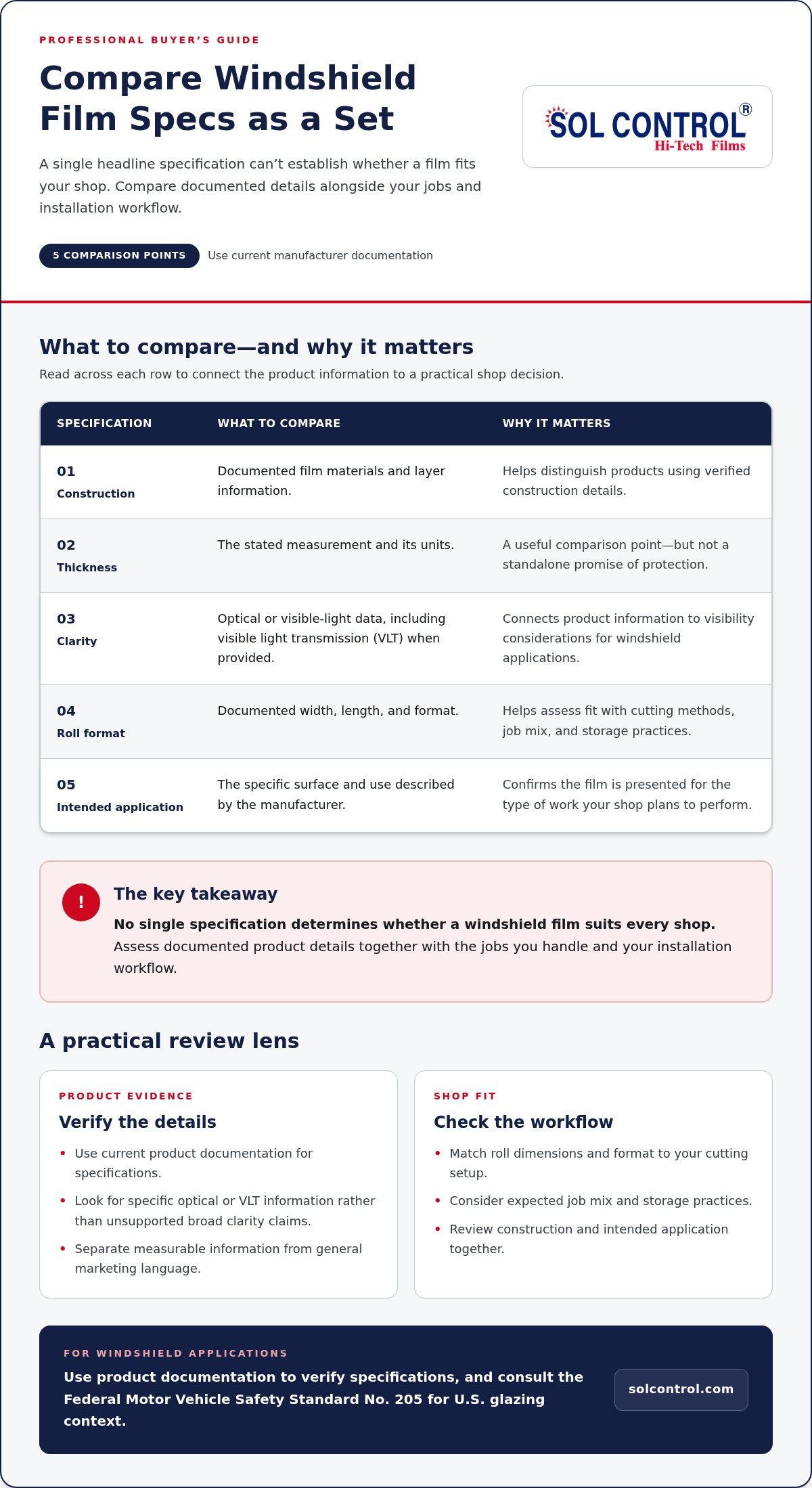
For windshield protection film wholesale purchases, compare specifications as a set, then assess how they relate to your shop’s jobs. A headline thickness or broad phrase such as “high clarity” cannot establish product suitability on its own. Specifications vary by product, so use current manufacturer documentation rather than assuming details from one film apply to another.
Specification
What to compare
Why it matters
Construction
Documented film materials and layer information
Helps distinguish products using verified construction details.
Thickness
The stated measurement and its units
Provides a useful point of comparison, not a standalone promise of protection.
Clarity
Optical or visible-light data, including visible light transmission (VLT) when provided
Connects product information to visibility considerations for windshield applications.
Roll format
Documented width, length, and format
Helps assess fit with cutting methods, job mix, and storage practices.
Intended application
The specific surface and use described by the manufacturer
Confirms that the film is presented for the type of work your shop plans to perform.
No single specification determines whether a windshield film suits every shop. Suitability depends on documented product details, the jobs you handle, and your installation workflow.
How to interpret thickness, visible clarity, and product documentation
Thickness is measurable, but it doesn’t establish how a film will perform in a particular job by itself. Read it alongside construction, intended application, and other documented characteristics. Evaluate clarity claims in the same way: look for specific optical or VLT information rather than relying on broad phrases without supporting data. For U.S. glazing context, consult the Federal Motor Vehicle Safety Standard No. 205. Use the film’s current product documentation to verify its specifications.
What to compare beyond the headline specification
Compare roll dimensions and available formats with your cutting setup and expected job mix. Review construction and application details together, and consider installation compatibility when the manufacturer documents it. Separate measurable information from general marketing language. An unverified promise is not a technical specification. A simple comparison sheet can help your team assess products consistently across orders.
How to plan wholesale roll quantities and manage windshield film inventory
A roll’s advertised coverage can help with initial comparisons, but it isn’t a shop-specific forecast. Usable yield depends on the jobs you take, windshield dimensions and shapes, cutting decisions, and installation experience. Build your purchasing plan around demand and material records, then revise it as your team gains experience with each film format.
Review demand. Look at completed jobs and upcoming bookings to see how often windshield film work comes in. Separate steady demand from occasional requests, and note changes in the types of vehicles you serve.
Estimate material use. Use prior job records where available. Consider how vehicle variety and windshield dimensions affect layout, and account for changes in your installation process. Don’t assume every job uses the same amount.
Choose a starting quantity. Match your initial order to observed work, storage capacity, and replenishment needs. A measured starting supply lets you gather real usage data without committing to more stock than your current workflow requires.
Track yield. Record the film used and remaining after each job, along with the vehicle and relevant notes about the cut or installation. Use those records to improve future estimates.
Estimate usable roll yield for your actual job mix
Keep advertised approximate coverage separate from your own expected yield. A published estimate may describe a specific roll and reference application, while your shop handles a different mix of windshield shapes and dimensions. Job records give you a more relevant planning basis: track roll use by installation, note leftover material, and compare results across similar jobs. Avoid assigning a fixed waste allowance until your own records support one.
Experience also affects usage. As installers become familiar with a material and refine their cutting process, patterns may change. Treat early estimates as working assumptions, not guaranteed coverage, and update them as your records grow.
Set a practical reorder routine without overstocking
Review recent usage alongside the film currently on hand. Factor in supplier lead-time information when available, then decide when to reorder based on your booking pattern and storage capacity. More frequent replenishment can limit the amount of stock you hold, while keeping a larger reserve may reduce the chance of running short between orders. Each approach has trade-offs.
A simple inventory log can show what’s being used, what remains, and when orders are placed. Use it to set a reorder point that fits your operation instead of relying on a universal quantity or threshold. This keeps windshield protection film wholesale purchases aligned with real demand as your shop’s work changes.
How wholesale windshield protection film fits a professional installation workflow
A reliable workflow connects the film selected through wholesale purchasing with how your shop receives, handles, installs, inspects, and explains it. Product choice matters, but it can’t guarantee an installation result on its own. Consistent preparation and quality-control checkpoints help teams follow the same process from job to job and identify issues before handoff.
Prepare materials and tools for consistent installation
Start when the roll arrives. Confirm it matches the order, handle it carefully, and store it according to the product documentation. Before use, review the manufacturer’s instructions and relevant specifications so the team works from current information rather than memory or assumptions.
Next, prepare the work area and the tools used in your established installation process. Tool needs vary by method and product, so follow documented guidance instead of assuming every shop needs an identical kit. Tinting tools and other professional equipment can support an organized workflow. For related tool considerations, see this guide to professional PPF installation tools.
Build repeatable checkpoints into the job
Use a consistent sequence: confirm the material and vehicle, prepare the windshield and work area, apply the film according to product instructions, and inspect the completed work before handoff. A simple checklist can help the team document each stage and review the process if a concern arises.
Inspection is part of quality control, not a promise that film selection alone will prevent every issue. Apply the same review standards across jobs and record observations that can help improve preparation or handling. This makes workflow consistency an everyday practice rather than an assumption tied to a particular roll.
Explain product purpose and care to customers
Explain the product in measured terms: windshield protection film is applied to the windshield surface for a protective purpose, but it shouldn’t be presented as protection against all chips, cracks, or damage. Describe its intended role in plain language and avoid claims that go beyond the product documentation.
At handoff, share aftercare guidance only when it’s supported by the instructions for the specific film used. This sets realistic expectations and gives customers useful, product-specific information. For shops evaluating windshield protection film wholesale, connecting material handling, documented instructions, inspection, and customer communication creates a more complete workflow. Explore SolControl’s windshield film and professional tools to support your shop’s supply planning.
Choose a windshield protection film wholesale partner that supports your shop
A distributor relationship should fit how your business buys and works, not just the specifications of one roll. Compare product selection and supply needs using practical criteria:
Product range: Consider whether the distributor’s film categories align with your shop’s work, including windshield protection film and adjacent film needs.
Product information: Look for current, product-specific details that help you evaluate construction, dimensions, intended application, and other relevant specifications.
Tools: Consider whether professional tinting tools are part of the supply range and relevant to your workflow.
Ordering clarity: Review the ordering details available to professional buyers so you can plan purchases with fewer assumptions.
Business relevance: Consider whether the distributor serves installers and contractors, and whether its product categories fit your day-to-day operations.
Evaluate the relationship beyond the film roll
A distributor’s broader categories can matter when your shop sources more than one type of film or needs professional tools alongside materials. A supplier focused on professional businesses can help you consider those purchasing needs together. SolControl is a wholesale distributor serving installers and contractors across the United States with windshield protection film, other window film categories, paint protection films, and tinting tools.
Keep the evaluation grounded in details relevant to your work. Compare product specifications and ordering information for the items you need, and distinguish product documentation from general marketing claims. Consider how the distributor’s range aligns with your operation and purchasing process.
Build a purchasing plan around real shop demand
Before placing a wholesale order, bring together the practical factors covered in this guide: specification fit, estimated usable yield, storage capacity, recent demand, and a workable reorder routine. Use job records to refine material estimates, then adjust purchasing as the mix of vehicles and installation work changes. This can help limit both stock gaps and excess inventory.
Also consider adjacent needs. If your business purchases other film categories or tinting tools, a distributor with a relevant range can support a coordinated supply plan. SolControl focuses on wholesale distribution for professional businesses across the United States, helping installers and contractors source products for their operations. Explore SolControl’s wholesale distribution range to review film and tool categories for your shop.
Make Your Next Film Purchase Fit the Work
A sound wholesale decision brings product specifications, realistic roll-yield estimates, and your shop’s installation workflow together. Use current product documentation to compare options, then use job and inventory records to guide purchase quantities and reorders. This helps keep supply aligned with actual demand instead of relying on a roll’s advertised coverage alone.
Choosing windshield protection film wholesale also means finding a distribution partner with a product range suited to your business. SolControl distributes windshield protection film and professional tinting tools to installers and contractors across the United States, focusing on wholesale supply.
What is windshield protection film, and how is it different from window tint?
Windshield protection film is applied to a windshield surface for a protective purpose. Automotive window tint is applied to vehicle glazing as a tinting product, commonly on cabin windows. Although both are automotive films, they’re intended for different applications and shouldn’t be treated as interchangeable. For professional purchasing, check each product’s intended use and current manufacturer documentation before matching it to a job.
Can windshield protection film help protect against chips and road debris?
Windshield protection film is intended to help protect the windshield surface, but the degree of protection depends on the specific film and conditions. It shouldn’t be represented as preventing every chip, crack, or impact-related issue. Installers can set clearer expectations by describing the product’s intended role and relying on the manufacturer’s current documentation for performance statements. Customers should understand that protection isn’t the same as damage-proofing.
How much windshield protection film does a wholesale roll cover?
There isn’t one coverage figure that applies to every roll or shop. Usable coverage depends on the roll’s documented dimensions, windshield size and shape, cutting layout, and material used during installation. Treat advertised coverage as an estimate tied to that product, not a guaranteed number of jobs. For a more useful forecast, compare the roll documentation with your own job records and track how much film each installation consumes.
What specifications should installers compare when buying windshield film wholesale?
Compare documented construction, thickness, clarity or visible-light data, roll dimensions, and intended application. Review the details together rather than choosing by one headline number: thickness alone doesn’t determine whether a film suits your work. For windshield protection film wholesale decisions, use current manufacturer documentation and evaluate fit with your shop’s vehicle mix, cutting approach, and workflow. Don’t transfer specifications or performance claims from one product to another.
Is windshield protection film the same as paint protection film?
No. Windshield protection film is intended for the windshield surface, while paint protection film is intended for painted vehicle surfaces. The categories serve different applications, so a product described as paint protection film shouldn’t automatically be assumed suitable for a windshield. Compare each film’s documented intended use and specifications. This helps shops select material for the surface being covered instead of relying on the broad “protection film” label.
How should an installer estimate wholesale windshield film quantities?
Start with completed jobs and upcoming bookings to understand demand, then use historical material consumption to estimate likely usage. Account for variation in vehicle types, windshield dimensions, cutting layouts, and installer experience. Choose a starting quantity that fits demand and storage capacity, and record film use and remaining material after each job. These records help refine future estimates and reorder timing without relying on a universal yield or inventory threshold.
Can windshield protection film be installed on every vehicle?
Not necessarily. Suitability depends on the specific film’s documented application, the vehicle’s windshield shape and dimensions, and whether the installation approach fits the product instructions. Installers should assess the vehicle and consult current manufacturer documentation rather than assuming one film or format works across every model. Assessing the fit before the job also helps set realistic expectations about the process and the film’s intended role.