Windshield Protection Film vs. PPF: The Professional Installer’s Guide
Applying standard paint protection film to a windshield isn't just a technical shortcut; it's a liability that could compromise the safety sensors your customers depend on. Many installers assume that any clear barrier will suffice, but the technical reality of windshield protection film vs ppf reveals two entirely different engineering paths. You've likely dealt with the frustration of a client returning because of wiper haze or distorted optics after a well-intentioned installation. It's a common challenge as modern windshield replacements now reach costs of $5,000 for luxury vehicles.
We understand that your shop's reputation relies on delivering results that last. This guide will clarify the critical technical distinctions between these materials so you can optimize your service offerings and protect sensitive ADAS technology. We'll explore the material science behind optical clarity, the business case for offering glass-specific protection, and how to source high-quality bulk rolls that keep your margins healthy. By the end of this article, you'll have the expertise needed to choose the right material for every surface that enters your bay.
Key Takeaways
Understand the material science of windshield protection film vs ppf and why PET/TPU hybrids are necessary for exterior glass durability.
Identify the optical engineering factors that prevent "ghosting" or "haze" to ensure your customers maintain perfect visibility at all angles.
Learn how protecting the windshield safeguards expensive ADAS sensors and prevents the need for $1,000+ recalibration fees.
Master key performance metrics like the 70% VLT requirement and TSER ratings to provide compliant, high-performance heat management.
Discover how sourcing bulk rolls from a wholesale-only partner helps you scale your shop's inventory without competing for local leads.
Windshield Protection Film vs. PPF: Understanding the Core Differences
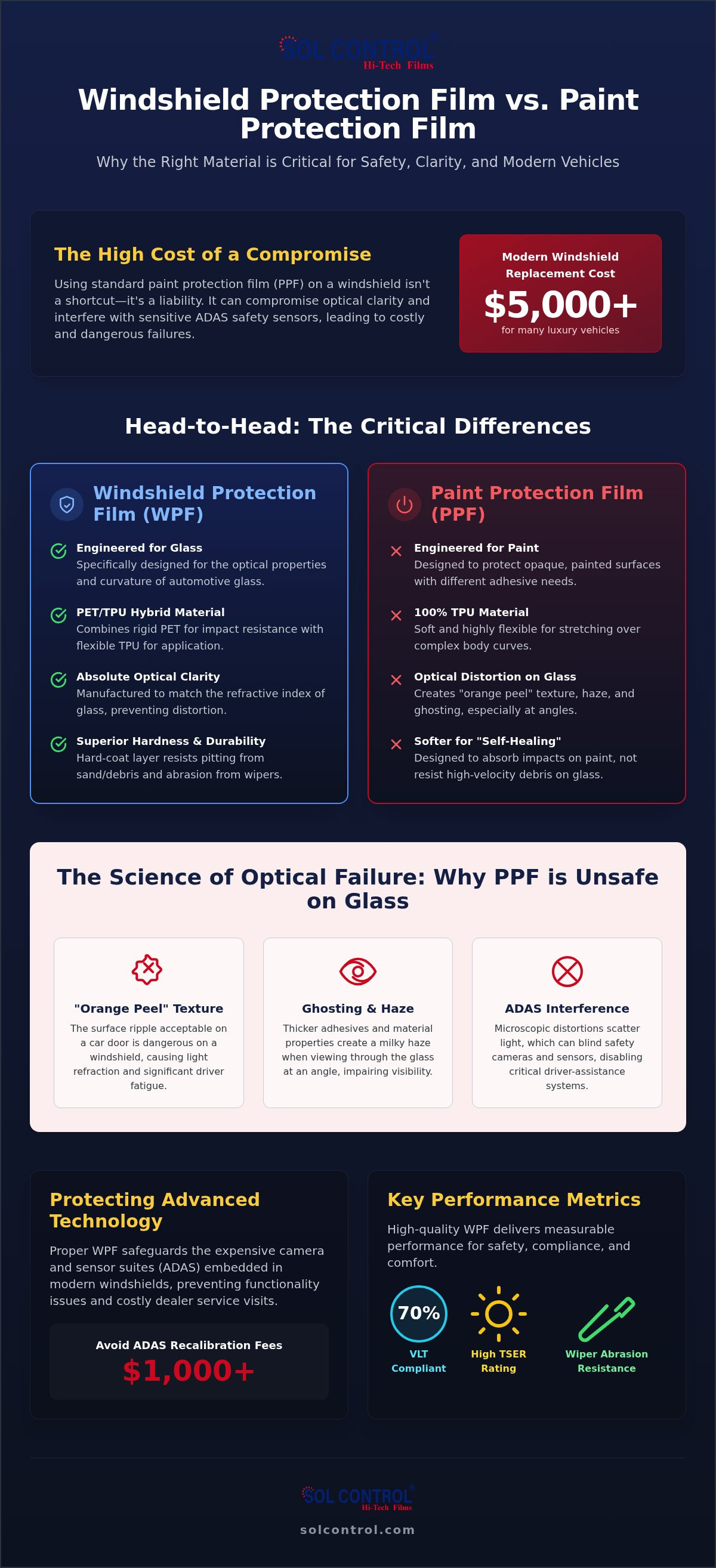
Installers often ask if they can simply use leftover scraps of body film on a client's windshield. The short answer is no. While both products offer defense against road debris, the debate of windshield protection film vs ppf comes down to specialized engineering. Windshield Protection Film (WPF) is a sacrificial, optical-grade barrier specifically designed for exterior glass surfaces. Unlike Paint Protection Film (PPF), which is primarily composed of thermoplastic polyurethane (TPU) to allow for stretching over complex body curves, WPF utilizes a hybrid construction to meet different performance standards.
This hybrid approach usually combines PET (polyethylene terephthalate) with TPU layers. The PET provides the structural rigidity needed to prevent a high-velocity rock from ever reaching the glass, while the TPU adds enough flexibility for the slight curvature of modern windshields. Standard PPF is designed to absorb impact and "self-heal" surface scratches through heat. In contrast, WPF is designed to resist those impacts while maintaining absolute optical clarity. If you apply standard PPF to a windshield, you'll immediately notice the "orange peel" texture. This slight surface ripple is acceptable on a car door, but it's dangerous on a windshield where it causes light refraction and significant driver fatigue.
Material Composition and Layering
The structural integrity of windshield films depends on the PET layers. This material is much harder than the TPU found in standard paint protection film technology. This specific hardness prevents the film from "pitting" when hit by sand or small gravel, which would otherwise create a hazy appearance over time. Specialized adhesives are equally important. Glass is a non-porous surface that reacts differently to pressure-sensitive adhesives than automotive clear coats. WPF adhesives must provide a strong bond that survives high-speed wind resistance while ensuring a clean, residue-free removal when the sacrificial layer reaches the end of its life.
Exterior Application vs. Interior Tinting
It's helpful to clarify for customers that WPF is an exterior application. Many drivers confuse it with interior window tint because of the similar PET base. However, the weathering requirements for an exterior film are far more extreme. These films must resist constant UV degradation on the vehicle's most exposed surface. They also face the mechanical stress of windshield wipers. High-quality windshield films feature advanced hard coats that provide wiper abrasion resistance. Without this coating, the friction from wipers would quickly scuff the film, leading to the "ghosting" effects that cause customer complaints. Understanding these nuances in windshield protection film vs ppf ensures your shop installs the right material for the right job.
The Science of Optical Clarity: Why PPF Fails on Glass
Choosing the wrong material for a windshield install doesn't just look bad; it creates a safety hazard. When comparing windshield protection film vs ppf, the most critical technical hurdle is the refractive index. Automotive glass is engineered to allow light to pass through with minimal bending. Windshield films are specifically manufactured to match this property. Paint protection film, however, is designed to sit on top of an opaque surface. Its adhesive layer is thicker and more aggressive, which often results in 'ghosting' or a milky haze when the driver looks through the glass at an angle.
The elasticity of PPF also works against it here. While its high stretch is great for wrapping a bumper, that same flexibility makes it nearly impossible to heat-shrink onto curved glass without introducing optical waves. These microscopic distortions scatter light, especially at night, turning oncoming headlights into blinding flares. This level of interference is unacceptable for modern Advanced Driver-Assistance Systems, which require a perfectly clear field of view to function reliably. Professional shops looking to avoid these liability issues should source dedicated glass protection materials that are built for the job.
Distortion and Driver Safety
Standard TPU films often exhibit 'waves' that aren't visible on a car's hood but become obvious when looking through a transparent pane. By 2026, safety standards for driver visibility have become even more stringent. Any barrier that causes light scattering or night-glare can compromise the driver's reaction time. Dedicated windshield films eliminate these risks by using a PET-hybrid structure that maintains a flat, consistent surface even after the heat-shrinking process. This ensures that the cameras and sensors mounted behind the rearview mirror receive an unaltered image of the road ahead.
Hard Coat Technology and Wiper Longevity
Wipers present another physical challenge. Standard PPF top-coats are designed to be soft so they can self-heal. On a windshield, this softness causes the wiper blades to 'grab' or chatter across the surface. This friction doesn't just ruin the film; it puts excessive strain on the wiper motor, potentially leading to mechanical failure during a heavy downpour. Unlike the 'soft' nature of PPF, windshield films utilize ceramic-infused hard coats. These coatings are engineered to resist the constant abrasion of wiper blades and the 'wiper trail' effect caused by road grit. Understanding these technical requirements is the only way to succeed when weighing windshield protection film vs ppf for a high-volume shop.
Protecting ADAS Technology: The Modern Business Case for Windshield Film
Modern vehicle windshields have evolved from simple transparent barriers into sophisticated housing units for LIDAR, high-definition cameras, and rain sensors. This technological shift has fundamentally changed the conversation around windshield protection film vs ppf. While a rock chip on a car's hood is a cosmetic nuisance, a chip in the "sensor zone" of a windshield can compromise lane-keep assist and emergency braking systems. Repairing this damage often costs far more than the glass itself. In 2026, a simple windshield replacement frequently necessitates a recalibration of these safety systems, which can exceed $1,000 in labor and specialized equipment fees.
Windshield protection film serves as essential insurance for the vehicle’s electronic nervous system. By absorbing the kinetic energy of road debris, the film prevents the microscopic pits and cracks that would otherwise trigger a "service ADAS" warning or cause sensor "blindness."
Preserving Factory Calibration
Retaining original equipment manufacturer (OEM) glass is a top priority for dealerships and fleet managers. Aftermarket glass, while often cheaper, may have slight variations in thickness or clarity that can lead to sensor misalignment. Professional installers must also ensure that any applied film complies with the Federal law on window light transmittance, which requires a minimum of 70% light transmittance to avoid rendering safety features inoperative. Applying the wrong material or an excessively thick layer can distort the camera's view, leading to system failures. For a deeper dive into industry standards, see The Professional Guide to Automotive Window Film.
ROI for Commercial Fleets and Luxury Vehicles
For commercial fleets, the real cost of a broken windshield is vehicle downtime. A replacement appointment can take hours or even days if the glass is backordered. Windshield protection film keeps vehicles on the road by acting as a sacrificial layer that can be replaced in a fraction of the time. It also preserves the structural integrity of the vehicle. In many modern designs, the windshield is a structural member that supports the roof in the event of a rollover. Maintaining the factory seal is always preferable to a third-party replacement. For luxury automotive clients, positioning WPF as a high-margin add-on is a logical upsell. It protects their investment and ensures the complex windshield protection film vs ppf decision results in long-term performance rather than expensive technical setbacks.
Key Performance Metrics for Evaluating Wholesale Protection Films
Evaluating the technical specifications of windshield protection film vs ppf requires a focus on optical metrics that go beyond simple impact resistance. For a professional shop, the most critical metric is Visible Light Transmission (VLT). Federal safety standards require front windshields to maintain at least 70% VLT. While many body films appear clear, they aren't always tested for the specific light transmittance required for legal glass application. Total Solar Energy Rejection (TSER) is another area where exterior films excel. By stopping infrared heat before it even reaches the glass, these films manage cabin temperatures more effectively than traditional interior tints.
Finding the "sweet spot" for material thickness is a technical balancing act. Most high-performance windshield films range between 4 and 6 mils. This thickness provides enough mass to deflect high-velocity road debris without causing the visual distortion common in thicker industrial plastics. Additionally, 99% UV rejection is a baseline requirement. This doesn't just protect the driver's skin; it prevents thermal degradation of the dashboard and the sensitive ADAS electronics housed near the rearview mirror.
Installation Efficiency for Shop Profitability
Time is money in a high-volume bay. Installers must evaluate the "shrinkability" of bulk rolls, especially when dealing with the complex compound curves of modern EVs. A film that resists heat shrinking leads to fingers and premature lift-off. Adhesive tack time is equally vital. Exterior installs are prone to environmental contamination, so an adhesive that bonds quickly but allows for repositioning is ideal. Using the right Professional PPF Installation Tools can significantly reduce the labor time per vehicle and improve the final finish.
Weathering and Delamination Resistance
Because these films live on the exterior, they face constant exposure to acid rain, road salt, and intense UV radiation. Lower-quality PET films often suffer from yellowing or bubbling within a single season. Professional shops should look for films with high edge-seal integrity. This prevents the film from lifting at high speeds or during pressure washing. Sourcing your inventory from a dedicated national distributor ensures you receive consistent, fresh stock that meets these rigorous performance standards. To scale your service offerings with reliable materials, browse our wholesale windshield protection inventory today.
Scaling Your Shop with SolControl: Wholesale Inventory and Professional Tools
Scaling your business requires a strategic approach to material sourcing and service diversification. Once you understand the technical nuances of windshield protection film vs ppf, you can effectively market your shop as a premier protection center. SolControl supports this growth by acting as your dedicated wholesale partner. We never compete with our clients for installation jobs, which means every lead in your area stays with you. This partnership allows you to focus on quality craftsmanship while we handle the logistics of your supply chain. By maintaining a steady inventory of bulk rolls, you can reduce lead times and capture more high-value projects.
Marketing your shop as a "Complete Protection Center" is a powerful way to stand out. When customers come in for a traditional tint job, you have the opportunity to educate them on the benefits of exterior glass shielding. Using SolControl materials ensures that you're delivering professional-grade results that won't result in the haze or distortion common with inferior products. This reliability builds the long-term trust necessary for repeat business and word-of-mouth referrals from luxury car owners and commercial fleet managers.
Why Wholesale Distribution Wins
Profitability in the protection industry is often decided by your per-roll cost and the reliability of your distributor. SolControl provides wholesale-only pricing that protects your margins and helps you stay competitive in your local market. With national distribution across the United States, we ensure that high-volume shops never face backorder delays that stall production. Our inventory includes the high-impact TPU and PET hybrid films discussed throughout this guide, giving you access to the best materials for both paint and glass. This consistency is vital for maintaining the high standards your customers expect. We also provide the technical support needed to help your crew master the specific shrinking techniques required for exterior glass.
Getting Started with Windshield Protection Services
Transitioning into glass protection is a logical step for any shop already offering tint or PPF. You'll need to equip your team with professional-grade tools designed specifically for the rigidity of windshield films. This includes heavy-duty squeegees for maximum water extraction and precision heat guns for shrinking film onto complex compound curves. By bundling these services with automotive window film, you create a comprehensive package that addresses heat rejection, UV safety, and impact resistance. This strategy maximizes the value of every car that enters your bay and streamlines your workflow. For the inventory and support you need to scale, contact SolControl for wholesale pricing on windshield protection film rolls today.
Elevate Your Shop’s Standards with Specialized Protection
Success in the automotive protection industry depends on more than just installation skill; it requires the technical discernment to choose the correct material for the surface. Understanding the engineering behind windshield protection film vs ppf allows your shop to offer services that protect both the vehicle’s glass and its sensitive electronic sensors. By prioritizing optical clarity and ADAS compatibility, you avoid the liability of haze and distortion while providing a high-margin solution for your clients. Retaining original factory glass is a priority for modern car owners, and your expertise makes that possible.
SolControl is dedicated to supporting your growth with exclusive wholesale pricing and national distribution across the United States. We provide bulk rolls designed for maximum durability and precision without ever competing for your local installation leads. It's time to streamline your workflow and secure your inventory from a partner that values your success. View our wholesale inventory of high-performance windshield protection films at SolControl and take the next step in scaling your service offerings. We look forward to helping your business reach its full potential.
Frequently Asked Questions
Is windshield protection film the same as paint protection film (PPF)?
Windshield protection film is not the same as paint protection film. While both provide impact defense, the material science of windshield protection film vs ppf is distinct. WPF uses a rigid PET-hybrid structure for optical precision on glass. Standard PPF is purely TPU, which is too soft for glass and creates visual ripples. Using the correct material ensures that drivers maintain a clear view of the road without the distortion associated with body-panel films.
Can I use PPF on a windshield to save on inventory costs?
You shouldn't use PPF on a windshield because it isn't engineered for high-visibility glass. The aggressive adhesives in PPF can cause a milky haze or "ghosting" when viewed at an angle. Additionally, the soft surface of PPF leads to wiper chatter and potential motor failure. Shops that try to save on inventory often face expensive redo jobs and customer complaints about night-glare and poor visibility through the "orange peel" texture.
Will windshield protection film interfere with ADAS cameras or LIDAR?
Professional-grade windshield films are specifically designed to be compatible with ADAS cameras and LIDAR sensors. These films maintain the required 70% Visible Light Transmission and match the refractive index of automotive glass. This prevents the sensor "blindness" or signal scattering that occurs with lower-quality plastics. Using a dedicated glass protection layer ensures that emergency braking and lane-keep assist systems receive an unaltered view of the environment, maintaining vehicle safety standards.
How long does a professional windshield protection film last on a daily driver?
A professional windshield protection film typically lasts between two and three years on a daily driver, depending on environmental exposure and wiper usage. Because it's a sacrificial layer, it gradually absorbs the impact of road grit and sand. Once the film shows signs of pitting or minor scuffing, it's easily removed and replaced. This cycle prevents permanent damage to the expensive factory glass and avoids the high costs of sensor recalibration.
Does the film affect the visibility of Head-Up Displays (HUD)?
Optical-grade windshield protection film does not negatively affect the visibility of Head-Up Displays (HUD). Because the material is engineered to bond perfectly with the glass surface, it doesn't create the double-imaging or blurring that non-optical films might cause. The light from the HUD projector passes through the film and reflects off the glass as intended. This allows drivers to utilize their technology without distraction while benefiting from the added impact resistance.
What tools are required for installing windshield protection film vs. PPF?
Installing windshield protection film requires different tools than those used for PPF. You'll need harder squeegees to extract water from the non-porous glass surface and high-output heat guns for shrinking the rigid PET layers. While PPF relies on high-stretch conformability, WPF requires precise heat management to avoid burning the film during the shrinking process. Specialized glass prep solutions are also necessary to ensure the adhesive creates a long-lasting, crystal-clear bond.
Is windshield protection film legal for use on the front glass nationally?
Windshield protection film is generally legal when it meets the federal requirement of 70% light transmittance. Most professional-grade films are virtually clear and don't reduce visibility. However, state-level regulations vary regarding the use of tinted strips or any film that might be perceived as a modification to the front glass. Installers should always verify that their chosen product complies with FMVSS No. 205 standards to ensure their customers remain legally compliant on the road.
How do you prevent wiper scratches on the exterior film surface?
Preventing wiper scratches requires using a film with a ceramic-infused hard coat. This specialized top layer is designed to resist the constant friction of wiper blades and the abrasive road salt they often drag across the surface. Installers should also advise customers to keep their wiper blades clean and replace them regularly. Applying a hydrophobic treatment to the film can further reduce friction, allowing wipers to glide smoothly while maintaining long-term optical clarity.