1-Ply vs. 2-Ply Window Film: Key Differences for Installers
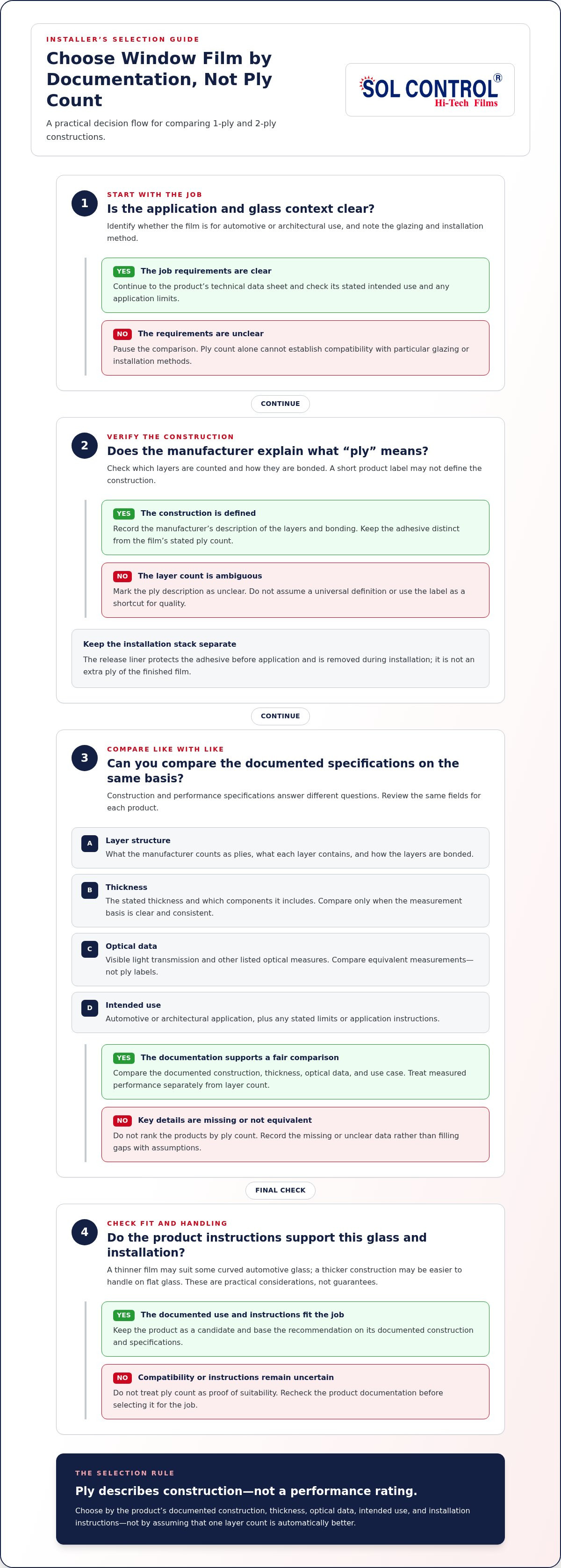
A 2-ply label doesn’t automatically make a window film the better choice for a job. Understanding the 1 ply vs 2 ply window film differences starts with separating layer count from performance: ply describes construction, while a product’s materials and documented specifications help determine its suitability for an application.
Installers are right to consider thickness, durability, and how a film handles during application. But terminology can vary, and ply count alone doesn’t establish heat rejection, UV protection, or compatibility with particular glazing or installation methods. A thinner film may suit some curved automotive glass, while a thicker construction may be easier to handle on flat glass. The specific product and its instructions still matter.
This guide explains what ply count refers to, compares practical trade-offs between 1-ply and 2-ply constructions, and shows which specifications to review before selecting wholesale film. You’ll also learn how to explain your choice to customers using product documentation rather than assumptions about what layer count guarantees.
Key Takeaways
Use the product’s technical data sheet to establish what “ply” means; terminology can vary between film descriptions.
Compare documented construction, thickness, optical data, and intended use instead of relying on marketing shorthand.
Consider VLT, UV rejection, and solar-energy performance as separate specifications when matching film to a job.
Follow a consistent selection process: define the requirements, choose a film category, compare specifications, and review installation instructions.
Understanding the 1 ply vs 2 ply window film differences helps you explain a film choice to customers with evidence, not assumptions.
1-Ply vs. 2-Ply Window Film: What Does Ply Count Actually Mean?
Ply count describes how a film is constructed, not whether it is automatically high or low quality. For installers comparing 1 ply vs 2 ply window film differences, the product’s technical documentation is the best starting point. Terminology can vary, and a ply label alone doesn’t identify the materials, intended application, or measured performance.
Quotable definition: Ply count describes a film’s layer construction. It is not a performance rating or a guarantee that the film suits a particular job.
The distinction matters because “layer” can refer to different parts of a product stack. A technical sheet may describe the film substrate and coatings separately from the adhesive that bonds the film to glass. The release liner is another component, but it protects the adhesive before application and is removed during installation. It isn’t an extra ply of the finished film.
For general context, Window film is commonly made from polyester film materials and used in a range of applications. That overview helps explain window film, but it doesn’t define how a particular manufacturer counts plies. Use the product’s own documentation for that.
What does 1-ply mean in a window film description?
A 1-ply description indicates a single-ply construction only when the manufacturer’s documentation defines it that way. It doesn’t, by itself, tell you whether the film is dyed, carbon-based, ceramic, or intended for automotive or architectural use. Those are separate product details. Check the construction notes and product category rather than inferring them from the ply label.
Keep the film separate from the installation stack. The release liner is peeled away, while the film’s adhesive helps attach it to the glass. Installation solution and other application materials don’t change the product’s stated ply count. This distinction keeps shop notes and customer explanations focused on the construction the manufacturer actually describes.
What does 2-ply mean, and what does it not prove?
When a manufacturer defines “2-ply” as two bonded film layers, the term describes that construction. The label alone doesn’t establish the layers’ materials, thickness, optical clarity, or intended use. If a listing says “two-ply” without explaining what is counted, treat the description as ambiguous rather than assuming it has a universal meaning.
A second layer also doesn’t prove greater durability, heat rejection, or easier installation. Those outcomes depend on product design and measured specifications, as well as whether the film suits the glass and application. Products with different ply labels may not be directly comparable unless their documentation uses consistent definitions and reports relevant test data.
Before comparing products, record what each technical sheet says about:
The layers included in the stated construction and how they’re bonded.
Whether thickness refers to the film itself or another measurement.
The film type, intended application, and separately reported performance data.
This gives you a reliable starting point: assess construction alongside the specifications that matter to the job instead of treating ply count as a shortcut for quality.
How 1-Ply and 2-Ply Window Film Constructions Differ
A useful comparison starts with the product data sheet, not a general rule about what “one” or “two” layers should do. A 1-ply product and a 2-ply product may differ in construction, but the label alone doesn’t show how they’ll perform or whether they’re right for a particular vehicle or building. Compare the same documented fields for each film.
Construction and performance specifications answer different questions: construction describes how a film is built, while measured data describes how it performs under stated test conditions.
Comparison point | What to check in the technical data sheet
Layer structure | How the manufacturer defines the plies, what each layer contains, and how the layers are bonded. Don’t infer the structure from a short product listing.
Thickness | The stated thickness and which components it includes. Compare values only when the measurement basis is clear and consistent.
Optical data | The listed visible light transmission and other optical measures, where provided. Compare equivalent measurements rather than treating ply count as an optical specification.
Intended use | Whether the documentation identifies the film for automotive or architectural applications, along with any stated limits or application instructions.
Construction, material, and adhesive are separate specifications
A data sheet may identify a film substrate, such as PET, and describe coatings or other construction details. The Architectural Window Film overview from the Whole Building Design Guide provides context on film materials and their use in buildings. For product selection, use the manufacturer’s documentation to establish the construction of the specific film you’re comparing.
Keep the adhesive separate in your notes. It bonds the film to the glass, but its specification doesn’t determine how many film plies the product has. Likewise, a release liner protects the adhesive before installation and is removed; it isn’t an installed film layer. If a description doesn’t explain what its layer count includes, record that detail as unclear rather than filling in the gaps yourself.
How construction may affect handling and installation
Thickness and flexibility can affect handling, but they’re distinct specifications. A thickness value doesn’t automatically tell you how a product will behave during forming, shrinking, or positioning. Look for application instructions that address the relevant technique and glass type, then use those directions to plan the job.
For example, when comparing two films for curved automotive glass, check whether each product’s instructions address that application. For flat architectural glazing, review the stated intended use and installation requirements. Don’t assume ply count predicts ease of installation or clarity. Product design and instructions matter.
Use this framework to evaluate 1 ply vs 2 ply window film differences without mistaking marketing shorthand for verified specifications. Installers sourcing automotive or architectural film can also explore wholesale window film categories for professional shops.
Which Window Film Specifications Matter More Than Ply Count?
Start with the job’s required function, then compare products that fit the application using their documented performance data. A ply label describes construction, but it doesn’t tell you whether a film provides the right light level, UV control, or solar-energy performance for the glass. This is the practical way to assess 1 ply vs 2 ply window film differences without assuming one construction is always superior.
Compare optical and solar-control data consistently
Visible light transmission (VLT) describes the amount of visible light passing through the glazing system. Judge the value against the project’s goals, not as a measure of UV protection or heat control. UV rejection and infrared performance need their own stated measurement context. They describe different parts of the light spectrum and aren’t interchangeable with VLT.
Solar-energy measures also require careful reading. A data sheet may report total solar energy rejected or solar heat gain, for example. Check the definitions, test methods, and glazing conditions behind each figure before comparing films. The Department of Energy’s discussion of Smart Window Films illustrates how film technologies can address solar control in different ways. It also shows why material or layer count can’t replace measured performance data.
VLT: Compare the same type of glazing-system value, not film labels alone.
UV: Review the stated UV measurement range and test context.
Solar and infrared data: Check each metric’s definition and test conditions. Don’t treat the measures as equivalent.
Verification: Confirm every numeric or product-specific claim against the current technical data sheet.
Match the film category to the job
Automotive and building-glass projects involve different application considerations. For a vehicle, define the customer’s goals and the glass areas involved, then review the product’s automotive instructions and documented optical data. SolControl’s automotive window film guide provides application-focused context. For residential or commercial glazing, consider the existing glass, the project’s goals, and the film’s architectural instructions. The architectural window film guide covers selection and performance considerations.
UV protection may be a priority in either setting, but don’t choose by a broad claim alone. Review the UV data and relevant application guidance, including SolControl’s UV-blocking window film guide. Compare products using like-for-like test methods and glazing conditions wherever the documentation provides them. If test conditions differ or aren’t stated, the figures may not support a direct comparison.
This gives installers a clear decision method: identify the intended function, select the appropriate film category, and compare verified measurements relevant to the glass and application. Ply count is useful construction information, but the job’s requirements and the product’s documented specifications should guide selection.
How to Choose Between 1-Ply and 2-Ply Film for a Job
Choose based on job requirements, not an assumption that more plies produce a better result. Construction is one consideration; the customer’s priorities, application, product specifications, and installation instructions all matter. Use this workflow when quoting or planning work, and record why the selected film fits the project.
Start with the application and customer priorities
First identify the glazing as automotive, residential, or commercial. Then clarify what the customer values, such as appearance, visible light transmission, UV protection, or solar control—an important consideration when vehicle owners are outfitting a car alongside specialized automotive accessories from sources like thechidrive.com. These priorities help narrow the product category before you compare layer counts. Don’t promise an outcome beyond the selected film’s documented capabilities.
Define the job requirements. Record the type of glass, areas to be filmed, project goals, and relevant customer preferences.
Identify the film category. Select products intended for the application, such as automotive film for vehicle glazing or architectural film for building glass.
Compare specifications. Review each candidate’s documented construction, thickness, optical data, and relevant performance measures. Compare equivalent measurements and test conditions where available.
Confirm instructions. Read the product’s installation guidance and glass-compatibility information before planning the work. Note any stated limitations that affect the job.
Select and record the rationale. Choose the product that best matches the requirements, then keep a record of the specifications supporting that choice for the quote and customer discussion.
Use the application needs as your decision matrix
This quick matrix keeps the decision focused on the job instead of ranking films by ply count. Treat it as a planning aid, then verify product-specific claims against current technical documentation.
Automotive appearance or light preference: Focus on the film’s documented optical data and automotive application instructions.
Automotive solar-control goal: Compare relevant solar and infrared measures, their definitions, and test conditions.
Residential or commercial building-glass project: Review the existing glass, intended use, project goals, and architectural product instructions.
Construction or handling is a priority: Compare documented layer structure, thickness, flexibility information, and installation guidance rather than inferring handling from ply count.
Validate the choice against product documentation
Before finalizing the quote or work plan, check that the technical data sheet supports the product’s intended use and the performance expectations discussed with the customer. Keep construction details distinct from measured results, and confirm that the instructions address the relevant glazing and installation method. If a description uses “1-ply” or “2-ply” without defining the construction, don’t use that shorthand as evidence of suitability.
The practical answer to 1 ply vs 2 ply window film differences is job-specific: neither layer count automatically guarantees a better outcome. Professional shops sourcing film for documented project requirements can explore wholesale window film options.
Source Professional Window Film with the Right Specifications
A repeatable, specification-led purchasing process helps your shop match each project with an appropriate film category and explain the choice clearly. Rather than presenting ply count as a quality ranking, show customers how documented construction relates to the application, and use performance data and instructions to inform the job plan. This makes the reasoning behind a selection easier to communicate and record.
Build a repeatable specification-led purchasing process
Before sourcing film, capture the intended application and the customer’s priorities. Then compare current product documentation against those requirements. Keeping the same details on file for each candidate makes comparisons more useful and supports consistent quoting and planning.
Record whether the job is automotive or architectural, and note the relevant glass and project goals.
Identify the performance measures that matter to the customer, such as light transmission or solar control.
Compare documented construction and optical data, using equivalent measures where possible.
Review installation guidance and any stated application considerations before selecting.
Save the technical information that supports the choice for future reference and customer discussions.
That record also helps keep explanations factual. Tell customers what the manufacturer documents about a film’s construction, then describe its stated performance separately. Avoid promising that a particular ply count guarantees a specific result. The relevant 1 ply vs 2 ply window film differences depend on the products being compared and the job requirements, not on a universal rule that more layers mean better performance.
Support the shop beyond the film roll
SolControl is a wholesale distributor serving professional installers and contractors. Its product range includes automotive and architectural window films, giving shops a wholesale source for different application types. Product selection remains specification-led: use project needs and current documentation to guide the choice rather than relying on a layer-count label by itself.
Film is only one part of running a professional tint business. SolControl also offers professional tinting tools and marketing materials to support shops. These products can complement film sourcing and customer communications, while each film’s product instructions continue to guide its use.
Use the same disciplined approach for every order: define the job, compare documented specifications, and keep the selection rationale on file. When a project calls for automotive or architectural film, SolControl’s wholesale offering serves professional shops and contractors.
Make Your Next Film Selection Specification-Led
Turn the selection method into a practical shop resource by keeping a short comparison record for each job. Include the application, customer priorities, relevant product measurements, and documentation behind your choice. That gives your team a consistent reference when planning similar work and helps keep customer conversations clear as products and project needs vary.
The key 1 ply vs 2 ply window film differences aren’t a shortcut to choosing a winner. Use construction details as one part of the decision, and let documented specifications guide the match between film and application. A clear rationale can help set expectations and support informed recommendations.
For your next project, explore SolControl’s wholesale offering for professional installers and contractors across the United States, including automotive and architectural films, tinting tools, and marketing materials. Explore professional window film and installer supplies to source products for your shop.
Frequently Asked Questions
Is 2-ply window film better than 1-ply film?
Not automatically. The better choice depends on the job and the documented performance of the specific film, not simply its ply count. For example, when comparing two products for a vehicle, review their relevant optical data and application instructions before deciding. The practical 1 ply vs 2 ply window film differences can frame the comparison, but product specifications should support your recommendation.
What is the difference between 1-ply and 2-ply window film?
The terms describe film construction as defined by the manufacturer. A product described as 1-ply may have a different documented layer structure from one described as 2-ply, but descriptions aren’t always standardized. For a reliable comparison, look for a construction diagram or written explanation in each product’s technical documentation. Check which components are counted, and don’t confuse the removable release liner with a layer that remains in the installed film.
Does 2-ply window film block more heat?
Not necessarily. Ply count alone doesn’t establish how much solar energy a film rejects or how it manages infrared energy. If heat control is the customer’s priority, compare the specific solar-performance measures reported for each candidate and note their test conditions. Products with different layer counts may report different heat-related performance, so use the relevant product data rather than promising that the 2-ply option will block more heat.
Can 1-ply window film be used for automotive and architectural applications?
That depends on the individual product. A 1-ply label doesn’t identify whether a film is designed for vehicle windows, residential glass, or commercial glazing. Check the product’s stated intended application and instructions before specifying it. Don’t assume a film documented for automotive use is suitable for building glass, or vice versa. Match the film category to the project and review any stated glass-compatibility guidance as part of planning.
Does ply count affect window film thickness or installation?
Ply count may relate to construction, but it doesn’t by itself establish the film’s measured thickness or how it will handle during installation. Review the manufacturer’s thickness measurement and application instructions separately. If the job involves curved glass, look for instructions that address that application rather than assuming a thinner or single-ply film will be easier to form. Product-specific guidance is more useful than a general rule based on layer count.
How should installers compare 1-ply and 2-ply window film specifications?
Start by recording the project type and the customer’s main requirements. Then compare candidate products using the same fields: documented construction, thickness, optical data, relevant solar measures, intended use, and installation guidance. Check whether the figures use comparable test conditions before drawing conclusions. If a data sheet leaves a point unclear, don’t present an assumption as fact. Keep the documentation supporting your selection with the job notes for consistent quoting and customer explanations.