Polarized Window Film: A Professional Guide to Technology and Applications
Most of what the industry labels as polarized window film is actually just high-performance solar tint, and that distinction matters more than your customers realize. You've likely seen the confusion firsthand. Installers and clients often conflate glare reduction with heat rejection, leading to mismatched expectations and frustrated buyers. It's a common pain point in a market where marketing buzzwords frequently outpace technical accuracy.
We understand that your reputation depends on the precision of your recommendations. This guide will clarify the technical reality of true polarization in window films, helping you distinguish between genuine light-filtering technology and standard solar control solutions. We'll examine the specific physics of how these films function, provide a framework for professional recommendations, and detail how to source reliable wholesale inventory for your business. By the end of this article, you'll have the expert knowledge required to navigate misleading claims and deliver the high-performance results your clients demand.
Key Takeaways
Differentiate between standard solar heat rejection and true light-filtering technology to provide more accurate client consultations.
Learn how polarized window film utilizes a multi-layered structure to specifically target and eliminate blinding veiling glare from reflective surfaces.
Understand the performance gap between traditional ceramic tints and polarized solutions by comparing Glare Reduction Index (GRI) and TSER metrics.
Identify high-value environments, such as waterfront properties and glass-heavy offices, where specialized light filtration offers the most significant safety and comfort benefits.
Master the criteria for evaluating wholesale suppliers to ensure consistent roll quality and batch matching for large-scale professional projects.
Understanding Polarized Window Film: Definition and Core Concepts
Polarized window film isn't just a darker version of standard tint; it's a specialized optical tool. While traditional films rely on pigments or metal layers to absorb light, a polarized film uses a specific chemical structure to block light based on its orientation. The primary objective is the elimination of veiling glare. This is the blinding light that bounces off horizontal surfaces like wet roads, car hoods, or bodies of water. By filtering out these specific waves, the film provides a level of clarity that standard darkening agents simply cannot achieve.
The Distinction Between Tinting and Polarization
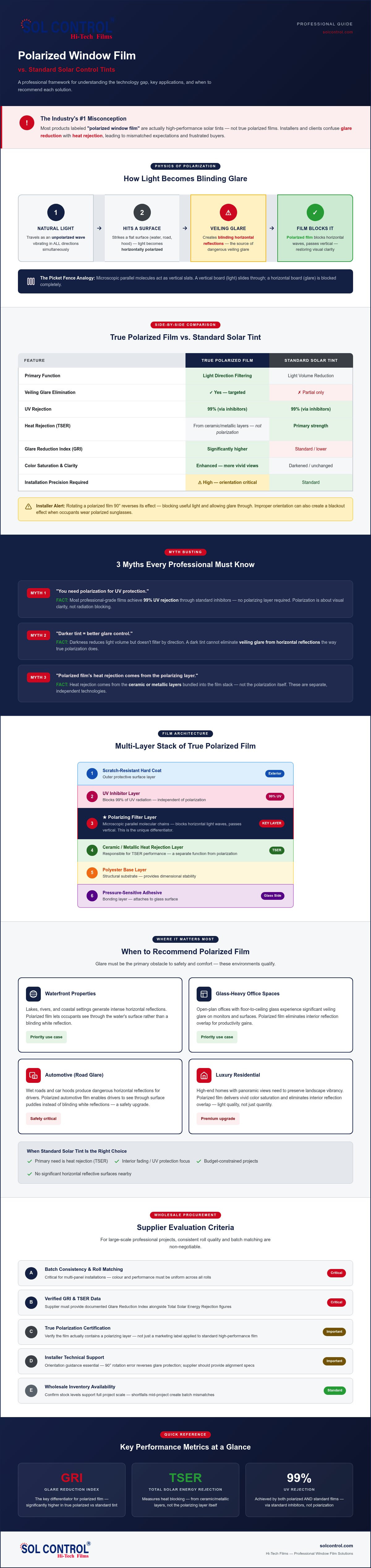
Standard tinting works by reducing the overall volume of light entering a space. Think of it like turning down a volume knob; everything gets quieter, or in this case, darker. Polarization operates differently. It functions like a microscopic set of vertical blinds. To understand this, one should look at The Physics of Polarization, which explains how light waves travel in multiple directions until they hit a flat surface and become polarized horizontally.
A high-quality polarized window film contains a dedicated filter layer within its multi-stage stack. This layer allows vertical light waves to pass through while blocking the disruptive horizontal ones. On a practical level, this means a driver can see through the surface of a puddle instead of seeing a white reflection. In architectural settings, it means seeing the vibrant colors of a landscape through a window rather than the reflection of the room's interior lights. It's about light quality, not just light quantity.
Common Misconceptions in the Window Film Industry
Many customers believe that a film must be polarized to offer high UV protection. This is a common industry myth. In reality, most professional-grade films provide 99% UV rejection through standard inhibitors, regardless of whether they have a polarizing layer. Polarization is about visual clarity, not just radiation blocking. You don't need a polarized layer to protect interiors from fading; you need it to see clearly in high-glare environments.
Confusion also exists regarding heat rejection. While polarized window film often performs well, its ability to block heat is usually a result of the ceramic or metallic layers bundled into the film's construction, not the polarization process itself. Professionals should clarify that "polarized" is often used as a marketing buzzword for any high-end film. True polarization is a specific technology designed for environments where glare is the primary obstacle to safety and comfort. Don't let a dark tint fool you; darkness alone doesn't mean the light is being filtered for direction.
The Physics of Polarization: How Light-Filtering Film Works
Light naturally travels as an unpolarized wave, vibrating in multiple planes as it moves through space. When this light strikes a flat, non-metallic surface, it undergoes a transformation. The light reflects and begins to vibrate primarily in a horizontal direction, creating what we perceive as blinding glare. Understanding how polarized light is produced is essential for professionals who want to explain the specific value of specialized films to their clients. By targeting these specific reflections, the film solves a visual problem that standard darkening cannot address.
A polarized window film functions much like a picket fence. Imagine trying to pass a large, flat board through the vertical slats of a fence. If the board is held vertically, it slides through easily. If it is held horizontally, the slats block it completely. The film contains microscopic, parallel chains of molecules that act as these slats. They absorb the horizontal light waves responsible for glare while allowing vertical waves to pass through. This selective filtering significantly enhances contrast and color saturation, making outdoor views appear more vivid and defined for the building's occupants.
Linear vs. Circular Polarization in Window Applications
In the architectural and automotive industries, linear polarization is the standard for fixed glass. This technology is highly effective at blocking reflections from roads and water, but it requires precise vertical alignment during installation. If an installer rotates the film 90 degrees, the film will block the useful light and allow the glare to pass through. Additionally, improper orientation can create a blackout effect when the occupant wears polarized sunglasses. When two linear polarizers are crossed at a 90-degree angle, they block nearly all visible light. Professional tinting tools and careful measurement are required to ensure the grain of the film remains perfectly vertical.
Material Composition of Professional Polarized Films
High-performance films are engineered using multiple layers for durability and clarity. The foundation is typically a high-grade Polyethylene Terephthalate (PET) substrate, chosen for its optical clarity and thermal stability. Manufacturers then integrate a polarizing layer, often consisting of iodine-based crystals or specialized dichroic dyes stretched into a specific orientation. This core is protected by a scratch-resistant hard coat and a high-tack adhesive system. This multi-layer construction ensures the polarized window film maintains its light-filtering properties despite years of exposure to intense solar radiation and environmental wear.
Polarized Film vs. Traditional Solar Control Tints
Choosing the right film requires a clear understanding of performance metrics. While most professionals focus on Total Solar Energy Rejection (TSER), polarized window film introduces the Glare Reduction Index (GRI) as a primary differentiator. Standard solar control tints primarily use absorption or reflection to reduce the volume of light. This works well for general brightness, but it fails to address the specific light wave orientation that causes blinding reflections. A high-performance polarized film can offer a GRI that significantly outperforms standard dyed or carbon alternatives, especially in environments where light bounces off horizontal surfaces.
The cost-benefit analysis for these films often reveals a premium price point. This is due to the complex multi-layer manufacturing process required to align the polarizing molecules. In high-exposure environments, the durability of these layers is critical. Professional-grade polarized solutions are engineered to resist the delamination that sometimes plagued earlier versions of the technology. They maintain their optical integrity and light-filtering capabilities long after cheaper, non-polarized alternatives have begun to fade or lose their effectiveness.
Polarization vs. Ceramic Technology
The main difference between these technologies lies in what they target. A high-quality ceramic window tint is designed to manage infrared heat without using metals or dyes. It excels at keeping interiors cool by blocking the invisible spectrum of solar energy. Polarization, however, is an optical tool focused on the visible spectrum. It relies on The Physics of Polarization to filter light directionally rather than just blocking heat.
In many high-end automotive or architectural projects, a hybrid approach is the most effective strategy. By combining a ceramic layer for heat rejection with a polarized layer for glare control, you provide the client with maximum comfort. Unlike older metalized films, neither ceramic nor polarized technologies interfere with electronic signals. This ensures that GPS, cellular, and radio frequencies remain crystal clear for the user.
Polarization vs. Carbon and Metalized Films
Aesthetics play a major role in film selection. Metalized films often create a "mirror" look that can be undesirable in residential or high-end commercial settings. Polarized film offers a color-neutral appearance that preserves the natural look of the glass while providing superior visual clarity. It doesn't rely on heavy dyes that can turn purple over time, nor does it use metals that can corrode in coastal environments. For wholesale distributors and installers, stocking polarized window film provides a premium, signal-friendly alternative for clients who prioritize visibility and safety over simple darkening.
Practical Applications: When to Recommend Polarized Solutions
Professionals must look beyond standard heat rejection when evaluating a project's specific needs. Recommending polarized window film is most effective when the primary challenge is intense reflected light rather than ambient brightness. Waterfront properties and structures in snowy climates present unique visual obstacles. In these environments, light reflects off the surface at a specific angle, creating a blinding effect that standard tints cannot neutralize. Specialized commercial spaces, such as airport control towers or high-end retail galleries, also require this technology to maintain color accuracy while eliminating distracting reflections.
Understanding the substrate is equally vital for a successful installation. When applying polarized film to tempered glass, installers must be aware of the "strain pattern" or "iridescence" effect. Tempered glass has internal stresses from the rapid cooling process. When viewed through a polarized filter, these stresses appear as dark spots or rainbow patterns. You should always test a small sample on tempered units to ensure the visual result meets the client's aesthetic standards. This level of technical foresight is what separates a professional installer from a general contractor.
Architectural and Commercial Benefits
In modern office environments, glare on computer screens is a leading cause of digital eye strain and reduced productivity. Integrating polarized window film into a project can resolve these issues without requiring employees to work in a cave-like atmosphere. This technology allows for higher visible light transmission while specifically cutting the rays that cause monitor wash-out. For those managing high-end architectural window film projects, polarization offers a way to enhance the view of the outdoors by deepening the blues of the sky and the greens of the landscape, providing a more immersive visual experience.
Automotive and Marine Safety
Automotive applications focus heavily on driver safety and comfort. Veiling glare from a dashboard reflecting onto the inside of a windshield can significantly obscure a driver's vision. A polarized solution effectively deletes these reflections. However, you must remain compliant with local regulations. For example, states like California and New York require a minimum of 70% Visible Light Transmission (VLT) for front side windows. In marine environments, the film is indispensable for captains who need to cut through the surface glare of the water to navigate safely. Explore our professional inventory to find the high-performance options required for these specialized safety applications.
Wholesale Procurement: Sourcing High-Performance Films for Professionals
Sourcing polarized window film requires a partner that understands the technical nuances of the trade. Professional installers cannot rely on consumer-grade retailers that lack the consistency required for high-precision applications. A batch-to-batch color shift or a slight variance in the polarizing axis can ruin a multi-window architectural project. You need a supplier that prioritizes rigorous quality control and provides the depth of inventory necessary to support large-scale contracts. Transitioning from retail-level sourcing to a professional distribution model is the most effective way to ensure your projects meet the high standards of performance and durability your clients expect.
Inventory Management for Tint Shops
Successful shops must balance their stock carefully to meet diverse client needs. While standard solar rolls handle the bulk of heat-rejection jobs, specialized polarized window film serves a premium niche that commands higher margins. Proper storage is essential for maintaining the integrity of these multi-layer products. We recommend vertical racking in climate-controlled environments to prevent the pressure marks and adhesive degradation that can occur when high-performance films are stored improperly. By utilizing uv blocking window film wholesale options alongside your polarized inventory, you can offer a tiered service model that caters to both budget-conscious clients and those requiring elite optical clarity.
Partnering with SolControl for National Distribution
Choosing the right distribution partner is a strategic business decision that impacts your bottom line. SolControl operates as a dedicated wholesale partner. We don't compete with our customers for installation contracts, ensuring our interests are always aligned with your success. We provide a national distribution network and competitive pricing to help your business scale efficiently. Staying informed on wholesale solar control film trends allows you to anticipate market shifts and maintain a competitive edge in a crowded field.
Our B2B partners gain access to comprehensive technical resources and marketing materials designed to explain complex technologies like polarization to their end customers. This support helps you close more sales by positioning your team as the authoritative experts in your market. Reliable logistics and methodical shipping processes ensure that high-volume contractors receive their materials on time, every time. Whether you are outfitting a commercial tower or a fleet of vehicles, having a partner that understands the practicalities of service and technical specifications is an invaluable asset.
Advancing Your Business with Precision Light Filtration
Mastering the distinction between standard solar control and true light-wave orientation allows you to provide a higher level of service to your clients. By understanding how polarized window film selectively filters horizontal glare, you can solve specific visual challenges in waterfront properties, high-glare offices, and automotive environments. This technical expertise, paired with a commitment to professional-grade materials, ensures that every installation delivers the clarity and comfort your customers demand. You're not just selling a tint; you're providing a specialized optical solution.
Success in the window film industry requires more than just technical skill; it requires a reliable supply partner. We provide a no-competition wholesale model and professional-grade technical support to help you grow your business with confidence. With our national distribution network across the United States, you can source the precise inventory you need for any project. Browse our full catalog of wholesale window films at SolControl and discover how our commitment to quality can elevate your next installation. We look forward to supporting your continued growth and success in the field.
Frequently Asked Questions
Is polarized window film the same as ceramic window tint?
No, polarized window film and ceramic tint are distinct technologies that serve different primary purposes. Ceramic films use nano-ceramic particles to block infrared heat while maintaining high visibility. Polarization is an optical process that filters light directionally to eliminate specific reflections. While manufacturers sometimes combine these technologies into a single high-performance product, a standard ceramic film won't provide the glare-killing properties of a dedicated polarized layer.
Does polarized window film make digital screens look black?
It's possible for digital screens to appear distorted or black when viewed through polarized film. This phenomenon occurs because many LCD and LED displays already use polarizing filters to control light. When the orientation of the screen's filter crosses with the film's filter at a 90-degree angle, it can block all visible light. Users might need to adjust their viewing angle or the screen's orientation to resolve this visual interference.
Can I install polarized film on double-pane windows?
You can install these films on double-pane units, but you must check the film's solar absorption rating first. Double-pane windows are sensitive to thermal stress; if a film absorbs too much heat, it can cause the glass to expand unevenly and crack. Professionals should always consult the manufacturer's film-to-glass compatibility charts to ensure the specific polarized product won't exceed the safe thermal thresholds for Insulated Glass Units (IGUs).
Why is polarized window film more expensive than standard tint?
The higher price point reflects the sophisticated multi-stage manufacturing process required to create an effective filter. Unlike standard dyed tints that simply darken the glass, polarized window film requires the precise alignment of microscopic molecular chains within the PET substrate. This precision ensures the film blocks horizontal light waves without distorting the vertical ones. The material costs for these specialized chemical layers and the quality control required for batch consistency drive the premium.
Does polarized film interfere with radio or GPS signals?
High-quality polarized films don't interfere with electronic signals like GPS, cellular data, or radio frequencies. This is because the polarizing layers are typically made from non-conductive materials like iodine or specialized dyes rather than metals. Unlike older metalized films that create a Faraday cage effect, modern polarized solutions allow electromagnetic waves to pass through freely. This makes them an ideal choice for modern vehicles and smart offices that rely heavily on wireless connectivity.
How long does professional polarized window film typically last?
Professional-grade polarized films typically have a lifespan of 10 to 15 years when properly maintained. The exact longevity depends on the intensity of UV exposure and the quality of the scratch-resistant hard coat. While entry-level products might show signs of delamination or bubbling sooner, the advanced adhesive systems used in professional distribution rolls ensure the film remains bonded to the glass. Regular cleaning with appropriate materials will help preserve the optical clarity for the long term.
Is polarized window film legal for automotive windshields?
Legality depends on the Visible Light Transmission (VLT) of the film and specific state regulations. In states like California and New York, the front side windows and windshields generally require a minimum of 70% VLT. While polarized window film is excellent for reducing dashboard reflections, installers must ensure the total VLT of the film plus the glass remains above the legal limit. Always verify local statutes, as laws in states like Louisiana or Texas allow for different darkness levels.
What is the best way to clean polarized window film without damaging it?
The safest way to clean these films is by using a soft microfiber cloth and a mild, ammonia-free soap solution. Ammonia can degrade the scratch-resistant coating and the adhesive over time, leading to premature failure or cloudiness. You should avoid using abrasive pads, paper towels, or sharp blades on the film surface. For professional results, spray the cleaner onto the cloth rather than directly onto the glass to prevent moisture from seeping into the edges of the film.