The Professional Guide to Pricing Commercial Tint Jobs in 2026
What if the difference between a lucrative multi-floor contract and a project that drains your bank account isn't your installation skill, but your mastery of the bid? For many installers, pricing commercial tint jobs feels like a high-stakes guessing game where one forgotten equipment rental or a miscalculated waste factor can erase months of profit. It's a common anxiety to fear underestimating labor on massive glass curtain walls or struggling to justify premium ceramic film prices to a skeptical facility manager.
We recognize that scaling your business into the architectural sector requires more than just technical precision; it demands a rigorous, data-driven approach to your estimates. This guide provides the exact variables and formulas professional installers use to quote architectural projects profitably and competitively. We'll break down a repeatable pricing framework that covers material nesting, labor multipliers for high-access work, and the strategic advantages of wholesale sourcing. By the end, you'll have the confidence to bid on million-dollar projects with the certainty that your margins are protected.
Key Takeaways
Master the fundamental pillars of pricing commercial tint jobs by balancing direct costs with value-based multipliers to protect your profit margins.
Learn how to align specific film performance metrics like TSER and VLT with client ROI goals to justify premium architectural film specifications.
Identify and account for hidden job-site overhead, including high-reach equipment logistics and site-specific labor differentials, before they impact your bottom line.
Develop a rigorous site walkthrough protocol to identify glass types and thermal stress risks, ensuring your bid includes the correct film-to-glass compatibility.
Leverage the stability of a national wholesale partnership to secure consistent material costs and optimize bulk roll purchasing for large-scale developments.
The Core Variables of Commercial Window Tint Pricing
Commercial window film installation is a specialized trade that demands a departure from the flat-rate models common in automotive shops. When you transition to architectural projects, you're no longer quoting a single vehicle; you're bidding on a physical environment with unique thermal and structural demands. Successful pricing commercial tint jobs relies on the square-footage multiplier as the primary benchmark. This approach ensures that every inch of glass is accounted for, providing a scalable foundation for both small retail fronts and massive high-rise developments.
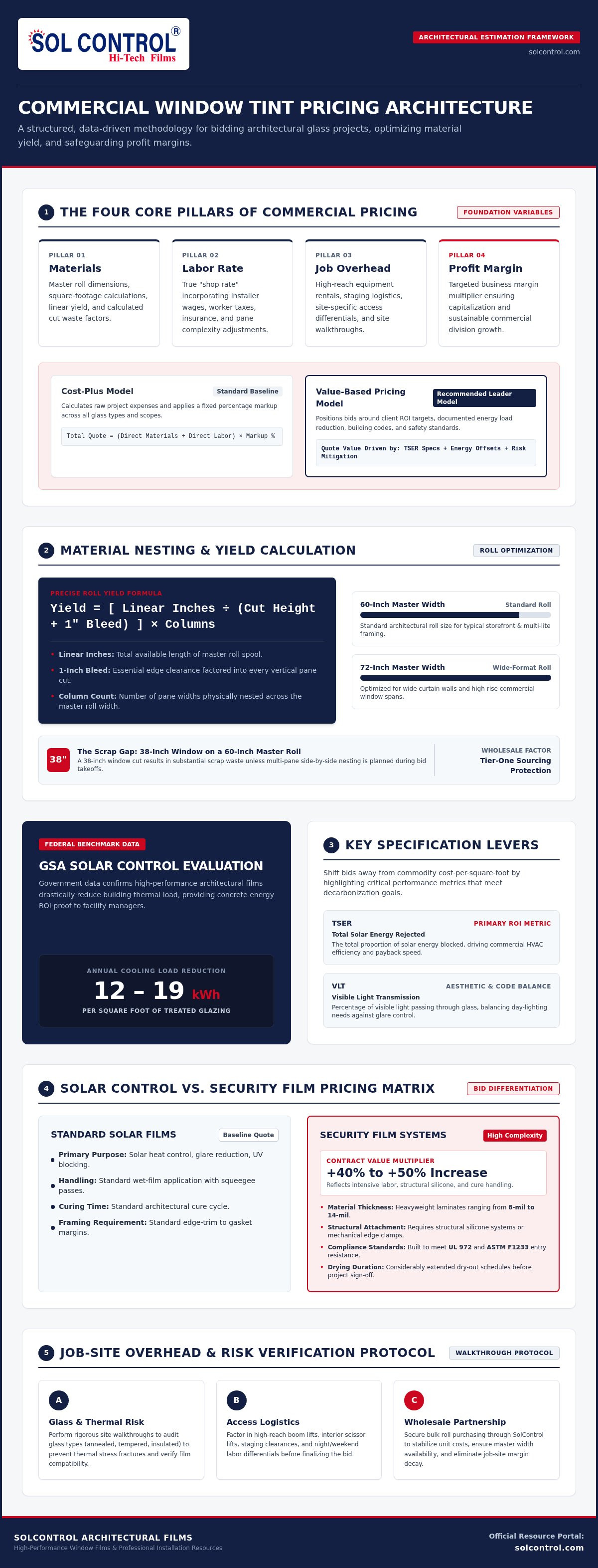
Profitability rests on four essential pillars: materials, labor, overhead, and your target profit margin. While many beginners rely on a "cost-plus" model, which involves adding a set percentage to their expenses, industry leaders often shift toward value-based pricing. This model allows you to command higher rates by focusing on the specific benefits detailed in architectural window film specifications, such as significant energy savings, UV protection, or enhanced building security. Understanding these variables is the first step toward building a sustainable commercial division.
Calculating Material Costs and Waste
Material expenses are more than just the price per square foot of the film. You must account for the physical dimensions of the rolls, typically 60-inch or 72-inch master widths, and how they align with the window panes on-site. If a window is 38 inches wide, a 60-inch roll will result in significant scrap unless you can nest multiple cuts side-by-side. To calculate your yield per roll, divide the total linear inches of the roll by the height of the window cut plus a one-inch bleed, then multiply by the number of possible columns across the roll width. Sourcing your films through a wholesale distributor like SolControl is vital. It ensures you have access to consistent master roll sizes and tier-one pricing that protects your margins against unexpected waste.
Establishing Your Base Labor Rate
Your labor rate isn't just what you pay your installers. It's a comprehensive "shop rate" that covers the hourly cost of keeping your crew on-site, including insurance and taxes. Standard projects might move quickly, but complex configurations like divided lites or arched windows require significantly more precision and time. Mastering the nuances of pricing commercial tint jobs involves adjusting your labor estimates for these difficulties. Using high-quality tinting tools is one of the most effective ways to increase your hourly efficiency. Professional-grade squeegees, precision blades, and specialized mounting solutions allow your team to clear more square footage per hour without sacrificing quality. This efficiency allows you to remain competitive while maintaining the high standards required for architectural sign-offs.
The selection of the right film is the most powerful lever you have when pricing commercial tint jobs. Commercial clients aren't just buying a darker window; they're investing in an asset class that must deliver a measurable return. By focusing on Total Solar Energy Rejected (TSER) and Visible Light Transmission (VLT), you can position high-performance films as a financial solution rather than an expense. Government data, such as the GSA solar control film evaluation, confirms that high-performance films reduce annual cooling loads by an average of 12 to 19 kWh per square foot of treated glazing. This data allows you to shift the conversation from the cost of materials to the speed of the payback period. Modern architectural window film also plays a critical role in helping buildings meet increasingly strict energy codes and decarbonization goals.
Solar Control vs. Security Film Pricing
Security films represent a significant jump in bid complexity. Unlike standard solar films, security laminates range from 8-mil to 14-mil in thickness, requiring specialized handling and longer drying times. The installation often involves structural silicone attachment systems or mechanical edge clamps to meet UL 972 and ASTM F1233 entry-resistance standards. These additions typically increase contract values by 40% to 50% due to the intensive labor involved. When bidding, leveraging UV blocking window film wholesale allows you to offer high-end solar protection as a baseline while upselling security packages as a premium safety audit requirement.
The Aesthetic Value of Reflective and Dual-Reflective Films
Visual impact is often the deciding factor for Class-A office asset managers. Reflective films provide excellent heat rejection and daytime privacy, but they can create a "night mirror" effect that obscures the view from the inside once the sun goes down. Dual-reflective technology solves this by utilizing a reflective outer layer and a neutral inner layer. This justifies a premium price point because it preserves the evening view for tenants. Matching these aesthetics to the building’s intent ensures your proposal resonates with the architect's vision. For installers looking to scale, exploring wholesale architectural options provides the technical variety needed to meet these diverse aesthetic demands.
Accounting for Job-Site Variables and Overhead
Accurate pricing commercial tint jobs requires a thorough evaluation of the physical constraints on a job site. Unlike controlled automotive bays, architectural environments introduce unpredictable structural variables. You face multi-story heights, restricted access windows, and strict property management rules. Accessibility challenges frequently require specialized equipment like scissor lifts, articulated boom lifts, or complex scaffolding systems. These logistical elements introduce mobilization fees and delivery drop charges that must be calculated before submitting a formal bid.
Operational overhead extends beyond the physical glass. Commercial projects typically demand higher general liability insurance caps, structural safety clearances, and specialized certifications for your crew. If a property manager requires the installation to occur outside normal business hours to avoid disrupting active office tenants, you must apply an after-hours labor multiplier to cover night or weekend shift premiums. Regional projects also require you to factor in travel time, lodging, and daily per-diem allowances for your installation team, ensuring these expenses don't erode your net margins.
Equipment and Tooling Requirements
When an architectural project requires treating windows higher than twelve feet, equipment rental costs should be passed directly to the client as a transparent line item in your proposal. This includes daily or weekly rental rates for electric slab lifts alongside potential loading dock standby fees. Your crew must also be equipped with heavy-duty squeegees, specialized extension poles, and industrial scrapers designed specifically for large-format architectural glass. Utilizing professional-grade tools minimizes the risk of film contamination, alignment errors, and costly re-dos that can destroy your profit margins. Securing these precision tools from a reliable national distributor ensures your team remains efficient on tight construction schedules.
Surface Preparation and Pre-Cleaning Costs
Failing to inspect the current state of the glazing is a frequent cause of underbidding. If the windows have an existing solar coating, failed old tint, or heavy construction debris, the labor required for removal can equal or exceed the actual installation time. Your contract must explicitly differentiate between a standard pre-cleaning wash and a deep scraping protocol. Outlining this scope protects your business if your team encounters stubborn silicone residue, degraded window gaskets, or architectural adhesives that slow down the installation process. Factoring these preparation variables into your workflow for pricing commercial tint jobs
Step-by-Step Guide to Creating a Winning Commercial Bid
Generating an accurate estimate is a multi-layered process that transforms raw job-site data into a professional contract. When pricing commercial tint jobs, your goal is to eliminate ambiguity. A winning bid doesn't just provide a price; it outlines a comprehensive solution that accounts for technical risks and client expectations. This process begins long before you cut your first piece of film, starting with a meticulous assessment of the building envelope.
The Site Audit: Identifying Potential Red Flags
The site walkthrough is your most critical opportunity to identify variables that could derail your profitability. You must identify the glass type, specifically looking for clear annealed, tinted annealed, or tempered glass. Applying high-absorption films to tinted annealed or double-pane IGUs carries a significant thermal stress breakage risk. You should also assess the condition of the window frames and gaskets. Documenting pre-existing scratches, seal failures, or frame corrosion protects your business from liability once the installation is complete. Ensure you locate reliable power access and water sources, as hauling water across a large facility adds significant labor time that must be reflected in your bid.
Drafting the Final Proposal
A professional proposal should offer a "Good, Better, Best" tiered structure. This approach gives the client a sense of control while allowing you to showcase the performance benefits of premium films. For example, you might offer a standard reflective film alongside a high-TSER ceramic option. Always include technical data sheets that prove your performance claims, such as UV rejection and SHGC improvements. This data-driven transparency builds trust with facility managers who are often focused on the long-term ROI of the project. To ensure your business remains competitive while scaling, you can access our wholesale architectural catalog to align your bids with reliable material availability.
Your proposal must also clearly define the financial and operational terms of the project. Commercial jobs often have longer timelines, so it's standard practice to require a deposit for materials followed by progress payments for completed floors or sections. Explicitly state the International Window Film Association (IWFA) visual quality standards, such as the 1/32 to 1/16 inch edge gap tolerance. This sets clear expectations for the final sign-off and ensures that minor water blisters, which are common during the 30 to 60-day curing period, don't lead to payment delays.
Step 1: Conduct a comprehensive site walkthrough to identify glass types and accessibility hurdles.
Step 2: Match film selections with wholesale availability to ensure consistent lead times.
Step 3: Apply labor multipliers for complexity, such as high-reach windows or night shifts.
Step 4: Present a tiered proposal focusing on energy savings and professional certifications.
Maximizing Profitability with Wholesale Partnerships
Securing a large-scale contract is a significant milestone, but protecting your margins during execution is where true profitability is won. The foundation of accurate pricing commercial tint jobs is a stable and predictable supply chain. When you rely on consistent wholesale pricing from a dedicated partner like SolControl, you eliminate the volatility that often plagues retail or third-party marketplace sourcing. This stability allows you to bid on projects months in advance with the certainty that your material costs won't fluctuate and erode your projected net profit.
Large-scale developments offer a unique opportunity to leverage "Bulk Roll" purchasing. By utilizing 60-inch and 72-inch master rolls, you can significantly reduce material scrap through software-driven nesting optimization. Industry benchmarks suggest that estimators should budget for 10% to 20% waste on architectural projects; however, access to wider master rolls allows you to minimize this drop factor on repetitive multi-floor curtain walls. This efficiency directly increases your gross margin without requiring you to raise your bid price, making your shop more competitive in crowded markets.
Scaling Your Shop for Commercial Success
Transitioning from one-off residential or automotive projects to recurring commercial contracts requires a shift in business strategy. To justify premium rates, you must build a portfolio that demonstrates your ability to handle complex architectural demands and strict construction deadlines. SolControl supports this growth by providing a national supply of high-performance architectural film and precision tools. Reliable lead times are essential in the commercial sector, where a delay in material arrival can trigger liquidated damages or disrupt the schedules of other trades on a job site. A national distribution model ensures that your crew has what they need exactly when they need it.
The SolControl Advantage for Professionals
Winning over architects and asset managers requires more than just a low price; it requires technical authority. We provide our partners with comprehensive technical data sheets and marketing materials that clearly communicate Solar Heat Gain Coefficient (SHGC) and U-factor improvements. These documents are vital when pricing commercial tint jobs for clients focused on ESG goals or energy modeling. Unlike retail vendors, a dedicated wholesale distributor acts as a mentor-partner, offering technical support for complex specifications like safety film attachment systems or thermal stress analysis. This expertise allows you to bid on high-value projects with the confidence of a market leader. Partner with a leader in wholesale window film distribution and start scaling your commercial division with precision and support.
Scaling Your Commercial Bidding Strategy
Mastering the science of pricing commercial tint jobs is what separates high-growth shops from those struggling to cover overhead. By shifting from a cost-plus mindset to a value-based approach, you can leverage high-performance solar control technology to justify premium rates. Your success depends on a rigorous site audit process and the ability to account for complex job-site variables before they impact your bottom line. Transitioning to architectural projects requires precision, but it also offers the potential for significant recurring revenue.
We're dedicated to your success as a mentor-partner. Our national wholesale distribution network ensures you have the consistent supply and technical data needed to win over the most demanding architects. With professional installer support and access to tier-one materials, you have everything necessary to bid on large-scale developments with absolute confidence. It's time to stop guessing and start quoting with the authority of an industry leader.
How much should I charge per square foot for commercial window tinting?
Commercial rates vary based on the specific film performance and site complexity. Most professionals target a gross profit margin between 60% and 80% to cover labor, overhead, and materials. You should adjust your rate based on the glass type, the height of the windows, and the performance tier of the architectural film selected for the project.
What is the standard waste factor for architectural window film rolls?
A waste factor of 10% to 20% is the industry standard for architectural roll drop calculations. This accounts for the difference between standard master roll widths, such as 60-inch or 72-inch, and the actual dimensions of the glass panes. Using nesting software can help you minimize this scrap and protect your margins on large-scale developments.
How do I factor in the cost of lift rentals for high-rise tint jobs?
Pass lift rental costs directly to the client as a transparent line item in your proposal. You must include mobilization fees, daily or weekly rental rates, and any standby charges for restricted loading dock access. Don't forget to account for the additional labor required for lift-certified technicians and dedicated safety spotters on the ground.
Is it better to charge by the hour or by the square foot for commercial work?
Square footage is the standard metric for pricing commercial tint jobs because it provides a clear, scalable value for the client. Internally, you should use your hourly shop rate to determine if your per-foot price covers your crew's time and overhead. This dual approach ensures your bids remain competitive while guaranteeing your business stays profitable.
What are the most common mistakes when pricing large architectural projects?
The most frequent errors include underestimating the time required for surface preparation and failing to account for material waste on odd-sized panes. Many installers also overlook thermal stress risks on tinted annealed glass, which can lead to costly breakage claims. Always conduct a thorough site walkthrough to identify these variables before submitting your final bid.
How does film type (ceramic vs. carbon) affect commercial pricing?
Ceramic films command a premium price because they offer superior Total Solar Energy Rejection (TSER) without a mirrored appearance. These films are often required for Class-A office buildings to meet energy codes. Carbon films are a durable, budget-friendly alternative, but they generally lack the high-end heat rejection necessary for significant HVAC load reductions in large commercial spaces.
Should I include a warranty in my commercial tinting quote?
Yes, your quote should explicitly state the manufacturer's warranty, which typically lasts 10 to 15 years for standard interior solar films. You should also define your own workmanship warranty period for the installation. Providing these details builds trust with facility managers and ensures everyone understands the long-term performance expectations for the architectural film.
How do I handle pricing for removals of old window film?
Removals must be quoted as a separate per-square-foot line item. The labor required to scrape failed coatings or remove stubborn adhesive can often equal the time spent on the new installation. Clearly specify in your contract whether the quote covers standard cleaning or heavy scraping to avoid scope creep once the project begins.