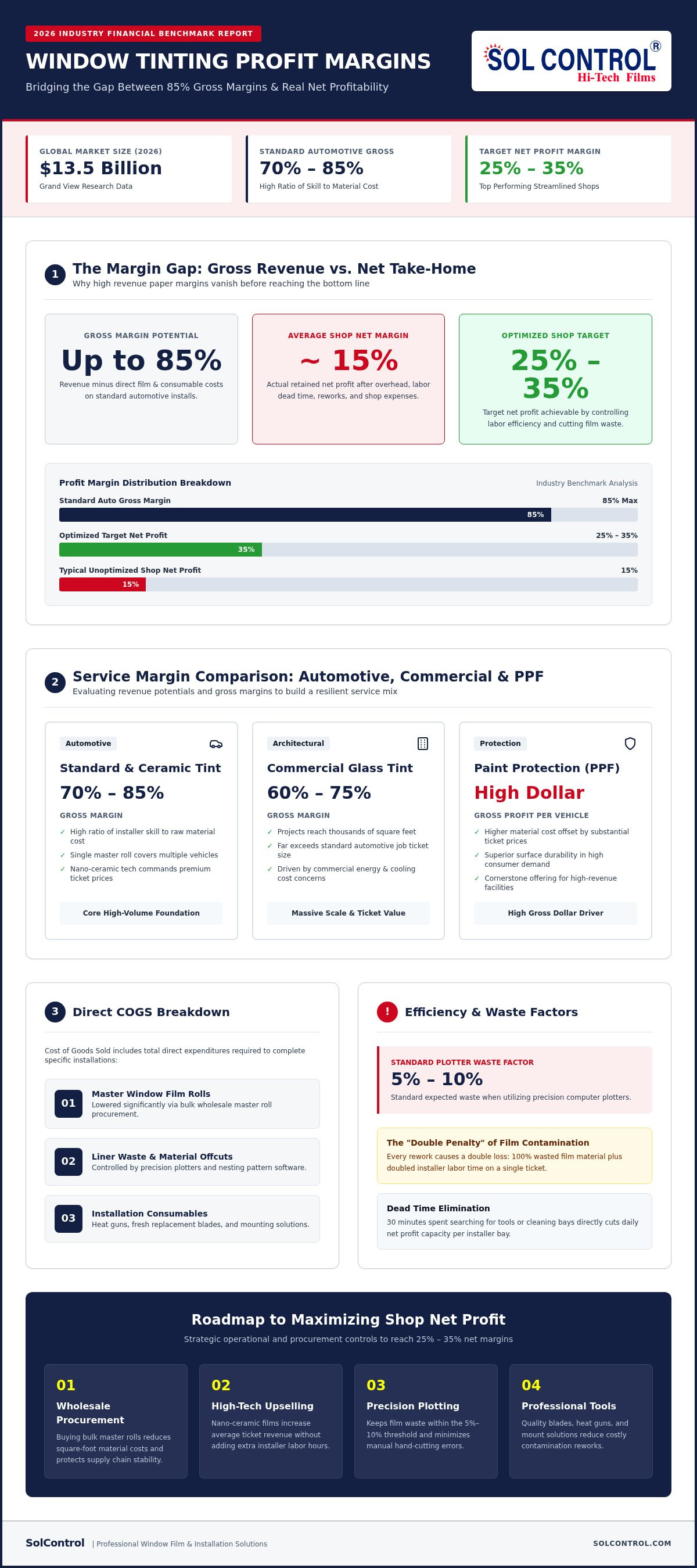
Did you know that while standard automotive jobs often boast gross profit margins on window tinting as high as 85%, the average shop's actual net profit often sits closer to 15%? It's a frustrating reality for many shop owners who see high revenue numbers on paper only to watch them vanish into rising material costs, labor inefficiencies, and film waste. You've likely felt the sting of a single rework job wiping out a day's gains or struggled to justify the price of premium ceramic films to a cautious customer.
This 2026 financial guide will show you exactly how to bridge that gap and protect your earnings. You'll discover the specific factors driving modern profitability and learn how to optimize your wholesale procurement and operational efficiency to maximize your bottom line. We'll break down the crucial difference between gross and net margins, provide strategies to slash film waste using professional tools, and offer a proven framework for upselling high-performance films that your customers will value. By the end of this guide, you'll have a clear roadmap to transform your shop from a high-volume installer into a high-margin business.
Key Takeaways
Distinguish between gross and net profit margins on window tinting to identify exactly where your revenue is being lost to overhead.
Minimize material waste and costly reworks by utilizing professional-grade tools and precision cutting patterns.
Evaluate the different revenue potentials of automotive, architectural, and paint protection films to build a more resilient service mix.
Protect your bottom line through strategic wholesale procurement that stabilizes your supply chain and reduces your cost of goods sold.
Implement a framework for upselling high-performance ceramic films to increase your average ticket size without adding labor time.
The window film industry has entered a period of robust growth. According to data from Grand View Research, the global window film market reached a valuation of $13.5 billion in 2026. For shop owners, understanding the nuances of profit margins on window tinting is no longer just about survival; it's about strategic expansion. You need to distinguish between your gross and net figures to truly gauge success. Gross margin represents the difference between your retail price and the cost of film and consumables. Net margin is what remains after you've paid for shop rent, installer commissions, marketing, and software subscriptions. While gross margins often look impressive, the net figure determines your actual business health.
Window tinting remains a high-margin service compared to other automotive or construction trades. Unlike general mechanical repair or home remodeling, tinting relies on a high ratio of skill to material cost. A standard roll of automotive and architectural window film can yield multiple jobs. This keeps your cost of goods sold (COGS) remarkably low compared to the high labor value you provide. Current demand is pivoting toward advanced nano-ceramic technology and Paint Protection Film (PPF). These products offer superior heat rejection and surface durability, allowing shops to command higher ticket prices. National energy concerns also play a role. As cooling costs rise, consumers increasingly view heat-rejection films as a necessary investment rather than a luxury.
What Constitutes a Healthy Profit Margin?
In 2026, a healthy automotive tinting operation typically maintains gross margins between 70% and 85%. To find your break-even point per roll, you must calculate the total cost of the master roll against the number of vehicles it can realistically cover. You should account for a standard 5% to 10% waste factor when using precision plotters. Professional pricing shouldn't fluctuate based on local guesswork. Instead, it should reflect the technical expertise required for high-end installations. High-performing shops often target net profit margins of 25% to 35% by strictly controlling overhead and labor efficiency.
Revenue Streams Beyond Standard Automotive Tint
Diversification is the most effective way to stabilize your bottom line. Architectural and commercial installations often yield gross margins of 60% to 75%. Project sizes in the commercial sector can reach thousands of square feet, far exceeding the typical automotive ticket. Additionally, PPF has become a cornerstone of high-revenue shops. While the material cost for PPF is higher, the massive gross dollar profit per vehicle makes it an essential offering. Successful shops also leverage secondary revenue through marketing materials and specialized maintenance kits to keep customers engaged long after the initial installation is complete.
Calculating Gross vs. Net Profit Margins on Tinting Services
To master the profit margins on window tinting, you must look beyond the simple retail price of a single job. Gross profit is your revenue minus the direct cost of materials. Net profit is what remains after every operational expense, from shop rent to the cost of a single replacement blade, has been subtracted. While a high gross margin suggests a healthy business, it's the net margin that determines your ability to scale and reinvest in your facility.
Breaking Down the COGS for a Standard Installation
Bulk wholesale procurement remains the most effective way to lower your cost per square foot. When you buy master rolls, you aren't just buying film; you're buying margin. You must also account for consumables like heat guns, fresh blades, and mounting solutions that ensure a clean finish. Cost of Goods Sold (COGS) represents the total direct expenditure for the window film rolls, liner waste, and installation consumables required to complete a specific job. Investing in professional-grade installation tools ensures you get the most out of every roll while minimizing material waste.
The Labor Efficiency Factor
Labor is often your largest variable expense. When calculating the true cost of an installer, you should reference Bureau of Labor Statistics installer wage data to ensure your compensation models are competitive yet sustainable. Efficiency isn't just about moving fast. It's about reducing dead time between vehicles. If an installer spends thirty minutes cleaning a bay or searching for tools, your net profit per day drops significantly.
Financial cost extends to installation errors and film replacement. Every instance of film contamination acts as a double penalty. You lose the material cost and the labor hours spent on the initial job plus the time required for the rework. Reducing your rework rate from 10% to 2% can have a more significant impact on your bottom line than simply raising your prices.
Fixed costs like rent, utilities, and insurance are the silent anchors of your business. Marketing expenses are also critical; you need a steady stream of leads to keep your bays full. Hidden costs often include tool replacement and warranty re-works. A scratched piece of film due to an old squeegee might seem minor, but these recurring issues aggregate into a substantial drain on your annual profit margins on window tinting.
High-Margin Service Comparison: Automotive, Architectural, and PPF
Maximizing your profit margins on window tinting requires a strategic mix of volume and high-value services. While automotive work provides the consistent baseline revenue most shops rely on, it is also the most competitive segment. Diversifying into architectural films and paint protection film (PPF) allows you to capture higher ticket sizes and better net returns. Each category offers a different financial profile, and understanding these differences helps you allocate your labor and bay space more effectively.
Architectural and Commercial Margins
Architectural and commercial projects often yield superior net profits because they eliminate many of the logistical hurdles found in automotive work. You aren't moving cars in and out of a bay or dealing with complex interior trim. Instead, you focus on large, flat glass surfaces that allow for high square footage installation in a single session. Architectural installations typically yield 60% to 75% gross margins on material. Commercial clients are often driven by energy efficiency ROI. High-performance films can significantly lower cooling costs, making the installation a financial asset for the property owner rather than just an aesthetic upgrade. For a deeper look at these opportunities, consult Architectural Window Film: The Professional Guide.
The Premium Spread: Carbon vs. Ceramic
The spread between carbon and ceramic films represents one of the most effective ways to boost your bottom line. While ceramic rolls carry a higher wholesale cost, the retail markup is significantly steeper because the performance benefits are so tangible. Total Solar Energy Rejection (TSER) is your most powerful sales tool here. When you show a customer the difference in heat rejection, the price increase for ceramic becomes an easy sell. This upselling strategy increases your profit margins on window tinting without requiring extra labor hours. You can learn more about these film types in The Professional Guide to Automotive Window Film.
Paint Protection Film (PPF) sits at the top of the pricing hierarchy. It demands the highest level of technical skill and a clean environment, but the gross dollar profit per vehicle is unmatched. PPF gross profit margins typically range from 40% to 60%. While the percentage is lower than standard tint due to higher raw material costs, the net dollar profit per job is significantly higher. By offering a tiered service menu that includes automotive, architectural, and PPF, you insulate your business against market fluctuations and ensure that every hour of labor generates maximum value.
How Tool Efficiency and Waste Reduction Drive Profitability
Precision is the foundation of a profitable shop. While many installers focus solely on the retail price of a job, the most successful operators look at the efficiency of their installation process. Cheap squeegees often develop nicks that are invisible to the naked eye but devastating to a fresh film surface. One microscopic scratch can force a complete strip and retint, doubling your material cost and tripling your labor time. This is why the most profitable shops treat their tool inventory as a high-yield investment. By replacing consumables frequently and choosing professional-grade equipment, you insulate your profit margins on window tinting against avoidable mistakes.
A clean environment and professional-grade tools work together to ensure first-time success. Rework is the single fastest way to destroy your hourly rate. You lose the film, the labor, and the opportunity cost of the next vehicle waiting for that bay. Investing in superior equipment ensures that your team can work with confidence and speed. This proactive approach protects your bottom line from the cumulative drain of small errors.
Investing in Professional-Grade Tinting Tools
Specialized squeegees and hard cards allow for more consistent pressure and water extraction. This reduces the risk of bubbling or peeling that leads to costly warranty claims. Precision blades are equally vital. A dull blade can snag the film or, worse, scratch the customer's glass. Professional tool kits pay for themselves through labor hour reductions. When an installer has the right tool for every corner and gasket, they finish jobs faster and with fewer errors. This increased throughput allows you to schedule more jobs per day without increasing your overhead.
Minimizing Film Waste on the Shop Floor
Manual trimming often leads to 20% to 25% material waste. In contrast, precision cutting plotters using automated nesting software can lower that waste to under 10%. Strategic nesting allows you to fit more patterns into a smaller area of film. This is particularly important for high-cost ceramic films where every square inch matters. While manual cutting relies on the installer's eye, digital patterns ensure consistency across every job. Managing partial rolls is another critical area. If you don't track your inventory, you'll end up with 'dead' stock that represents tied-up capital. Reducing film waste by just 5% can significantly increase the total yield of a 100-foot master roll, directly boosting the net profit of every vehicle tinted.
Scaling Profitability Through Strategic Wholesale Procurement
Sustainable growth depends on your supply chain. Many shops rely on local retail sources or secondary distributors, but this approach often erodes your profit margins on window tinting. A dedicated wholesale distributor provides a direct link to high-performance manufacturing. This bypasses middleman markups and ensures that your cost of goods sold remains predictable. Consistency is another major advantage. When you use the same high-quality rolls across every bay, your installers develop a rhythm that reduces errors and speeds up the application process. This operational stability is what allows a shop to scale without sacrificing quality.
SolControl operates on a pure B2B model. This means we never compete with our customers for installation contracts. We focus entirely on providing the bulk rolls and professional tools you need to succeed. By leveraging distributor support, you gain access to marketing materials and technical training that would be expensive to develop in-house. This partnership allows you to focus on your craft while we handle the logistics of national distribution. It's a model designed to protect your bottom line by providing the resources of a global player with the personal support of a dedicated partner.
The Benefits of a Wholesale Partnership
A reliable supply chain is essential for scaling to multiple service bays. If you run out of a popular ceramic shade mid-week, your bay sits empty and your revenue stops. Partnering with a national distributor ensures you have access to premium automotive and architectural films exactly when you need them. You can also use distributor-provided technical data, such as UV rejection and TSER ratings, to build trust with your customers. This data provides the objective proof needed to justify the higher retail price of high-performance films, which is vital for maintaining healthy profit margins on window tinting as consumer expectations rise.
Future-Proofing Your Margins for 2026
The industry is moving toward specialized solutions like advanced ceramic and windshield protection films. Shops that fail to adapt will find themselves competing on price for basic dyed films; this is a race to the bottom. Building a business model that prioritizes net profit over pure job volume is the only way to ensure long-term stability. Focus on the jobs that offer the highest return on labor and use your wholesale partnership to keep those material costs low. This strategic approach ensures you're prepared for the technical demands of 2026 and beyond.
Maximizing Your Shop's Potential for 2026 and Beyond
The window film industry is evolving; your financial strategy must evolve with it. Protecting your profit margins on window tinting requires a disciplined focus on net income rather than just volume. By reducing material waste through professional tools and diversifying into high-ticket services like architectural film and PPF, you build a resilient business model. Success isn't just about the number of cars in your bays. It's about the precision of your installation and the strength of your supply chain.
As a dedicated B2B wholesale partner with national US distribution, we're here to support your growth without competing for your customers. Our comprehensive inventory of high-performance automotive, architectural, and paint protection films ensures you always have the right products to meet shifting market demands. Scale your profits with SolControl’s wholesale window film and professional tools. We look forward to helping you reach new levels of operational excellence and profitability in the coming year.
Frequently Asked Questions
What is the average profit margin for a window tinting business?
Most established tint shops see gross profit margins on window tinting between 70% and 85%. This figure represents the revenue remaining after direct material costs are subtracted. However, true net profit margins usually range from 15% to 25% after accounting for rent, labor, and marketing. Solo mobile installers often report higher net percentages because they avoid the fixed overhead costs associated with maintaining a physical storefront or commercial bay.
How do ceramic window film margins compare to standard carbon film?
Ceramic films typically offer a significantly higher gross dollar profit per vehicle compared to carbon or dyed alternatives. Although the wholesale cost of a ceramic roll is higher, the retail price for these premium installations often doubles. Because the labor time remains nearly identical for both film types, the additional revenue goes directly toward your bottom line. High heat rejection performance makes ceramic an easy upsell for performance-minded customers.
Is architectural window tinting more profitable than automotive tinting?
Architectural projects often yield higher net profits per job because of their massive scale and reduced logistical complexity. While automotive work provides steady daily volume, a single commercial contract can cover thousands of square feet of flat glass. These projects focus on energy efficiency and cooling cost reduction, allowing shops to command professional rates. The lack of complex interior vehicle trim also allows installers to maintain a faster square-footage application rate.
How can I reduce film waste to improve my shop's bottom line?
Transitioning from manual hand-cutting to a digital plotter system is the most effective way to minimize waste. Precision cutting software utilizes nesting algorithms to fit patterns tightly together, often reducing material loss from 25% down to less than 10%. Additionally, maintaining a clean, dust-controlled environment prevents contamination reworks. Every piece of film saved through better organization and professional equipment directly increases the total yield and profitability of every master roll.
Does professional-grade equipment really impact my profit margins?
High-quality installation tools are essential for protecting your profit margins on window tinting by preventing costly reworks. A single scratch caused by a cheap, nicked squeegee or a dull blade can force you to strip and redo an entire window. This mistake doubles your material cost and consumes valuable labor hours that could be spent on new jobs. Investing in professional-grade equipment ensures consistent results and allows your team to work with greater speed and confidence.
How much should I charge for labor vs. materials in a tint job?
Your pricing should reflect the high level of technical skill required for a professional installation rather than just the cost of the film. In most successful shops, the material cost represents a small fraction of the total ticket price. You should calculate your labor rate based on installer expertise and shop overhead requirements. Using industry benchmarks for installer compensation helps ensure your labor rates are competitive while still leaving enough room for a healthy net profit.
What are the hidden costs that most new tint shop owners overlook?
New owners often overlook the cumulative impact of rework rates, marketing expenses, and software subscriptions. Rework due to dust or poor technique is a primary profit killer because it wastes both time and film. Customer acquisition costs through digital advertising can also be substantial. Other hidden expenses include the cost of specialized plotting software, shop insurance, and the regular replacement of consumable tools like blades and hard cards that wear down over time.
How does wholesale procurement help small tinting businesses compete with franchises?
Direct wholesale procurement allows independent shops to access the same high-performance films and bulk pricing enjoyed by large franchises. By partnering with a dedicated B2B distributor like SolControl, you lower your cost of goods sold without the burden of franchise fees or territorial restrictions. This access to premium automotive and architectural rolls enables you to offer superior technology to your customers. Strategic purchasing ensures your pricing remains competitive while your profit margins stay protected against market fluctuations.