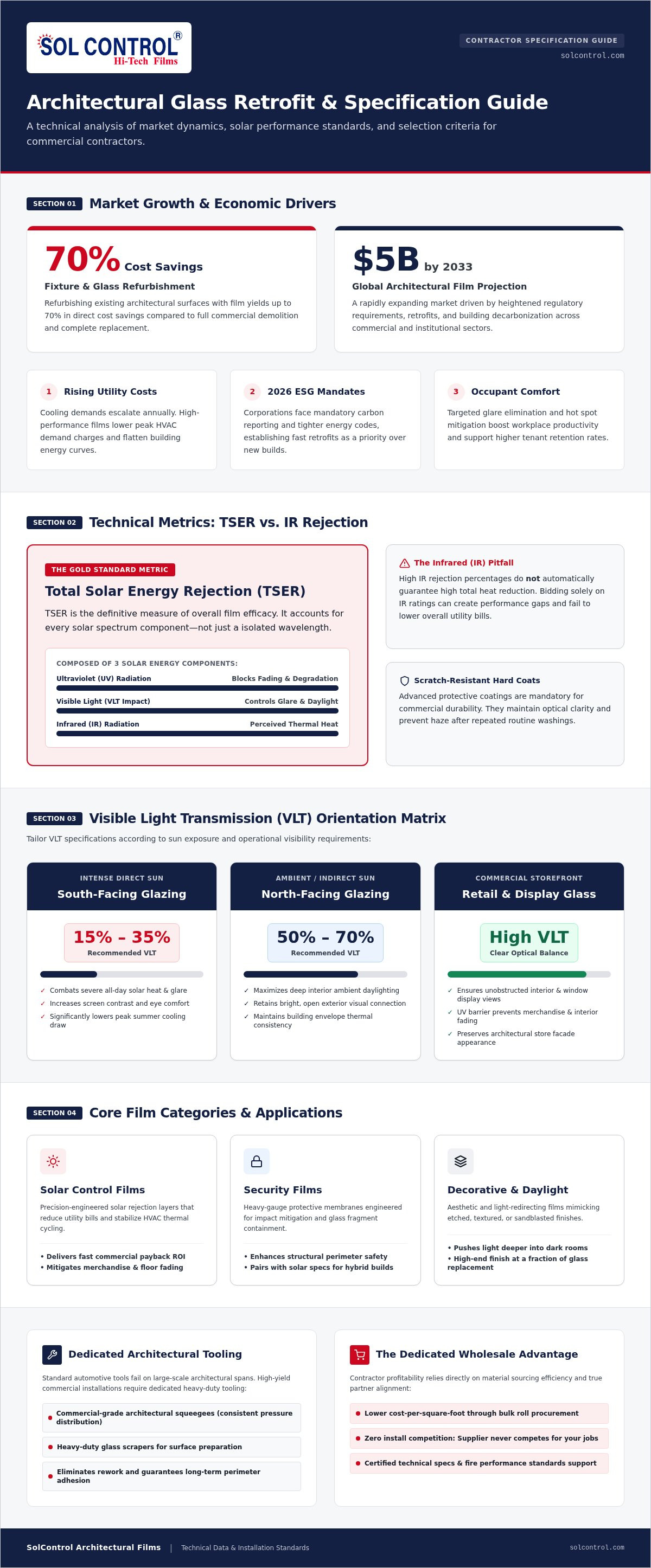
Did you know that refurbishing interior fixtures with architectural film can yield up to 70% cost savings compared to full demolition and replacement? In a market projected to reach nearly $5 billion by 2033, this isn't just a trend; it's a massive competitive advantage for your business. You've likely felt the frustration of losing a bid because of high overhead or dealing with the fallout of inconsistent film quality that leads to expensive re-work. It's a common hurdle that eats away at your project margins and damages client trust.
This 2026 buying guide is designed to help you master the technical specifications and selection criteria for architectural film for contractors, ensuring every roll you buy adds to your bottom line. We'll show you how to lower material costs through bulk purchasing and access high-performance specs like superior TSER and IR rejection. We'll also cover the essential fire performance standards and how to secure a reliable distribution partner that supports your growth without competing for your installs.
Key Takeaways
Understand how 2026 ESG mandates and rising energy costs are creating a surge in commercial demand for high-performance glass retrofits.
Master the nuances of TSER and VLT to select the right architectural film for contractors that balances heat rejection with building aesthetics.
Identify the specific differences between solar, security, and decorative films to offer hybrid solutions that maximize client safety and comfort.
Learn why standard automotive tools aren't enough and which specialized architectural squeegees and scrapers are essential for a professional finish.
Discover how a dedicated wholesale partnership allows you to lower cost-per-square-foot through bulk roll procurement without competing against your own supplier.
Architectural film is a high-performance retrofit for glass surfaces. It's a precision-engineered layer that upgrades existing windows without the waste or expense of full replacement. In 2026, building owners are facing tighter energy regulations and aggressive ESG mandates. They need solutions that work fast. This has shifted the market from simple aesthetic tinting to sophisticated, "smart" solar control technology.
You play a vital role in this shift. As a professional, you're a key partner in the sustainable building movement. By providing architectural film for contractors, you help clients meet decarbonization goals while significantly improving building comfort. The global market is surging, with projections reaching nearly $5 billion by 2033. This growth is driven by three main factors:
Rising Utility Costs: Cooling large buildings is becoming more expensive every year.
ESG Reporting: Corporations must now document their energy-saving efforts.
Occupant Comfort: Reducing glare and hot spots improves productivity and tenant retention.
Commercial Energy Efficiency and ROI
Commercial clients prioritize the bottom line. Solar control films are a direct investment in building performance because they reduce HVAC loads and peak demand charges. During summer months, heat gain through untreated glass forces cooling systems to work overtime. High-performance films flatten this energy curve. This leads to measurable ROI, with many commercial projects seeing a full payback in just a few years.
For retail and office spaces, the benefits extend to inventory protection. Using UV blocking window film wholesale allows you to offer clients a way to prevent merchandise fading and interior degradation. It's a high-value upsell that protects their assets while lowering their monthly overhead.
Residential Privacy and Aesthetic Upgrades
In the residential sector, homeowners are looking for privacy without sacrificing natural light. Modern "daylight redirecting" films solve this by pushing light deeper into a room while blocking the view from the outside. It's a functional upgrade that enhances the living experience. Modern films can also mimic expensive etched, sandblasted, or textured glass finishes at a fraction of the cost.
Offering specialized architectural film for contractors in the residential space allows you to capture a market looking for both beauty and utility. You can provide custom decorative solutions that look like high-end designer glass. These films are durable, easy to maintain, and can be updated if the homeowner's style changes. It's a flexible, cost-effective way to deliver premium results that drive client satisfaction.
Technical Specifications: What Contractors Must Know
Technical expertise separates elite installers from the hobbyists. When you source architectural film for contractors, you need to speak the language of performance to close high-value bids. Total Solar Energy Rejection (TSER) stands as the gold standard metric for evaluating film efficacy. Unlike metrics that focus only on a narrow band of the light spectrum, TSER is the comprehensive measure of all solar energy components, including ultraviolet, visible light, and infrared radiation.
Don't let infrared (IR) rejection numbers confuse your sales pitch. While IR makes up a large portion of the heat we feel, a high IR rejection percentage doesn't always guarantee high total heat rejection. TSER provides the true picture of how much energy is kept out of the building. Focusing solely on IR can lead to performance gaps that frustrate energy-conscious clients when their cooling bills don't drop as expected. Additionally, ensure your chosen films feature advanced scratch-resistant coatings. These protective layers are essential for long-term durability, allowing the film to maintain its optical clarity even after years of regular cleaning.
Decoding TSER and VLT for Bidding
Visible Light Transmission (VLT) determines the percentage of light that passes through the film and directly impacts building aesthetics. Lower VLT percentages provide more privacy and glare reduction, while higher VLTs maintain a "natural" window appearance. You should tailor your recommendations based on window orientation:
South-facing windows: Recommend low VLT (15% to 35%) to combat intense, all-day glare.
North-facing windows: Suggest high VLT (50% to 70%) to maximize natural light levels.
Retail storefronts: Use high VLT films to maintain clear visibility of interior displays while still rejecting heat.
High TSER remains your primary selling point for clients focused on energy savings. If you're looking to upgrade your current project inventory, you can browse our wholesale architectural films to find the perfect balance of technical specs for your next bid.
UV Protection and Fading Prevention
Professional-grade architectural films must meet the 99% UV rejection standard. Ultraviolet radiation is the leading cause of fading for interior assets like hardwood floors, luxury upholstery, and valuable artwork. By blocking these harmful rays, you provide a shield that extends the life of a client's interior design. This protection is vital for high-end residential and commercial retail projects where interior assets represent a significant investment. For a deeper dive into how these metrics interact with specific glass types, check out our architectural window film guide.
Comparing Architectural Film Categories for Project Success
Selecting the right product involves more than just picking a shade. It's about solving specific building performance issues with precision. Most architectural film for contractors is categorized by its primary function: solar control, security, or decorative. In 2026, the lines are blurring as hybrid films gain popularity. These advanced products offer the heat-rejection properties of a solar film combined with the structural integrity of a safety film, allowing you to provide two solutions in a single application.
You must also decide between reflective and non-reflective technologies. Silver and bronze reflective films provide high TSER at a lower price point but significantly change the building's exterior appearance. Non-reflective ceramic films use nanotechnology to block heat without the mirror look. These are perfect for high-end residential projects or historic buildings where maintaining the original glass appearance is mandatory. For homeowners and builders coordinating broader property upgrades that go beyond window treatments, visit River City Construction Inc for an insightful guide to comprehensive 2026 residential remodeling. Don't overlook anti-graffiti films either. These sacrificial layers protect against etching and spray paint, offering a low-cost alternative to glass replacement for urban retail clients.
Solar Control vs. Low-E Films
Standard solar films are designed to reject incoming heat, making them ideal for cooling-dominated climates where HVAC systems run year-round. Low-E (Low Emissivity) films go a step further by reflecting interior heat back into the room during winter months. This makes Low-E films a superior choice for northern regions where heating costs are a major concern. For clients worried about night-time glare or the "mirror effect," suggest dual-reflective films. They utilize a reflective outer layer for maximum heat rejection while maintaining a low-reflectance inner layer for clear views after sunset.
Safety and Security Film Standards
Security films are significantly thicker than standard solar versions, typically ranging from 4 mils to 14 mils. This thickness is critical for shatter resistance and preventing smash-and-grab thefts. Professional installs often require specialized attachment systems, such as wet-glaze silicone or mechanical profiles, to anchor the film to the window frame. Gaining a deep understanding of windshield protection film vs ppf provides a great foundation for understanding how different film densities handle impact resistance versus surface abrasion in architectural settings.
The Professional Installation Kit for Architectural Projects
Automotive tinting tools often fall short on commercial job sites. When applying architectural film for contractors, the scale of the glass requires a kit designed for flat-surface efficiency. You aren't dealing with the compound curves found in vehicle windows; you're managing massive square footage where speed and uniformity are the priorities. Using small automotive squeegees on a 60-inch window panel is inefficient. It also increases the risk of leaving air pockets or water streaks that can ruin a high-value install.
Precision cutting tools are non-negotiable for large-scale work. Commercial glass often features thick gaskets or heavy frames that require surgical accuracy to ensure the film sits perfectly without light gaps. High-quality slip solutions are also vital. For large panels, you need a solution with a longer "open time" to allow for precise positioning before the pressure-sensitive adhesive grabs the glass surface. This control is essential for preventing premature tacking on oversized architectural glass.
Essential Architectural Squeegees and Scrapers
Efficiency on a large project is measured in inches per stroke. Professional kits should include 12-inch and 18-inch squeegees to cover maximum surface area quickly. When it comes to cleaning, heavy-duty scrapers with stainless steel blades are preferred over carbon steel. Stainless steel is less likely to scratch architectural glass, which often has specific coatings or temperaments that require a delicate yet firm touch. For high-precision cutting options that work across various film types, you can check the professional PPF installation tools guide.
Measuring and Prepping Large Glass Areas
Accurate bidding starts with precise measurements. For high-rise projects or large office complexes, laser measures are essential for speed and accuracy. Once the contract is won, the prep phase determines the longevity of the install. You must perform a "glass-to-edge" cleaning process. This involves deep-cleaning the perimeter where the glass meets the frame, as this is where most contaminants hide. If these areas aren't scrubbed, the film edges may lift over time.
Managing dust in active commercial environments is a constant challenge. You can use portable plastic sheeting to create a temporary "clean zone" around your work area. This prevents airborne debris from settling on the glass during the critical application window. If you need to upgrade your gear for an upcoming project, you can buy professional tinting tools directly from our wholesale inventory to ensure you have the right equipment for the job.
Scaling Your Business with a Wholesale Partnership
Success in the architectural market isn't just about the quality of the install. It's about the efficiency of your supply chain. Choosing the right partner for architectural film for contractors can mean the difference between a thin margin and a highly profitable project. While many contractors start by purchasing partial cuts for specific jobs, scaling your business requires a shift toward a wholesale mindset. This strategy lowers your material costs and ensures you have the inventory ready when a high-value project lands on your desk.
Beyond pricing, the structure of your partnership matters. You need a distributor that acts as a silent partner rather than a competitor. Some suppliers maintain their own installation teams, which means you could end up bidding against your own source of material for the same commercial contracts. A dedicated B2B distributor avoids this conflict of interest, focusing entirely on providing the bulk rolls, professional tools, and support you need to win. This reliability allows you to focus on your craft while knowing your supply line is secure.
Inventory Management and Bulk Savings
The math behind bulk procurement is simple but powerful. When you buy 100ft master rolls instead of cut-to-length yardage, your cost-per-square-foot drops significantly. This buffer allows you to be more competitive in your bidding without sacrificing your profit. Stocking popular shades, such as 35% or 50% VLT, also improves your turnaround time. Instead of waiting for a shipment to arrive for every small residential call, you can offer same-day or next-day service. SolControl supports this growth with national shipping coverage across the US, ensuring that your supply remains consistent regardless of your project's location.
The SolControl Advantage for B2B Partners
We understand the unique pressures facing tint shops and glass contractors in 2026. Our model is built exclusively to support your business, providing a comprehensive inventory of solar, safety, and decorative films in one place. This one-stop-shop approach reduces administrative overhead and shipping costs. We also provide professional-grade marketing materials to help you explain technical ROI and aesthetic benefits to your clients. These resources are essential for closing complex commercial deals where stakeholders need to see data-backed performance specs. If you're ready to increase your margins and streamline your procurement, it's time to partner with SolControl for your next architectural project.
Future-Proof Your Contracting Business in 2026
The demand for high-performance glass retrofits is set to accelerate as energy costs rise and sustainability mandates tighten. By mastering technical metrics like TSER and investing in specialized architectural tools, you position your business as a leader in the sustainable building movement. You now have the framework to categorize films for project success and understand why a professional-grade installation kit is non-negotiable for large-scale commercial glass.
Scaling your operations requires more than just technical skill; it demands a strategic supply chain. Accessing premium architectural film for contractors through a wholesale partner ensures you maintain healthy margins without the risk of supplier competition. SolControl provides the exclusive B2B support you need to thrive, offering high-performance films with industry-leading heat rejection and fast national shipping across the United States. Browse Wholesale Architectural Film Rolls at SolControl and take the next step in growing your professional portfolio today. We're here to help you succeed on every job site.
Frequently Asked Questions
What is the best architectural film for reducing commercial energy costs?
Films with high Total Solar Energy Rejection (TSER) are the most effective for lowering commercial utility bills. In 2026, ceramic and dual-reflective films are the preferred choice because they block significant heat without creating a dark or overly mirrored exterior. These products reduce the strain on HVAC systems during peak demand hours. This efficiency helps building owners meet modern ESG mandates while providing a measurable return on investment through lower monthly cooling expenses.
Can I install architectural film on dual-pane or Low-E glass?
Yes, you can install specialized architectural film for contractors on these glass types, but you must select a film compatible with the specific glazing. Installing the wrong film on dual-pane glass can lead to excessive heat absorption and thermal stress, which might cause the glass to crack. You should always consult the manufacturer's glass-to-film compatibility chart. Low-E films are specifically engineered to work with these modern windows to enhance their existing insulation properties.
What thickness of security film is required for smash-and-grab protection?
A minimum thickness of 4 mils is required for basic shatter resistance, but 7 or 8 mils is the standard for effective smash-and-grab deterrence. Thicker films provide the structural integrity needed to hold glass fragments together during an impact. For high-security commercial environments, contractors often use 12-mil or 14-mil films paired with specialized attachment systems. These systems anchor the film to the window frame, making it significantly harder for an intruder to gain entry.
How does wholesale architectural film pricing benefit independent contractors?
Wholesale pricing allows you to purchase full master rolls, which lowers your cost-per-square-foot compared to buying partial cuts. This wider margin gives you the flexibility to bid more competitively on large commercial projects while maintaining healthy profits. By partnering with a distributor like SolControl, you gain access to bulk savings and national shipping. This ensures you have the inventory needed to handle unexpected project surges without the high overhead of retail-priced materials.
Is there a difference between automotive and architectural film tools?
Architectural installations require larger and more robust tools than automotive tinting. Because you're working with large, flat glass surfaces, you'll need 12-inch or 18-inch squeegees to ensure uniform pressure and efficient water removal. Heavy-duty scrapers with stainless steel blades are also essential for prepping large panes without scratching the glass. While some basic skills transfer between industries, the specialized architectural kit is designed to handle the scale and precision of commercial building projects.
How long does professional architectural window film typically last?
Interior architectural films generally have a performance lifespan of 10 to 15 years when installed correctly. Factors such as window orientation and local UV intensity can influence this duration. Exterior-grade films face harsher environmental conditions and typically last between 3 and 7 years. Using high-quality wholesale rolls ensures the adhesive and scratch-resistant coatings remain stable. Regular cleaning with non-abrasive materials will also help the film maintain its optical clarity and performance over the long term.
Do I need a special certification to buy architectural film rolls wholesale?
SolControl is a dedicated B2B partner, so you'll typically need a business license or tax ID to access our wholesale architectural film for contractors. While some specific high-end product lines may require manufacturer-led training for warranty backing, many of our professional-grade films are available to established tint shops and glass contractors. We focus on supporting your growth by providing the bulk materials and marketing resources you need to succeed without competing for your installation jobs.
What is the most popular decorative film for office privacy in 2026?
What is the most popular decorative film for office privacy in 2026?
Frosted matte and sophisticated gradient films are the top choices for office privacy in 2026. These patterns provide the necessary visual barrier for conference rooms and private offices while allowing natural light to flow through the workspace. For projects requiring on-demand switchable privacy that transitions from clear to frosted at the touch of a button, companies like Fågg AS provide advanced solutions for modern commercial interiors. Modern decorative films can also mimic the look of expensive sandblasted or etched glass at a fraction of the cost. They are also easy to update if a tenant moves out or if the building's interior design requirements change.