Ceramic Window Tint: A 2026 Guide for Film Professionals
The darkest film in the sample book may not reject the most heat. When customers ask about ceramic window tint, shade is only one part of the decision. The film’s specifications help explain what its performance data actually says.
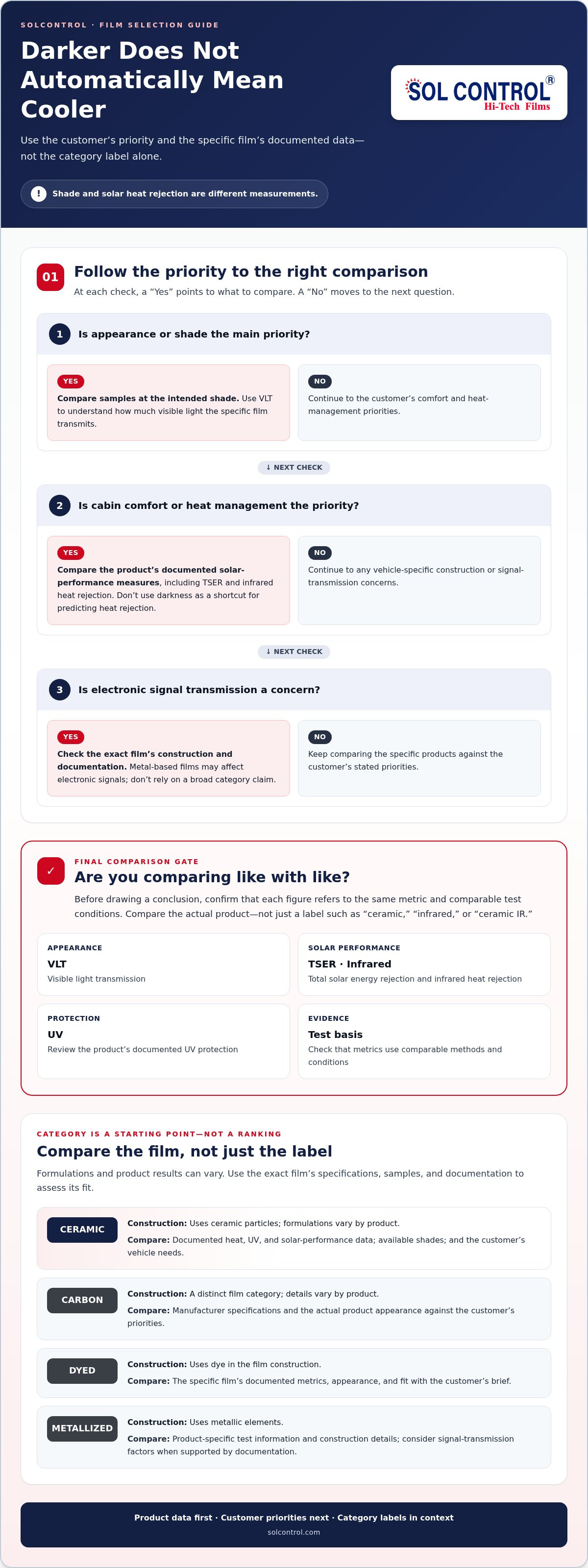
Customers often associate a darker appearance with a cooler cabin, but visible light transmission (VLT) and solar heat rejection measure different things. The word “ceramic” does not settle the comparison either. Films in the same category can differ, so start with the specifications for the specific product.
This guide explains how ceramic tint works, how it compares with dyed, carbon, and other film options, and which specifications help you assess a film for a vehicle and customer’s priorities. It covers VLT, total solar energy rejection (TSER), UV protection, and infrared heat rejection, with a practical framework for comparing products, planning inventory, and supporting a consistent shop workflow.
Key Takeaways
“Ceramic” describes a film category, not a guaranteed shade or performance level.
Compare ceramic window tint, carbon film, and other options using documented specifications and the priorities each product may serve.
Use a consistent selection process that considers vehicle glass, appearance goals, comfort priorities, and compliance.
Wholesale access to films, tinting tools, and marketing materials can support your shop’s workflow and customer offering.
What ceramic window tint is, and what the name does not tell you
“Ceramic” describes a film’s material composition, not a particular shade or guaranteed level of heat rejection. Ceramic window tint uses ceramic particles in the film, but the category name alone doesn’t tell an installer how much visible light the product transmits, how it performs across the solar spectrum, or how it compares with another film sold as ceramic.
Quotable definition: Ceramic window film is a film category made with ceramic particles. Its shade and solar-control performance depend on the specific product’s documented specifications.
Ceramic films are often discussed for heat management and UV protection. Their non-metallic construction distinguishes them from films that use metal layers, a consideration in applications where metal-based films may affect electronic signals. But “ceramic” is not a universal performance rating. As the general overview of Window film illustrates, film technologies vary. Product-level data turns a broad category into a useful comparison.
Appearance can mislead. A darker film transmits less visible light, but that does not automatically mean it rejects more solar heat. A lighter film may have different heat-control characteristics, depending on its construction and tested performance. For customers focused on cabin comfort, use measured product data rather than shade as a shortcut for predicting results.
How nano-ceramic particles relate to film performance
Nano-ceramic refers to very small ceramic particles incorporated into a film. In general, these particles are intended to help manage selected portions of incoming solar energy while maintaining a non-metallic construction. That explains why ceramic technology is associated with heat and UV control, but it does not establish a uniform result. Particle formulation, film design, and product testing all matter. Tie performance claims to the specific film instead of assuming they apply to every product with a ceramic label.
Ceramic tint, infrared tint, and ceramic IR labels
Sellers may use “ceramic,” “infrared,” or “ceramic IR” in overlapping ways. These terms might describe a material category, a performance focus, or manufacturer-specific product language. They are not interchangeable measurements. An infrared claim alone does not show how the complete film performs across the solar spectrum. Compare the manufacturer’s documented metrics and test conditions, then explain what each figure measures. This keeps a label from standing in for evidence.
In shop conversations, separate three questions: What is the film made with? What appearance does its VLT indicate? What do its performance metrics report? Answering each independently helps customers understand why two products called ceramic may differ, and why a darker look is not a dependable measure of heat rejection. Next, compare ceramic with other film categories using product data and customer priorities.
How ceramic window tint compares with carbon film and other options
Film categories can help organize choices, but a category name cannot predict the result of a particular product. Category labels alone don’t establish which film performs better. Compare product specifications measured under comparable test conditions. Before discussing differences with customers, confirm that the figures refer to the same metric and testing basis.
Film category
Construction
Performance comparison
Appearance and customer priorities
Ceramic
Uses ceramic particles; formulations vary by product.
Compare each film’s documented heat, UV, and solar performance data.
Consider available shades alongside comfort goals and other vehicle needs.
Carbon
A distinct film category; construction details vary by product.
Use the manufacturer’s specifications rather than assuming category-wide results.
Compare the actual product appearance with the customer’s priorities.
Dyed
Uses dye in the film construction.
Review documented metrics for the specific film.
Consider it when its appearance and stated performance fit the brief.
Metallized
Uses metallic elements in its construction.
Assess product-specific test information and construction details.
Consider signal-transmission factors when supported by product documentation.
Ceramic versus carbon: compare the film, not just the label
Carbon and ceramic identify different film categories, not a universal ranking. For a customer focused on heat management, compare the products’ reported solar-performance measures. If a particular look matters most, compare samples at the intended shade. If signal transmission is a concern, rely on documentation for the exact film rather than general claims about its category.
Keep the comparison fair by matching the tested shade where possible and checking that the figures use comparable methods and conditions. A difference between two specifications is useful only if both measurements describe the same thing. This helps installers explain trade-offs without turning a category label into a promise.
When a different film category may suit the brief
A customer may prioritize a particular appearance, a documented heat-management result, or a specific construction type. Dyed and metallized films offer alternatives to ceramic and carbon, but no category automatically fits every vehicle or brief. Start with the customer’s priorities, then compare product data and samples. For shops sourcing across film categories, SolControl’s automotive window films support professional film selection.
For each candidate, record its shade, documented performance measures, test basis, and relevant construction or signal-transmission information. This makes it easier to explain why two films with similar labels may suit different customers, or why products in separate categories still need a specification-by-specification comparison. Base the recommendation on the specific film and the customer’s needs, not a broad category claim.
Which ceramic tint specifications matter when comparing film
A useful film comparison starts by matching each metric to the customer’s question. Shade, heat management, ultraviolet protection, and glare control all relate to the driving experience, but they are not interchangeable measurements. For ceramic window tint, read the specification sheet as a set of distinct data points rather than looking for one number that summarizes every benefit.
Reading VLT, TSER, and infrared claims
Each metric answers a different question. VLT describes visible shade; TSER measures a broader share of solar energy rejected; infrared rejection reports performance for a specified infrared range or test method. UV blocking and glare reduction are separate measures as well. A figure for one metric does not establish the others, so connect each claim to the benefit it actually describes.
VLT (visible light transmission): The percentage of visible light transmitted through the glazing and film. Lower VLT generally means a darker appearance, though the installed result also depends on the vehicle glass.
TSER (total solar energy rejected): A broader measure of how much total solar energy the glazing-and-film system rejects. It is not another name for infrared rejection.
Infrared rejection: A measurement focused on infrared energy. Its meaning depends on the reported wavelength range and testing method, so figures from different documentation may not be directly comparable.
UV and glare figures: UV data relates to ultraviolet transmission or blocking; glare measures concern visible brightness. Neither metric substitutes for TSER or VLT.
Quotable rule: Performance figures are comparable only when the test methods, conditions, and measured ranges align.
Before repeating a numerical claim in a customer conversation or shop material, verify it against the manufacturer’s documentation. Confirm which product and shade the figure applies to, what the test measures, and whether the method matches the comparison film. For example, don’t present a high infrared-rejection claim as though it were the film’s total solar energy rejection. Keep a test result attached to the product it describes instead of treating it as a benchmark for all ceramic films.
Appearance, application, and specification fit
Specifications are useful when they fit the vehicle and customer’s priorities. Discuss whether the customer wants a lighter or darker look, how the vehicle is used, and which comfort or visibility concerns matter most. Then compare relevant product data and samples. The same film can look different across vehicles because factory glass varies in color and light transmission.
Consider the full glazing combination. The vehicle’s existing glass and the film applied over it can affect the final appearance and combined light transmission, so a film’s stand-alone VLT may not describe the finished window exactly. This is especially relevant when a customer has a strict shade preference or is concerned about front-window visibility.
Include compliance in the selection discussion. Tint requirements vary by state and may differ by window position or vehicle type. Use current requirements for the relevant state when discussing a proposed shade; don’t assume one VLT choice suits every vehicle. A clear, documented comparison helps installers explain trade-offs accurately and select film based on both measured performance and application needs.
A practical ceramic window tint selection checklist for installers
Clarify the customer’s priorities. Ask what matters most: heat management, visibility, glare reduction, UV protection, appearance, or a balance of these. Separate requirements from preferences. For example, a particular look may be preferred, while visibility or compliance may be non-negotiable.
Review the vehicle glass and use. Consider the existing glass, its color and visible-light transmission, which windows will be filmed, and how the vehicle is used. The glass-and-film combination can affect the final shade, so a film specification alone may not describe the finished appearance.
Set appearance and compliance criteria. Discuss the desired shade and check current requirements for the relevant state and window positions. Don’t treat a sample shade as proof of compliance; make compliance a separate selection criterion.
Compare suitable films using documentation. Review the manufacturer’s data for the exact product and shade. Match each metric to the customer’s concern, and compare figures only when their test methods and conditions align.
Record the selection clearly. Note the selected film, shade, relevant specifications, customer priorities, and compliance considerations discussed. Clear records help staff explain what the data says without turning a specific claim into a blanket promise about ceramic window tint.
Turn a customer brief into film-selection criteria
Make the brief specific before presenting options. A customer who says “keep the car cooler” may also care about a lighter appearance or night visibility. Confirm which need takes priority, then translate it into criteria the product documentation can address. Explain the distinction: a heat-related metric does not establish shade, and a shade preference does not establish heat performance.
Plan inventory and workflow around shop demand
Use customer requests to guide inventory planning. Consider the shades customers commonly choose, the vehicles your shop serves, and roll formats that suit its work mix. Plan professional tools alongside materials so the supplies fit the shop’s workflow. The professional automotive window film guide offers a related wholesale perspective on film decisions.
Build a ceramic tint offering with a wholesale partner
A ceramic tint offering works best when product education, sourcing, and shop operations support one another. Installers need to explain what film specifications mean while planning materials and tools around the work customers request. A wholesale distribution partner can support that workflow by supplying professional businesses with film and operational materials.
What professional buyers gain from a distribution-focused partner
SolControl is a U.S.-wide wholesale distributor serving installers, tint shops, glass companies, and automotive dealers. Its offerings include automotive and architectural window films, paint protection films, windshield protection films, professional tinting tools, and marketing materials. Sourcing these categories through a wholesale relationship can help a business plan film needs alongside the tools and customer-facing resources used in its operations.
Consider the shop’s needs as a connected set:
Film sourcing: Build an offering around the vehicle types and customer priorities your business serves.
Operational supplies: Plan professional tinting tools alongside film materials.
Customer communication: Use marketing materials to support clear, consistent conversations about film options.
Keep customer education connected to reliable film information
Consistency matters. Make sure the team describes each product using its own documentation, distinguishes between performance metrics, and avoids treating a category label as proof of a specific result. A shared approach to explaining specifications helps customers understand trade-offs without overstating claims. For background on UV-related film considerations, the UV-blocking window film wholesale guide connects technical education with a professional wholesale perspective.
As you review your offering, map customer demand to film categories, identify the tools and materials that support your workflow, and organize product information your team can communicate clearly. This gives your shop a practical foundation for serving varied customer needs while connecting sourcing with education.
Turn product knowledge into a repeatable shop process. Use customer priorities to guide film selection, keep product specifications accessible to your team, and review whether your materials and tools support the work your business wants to grow. This foundation helps you present ceramic window tint as a considered option rather than relying on category labels alone.
SolControl supports professional customers nationwide through wholesale distribution, bringing automotive, architectural, and protection films together with professional tinting tools and marketing materials. Align sourcing and operational resources with the customers you serve, while keeping film education clear and consistent.
Neither category is automatically better. The right choice depends on the specific films and the customer’s priorities. Compare documented performance, shade options, appearance, and product information side by side. A customer focused on a particular look may prefer one sample, while someone prioritizing heat management may give more weight to the relevant test data. Recommend based on the documented products, not a blanket ranking of ceramic over carbon.
Does ceramic window tint block infrared heat?
Some ceramic films are designed to manage infrared energy, but performance varies by product. Review the manufacturer’s infrared data for the exact film, including the wavelength range and testing method behind the claim. Infrared rejection is not the same as total solar energy rejection, so one figure should not stand in for overall solar performance. Explain what the reported metric measures, and don’t generalize a product claim to all ceramic films.
Can ceramic window tint interfere with phone or GPS signals?
Non-metallic construction is one reason ceramic films are often considered when signal transmission matters, but don’t promise identical effects for every film. Check the manufacturer’s documentation for the specific product and the signal types relevant to the vehicle’s devices. If a customer relies on a phone, GPS, or other in-car connectivity, include that in the selection criteria and explain claims using product-specific information rather than assuming performance from the word “ceramic.”
How long does ceramic window tint last?
There isn’t one lifespan that applies to every ceramic film. Longevity can depend on the film’s construction, installation quality, vehicle use, and care. For a specific product, refer to its manufacturer’s published warranty terms and maintenance guidance rather than promising a set number of years based on the category. Keep those documents accessible, explain their terms accurately, and distinguish warranty coverage from expected service life.
Is ceramic window tint legal on every vehicle window?
Don’t assume one shade or application is legal for every window and vehicle. Requirements vary by state and can depend on window position and vehicle type. Before recommending a shade, review current rules for the vehicle’s jurisdiction and the windows being considered. If a customer has a specific VLT target, compare it with the applicable requirement and account for the existing glass when discussing the finished window’s light transmission.
How much ceramic window tint film does an installer need for a vehicle?
The amount depends on the vehicle’s window dimensions, the roll’s usable width, the cutting layout, and the material needed for fitting and trimming. A compact car and a large SUV won’t necessarily require the same quantity. Use vehicle patterns or measurements to estimate each pane, then plan cuts to limit offcuts while retaining workable material. For inventory planning, track actual film use by vehicle type and shop cutting practices rather than relying on one universal estimate.