How to Calibrate a Tint Meter: A Professional Installer’s Guide
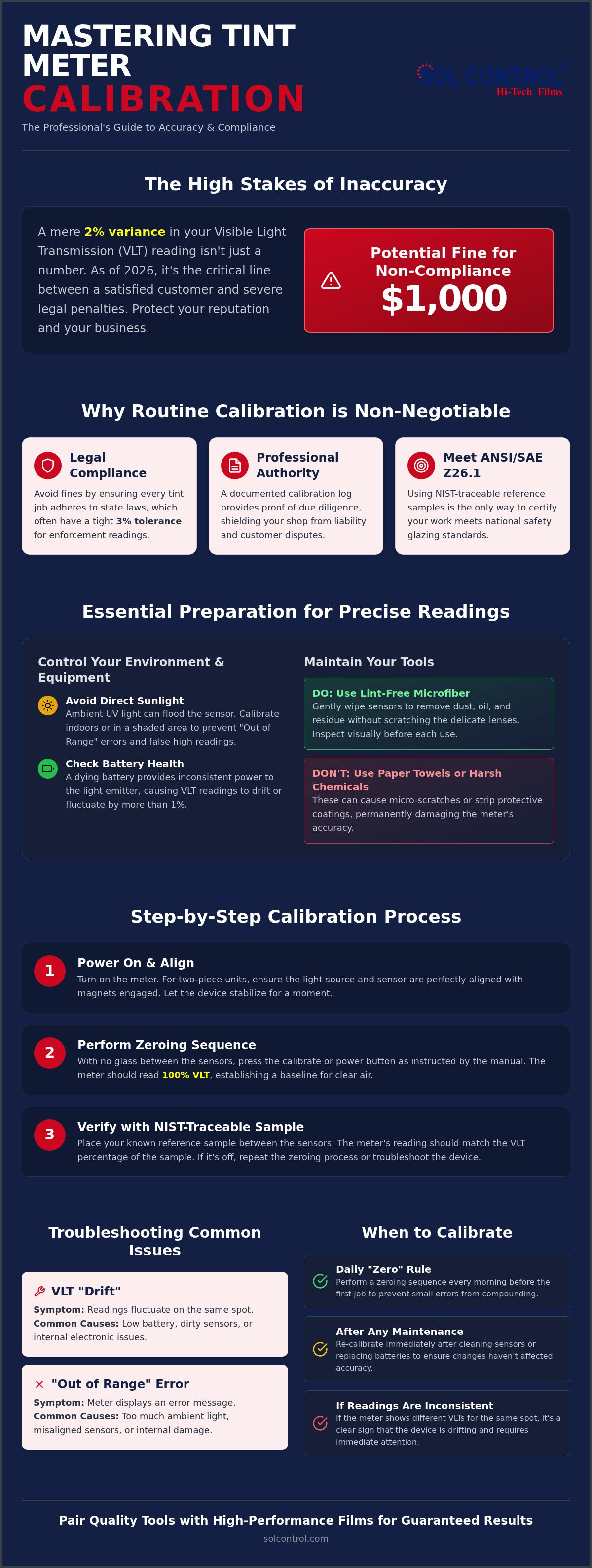
A single 2% variance on your VLT reading isn't just a technical glitch. In 2026, it's the thin line between a satisfied customer and a $1,000 legal penalty. You already know that precision is the backbone of a reputable tint shop, but inconsistent readings between different devices can still cause major headaches. Learning exactly how to calibrate a tint meter is the most effective way to eliminate that doubt and protect your business from legal liability.
This guide provides the professional steps you need to keep your VLT meter accurate and compliant with current ANSI/SAE Z26.1 standards. You'll gain a repeatable, foolproof process that works for industry-standard tools like the Enforcer II and the Tint-Chek series. We will cover self-calibration routines, the proper use of NIST-traceable reference samples, and the environmental factors that often skew your data. By the end, you'll have the confidence to certify every installation with total professional authority.
Key Takeaways
Ensure your shop meets 2026 ANSI/SAE standards by understanding why routine calibration is a legal necessity for every professional installer.
Learn critical preparation steps, such as sensor maintenance and the proper handling of NIST-certified reference samples, to avoid measurement errors.
Discover the exact steps for how to calibrate a tint meter using zeroing sequences and light source alignment for both one-piece and two-piece devices.
Troubleshoot common technical discrepancies like "Drift" and "Out of Range" messages to maintain consistent accuracy throughout a busy workday.
Elevate your service quality by pairing professional-grade tinting tools with high-performance films to guarantee precise VLT results for every client.
The Importance of Tint Meter Accuracy in 2026
Visible Light Transmission (VLT) measures the percentage of light that passes through a window. It's the primary metric used by regulators to balance driver privacy with road safety. These devices operate on spectrophotometry principles, using a light source and a sensor to quantify light loss. While most professional meters arrive with a factory-calibrated seal, this isn't a permanent guarantee of precision. In a high-volume shop, environmental factors like humidity and dust can quickly degrade sensor performance. Relying on a factory setting without regular verification is a liability you can't afford.
Using NIST-traceable standards is the only way to certify that your work meets national requirements. NIST-traceable reference samples provide a physical benchmark that matches national safety glazing standards like ANSI/SAE Z26.1. If your meter isn't regularly verified against a known reference, you risk installing film that falls outside legal limits. This leads to failed inspections, costly re-dos, and potential damage to your shop's reputation. Professional-grade shops use these samples to verify their equipment at the start of every week to ensure their readings are objectively accurate.
Legal Compliance and Professional Liability
Most states apply a 3% tolerance for law enforcement readings. If your meter has drifted just a few points, you might certify a vehicle at 25% that a police officer reads as 21%. Fines for these violations can reach $1,000 in 2026. Consistent documentation of your calibration routine acts as a shield against insurance claims and customer disputes. It proves you followed industry standards at the time of installation. When a customer questions the legality of their tint, having a logged calibration history provides the professional authority needed to resolve the conflict quickly.
When Should You Calibrate Your Meter?
High-volume shops should follow the "Daily Zero" rule. Knowing how to calibrate a tint meter every morning prevents small errors from compounding throughout the week. You should also re-calibrate after any maintenance, such as a battery replacement or sensor cleaning. If you notice inconsistent readings on the same piece of glass, it's a clear sign your equipment is drifting. Maintaining accuracy is especially critical when working with high-performance architectural window film, where light transmission specs are often tighter than automotive standards. Regular maintenance ensures your expensive testing equipment lasts longer and performs reliably under pressure.
Essential Preparation for Precise Meter Testing
Preparation is the foundation of accuracy. Before you begin the process of how to calibrate a tint meter, you must control the variables that lead to false readings. A meter that hasn't been properly prepared will provide inconsistent data, leading to customer disputes or legal non-compliance. Accurate measurement is not just a shop preference; it is a safety standard highlighted in the NHTSA report on tinting safety, which details how light transmission levels impact driver visibility.
Direct sunlight is a common but overlooked enemy of precision. Because tint meters use infrared or visible light emitters, high levels of ambient UV can flood the receiver. This interference often results in an "Out of Range" error or an artificially high VLT reading. Always perform your calibration in a shaded area or inside the shop bay to maintain a neutral baseline. Similarly, monitor your battery health. A dying battery often lacks the voltage to power the emitter consistently, which is the hidden culprit behind fluctuating VLT readings. If your meter jumps more than 1% while testing the same spot, swap the battery before you attempt a recalibration.
Cleaning the Optical Sensors
Dirty sensors are the leading cause of calibration failure. Dust, oils from your skin, and adhesive residue can accumulate on the photodiode lenses, causing the meter to "see" a tint even when nothing is there. Use only lint-free microfiber cloths to wipe the sensors. Standard paper towels or shop rags can leave micro-scratches on the delicate lenses, which permanently diffuses the light and ruins the tool's accuracy. Avoid harsh chemicals or glass cleaners, as these can strip the protective coatings on the sensors. High-performance sensors require a visual inspection before every calibration and a thorough cleaning with a lint-free cloth at least once per daily shift.
Managing Your Calibration Reference Samples
Your reference samples are the only way to verify that your meter is reading correctly. These pieces of glass are precision-engineered to specific VLT percentages and must be protected from oxidation and environmental damage. Store them in a padded case or a dedicated protective sleeve when they aren't in use. If a sample becomes scratched, it's no longer a reliable benchmark and should be replaced immediately. Organizing your window tint kit to include a dedicated slot for these samples prevents them from being lost or damaged in a busy shop environment. Equipping your shop with professional-grade testing tools ensures that your preparation translates into flawless execution and long-term equipment reliability.
Step-by-Step: How to Calibrate Your Tint Meter Properly
Calibrating your equipment is a technical requirement that ensures your shop's reputation remains untarnished. While most modern devices feature automated routines, understanding the manual verification steps is essential for professional accuracy. The process of how to calibrate a tint meter begins with an "Air Calibration," which establishes the 100% transmission baseline by measuring the absence of any obstruction. This baseline ensures the device's internal light source and receiver are communicating without interference.
Always perform a "Zero Check" using an opaque object after your 100% calibration. If the meter reads 0% when the light path is fully blocked, you know the sensor range is linear and accurate. This two-point verification, checking both 0% and 100% transmission, is the industry standard for 2026. Mastering how to calibrate a tint meter for both one-piece and two-piece styles prevents the drift that often leads to inconsistent readings across different vehicles.
Calibrating One-Piece (Slot-Style) Meters
One-piece meters, often called slot-style meters, are common in fast-paced shops. Before you power the unit on, ensure the slot is completely clear of debris. Any dust trapped in the corner of the slot can cause the meter to fail its initial zeroing sequence. Once the device is active, engage the auto-calibration mode and wait for the display to stabilize at exactly 100%. Don't ignore a fluctuating signal; it usually indicates a dirty sensor. After the 100% signal is confirmed, insert your reference sample. If you're testing a 35% sample and the meter reads within the +/- 2% tolerance, your device is ready for the day's work.
Aligning and Calibrating Two-Piece Meters
Two-piece meters require more attention to the physical light path because the emitter and receiver are separate units. These units use magnetic coupling to align the sensors through the vehicle's glass. For the initial calibration, you must align the two halves in open air, away from any glass. The magnets will pull the sensors into a perfectly parallel position, ensuring the light path is direct and unobstructed. This step is critical when you're certifying high-end automotive window film, as it guarantees the combined VLT of the factory glass and the aftermarket film remains within state limits. Some advanced 2026 models allow for zeroing directly across the glass, but you should always verify in the air first to confirm the device's baseline health.
Troubleshooting Common Calibration Discrepancies
Even when you follow the standard procedures for how to calibrate a tint meter, technical errors can still occur. These discrepancies often manifest as an "Out of Range" message or a reading that refuses to stabilize. In most cases, an "Out of Range" error during the zeroing phase indicates that the sensor is detecting an obstruction or extreme light contamination. If this happens, move the device to a darker area of the shop and perform a secondary visual inspection of the optical path. If the error persists, it may signal that the internal emitter has failed or the sensor has moved out of alignment.
Reading "Drift" is a separate issue where the VLT percentage slowly fluctuates while the meter is stationary on the glass. This is frequently caused by temperature fluctuations. Photodiodes are sensitive to extreme heat and cold; if your meter has been sitting in a hot service van or near a bay door in the winter, the electronics may struggle to provide a linear reading. Allow the device to acclimate to the shop's ambient temperature for 15 minutes before attempting a recalibration. If your equipment continues to show inconsistent data after acclimation and a battery swap, it likely suffers from permanent sensor degradation and should be retired to maintain your professional standards.
Managing Interference and Light Leaks
High-intensity LED shop lights can "trick" a VLT meter by flooding the receiver with infrared or visible light wavelengths. This interference is particularly common with two-piece meters if the housing has developed micro-cracks or if the magnetic seal is loose. Creating a shaded environment is the most effective way to ensure a pure calibration. You can test for light leaks by covering the meter with a dark, heavy cloth during the 100% air calibration; if the reading changes significantly when covered, your environment is too bright for an accurate baseline. To ensure your shop is equipped with the most reliable hardware, consider upgrading to professional-grade tinting tools designed with superior light-shielding properties.
Battery and Power Issues
Power supply is the most overlooked factor in meter accuracy. A standard 9V alkaline battery at 70% power often lacks the necessary voltage to drive the light emitter at a constant intensity, which can lead to reading errors of 5% or more. Switching to lithium-ion batteries is a better choice for digital meters because they maintain a consistent voltage until they are nearly depleted. A steady voltage supply is directly correlated to the precision of the light emitter and the overall sensitivity of the sensor. When you are learning how to calibrate a tint meter for long-term reliability, always start with a fresh, high-capacity power source to eliminate voltage drop as a variable.
Maintaining Professional Standards with Quality Equipment
Professional excellence in the window film industry is built on a foundation of repeatable accuracy. While mastering how to calibrate a tint meter provides the technical skill needed for daily operations, maintaining high standards requires a cultural shift within the shop. Top-tier installers don't view calibration as a chore; they see it as a quality assurance protocol that protects their business reputation. By implementing a shop-wide Standard Operating Procedure (SOP), you ensure every technician follows the same rigorous verification steps before a vehicle ever leaves the bay.
Precision measurement becomes even more critical when transitioning between different film types. For instance, the light transmission properties of high-performance architectural window film often require meters capable of handling thicker glass substrates without losing accuracy. SolControl serves as your national partner in this endeavor, providing not only the wholesale films that meet 2026 standards but also the professional-grade diagnostic tools required to verify them. Using NIST-traceable equipment ensures that your measurements are legally defensible and scientifically sound.
Building a Reliable Installation Kit
A professional installation kit is only as strong as its weakest tool. Leading installers prioritize precision measurement devices that offer consistent performance across both automotive and commercial applications. High-end meters are designed to resist the environmental drift discussed in previous sections, offering more robust housing and better sensor shielding. SolControl supports this commitment to quality by offering a curated selection of tools that integrate seamlessly with advanced film technologies. Investing in these professional-grade instruments reduces the long-term costs associated with equipment failure and customer disputes.
Final Verification for Customer Delivery
Transparency is a powerful tool for building customer trust. Performing a final VLT check in front of the client serves as a visible demonstration of your shop's dedication to legal compliance. Use your calibrated meter to show the final reading and explain the 3% variance allowance applied by law enforcement. You can even issue a signed VLT compliance certificate based on that specific, verified reading. This level of professionalism distinguishes your shop from competitors and provides the customer with peace of mind. If your current equipment struggles to provide these stable results, it's time to explore the latest diagnostic upgrades available through your wholesale partner.
Elevate Your Precision and Protect Your Reputation
Mastering the technical process of how to calibrate a tint meter is the first step toward total shop compliance. You've learned that consistent zeroing routines and NIST-traceable reference checks are the only ways to defend your work against 2026 legal standards. By controlling environmental variables and maintaining your equipment's power supply, you eliminate the reading drift that often leads to costly customer disputes and potential liability.
Professional results depend on the quality of your hardware and the reliability of your supply chain. SolControl stands as a national wholesale distributor dedicated to your shop's success. We offer a comprehensive inventory of professional-grade installation tools and high-performance films, backed by dedicated B2B support for installers across the US. Our goal is to ensure you have the precision equipment needed to meet every national standard with total confidence.
You should calibrate your tint meter at the start of every work shift or before every critical certification. High-volume shops benefit from a "Daily Zero" routine to account for environmental changes in the shop bay. Regular calibration ensures your VLT readings remain consistent with law enforcement standards. If you move the device between extreme temperatures, a quick recalibration helps maintain the precision expected of a professional installer.
Why is my tint meter giving different readings on the same window?
Inconsistent readings on a single window are usually caused by glass curvature, surface contaminants, or sensor misalignment. Even small amounts of road film or interior oils can alter how light passes through to the receiver. Ensure the glass is perfectly clean before testing. If the variance persists, it may indicate that you need to learn how to calibrate a tint meter to reset the 100% air baseline.
Can I calibrate my tint meter without a reference sample?
You can perform a basic air calibration or "zeroing" without a sample, but you cannot verify the meter's accuracy across the full VLT range. A reference sample acts as a physical benchmark to confirm the device is reading correctly at specific percentages like 25% or 35%. Without this secondary check, you have no way to prove your equipment hasn't drifted from its factory specifications or sustained internal damage.
What is a NIST-traceable reference and why do I need it?
A NIST-traceable reference is a calibration tool that has been certified against national standards held by the National Institute of Standards and Technology. You need these samples to provide a legally defensible audit trail for your shop. If a customer disputes a reading or a vehicle fails a police inspection, your NIST-certified logs prove that your equipment was verified against an objective, national benchmark for safety glazing.
Does temperature affect the accuracy of my VLT meter?
Temperature significantly impacts photodiode sensitivity and internal battery voltage. Extreme heat or cold can cause the light emitter to fluctuate, leading to "reading drift" or false VLT percentages. Always allow your equipment to acclimate to the shop's ambient temperature for at least 15 minutes before use. This stabilization period is a critical part of the process when you determine how to calibrate a tint meter for maximum accuracy.
What should I do if my meter fails to zero out?
If your meter fails to zero out, first inspect the optical path for dust, adhesive residue, or physical obstructions. Low battery voltage is another common culprit, as it prevents the device from reaching its required 100% transmission baseline. If the sensors are clean and the battery is fresh, try moving to a shaded area. High-intensity shop lights can sometimes flood the receiver and trigger a persistent error code.
Are two-piece meters more accurate than one-piece meters?
Accuracy depends more on sensor quality and routine maintenance than on the device's physical design. One-piece meters are efficient for roll-down windows, while two-piece meters are essential for fixed glass like windshields or rear windows. Both styles utilize similar spectrophotometry principles. The key to professional results is not the model type, but rather your commitment to routine maintenance and precise magnetic alignment during the testing phase.
How do I clean the sensors on my tint meter without damaging them?
Clean your sensors using a dry, lint-free microfiber cloth to gently remove dust and fingerprints. Avoid using paper towels or abrasive shop rags, as these can create micro-scratches on the photodiode lenses. Never apply harsh chemicals or glass cleaners directly to the sensors. If you encounter stubborn residue, a tiny amount of isopropyl alcohol on a cotton swab is generally safe for most professional-grade optical components used in the industry.