How to Start a Window Tinting Business in 2026: The Professional Roadmap
Did you know the global window film market is projected to reach $21.9 billion by 2033? This growth represents a massive opportunity for entrepreneurs ready to claim their share of the industry. If you're considering starting a window tinting business in 2026, you're entering a market where high-performance nano-ceramic films and the rise of electric vehicles are driving record demand. It's natural to feel some uncertainty about the technical side. You might worry about choosing the wrong film type or overspending on your initial tool investment before you've even booked your first client.
We believe that your success depends on having the right knowledge and a reliable supply partner. This guide provides the exact professional roadmap you need to launch a profitable shop from day one. You'll learn how to navigate film specifications, master professional installation tools, and source wholesale materials that protect your reputation. We'll provide a clear inventory list and a plan for scalable growth, ensuring you have everything required to transition from a startup to a high-performing automotive styling studio.
Key Takeaways
Capitalize on the surging demand for high-performance ceramic films in the electric vehicle and energy-efficient architectural markets to ensure long-term profitability.
Establish a professional foundation for starting a window tinting business by mastering state-specific VLT regulations and securing specialized garage liability insurance.
Build a high-standard inventory by distinguishing between carbon and nano-ceramic technologies to provide your customers with superior heat rejection and UV protection.
Protect your profit margins by partnering with a dedicated wholesale distributor that offers professional tools and bulk film rolls without competing for your installation jobs.
Scale your operations quickly by utilizing professional marketing materials and optimized local SEO strategies to attract and retain your first 100 clients.
Market Opportunity: Why Start a Window Tinting Business in 2026?
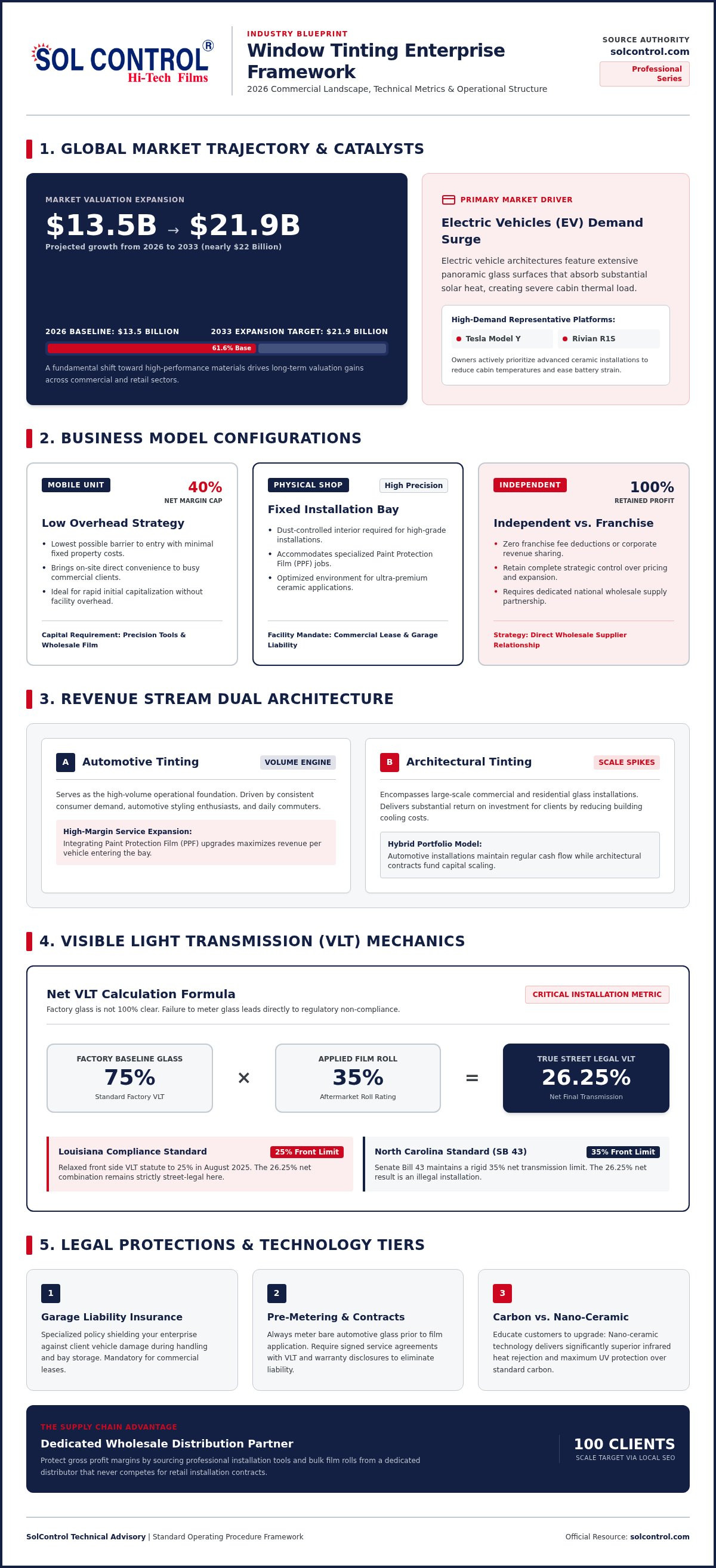
The global window film market reached an estimated $13.5 billion in 2026; it is projected to expand to nearly $22 billion by 2033. This growth represents a fundamental shift in how consumers view vehicle and building maintenance. Starting a window tinting business in this environment allows you to tap into a market where high-performance materials are the new standard. Electric vehicles (EVs) are a primary driver of this demand. Models like the Tesla Model Y and Rivian R1S feature massive panoramic glass that absorbs significant solar heat. Owners proactively seek out ceramic films to reduce cabin temperatures and ease the drain on their batteries.
Low overhead costs make this industry particularly attractive compared to traditional automotive repair. You don't need expensive diagnostic computers or heavy machinery to begin. Instead, your success relies on precision tools and the quality of your wholesale film. By incorporating high-margin add-ons like Paint Protection Film (PPF), you can maximize the revenue from every vehicle that enters your bay. Understanding the technical composition of various types of window film is critical for educating your customers on why they should invest in premium upgrades.
Automotive vs. Architectural Revenue Streams
Automotive tinting provides the high-volume foundation for most shops. It's a steady stream of business driven by car enthusiasts and daily drivers. However, savvy owners are increasingly looking toward architectural film for commercial and residential buildings. These contracts offer larger-scale opportunities and significant ROI for clients who want to reduce cooling costs. A hybrid model provides the best stability. While automotive jobs keep your schedule full, architectural projects deliver the large-scale revenue spikes that fund expansion and long-term growth.
Defining Your Business Model
Choosing the right structure is a pivotal step when starting a window tinting business. A mobile unit offers the lowest possible overhead, allowing you to operate with net margins as high as 40 percent. Mobile tinting allows you to bring the service directly to the customer, which is a major selling point for busy professionals. A fixed-location shop provides the dust-controlled environment required for installing specialized paint protection films and premium ceramic applications. While some consider franchising, independent ownership allows you to keep 100 percent of your profits. Success as an independent shop owner depends on your wholesale supply chain. Partnering with a national distributor ensures you have the high-performance film and professional tools needed to compete without the burden of franchise fees.
Foundations: Legal Requirements and Professional Workspace
Building a sustainable enterprise requires more than just installation skill. You must navigate a specific framework of legal and environmental requirements to protect your investment. Referencing the SBA guide to starting a business is a reliable first step for handling registration, tax IDs, and permits. Beyond basic registration, specialized garage liability insurance is essential. This coverage protects your business if a customer's vehicle is damaged while in your care, a common requirement for securing commercial leases.
Compliance with Visible Light Transmission (VLT) statutes is a daily operational necessity when starting a window tinting business. State laws are constantly evolving; for example, Louisiana relaxed its front side VLT to 25% in August 2025, while North Carolina maintained its 35% limit under Senate Bill 43. You must account for the factory tint already present on most glass. Applying a 35% film to a window with a 75% factory baseline results in a net 26.25% VLT, which could lead to legal issues for your clients in stricter states. Always meter the bare glass before starting any installation to ensure the final result remains street-legal.
Compliance and Legal Protections
Professionalism extends to your documentation. Every job should include a signed service agreement that outlines VLT compliance and warranty disclosures. This protects you from liability regarding roadside enforcement. Additionally, you must manage your workspace waste responsibly. While window film is generally non-hazardous, many municipalities require specific disposal methods for adhesive backing and scrap material. Utilizing a high-quality tint meter allows you to verify every vehicle meets local standards before it leaves your bay.
Optimizing Your Installation Bay
Showroom quality results depend entirely on your environment. Dust is the primary enemy of a flawless install, so your bay must be a controlled zone. Sealed epoxy floors are preferred because they don't trap debris and allow for easy water management during the shrinking process. Temperature control is equally vital; keeping your shop between 60°F and 80°F ensures the film adhesive cures at a predictable rate.
Lighting is another area where you cannot cut corners. High-CRI LED lighting (CRI 90+) along both walls and ceilings is non-negotiable for spotting micro-contamination and "fingers" before the film dries. Separating your customer waiting area from the clean-room installation zone prevents foot traffic from kicking up dust that could ruin a fresh application. Acquiring professional-grade installation tools from the start helps you maintain these rigorous standards and deliver the precision your clients expect.
The Professional Kit: Selecting Films and Installation Tools
Your inventory is the foundation of your service quality. When starting a window tinting business, you must distinguish between entry-level materials and high-performance technologies. Dyed films serve as a cost-effective option for aesthetics; however, modern consumers increasingly demand carbon and ceramic alternatives. Carbon film provides a matte finish without signal interference, while nano-ceramic film offers the highest Total Solar Energy Rejection (TSER). These premium options allow you to charge higher rates because they reflect up to 99 percent of UV rays and significantly block infrared heat.
Expanding your menu to include Paint Protection Film (PPF) and windshield protection film is a strategic move for 2026. These products cater to owners of high-end vehicles and EVs who want to preserve their paint and glass from road debris. All glazing materials you install must comply with Federal Motor Vehicle Safety Standard No. 205, which regulates light transmittance and safety performance. Selecting the right wholesale partner ensures your inventory meets these rigorous national standards and provides the longevity your customers expect.
Choosing Your Film Inventory
Diversifying your stock beyond automotive rolls is essential for long-term stability. Utilizing architectural window film is a must-have for year-round revenue, as commercial and residential projects aren't subject to the same seasonal fluctuations as car tinting. You should stock various VLT levels in ceramic lines to meet specific heat rejection demands. This flexibility allows you to handle everything from a single sedan to a multi-story office building with absolute confidence.
The Installer’s Tool Belt
Precision is the difference between an amateur job and a professional finish. You'll need a kit that includes specialized squeegees, stainless steel blades, and high-output heat guns. Using professional PPF installation tools is critical when performing high-end protection work, as standard tinting tools can cause micro-scratches on sensitive coatings. Mastering the shrinking process requires a reliable heat gun; while some old-school installers use torches, heat guns provide the consistent temperature control needed for modern ceramic films. High-quality tools respect your time and reduce the risk of costly rework when starting a window tinting business.
The Wholesale Advantage: Building a Scalable Supply Chain
Profitability in this industry is built on the spread between material cost and labor value. When starting a window tinting business, buying bulk rolls is the only way to maintain professional margins. Retail sites cater to DIY enthusiasts; they often sell inferior products that lack the technical consistency required for a professional shop. Avoiding this "retail trap" is critical for your brand reputation. A single 100-foot roll of high-quality automotive film can yield enough material for 8 to 12 vehicles, significantly lowering your cost per job compared to buying pre-cut kits.
Consistency in film performance and shipping speed are the two most important factors when evaluating a wholesale distributor. You need a partner that understands the pressure of a full schedule. If a roll arrives damaged or the shade doesn't match a previous install, your timeline collapses. A reliable partner also provides professional marketing materials, such as heat lamp displays and shade swatches, which help you upsell customers to premium ceramic lines. These resources allow you to demonstrate value without needing to invent your own sales collateral.
Partnering with a National Distributor
Establishing a relationship with a dedicated wholesale window film partner like SolControl provides more than just inventory. You gain access to detailed technical data sheets (TDS) for architectural and solar control films, which are essential for winning commercial contracts. This data allows you to prove performance claims regarding heat rejection and energy savings. In 2026, UV blocking window film wholesale is the foundation of energy-efficient business models. It positions your shop as a technical consultant rather than just an installer.
Inventory Management for Growth
Efficiently starting a window tinting business requires strategic inventory choices. Begin by stocking the "Core 3" VLT percentages: 5%, 20%, and 35%. These shades cover the vast majority of automotive requests and state legal limits. For architectural projects, a just-in-time ordering system often works best to avoid tying up capital in specialty rolls. However, keeping bulk stock of your most popular solar control films ensures you can respond to residential leads immediately. Tracking your film usage and minimizing scrap per roll will directly increase your net profit margins.
Marketing and Scaling: Getting Your First 100 Customers
Securing your first 100 customers is the milestone that validates your operational model and sets the stage for sustainable growth. When starting a window tinting business, your marketing efforts must bridge the gap between technical expertise and consumer benefits. Visual proof is your most persuasive asset. High-quality photography of "before and after" installations provides the social proof needed to justify premium pricing. You should document every job, focusing on the clarity of the film and the precision of the edges, to build a portfolio that reflects your shop's high standards.
Local SEO is the primary engine for customer acquisition in the digital age. Optimizing your Google Business Profile ensures you appear in local searches when drivers look for "window tinting near me." However, don't rely solely on retail traffic. Establishing B2B partnerships with local auto dealerships and glass replacement companies creates a reliable referral network. These professional relationships provide a steady baseline of work that helps you manage the seasonal fluctuations common in the automotive restyling industry. By positioning yourself as their preferred installation partner, you gain access to high-volume leads without the high cost of paid advertising.
Digital Presence for the Modern Shop
A professional website acts as your digital showroom. It's the place to showcase technical specifications, such as Total Solar Energy Rejection (TSER) stats, which help customers understand the value of premium ceramic films. You can also use social media platforms to demonstrate the "self-healing" properties of Paint Protection Film (PPF). Short, engaging videos that show heat-activated scratch removal build trust and excitement. Actively gathering and displaying customer reviews further establishes your professional authority, making it easier for new clients to choose your shop over lower-priced competitors.
Sales Strategies for High-Ticket Services
Education is the key to upselling. Most customers arrive asking for "dark tint," but your job is to explain the functional differences between carbon and ceramic options. Moving a client from a basic aesthetic upgrade to a high-performance heat rejection package significantly increases your profit per vehicle. You can further maximize revenue by bundling automotive tint with windshield protection film to create a "Total Shield" package. For commercial projects, closing architectural contracts requires a different approach. Providing energy audit data that demonstrates long-term cooling savings allows you to win high-ticket contracts with property managers and business owners who prioritize ROI. This strategic approach ensures that starting a window tinting business leads to a scalable, high-margin enterprise.
Building Your Future in the Window Film Industry
Profitability in 2026 lies in specializing in high-demand solutions like nano-ceramic films for electric vehicles and energy-saving architectural contracts. By prioritizing a dust-controlled workspace and mastering precision tools, you'll ensure every vehicle or building becomes a moving advertisement for your expertise. Success in starting a window tinting business depends on your ability to deliver flawless results while maintaining healthy margins through a strategic supply chain. You don't need the overhead of a franchise to access premium quality; you simply need a partner committed to your independent success.
Your journey from a startup to a market leader is supported by the materials you choose and the relationships you build. We're dedicated to providing the high-performance engine your business needs to thrive. Launch your shop with professional wholesale film and tools from SolControl. We offer a no-competition guarantee where we distribute and you install. You can rely on national US shipping for all bulk film rolls and a complete inventory of professional-grade installation tools. Your expertise paired with industry-leading materials is the ultimate formula for a thriving, scalable shop.
Frequently Asked Questions
Is a window tinting business profitable in 2026?
Yes, window tinting remains highly profitable due to the increasing demand for thermal rejection in electric vehicles. Shops that prioritize nano-ceramic technology and architectural energy-saving contracts often see the highest margins. By focusing on performance upgrades rather than basic aesthetics, you can build a sustainable business model. The key to long-term success is balancing high-volume automotive work with high-ticket commercial projects that offer significant solar control benefits.
How much does it cost to start a window tinting business?
Initial costs depend on whether you launch as a mobile unit or a fixed-location shop. A lean mobile setup focuses on hand tools, a heat gun, and a few starter film rolls. A professional bay requires additional investment in CRI 90+ lighting, dust-controlled flooring, and shop insurance. You should research current market rates for commercial leases and specialized equipment to develop a realistic financial plan for your specific business goals.
Do I need a license to start a window tinting business?
You generally need a standard business license and a state tax ID to operate legally. Some jurisdictions might require additional environmental permits for waste management or specific contractor certifications for large-scale architectural installations. It's essential to consult the Small Business Administration or your local clerk's office to identify the exact regulatory requirements for your area. Maintaining proper garage liability insurance is also a critical step for protecting your new venture.
What are the best window tinting tools for beginners?
Beginners should invest in a professional-grade kit that includes specialized squeegees, stainless steel snap-off blades, and a high-performance heat gun. A pressurized sprayer and a reliable tint meter are also essential for verifying VLT compliance. Using high-quality tools from the start prevents micro-scratches and ensures a cleaner installation. This initial investment in quality hardware reduces the risk of costly rework and helps you build a reputation for precision and excellence.
How do I find a reliable wholesale window film supplier?
Evaluate potential partners based on their shipping speed, technical support, and product consistency. A dedicated national distributor like SolControl provides the automotive, architectural, and protection films you need without competing for your local installation jobs. Reliable suppliers also offer technical data sheets and marketing materials to help you educate your clients. Choosing a partner with a national distribution network ensures you receive your bulk rolls quickly to keep your schedule moving.
Can I start a window tinting business from home?
You can begin as a mobile service if you have access to a clean, enclosed environment for film prep. However, starting a window tinting business from a residential garage requires meticulous dust control and upgraded lighting to meet professional standards. You must also verify that your local zoning laws and insurance policies allow for a commercial operation at your home. Many successful owners eventually transition to dedicated bays to better manage environmental contamination.
What is the difference between automotive and architectural window film?
Automotive film is engineered to shrink and conform to the complex curves of vehicle windows while meeting strict safety standards for light transmittance. Architectural film is designed specifically for flat glass in residential or commercial buildings, focusing on maximum heat rejection and glare control. Using automotive film on flat glass or vice versa can result in adhesive failure or even glass breakage. Stocking both types of rolls allows you to diversify your revenue streams effectively.
How long does it take to learn professional window tinting?
Developing the technical skills required for starting a window tinting business typically involves several months of dedicated practice. While basic side window installations are learned relatively quickly, mastering complex rear window shrinking and paint protection film requires more advanced training. Many professionals find that attending specialized workshops or working under a mentor significantly accelerates their proficiency. Consistent practice with professional tools is the best way to reduce material waste and achieve showroom-quality results.