Wholesale Performance Tint: The Professional Installer’s Guide to High-End Films
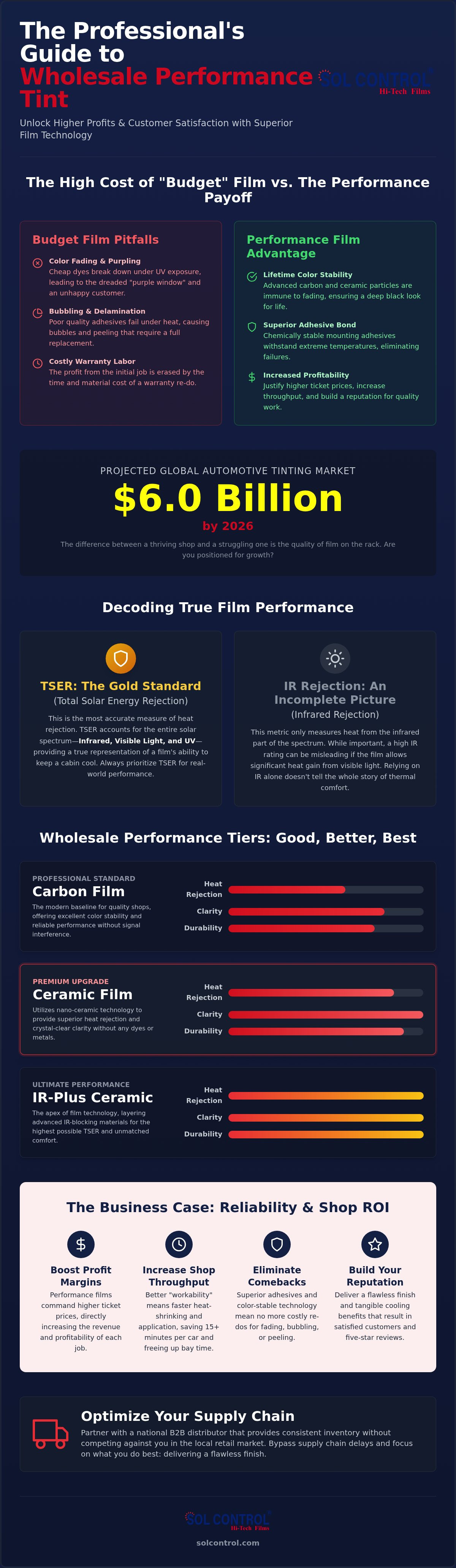
In a market where the global automotive tinting industry is reaching a staggering $6.0 billion in 2026, the difference between a thriving shop and one struggling with overhead often comes down to the quality of the rolls on the rack. You've likely felt the sting of a "budget" film that handles poorly during installation or results in a frustrated customer returning with faded, purple windows. These warranty claims don't just cost you time; they erode the professional reputation you've worked hard to build.
Choosing the right wholesale performance tint is your best insurance policy against labor-intensive re-dos and price-sensitive competition. We understand that you need films that offer consistent heat rejection and superior durability to justify a higher ticket price. This guide explores how to navigate technical specifications like Total Solar Energy Rejection (TSER) and Infrared (IR) Rejection to select films that perform exactly as promised. We'll also examine how sourcing from a dedicated national partner can help you bypass supply chain delays and focus on what you do best: delivering a flawless finish.
Key Takeaways
Understand why Total Solar Energy Rejection (TSER) and full-spectrum IR metrics are the only reliable ways to measure true film efficiency.
Learn how to select the ideal wholesale performance tint by evaluating the specific technical advantages of carbon, ceramic, and IR-Plus tiers.
Discover how high-end films improve shop throughput by offering more predictable handling and faster heat-shrinking during the application process.
Increase your shop’s profitability by shifting toward performance-grade films that command higher ticket prices and eliminate common fading or bubbling complaints.
Identify the benefits of a national B2B distribution partner that provides consistent inventory without competing against you in the local retail market.
Defining 'Performance' in the Wholesale Window Tint Market
Performance in the window film industry used to be a simple measure of aesthetic. If a film looked dark and stayed black for a year, it often passed the test. That standard has changed. Today, the term wholesale performance tint refers to a complex interplay of heat rejection, UV protection, and signal transparency. Professionals no longer define quality by the visible light transmission (VLT) alone. Instead, they look at how a film manages the entire solar spectrum, specifically targeting infrared radiation and ultraviolet rays while maintaining optical clarity.
Many entry-level "High Performance" (HP) films rely on a hybrid construction of dye and metalized layers. While these offer decent heat rejection, they often interfere with modern vehicle electronics. True performance films utilize nano-ceramic or carbon structures. These materials are inherently non-conductive, ensuring that GPS, cellular signals, and tire pressure monitoring systems function without interruption. For a shop to remain competitive in 2026, distinguishing between these tiers is essential for setting customer expectations and justifying premium pricing.
The Evolution of Film Technology
The industry has transitioned from basic 1-ply dyed films to sophisticated multi-layered structures. Early dyed films were notorious for turning purple as the polyester degraded under UV exposure. Modern carbon and ceramic films use inorganic pigments and advanced nano-particles that are virtually immune to fading. This evolution ensures color stability for the life of the vehicle. Advanced adhesive technology also plays a critical role. High-end films use chemically stable mounting adhesives that prevent the bubbling and delamination common in lower-tier products, providing a bond that withstands extreme temperature fluctuations.
Why Professional Shops are Moving Away from Economy Rolls
Relying on economy rolls is a high-risk strategy for a modern tint shop. The initial savings on a roll are quickly erased by the cost of warranty labor. If a film fails after two years, the shop loses the profit from the original job and the opportunity cost of the bay time required for the removal and re-installation. Choosing a premium wholesale performance tint isn't just about the customer's comfort; it's about protecting your shop's bottom line.
Performance films also offer better "workability" for the installer. They shrink more uniformly and respond predictably to heat, which reduces the time spent on complex rear windows. In a competitive market, saving fifteen minutes per car while eliminating the risk of a comeback is the most direct path to higher profitability. Modern vehicle owners expect their cabin to remain cool even in direct sunlight. Meeting these expectations requires films that prioritize Total Solar Energy Rejection (TSER) over simple darkening.
Critical Performance Metrics: Understanding TSER and IR Rejection
To scale a professional shop, you must move beyond selling "dark windows" and start selling thermal comfort. When you evaluate wholesale performance tint, the spec sheet tells the real story of the film's quality. Understanding the science behind these numbers allows you to justify premium pricing to your clients while ensuring the products you install meet the rigorous demands of 2026 vehicle owners. Performance isn't just a marketing buzzword; it's a measurable data point that dictates how a vehicle will feel in the peak of summer.
Every professional-grade film should provide at least 99% UV rejection. This metric is non-negotiable for protecting the vehicle's interior from fading and cracking, while also shielding passengers from harmful radiation. Conversely, Visible Light Transmission (VLT) is often misunderstood by consumers. A common mistake is assuming darker films always reject more heat. High-performance ceramic technology allows for lighter films to achieve ratings that rival or exceed traditional "limo" tints, providing clarity without sacrificing cooling power.
Decoding TSER for Your Customers
TSER represents the sum of all solar energy rejected by the film, including ultraviolet, visible light, and infrared radiation. This is the gold standard for efficiency because it accounts for the entire solar spectrum rather than just a single segment. While many shops focus on infrared alone, a film with a high TSER provides a more comprehensive cooling effect for the driver. Explaining this to a customer can be difficult without visual aids. Most clients don't understand the physics of solar energy, but they do understand the heat they feel on their skin. Using a tint meter during a sales pitch provides immediate, objective proof of performance. You can show them exactly how much energy is being blocked by a ceramic film compared to their factory glass or an economy dyed roll. This transparency builds trust and makes the upsell to a performance tier feel like a logical decision.
The Importance of Infrared (IR) Rejection
Infrared energy accounts for roughly 50% of the solar heat felt inside a vehicle cabin. However, not all IR rejection claims are equal in the wholesale market. Some suppliers measure rejection at a single wavelength, such as 900nm, where performance is naturally higher. Professional installers should look for films that maintain consistent rejection across the full spectrum from 900nm to 2500nm. Ceramic technology excels here because it uses nano-particles to absorb and dissipate this energy before it enters the vehicle. You can browse our full range of high-rejection automotive window films to see how our technical specifications hold up across these critical benchmarks. Choosing a film that targets both near-infrared and far-infrared wavelengths ensures that your customers experience maximum cooling even during the hottest hours of the day.
Wholesale Performance Tiers: Carbon vs. Ceramic vs. IR-Plus
Stocking the right tiers of wholesale performance tint is a strategic decision that directly impacts your shop's inventory turnover and average ticket size. While every installer wants to provide the best possible product, your choice of film should align with the specific needs of your local market and the types of vehicles entering your bays. In 2026, the market has standardized around three primary performance categories: carbon, ceramic, and ultra-high IR nano-ceramics. Each serves a distinct purpose in a professional's portfolio.
Carbon Film: The Reliable Workhorse
Carbon rolls represent the first true step into performance-grade materials. Unlike traditional automotive window film that relies on unstable dyes, carbon films use actual carbon particles infused into the polyester. This construction provides a deep, matte-black finish that many customers prefer for its aesthetic appeal. For a professional shop, carbon is the ideal entry-level wholesale performance tint. It offers significant advantages over dyed products:
Color Stability: Carbon particles are inorganic and don't fade or turn purple over time.
Signal Transparency: Because it contains no metal layers, it won't interfere with radio, GPS, or cellular signals.
Cost-to-Performance Ratio: With TSER ratings typically ranging from 35% to 50%, it provides a noticeable upgrade in heat rejection without the premium price of ceramic.
Ceramic and Nano-Ceramic: The Premium Upsell
Ceramic films have become the gold standard for high-end automotive applications. These films use non-conductive, non-metallic ceramic particles that are small enough to maintain perfect optical clarity while blocking massive amounts of solar energy. This technology is particularly critical for Electric Vehicles (EVs) and modern luxury cars equipped with advanced driver-assistance systems (ADAS) that rely on clear signal reception. The science behind ceramic film allows it to reject infrared heat far more effectively than carbon.
This efficiency means you can offer a 70% VLT film that rejects more heat than a 5% carbon film. For shops targeting a high-end demographic, ceramic rolls with TSER ratings between 45% and 65% are the primary driver of profitability. They allow you to solve the customer's heat problem without forcing them into a dark shade that might conflict with local regulations. The peak of 2026 technology is found in IR-Plus or Nano-Ceramic Plus tiers. These specialized films can achieve TSER ratings of 70% or higher and block up to 97% of infrared rays. By stocking these tiers, you position your shop as an authoritative expert capable of handling everything from a daily commuter to a high-performance luxury vehicle.
The Business Case for Performance Film: Reliability and Shop ROI
Many shop owners focus solely on the cost per linear foot when sourcing rolls. However, the true Return on Investment (ROI) of wholesale performance tint is found in the hours saved in the bay and the lack of unpaid rework. When you use high-end films, you're buying consistency. Cheap films often exhibit erratic shrinking patterns or inconsistent adhesive tack, which forces your installers to work slower or, worse, restart a window entirely. By investing in premium materials, you adopt a "One-and-Done" philosophy that maximizes your daily vehicle throughput and keeps your bays moving.
Strategic upselling becomes significantly easier when you can back your claims with performance data. Moving a customer from a standard dyed film to a high-performance ceramic package doesn't just increase your profit margin on the material; it changes the nature of the sale from a commodity to a premium service. This shift allows you to compete on quality rather than being trapped in a "race to the bottom" on price with local competitors who rely on economy-grade rolls.
Operational Efficiency and Film Handling
Predictability is the greatest asset of a performance-grade film. High-end ceramic and carbon structures are engineered with a specific thickness that balances durability with flexibility. This allows the film to "snap" into place more easily on complex, curved rear glass. When paired with high-quality professional tinting tools, these films reduce the physical strain on your installers and minimize the risk of creasing or contamination. Consistent roll quality also means less waste. You don't have to worry about factory defects or visual distortions mid-roll that can ruin a nearly finished job. Every inch of the roll is usable, which stabilizes your material costs and ensures that your bottom line reflects your actual labor output.
Customer Retention and Warranty Management
Your brand’s reputation is only as strong as the oldest tint job currently driving around your city. Performance films are designed to resist the common failures of economy dyes, such as the unsightly "purple" fading or adhesive delamination. When a customer's car looks just as good five years later as it did on day one, you've earned a lifelong advocate. This longevity significantly reduces warranty claims, which are the silent killers of shop profitability. Every hour spent fixing a failed film is an hour you aren't billing for a new client. To further increase your average ticket price, consider offering windshield protection film as a high-performance add-on. This service complements a full ceramic tint package and provides a comprehensive shield for the vehicle's glass. You can view our wholesale inventory to find the right products to build your premium service menu.
Optimizing Your Supply Chain with a National Performance Tint Distributor
Selecting a distribution partner is as critical as selecting the film itself. A primary concern for many professional installers is the conflict of interest that arises when a distributor also operates retail installation bays in the same market. This practice creates a scenario where your supplier is also your direct competitor. SolControl operates as a dedicated B2B partner. We don't compete with our clients for retail business; instead, we focus entirely on ensuring you have the wholesale performance tint and technical support necessary to dominate your local area. This exclusive focus allows us to invest more heavily in your success through consistent inventory and professional-grade resources.
Maintaining consistency across your entire inventory is vital for brand reliability. Whether you are stocking automotive rolls or specialized architectural window film, the performance specifications must remain uniform. Sourcing from a single national distributor allows you to streamline your procurement process. You can manage your film, paint protection film (PPF), and professional tools through one point of contact. This reduces administrative overhead and ensures that your installers are always working with familiar, high-quality materials that behave predictably during application.
The SolControl Advantage
Our national distribution network is designed to eliminate the supply chain bottlenecks that can stall your business. We understand that an empty bay is a lost opportunity. To keep your shop moving, we maintain a comprehensive inventory of high-performance films ready for immediate dispatch. Beyond the physical rolls, we provide access to professional marketing materials. These resources are designed to help you communicate complex technical benefits, such as TSER and IR rejection, to your customers. By bridging the gap between advanced science and consumer understanding, we help you close more premium sales and increase your average ticket price.
Next Steps for Professional Installers
Transitioning your shop to a performance-first model requires a careful evaluation of your current inventory. If your racks are filled with economy rolls that lack verifiable performance data, your business is vulnerable to more efficient competitors. Start by benchmarking your current stock against the ceramic and carbon standards discussed in this guide. Once you identify the gaps in your offering, you can begin integrating higher-tier films that command better margins and generate fewer warranty claims. When you are ready to elevate your shop's standards and secure a reliable supply of wholesale performance tint, you can create a wholesale account to access our full inventory of premium automotive and architectural solutions.
Future-Proof Your Business with Advanced Film Technology
The shift toward ceramic and nano-ceramic technology is the new benchmark for professional shops. By prioritizing high TSER and IR rejection, you protect both your reputation and your bottom line. Moving away from economy rolls eliminates the hidden costs of film failure and allows you to focus on high-margin, luxury applications. You've seen how the right material can transform an installation from a struggle into a seamless, profitable process.
Success in this industry requires more than just technical skill; it requires a supply partner dedicated to your growth. SolControl provides B2B exclusive distribution and national US shipping to ensure your bays never sit empty. We also offer a full range of professional tinting tools to complement our high-end rolls. It's time to stop competing on price and start winning on performance. Upgrade your shop's inventory with SolControl's performance tint rolls and experience the difference that professional-grade wholesale performance tint can make for your business. We are ready to help you reach the next level of profitability and customer satisfaction.
Frequently Asked Questions
What is considered a 'good' TSER rating for wholesale performance tint?
A good TSER rating depends on the film technology you're stocking. For standard carbon rolls, a rating between 35% and 50% is typical. Professional ceramic films should aim for 45% to 65%, while premium nano-ceramic options can exceed 70%. When sourcing wholesale performance tint, look for these benchmarks to ensure you're providing genuine thermal protection. Higher ratings directly correlate with cabin comfort and customer satisfaction.
Does performance ceramic tint interfere with GPS or cellular signals?
No, high-quality ceramic tint is completely signal-enabling because it contains no metal layers. Unlike traditional metalized films that can disrupt GPS, cellular reception, or tire pressure monitoring systems, ceramic particles are non-conductive. This makes ceramic the ideal choice for modern vehicles equipped with advanced driver-assistance systems and internal connectivity. You can confidently install these films on high-tech luxury cars without worrying about electronic interference or connectivity issues.
How do I explain the cost difference between carbon and ceramic to my customers?
Focus your explanation on heat rejection and technology rather than just price. Carbon film provides excellent color stability and a matte look but has lower thermal efficiency. Ceramic film uses advanced nano-particles to block a much higher percentage of infrared heat without needing a darker shade. Tell your customers that ceramic is an investment in long-term comfort and interior protection, whereas carbon is a reliable entry-point for aesthetic upgrades and basic UV protection.
Can performance automotive tint be used for architectural applications?
It's generally not recommended to use automotive film for architectural windows. Dual-pane residential or commercial glass has different thermal expansion properties than tempered automotive glass. Using automotive film on these windows can lead to excessive heat absorption and potential glass breakage. Instead, you should source dedicated architectural window films that are specifically engineered to handle the flat glass environment while providing the same high-performance UV and heat rejection benefits.
What are the most essential tools for installing high-performance ceramic film?
Installing premium ceramic film requires high-quality tools to match the material's sensitivity. You'll need a precise heat gun for uniform shrinking, as ceramic can be thicker than dyed films. Specialized hard cards and soft-edge squeegees are vital to avoid scratching the high-end coating. Additionally, using professional-grade mounting solutions ensures a clean bond. Using the right tinting tools prevents common installation errors like creasing or contamination, which helps maintain your shop's efficiency.
How does the shrinking process differ between economy and performance films?
Performance films typically offer a more predictable and uniform shrinking process compared to economy rolls. High-end polyester structures respond more consistently to heat, allowing you to form the film to complex curves without the "fingers" or ghosting often seen in cheaper materials. While some performance films are slightly thicker, their superior construction means they won't over-shrink or melt as easily. This predictability saves significant time in the bay and reduces material waste.
Why is UV rejection important if the film is already rejecting heat?
UV rejection and heat rejection serve two different purposes. While infrared rejection manages the heat you feel, UV rejection blocks the radiation responsible for fading car interiors and damaging skin. A film can block heat while still letting harmful UV rays through if it isn't properly engineered. Providing 99% UV protection ensures that dashboards, leather seats, and plastic trim don't crack or discolor over time, which is a major selling point for vehicle longevity.
What should I look for in a wholesale window film warranty?
A professional wholesale performance tint warranty should cover color stability, bubbling, peeling, and delamination for the life of the product. Look for manufacturers that back their performance claims with a clear, written guarantee that you can pass on to your customers. Reliable distributors should also provide support for warranty claims so you aren't left covering the labor costs of film failure. A strong warranty is a sign of the distributor's confidence in their film's long-term durability.