PPF vs Ceramic Coating: 2026 Professional Buying Guide
The most profitable detailing shops in 2026 aren't choosing between film and liquid protection; they're mastering the synergy of both to protect their margins. While many still view the debate of ppf vs ceramic coating for professional installers as a zero-sum game, the reality is that rising material costs and installation failures are the true threats to your bottom line. You've likely felt the frustration of explaining a $5,000 package to a skeptical client or watching your hard-earned profit disappear into wasted film during a difficult install.
It's time to move past basic comparisons and adopt a strategic framework that treats TPU film as the primary armor and ceramic as the high-performance finish. This guide will help you master the technical and commercial nuances required to optimize your inventory and maximize per-vehicle profit. We'll explore reliable wholesale sourcing for high-quality TPU films, provide a clear roadmap for upselling combined packages, and show you how to reduce installation waste to keep your shop running at peak efficiency.
Key Takeaways
Discover why the 2026 market has shifted from an "either-or" choice to a synergy model that combines physical TPU barriers with chemical ceramic enhancements.
Learn the technical distinctions between Aliphatic TPU and Silicon Dioxide to better explain ppf vs ceramic coating for professional installers when justifying premium package rates.
Master a data-driven profitability framework to analyze margins per hour and identify the most lucrative ways to bundle film with existing window tint services.
Identify the critical criteria for evaluating bulk inventory, including how to verify TPU clarity and select adhesive tack levels that balance repositionability with edge security.
Streamline your workflow by identifying the specialized tools and environmental controls required to maintain a high-standard, contaminant-free installation environment.
The Professional Pivot: Why PPF and Ceramic Coating Coexist in 2026
Consumer expectations in 2026 have moved toward "total protection." It's no longer enough to offer a simple wax or a basic coating. High-end clients demand a solution that addresses both mechanical damage and environmental degradation. This shift has changed the conversation around ppf vs ceramic coating for professional installers from a choice between products to a strategy of layering them. By positioning these services as complementary rather than competitive, you can capture a larger share of the client's budget while providing a superior result.
PPF as the 'Primary Shield'
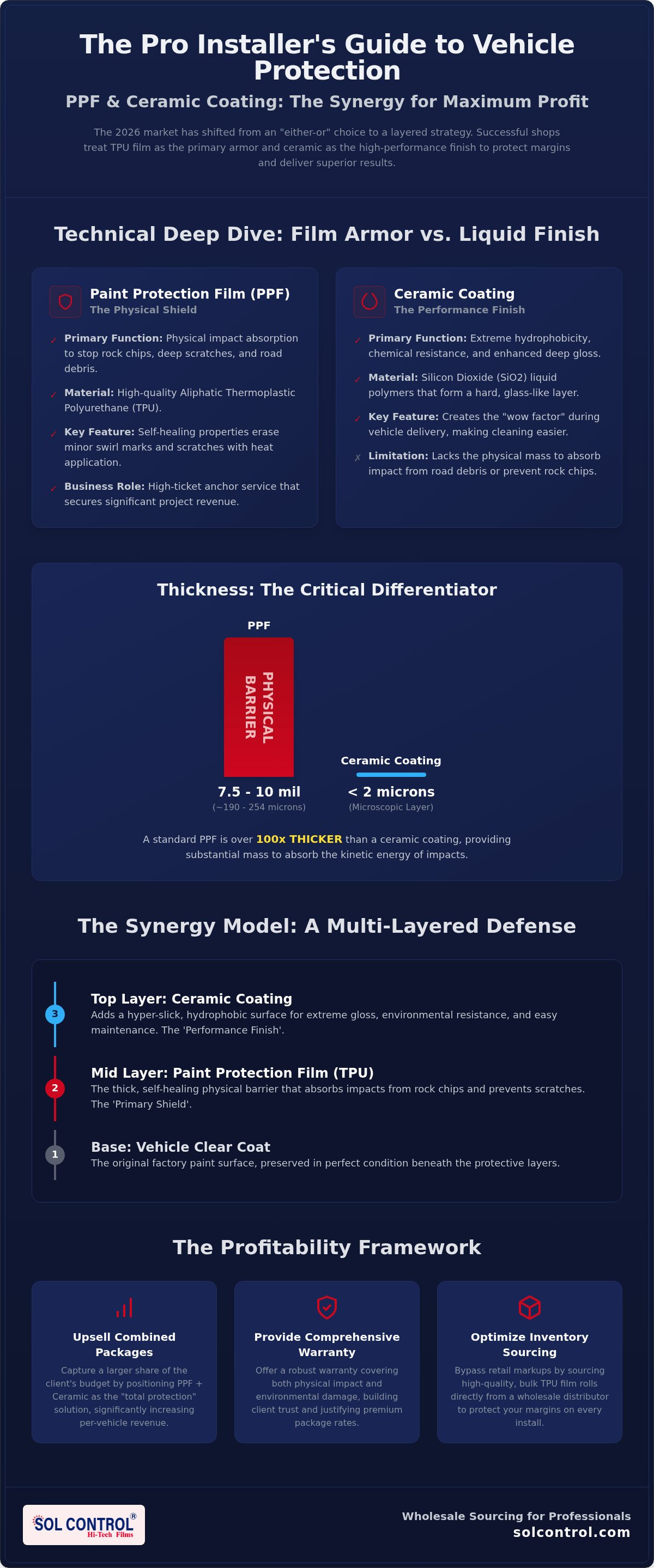
Paint Protection Film (PPF) serves as the physical armor for a vehicle. Utilizing high-quality Thermoplastic Polyurethane (TPU), typically between 7.5 and 10 mil in thickness, it provides the impact absorption necessary to stop rock chips and road debris. Modern TPU films are engineered with self-healing properties. This means that minor swirl marks and scratches vanish with the application of heat, solving a major pain point for car enthusiasts. For a professional studio, PPF is the high-ticket anchor that secures the most significant portion of a project's revenue. It's the only way to prevent the physical pitting that ruins a high-end paint job over time.
Ceramic Coating as the 'Performance Finish'
While film provides the shield, ceramic coating acts as the performance enhancer. These liquid polymers create a semi-permanent chemical bond with the substrate, whether that is the factory clear coat or the surface of the PPF itself. They provide the extreme hydrophobicity and deep gloss that customers love. It's the "wow factor" during the final delivery. However, you must be transparent about limitations. A ceramic coating is only a few microns thick. It cannot absorb the energy of a stone at highway speeds. It won't replace the physical protection of a film, which is why the most successful installers use it as a top-tier finishing layer.
Offering both services is the only way to ensure long-term shop profitability and customer retention. When you bundle these services, you provide a comprehensive warranty that covers both impact and environmental damage. Understanding the technical synergy of ppf vs ceramic coating for professional installers allows you to build more persuasive sales presentations. To maintain your margins on these complex installs, sourcing from a dedicated wholesale distributor like SolControl is essential. By securing bulk rolls of Clear and Gloss TPU directly, you bypass the retail markups that eat into your per-vehicle profit. This partnership allows you to focus on the craftsmanship of the install rather than the fluctuating costs of your inventory.
Technical Comparison: TPU Film vs. Liquid Polymer Chemistry
The choice of ppf vs ceramic coating for professional installers is fundamentally a question of chemistry and physics. Aliphatic Thermoplastic Polyurethane (TPU) is the backbone of modern film. It's a high-molecular-weight polymer designed for elasticity and UV stability. In contrast, ceramic coatings rely on Silicon Dioxide (SiO2) liquid polymers that cross-link to form a hard, glass-like layer. While both protect the substrate, they do so through entirely different mechanisms.
Thickness remains the most significant differentiator. A standard professional film is 7.5 mil thick, providing substantial material to absorb the kinetic energy of road debris. Mil thickness is the industry-standard measurement for film puncture resistance. Ceramic coatings are measured in microns, often providing less than 2 microns of coverage. While coatings offer superior chemical resistance and gloss, they lack the physical mass required to prevent rock chips or deep scratches. Over time, UV exposure can cause low-quality films to yellow, whereas ceramic coatings gradually wear away through abrasion and chemical degradation.
The Anatomy of Professional PPF
A professional-grade roll consists of more than just a single layer of plastic. It's a multi-stage construction involving a pressure-sensitive adhesive, a central TPU core, and a self-healing top coat. The quality of the TPU core determines the film's clarity and resistance to yellowing. High-quality aliphatic resins resist the oxidation that caused older films to fail prematurely under heavy UV exposure. For those sourcing bulk paint protection films, the presence of a protective capsheet is essential. This layer prevents "orange peel" textures and surface marring that can occur during transit or bulk handling.
Adhesive Layer: Engineered to offer high initial tack for edges while remaining repositionable during complex bulk installs.
TPU Core: The energy-absorbing heart of the film that provides flexibility for wrapping around curved body panels.
Self-Healing Top Coat: A high-density layer that uses heat to reform its structure, effectively erasing swirl marks.
Ceramic Coating Application Nuances
Applying a coating is a chemical process, not a mechanical one. Surface preparation is non-negotiable. Any defect left in the paint will be locked under the coating, making paint correction the most labor-intensive part of the job. Curing times also dictate shop throughput. Most coatings require a 12 to 24-hour dwell time in a controlled environment to reach full hardness. This is why many 2026 shops have adopted the "film-first" workflow. Applying a ceramic coating over the PPF is now the gold standard. It combines the impact resistance of TPU with the extreme hydrophobicity and maintenance ease of SiO2 chemistry.
The Profitability Framework: Maximizing Shop ROI
Analyzing the ROI of ppf vs ceramic coating for professional installers requires looking beyond the initial sticker price. Ceramic coating jobs are often labor-intensive due to the required paint correction, with labor estimated at 60-70% of the total cost. In contrast, a paint protection film installation is a high-ticket anchor that leverages material quality. While the material cost for TPU is higher, the per-hour profit on a full-front PPF install often exceeds that of a multi-stage ceramic coating. This is because the physical application, while skilled, is faster than 20 hours of meticulous polishing.
Maximizing these margins depends on your inventory strategy. Sourcing from a wholesale partner like SolControl ensures you aren't competing with your own distributor for retail customers. This "installer-first" model allows you to focus on volume without worrying about price undercutting from the same brand that sells you your film. By combining these services with window tinting, you create a one-stop-shop experience that increases the average transaction value significantly.
The 'Hybrid' Sales Pitch
The most effective upselling strategy in 2026 is the "Hybrid" or "Track Pack" model. This approach applies PPF to high-impact zones like the bumper, hood, and mirrors, while treating the remaining panels with ceramic coating. It's an easier sell because it addresses the client's total cost of ownership. You aren't just selling a shiny car; you're preventing a $2,000 respray down the line. If a customer is hesitant, referring them to a clear explanation of what is paint protection film can help bridge the knowledge gap between a liquid coating and a physical barrier.
Calculating Inventory Turnover
Inventory management is where shops either thrive or bleed cash. Ordering pre-cut kits might seem convenient, but it locks you into high per-square-foot prices and leaves you vulnerable to plotter errors. Stocking bulk rolls, specifically 60-inch widths for full hoods and 24-inch or 30-inch rolls for rocker panels, reduces waste and increases agility. Balancing your stock of standard clear gloss with specialty matte films ensures you can say "yes" to high-margin custom projects immediately. By partnering with a national US distributor, you minimize lead times and keep your cash flow fluid. This prevents thousands of dollars in film from sitting idle on a shelf while you wait for a specific customer request.
Professional Selection Guide: Choosing Your Bulk Inventory
Evaluating ppf vs ceramic coating for professional installers often comes down to how well the inventory supports your workflow. For film, clarity is the primary metric. You must avoid films that exhibit an "orange peel" texture, which often stems from low-quality TPU or poor storage conditions. High-quality aliphatic TPU should remain optically clear, ensuring the factory paint's depth remains visible. Adhesive tack is the second critical factor. You need enough initial tack to secure difficult edges, yet enough repositionability to lift the film and remove contaminants during a bulk install. Finding this balance reduces rework and saves hours of labor on complex body panels.
Current automotive trends show a rising demand for both high-gloss and sophisticated matte finishes. While gloss remains the volume leader, stocking matte TPU allows you to offer "stealth" conversions that command premium rates. Regardless of the finish, 60-inch rolls have become the industry standard for seamless hood installations. Using narrower rolls for large panels creates visible seams that modern clients simply won't accept. It's a matter of matching your inventory to the high standards of the 2026 market.
SolControl Collection Highlights
Our inventory is curated to support high-volume shops that prioritize both quality and margin. The PPF-Clear Series offers high-performance TPU available in convenient 24-piece packets or bulk rolls ranging from $75.0 to $990.0. For projects requiring maximum visual impact, the GLOSS series provides an enhanced finish with exceptional depth. These rolls, priced between $656.25 and $1800.0, include a protective capsheet to ensure the film remains pristine during handling. We also provide Partial Coverage Solutions, such as 12" x 50FT rolls for $447.0, which are perfect for protecting door edges, sills, and rocker panels without wasting wider, more expensive film.
Sizing for Efficiency
Optimizing your roll widths is the fastest way to reduce material waste. While 60-inch rolls are necessary for hoods, 30-inch and 36-inch widths are the "sweet spot" for bumpers and fenders. These sizes allow for easier handling and less trimming, which speeds up the installation process. Many of our premium PPF rolls also include "Optical Window Film" bonuses, providing extra value that you can pass on to your customers or use to bolster your own shop's service offerings. Choosing the right sizes ensures your cash isn't tied up in scrap material on the shop floor.
Successful application of ppf vs ceramic coating for professional installers relies on a fundamental shift in shop equipment. While window tinting tools prioritize water evacuation from thin polyester, tools for paint protection film installation must handle the thicker, more elastic TPU material. Using a standard tint squeegee on an 8 mil film often results in "silvering" or trapped air pockets. The tool lacks the necessary rigidity to compress the high-tack adhesive. You need specialized blades that can navigate complex curves without marring the self-healing top coat.
Environmental control is your next priority. A speck of dust under a ceramic coating is a minor defect. Under PPF, it's a visible bubble that can ruin an entire 60-inch hood panel. You need a dedicated, well-lit bay with temperature controls maintained between 65°F and 75°F. This range ensures the adhesive remains workable without becoming too aggressive or losing its tack prematurely. Post-install care is just as vital. Providing your customers with a specific maintenance guide, including pH-neutral soap recommendations and a "no-pressure-wash" curing period, protects your work and reduces unpaid warranty claims.
Equipping Your Shop
Selecting the right squeegees and slip solutions is essential for managing high-tack adhesives. You need a variety of durometers to handle both flat panels and deep recesses. The slip solution ratio is your most important variable; too much soap prevents the edges from locking, while too little soap leads to premature tacking and stretch marks. A professional heat gun is used during the final inspection to seal edges and activate the self-healing properties of the film. Check our 2026 wholesale automotive window film guide for complementary shop equipment that supports both your tint and protection services.
Your National Wholesale Partner
SolControl serves as the dedicated "Installer's Partner" by providing more than just bulk rolls. We supply the technical data sheets and marketing materials you need to justify the value of $5,000+ packages to your clients. Our B2B-only model is a strategic advantage for your business. We never compete for your local installation customers, ensuring our success is tied directly to yours. With national US shipping on bulk PPF rolls and a comprehensive inventory of tools, we help you maintain your margins and reduce lead times. This partnership allows you to focus on the craftsmanship of the install while we handle the logistics of your supply chain.
The shift in 2026 consumer demand has made it clear that mastering the synergy of ppf vs ceramic coating for professional installers is the most reliable path to sustained profitability. By integrating high-performance TPU films for physical armor and liquid polymers for chemical resistance, you provide the total protection that modern vehicle owners expect. Success in this competitive market depends on more than just installation technique. It requires a strategic approach to bulk inventory management and a dedicated partnership with a distributor that respects your business model.
SolControl remains dedicated to your growth by offering professional-grade TPU films and wholesale pricing exclusively for US installers. Our B2B-only model ensures we never compete for your local retail customers, allowing you to focus entirely on your craftsmanship and customer service. You've got the skills to deliver excellence; we provide the materials to make it profitable. Shop Wholesale Paint Protection Film Rolls today to elevate your shop's standards and secure your margins with a partner truly invested in your long-term success.
Professional Installation FAQ
Can you apply ceramic coating directly over paint protection film?
Yes, applying a ceramic coating over PPF is considered the industry gold standard for 2026. This combination provides the physical impact resistance of the film with the extreme hydrophobicity and maintenance ease of a liquid polymer. When discussing ppf vs ceramic coating for professional installers, it's important to note that the coating should be applied after the film has properly outgassed to ensure a permanent chemical bond without bubbling.
What is the primary difference in installation time between PPF and ceramic coating?
The primary difference lies in the nature of the labor and environment. A full-front PPF installation typically takes 4 to 8 hours of mechanical application. In contrast, a professional ceramic coating project often requires 2 to 3 days. This timeline includes extensive paint correction, which is non-negotiable for high-end results, followed by a mandatory 12 to 24-hour curing period in a controlled environment to reach full hardness.
Does paint protection film or ceramic coating provide better UV resistance?
Both products offer UV protection, but they do so through different mechanisms. High-quality Aliphatic TPU films are specifically engineered with UV inhibitors to prevent the film itself from yellowing or becoming brittle over time. Ceramic coatings act as a sacrificial barrier for the factory clear coat, reflecting UV rays to prevent paint oxidation. For maximum longevity, layering a UV-stable coating over a premium TPU film provides the most robust defense.
What are the common mistakes to avoid when buying wholesale PPF rolls?
One common mistake is overlooking the presence of a protective capsheet, which prevents surface marring during transit. Installers also frequently struggle with adhesive tack levels that are either too aggressive for repositioning or too weak for edge security. To avoid these issues, professional installers should source bulk rolls from a dedicated national distributor that provides technical data sheets and verified TPU clarity to ensure a professional, "orange-peel" free finish.
How do I explain the cost difference between PPF and ceramic coating to a client?
Focus the conversation on the Total Cost of Ownership and the specific type of protection provided. Explain that ceramic coating is a chemical shield designed for gloss and ease of washing, while PPF is physical armor that stops rock chips. When weighing ppf vs ceramic coating for professional installers, emphasize that PPF prevents the expensive resprays that coatings cannot stop, making it a higher-value investment for long-term vehicle preservation.
What tools are non-negotiable for a professional PPF installation in 2026?
Precision squeegees with specific durometers are essential for handling the 7.5 to 10 mil thickness of modern TPU films. You also need professional-grade heat guns to activate self-healing properties and secure difficult edges. Additionally, using calibrated slip solutions and high-output lighting is non-negotiable for identifying contaminants before the film tacks. Having the right tools ensures you don't waste expensive bulk inventory on failed installations or rework.
How long does a bulk 60-inch by 50-foot roll of PPF typically last in inventory?
A standard 60-inch by 50-foot roll is the backbone of high-volume shop inventory. Depending on the vehicle size and coverage level, a single roll typically provides enough material for 3 to 5 full vehicle wraps or significantly more partial-front packages. Managing your turnover effectively requires balancing this wide stock with 24-inch or 30-inch rolls to minimize scrap waste and maximize the yield of every square foot in your shop.
Will ceramic coating prevent rock chips as well as PPF?
No, ceramic coating will not prevent rock chips. While coatings offer impressive chemical resistance and surface hardness, they are only a few microns thick. This is insufficient mass to absorb the kinetic energy of road debris at highway speeds. Only the 7.5 to 10 mil thickness of a Thermoplastic Polyurethane (TPU) film provides the mechanical barrier necessary to stop physical punctures and pitting on the vehicle's surface.