Selling Window Film to Car Dealerships: The Complete B2B Playbook for 2026
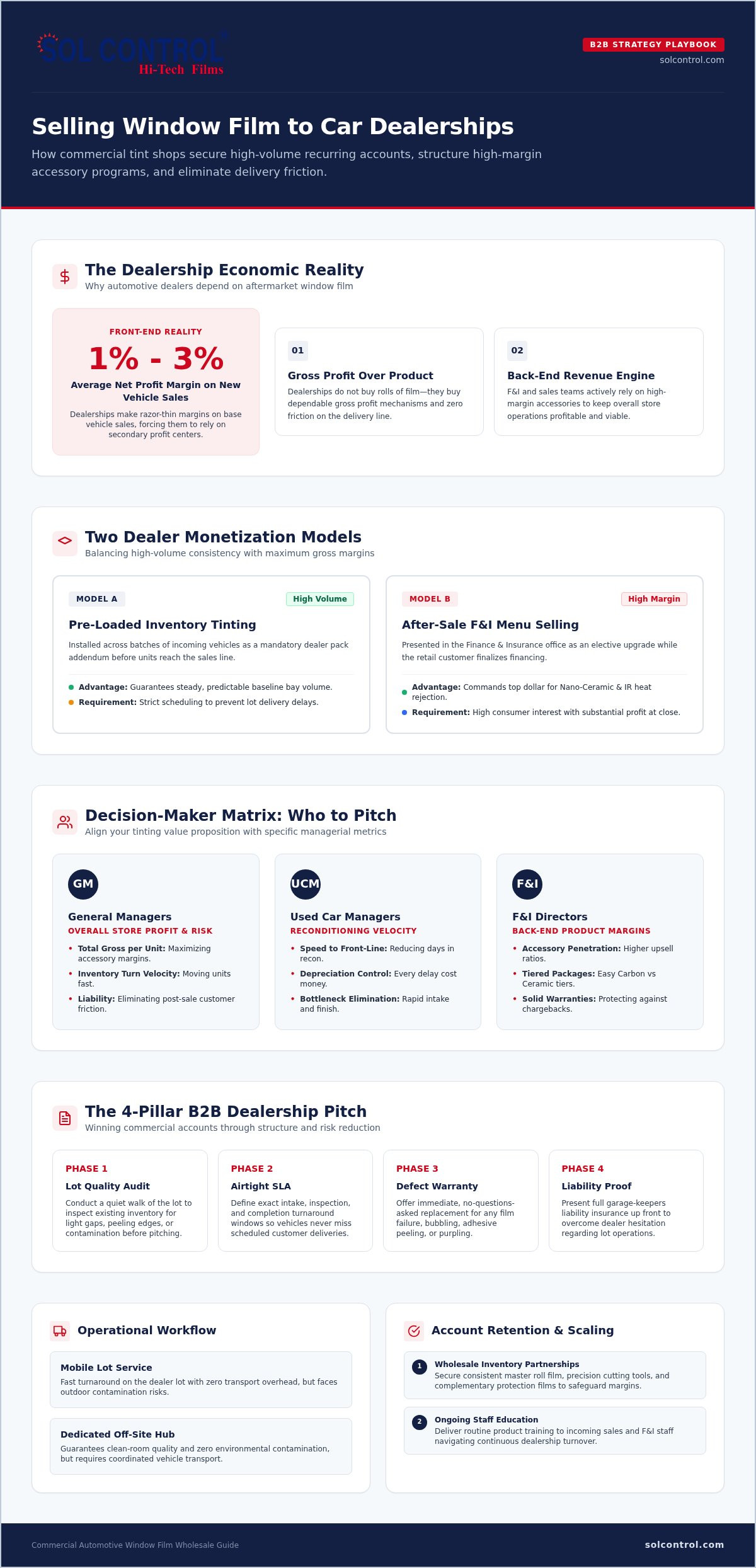
With average net profit margins on new vehicle sales hovering at just 1% to 3%, automotive retailers do not actually care about rolls of film; they care about dependable gross profit and zero friction on the delivery line. If you have struggled with selling window film to car dealerships, you know the frustration firsthand. Getting past protective gatekeepers, structuring volume pricing without destroying your margins, and managing relentless lot turnaround schedules can feel like an uphill battle.
The reality is that dealership sales and finance teams actively depend on high-margin aftermarket accessories to keep their stores profitable, creating an exceptional opportunity for your shop. In this complete playbook, you'll discover how to land, service, and scale recurring dealership accounts without sacrificing installation quality or profitability. We will cover proven strategies to engage key decision-makers, package upsells that finance managers can easily close, and streamline your wholesale inventory to protect your operational margins.
Key Takeaways
Understand how dealership gross profit structures work, allowing you to position pre-load accessory programs that secure steady, high-volume vehicle volume.
Refine your strategy for selling window film to car dealerships by leveraging lot quality audits and presenting tiered carbon and ceramic product packages.
Compare the operational logistics of mobile lot tinting versus dedicated off-site hubs to safeguard turnaround speed while minimizing installation contamination.
Protect your operational margins by partnering with a dedicated wholesale distributor for consistent master roll film, precision tools, and complementary protection films.
Retain accounts long term by delivering routine product education to new sales staff and Finance and Insurance (F&I) managers navigating dealership turnover.
Understanding the Dealership Business Model: How Dealers Profit from Window Tint
To build a sustainable commercial pipeline, you must view your services through the eyes of dealer management. Traditional vehicle sales produce razor-thin front-end margins, which forces stores to generate substantial profit through back-end operations and dealer accessories. The modern car dealership business model relies heavily on these secondary profit centers to remain viable. When approached correctly, selling window film to car dealerships isn't about pitching installation hours; it is about providing a turnkey mechanism for gross margin expansion.
Pre-Loaded Inventory Tinting vs. After-Sale F&I Menu Selling
Dealerships monetize automotive window film using two distinct operational workflows:
Pre-Loaded Programs: Film is installed across batches of incoming inventory as a dealer pack addendum before vehicles hit the sales line. This model guarantees consistent baseline volume for your bays, though it demands strict scheduling discipline to prevent lot delivery delays.
After-Sale F&I Menus: Window film is presented in the Finance and Insurance office as a personalized upgrade while the customer completes financing. F&I managers favor high-performance nano-ceramic products with noticeable infrared heat rejection because they command strong consumer interest and yield substantial profit margins at closing.
Balancing both avenues gives your shop predictable bulk volume while capturing high-margin ceramic upgrades that finance teams love to sell.
Key Stakeholders: Identifying the True Decision-Makers on the Lot
Successfully selling window film to car dealerships requires tailoring your value proposition to the exact metrics each manager protects:
General Managers: They oversee total store profitability, inventory turn velocity, and overall store liability. Your proposal must demonstrate how your service improves gross per unit without creating post-sale service friction.
Used Car Managers: Speed is their primary concern. Every day an acquired vehicle sits waiting for reconditioning and tint is a day it depreciates. They prioritize fast turnaround times that eliminate prep bottlenecks.
F&I Directors: These leaders focus on back-end accessory penetration and average product profit per deal. They require straightforward carbon and ceramic performance tiers supported by manufacturer warranties that prevent costly chargebacks.
The B2B Dealer Pitch: How to Win and Secure Commercial Tinting Contracts
Securing commercial accounts requires moving past casual drop-ins and executing a structured, value-driven presentation. When selling window film to car dealerships, the most effective approach begins before you step foot in the showroom. Conduct a quiet walk of the dealer lot to inspect their current inventory for light gaps, peeling edges, or contamination. Once you identify these vulnerabilities, approach management with a complete operational solution: a tiered product menu, an airtight Service Level Agreement, and a live demo vehicle that proves your precision.
Building an Irresistible Service Level Agreement (SLA)
Dealership operations hinge on predictable timelines. Your SLA must define precise intake, inspection, and completion windows so vehicles never miss scheduled customer deliveries. Include an immediate, no-questions-asked warranty replacement policy for any installation defects. Dealerships take comfort in knowing that your shop uses professional-grade automotive window film engineered to resist adhesive failure, bubbling, and purpling over time.
Overcoming the Most Common Dealership Objections
Expect pushback from managers who already work with an established vendor. Address this directly by highlighting how your turnaround speed accelerates front-line readiness and reduces costly reworks. Because dealership operators manage complex operational liabilities governed by the legal and business aspects of a car dealership, present proof of full garage-keepers liability insurance up front. When price resistance surfaces, demonstrate how multi-tier offerings generate new back-end revenue rather than compressing existing vehicle profit margins.
Designing Tiered Film Packages for Dealership Sales Teams
Equip the sales and finance floor with an intuitive menu that customers can quickly evaluate:
Good: Standard color-stable privacy film for baseline aesthetic enhancement and glare reduction.
Better: Advanced carbon film delivering superior ultraviolet blockage and moderate solar heat control.
Best: High-performance nano-ceramic film maximizing infrared heat rejection and passenger comfort without interfering with electronic signals.
Backing these tiers with clear performance specs makes selling window film to car dealerships an ongoing partnership. Sourcing your bulk inventory through dedicated partners like SolControl ensures your installation bays always have the rolls and tools needed to support high-volume dealer turnarounds.
Operational Workflow: Mobile Lot Service vs. Dedicated Off-Site Hubs
Delivering high-volume dealer tinting requires choosing an installation model that fits your operational capacity. Successfully selling window film to car dealerships depends as much on fulfillment logistics as on your initial sales pitch. You must decide whether to service vehicles directly on the dealership lot or transport them to a central installation shop. Many operations also deploy a hybrid schedule, utilizing dedicated dealer service bays during specific low-traffic weekdays.
Mastering On-Site Dealer Installations Without Quality Compromise
Mobile tinting removes logistical friction for dealer staff by eliminating off-site transport risks and conserving valuable porter hours. However, lot conditions present severe environmental challenges that can compromise installation quality if unmanaged. Counter dust, wind, and debris by establishing standard operating controls:
Negotiate Dedicated Wash Bay Access: Secure indoor wash or detail bays during specific operational hours rather than attempting installations on an open lot.
Run Self-Contained Mobile Rigs: Equip mobile vans with closed pressurized water tanks, multi-stage water filtration, and independent power to maintain consistent slip solution purity.
Utilize Mobile Cutting Stations: Plot all vehicle patterns using mobile digital cutting software inside the van, avoiding risky hand-cutting on brand-new customer glass.
Logistics and Fleet Portering for Off-Site Transport
Off-site installation hubs provide clean, climate-controlled environments with overhead task lighting, which drastically reduces contamination risks and redo rates. The challenge lies in moving inventory efficiently without causing lot bottlenecks. When operating an off-site model, follow these operational rules:
Batch Pickups and Drop-offs: Schedule two fixed transit runs per day rather than moving single vehicles on demand, minimizing driver labor and transport exposure.
Digital Condition Documentation: Conduct a rapid digital check-in on dealer property using a mobile tablet, recording existing windshield micro-pits, glass scratches, and wheel rash to avoid unjustified damage claims.
Protected Key Management: Deploy a dedicated lockbox protocol for vehicle key fobs, preventing misplaced inventory that stalls showroom deliveries.
Clear logistics protect your turnaround commitments, ensuring that selling window film to car dealerships remains a predictable, scalable enterprise rather than a daily logistical headache.
Wholesale Material Strategy: Selecting Bulk Film and Tools for Dealership Volume
Commercial volume quickly exposes material flaws. When managing multi-vehicle dealer batches, dealing with adhesive failures, inconsistent heat shrink, or distributor backorders instantly evaporates your margin. Successfully selling window film to car dealerships demands a disciplined inventory strategy backed by dependable wholesale supply and precision installation gear.
Optimizing Automotive Window Film Rolls and Inventory Forecasting
Controlling material waste begins with intelligent roll sizing. Standardizing your inventory with 20, 36, and 40-inch master rolls allows cutters to nest patterns efficiently, cutting down scrap across diverse fleet body styles. Select color-stable carbon and ceramic lines with verified Total Solar Energy Rejection (TSER) ratings that match what dealership finance teams promise their buyers. Ensure your film rolls deliver identical shrink characteristics and uniform adhesive release across every roll. Equipping technicians with professional-grade squeegees, hard cards, and precision cutting tools accelerates bay speed while reducing physical fatigue during heavy lot cycles.
Expanding Dealer Contracts with High-Margin Surface Protection
Once you secure a dealership account, don't stop at side and rear glass. Dealers actively seek comprehensive appearance packages that raise vehicle profit margins on the showroom floor. You can significantly expand your monthly billing by integrating complementary vehicle surface products:
Vulnerable Impact Zones: Pitch high-wear partial front-end kits and high-contact coverage using durable paint protection film to shield door cups, edge guards, and bumper lips.
Forward Glass Defense: Cross-sell exterior glass defense with advanced windshield protection film, shielding expensive sensor-equipped glass against road debris and rock chips.
Bundling these solutions transforms your shop from a transactional glass tinter into an essential restyling partner. To maintain dependable delivery schedules and protect your operational margins without channel conflict, source your master rolls and installation tools through SolControl.
Scaling and Retaining Dealership Accounts: Long-Term Growth Strategies
Dealerships experience notorious personnel turnover. An account you win today can evaporate tomorrow if a new General Manager brings in their own preferred vendors. Long-term success in selling window film to car dealerships requires institutional integration rather than relying on a single contact. Provide monthly performance reviews detailing turnaround speed, completed unit volume, and warranty claim rates. Hard data proves your value to upper management, safeguarding your contract against staff shakeups.
Training Dealer Sales Reps to Sell Premium Film Options
Front-line sales consultants rarely understand the technical differences between standard dyed, carbon, and nano-ceramic films. When dealership staff can't articulate infrared rejection, F&I penetration drops. Equip their showroom with practical sales tools:
Interactive Demonstrations: Install a counter-top heat lamp display in the customer lounge so buyers physically feel the ceramic temperature difference.
Clear Consumer Collateral: Provide sleek marketing sheets explaining solar heat gain, ultraviolet defense, and interior upholstery protection.
Quarterly Lunch-and-Learns: Host brief training sessions for incoming sales representatives to teach them how to position film packages during vehicle walkarounds.
Managing Expansion Across Multi-Store Dealer Groups
Once you prove reliability at a single store, leverage that track record across the dealer group's regional rooftops. Scaling your service to multiple locations requires disciplined operational systems:
Centralized Billing: Standardize purchase orders, vehicle stock numbers, and monthly consolidated invoicing to simplify processing for the group's corporate accounting department.
Dedicated Account Management: Assign a point coordinator to balance daily scheduling, communicate with lot managers, and resolve delays across locations.
Scalable Supply Chain: Support multi-store volume by partnering with a dedicated national wholesale distributor that supplies master rolls, specialty protection films, and precision tools without inventory interruptions.
Executing these organizational systems turns single accounts into permanent commercial relationships, establishing your shop as the undisputed restyling partner for regional dealer networks.
Transform Dealership Accounts into Long-Term Profit Centers
Mastering commercial accounts comes down to positioning your services around gross margin expansion and seamless delivery. By aligning with Finance and Insurance targets, establishing an airtight Service Level Agreement, and choosing an operational workflow that safeguards turnaround speed, you eliminate dealer friction. Consistent execution turns transactional tint jobs into durable, multi-store commercial partnerships.
Scaling this volume requires absolute confidence in your material supply chain. When selling window film to car dealerships, you can't afford unexpected backorders, erratic heat shrink, or distributor channel conflict. Partner with SolControl for Wholesale Automotive Films and Professional Tools to secure a dedicated wholesale-only catalog of automotive window films, paint protection films, windshield protection, and precision application gear engineered for speed. Take control of your commercial pipeline today and build an enduring, highly profitable dealership network.
Frequently Asked Questions
How do I approach a car dealership to pitch window tinting services?
Start by walking the inventory lot to identify quality issues on currently tinted inventory, then schedule an appointment directly with the Used Car Manager or General Sales Manager. Avoid cold pitches to floor salespeople. Present a concise Service Level Agreement outlining guaranteed completion times and transparent tier menus. Offering to tint one demo vehicle at no initial risk proves your edge precision and clean finish better than any sales presentation can.
What is the difference between pre-loaded tinting and after-sale dealer tinting?
Pre-loaded tinting involves installing film across entire shipments of incoming inventory as a standardized dealer pack accessory before vehicles hit the front line. After-sale tinting, by contrast, is sold directly to car buyers inside the Finance and Insurance office during contract finalization. Pre-loading delivers steady bulk volume for installers, while after-sale menu sales generate higher gross margins through premium ceramic performance upgrades.
Do car dealerships prefer mobile window tinters or off-site installation shops?
Dealers generally prefer whichever service model eliminates turnaround friction and reduces porter labor. High-volume dealerships often favor mobile tinters because cars remain on dealer property, avoiding transport liability and mileage accrual. However, stores with luxury or high-performance lines frequently lean toward dedicated off-site facilities. Off-site bays provide controlled lighting, climate stability, and clean environments that minimize airborne contamination on complex glass installations.
What type of window film should I offer to car dealerships?
When selling window film to car dealerships, offer a structured two-tier or three-tier portfolio featuring color-stable carbon and advanced nano-ceramic films. Avoid entry-level dyed films that degrade or turn purple quickly. Premium ceramic lines provide superior infrared heat rejection and total UV defense without blocking modern vehicle GPS, cellular, or radio signals. Pairing these with complementary paint protection films helps dealers expand their showroom appearance packages even further.
How should a tint shop handle warranty claims on dealership vehicles?
Establish an immediate, no-fault warranty replacement protocol that handles dealer vehicle re-tints ahead of routine daily work. When a retail customer returns with peeling edges or contamination, replace the damaged piece immediately without arguing over responsibility. Sourcing durable master rolls backed by reputable wholesale distributors ensures your material won't suffer adhesive breakdown, keeping your commercial warranty claim rate comfortably below one percent across all dealer accounts.
Can independent tint shops compete against in-house dealer tint technicians?
Yes, independent shops consistently outperform in-house dealership installers by eliminating dealership overhead and staffing headaches. Car stores struggle with technician turnover, equipment maintenance, and bay allocation during peak service hours. An outside partner provides dedicated capacity, professional precision tools, and consistent execution without adding payroll liability. Positioning your shop as an on-demand commercial contractor solves the dealer's staffing problem while guaranteeing predictable vehicle turnaround times.
What insurance coverage is required to tint vehicles on a dealership lot?
Car dealerships require independent contractors to carry comprehensive commercial general liability insurance paired with garage-keepers liability coverage. General liability covers third-party bodily injury or property damage, while garage-keepers coverage protects customer and dealer-owned vehicles while in your care, custody, and control. In commercial accounts like selling window film to car dealerships, providing a formal certificate of insurance naming the dealership group as an additional insured is mandatory before touching inventory.