Wholesale Ceramic Window Film: Pro Installer Guide 2026
What if the biggest threat to your shop's profitability isn't the competitor down the street, but the supplier shipping your material? As a professional installer, you know the frustration of unboxing a roll only to battle ghosting, adhesive failure, or optical haze on a curved rear window. Worse yet, too many suppliers now sell directly to retail consumers, actively undercutting your hard-earned local business. Sourcing dependable wholesale ceramic window film shouldn't force you to compromise on optical clarity or compete against your own vendor.
You deserve nano-ceramic bulk rolls that shrink predictably, deliver verified heat rejection, and protect your bottom line. In this guide, you'll discover how to evaluate, source, and profit from wholesale ceramic window film rolls designed for high-performance automotive and architectural applications. We break down the real science behind true infrared performance, explain how to protect your ticket margins by partnering with a strictly trade-only distributor, and detail the technical benchmarks that ensure seamless shop execution.
Key Takeaways
Understand how microscopic ceramic particles deliver advanced infrared heat rejection without blocking vital electronic signals or relying on unstable dyes.
Learn why evaluating Total Solar Energy Rejection (TSER) and broad-band data protects your business against inflated single-wavelength marketing claims.
Master thermal forming and pressure-sensitive adhesive handling techniques to eliminate optical distortion, curling, and costly installation comebacks.
Calculate roll yields and structure tiered service menus with wholesale ceramic window film to maximize revenue per bay.
Discover the strategic advantage of sourcing from a pure B2B distributor committed to supporting professional installers rather than competing for retail jobs.
What Defines Commercial-Grade Wholesale Ceramic Window Film?
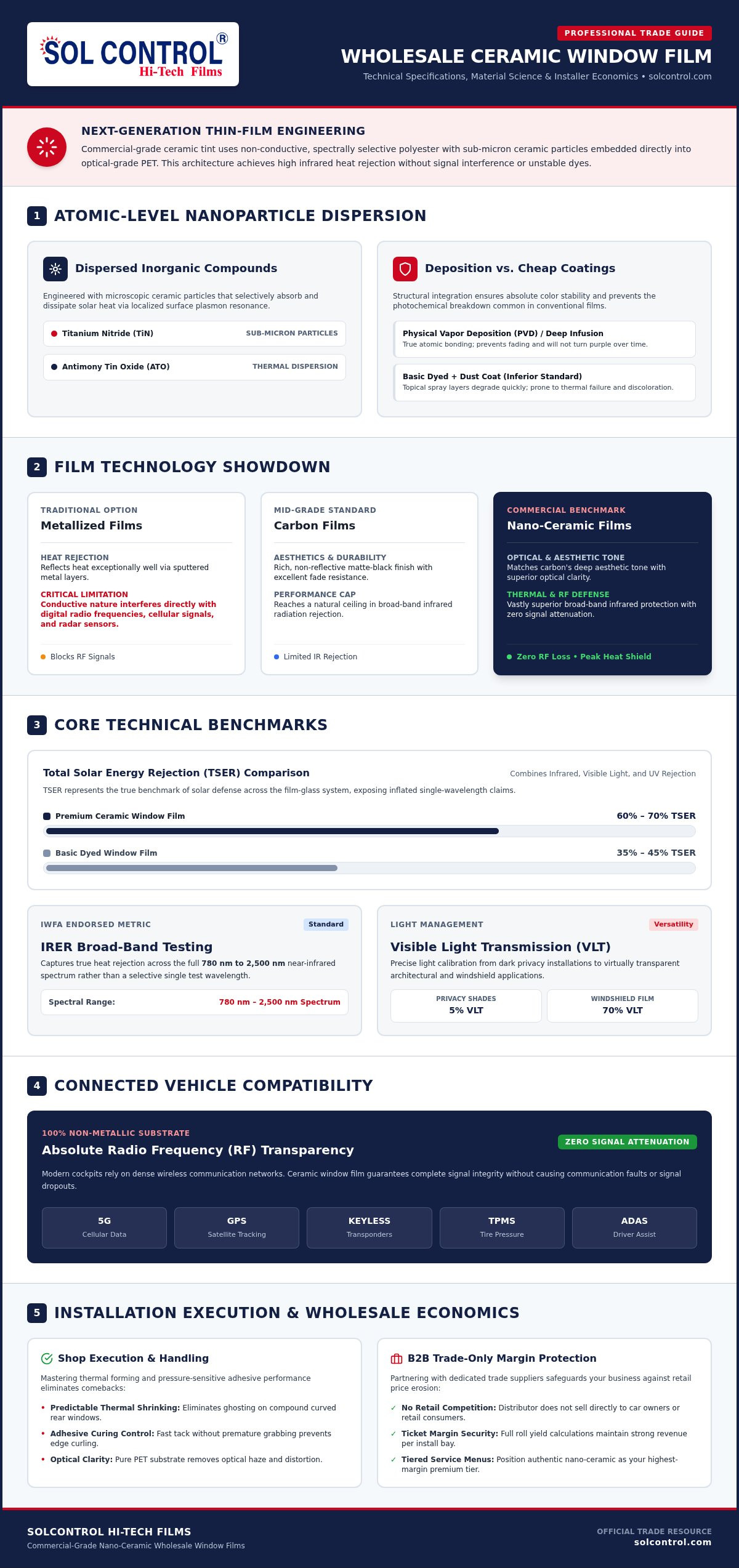
Commercial-grade ceramic tint represents a fundamental shift in thin-film engineering. Rather than relying on dark chemical dyes or reflective metals to combat solar radiation, true nano-ceramic window film utilizes non-conductive, spectrally selective polyester. Microscopic ceramic particles are embedded directly within the film substrate to selectively target and absorb solar heat. This approach allows high visual light transmission while effectively managing thermal transfer without dark, privacy-focused shades.
The core advantage lies in atomic-level performance. Understanding modern window film technology and materials reveals how manufacturers embed sub-micron particles into optical-grade polyethylene terephthalate (PET). These ceramic agents absorb and disperse infrared radiation across broad thermal spectrums, preventing solar energy from radiating into vehicle cabins or interior architectural spaces.
Because nano-ceramics are completely non-metallic, they provide absolute radio frequency transparency. Modern vehicles rely on dense electronic ecosystems: 5G connectivity, satellite GPS, keyless entry transponders, tire pressure sensors, and advanced driver assistance systems (ADAS). Sourcing authentic wholesale ceramic window film ensures your shop delivers premium thermal defense without degrading cabin electronics or triggering sensor communication faults.
The Science of Nano-Ceramic Nanoparticle Dispersion
High-performance rolls integrate dispersed nanoparticles such as titanium nitride (TiN) or antimony tin oxide (ATO). These inorganic compounds target infrared energy through localized surface plasmon resonance. While cheaper alternatives rely on basic dyed polyesters topped with a light ceramic dust coat, premium manufacturing utilizes pure physical vapor deposition sputtering or deep infusion. This structural integration yields complete color stability, eliminating the photochemical breakdown that causes standard films to turn purple over extended exposure cycles.
Ceramic vs. Metallized and Carbon Wholesale Rolls
Selecting materials for your shop requires balancing installer handling, aesthetics, and client expectations:
Metallized Films: Sputtered metal layers reflect heat exceptionally well, but their conductive nature interferes directly with digital radio frequencies, cellular signals, and automated radar sensors.
Carbon Films: Carbon delivers a rich, non-reflective matte-black tone with excellent fade resistance, yet it reaches a natural ceiling in broad-band infrared radiation rejection.
Nano-Ceramic Films: Ceramic matches carbon's deep aesthetic tone while offering vastly superior infrared protection and zero signal attenuation.
For shops looking to elevate their menu, stocking true nano-ceramic rolls bridges the gap between clean aesthetics and peak thermal comfort. You can see how these material differences impact modern bay operations in our comprehensive guide to automotive window film, helping your technicians match vehicle platforms with optimal film formulations.
Key Technical Specifications Every Tint Shop Must Evaluate
Vetting master rolls requires moving past surface-level marketing claims. Professional tint shops succeed on consistency and measurable performance. When sourcing wholesale ceramic window film, you need objective data to ensure the product shrinks cleanly, delivers true heat rejection, and maintains optical clarity over the lifetime of the vehicle.
Every commercial film roll must be evaluated across five core metrics:
Total Solar Energy Rejection (TSER): The true benchmark of solar defense. TSER calculates the combined percentage of infrared energy, visible light, and ultraviolet radiation blocked by the film-glass system. Premium ceramic films regularly achieve 60% to 70% TSER, while basic dyed films rarely exceed 35% to 45%.
Infrared Energy Rejection (IRER): The measurement endorsed by the International Window Film Association, capturing heat across the full 780 nm to 2,500 nm near-infrared spectrum rather than a narrow test point.
Visible Light Transmission (VLT): The precise percentage of visible light passing through the glass, ranging from 5% privacy shades to virtually clear 70% films designed for full windshield applications.
Ultraviolet Rejection: High-performance rolls should block greater than 99% of damaging UVA and UVB rays, a standard thoroughly explored in our overview of UV blocking window film wholesale options.
Low-Angle Haze (LAH): The clarity of the film under direct sunlight at acute angles, critical for sloped modern windshields.
TSER vs. Selective Infrared Rejection: Avoiding Deceptive Ratings
Many overseas suppliers advertise 95% to 99% infrared rejection to mislead buyers. These figures almost always represent selective infrared rejection (IRR) measured at a single wavelength, such as 950 nm. A roll showing 95% IRR at a single point does not deliver 95% total heat defense. Solar heat energy spans the entire near-infrared range up to 2,500 nm. Presenting verified TSER ratings to vehicle owners protects your shop's reputation and sets clear performance expectations.
Clarity, Low Angle Haze, and Optical Distortion
Substandard nano-ceramic rolls often suffer from low-angle haze, producing a milky, cloudy look under direct afternoon sun. This haze occurs when ceramic nanoparticles clump together during manufacturing rather than remaining evenly suspended in the polyester matrix. Low-grade mounting adhesives make the distortion worse. Always inspect newly received master rolls by unrolling a test cut under bright, directional lighting to verify optical clarity before running high-volume jobs.
To ensure your shop delivers flawless visibility and verified solar protection on every install, explore our dedicated inventory at SolControl for professional-grade film options.
Installer Handling: Shrinking, Adhesive Curing, and Workability
Working with premium nano-ceramic film requires distinct adjustments at the installation bay. Unlike standard single-ply dyed polyesters, high-performance ceramic rolls feature a multi-ply construction, typically around 2.0 mil in structural thickness. This added substance delivers outstanding heat defense, but it also alters thermal conductivity and physical pliability during the heat-forming process.
High-end wholesale ceramic window film absorbs thermal energy rapidly during shrinking. Because the nano-particles are designed to capture heat, technicians who linger in one spot risk surface burning or adhesive distortion. Success comes down to disciplined technique, correct heat dispersion, and balanced slip chemistry.
To ensure clean execution and reduce material waste, installers should follow three core shop practices:
Dry Shrinking Protocols: Utilize dry shrinking methods using a uniform release agent, such as dried soap film. Wet shrinking often traps water pockets under dense ceramic plies, creating uneven heat absorption on aggressive compound curves.
Grain Alignment: Always cut patterns along the natural roll machine direction. Shrinking across the transverse grain creates stubborn fingers that fight the squeegee along lower dot-matrix edges.
Controlled Heat Gun Sweeps: Maintain a broader, continuous circular heat pattern. Keep the nozzle slightly further from the film face than you would with carbon or dyed materials to let the heat soak uniformly across both plies.
Thermal Forming Dynamics on Curved Automotive Glass
Ceramic layers act as a thermal sponge. Moving your heat gun too slowly causes localized overheating, producing permanent micro-creases or ghosting in the optical polyester. Increase your sweep speed and allow the sheet to soften gradually across the glass surface. For severe compound curvature, such as modern sports coupe rear windows, anchor the center firmly with an H-pattern before easing excess fullness toward the top and bottom edges.
Mounting Adhesives, Slip Solutions, and Dry-Out Windows
Pressure-sensitive adhesive (PSA) formulations on commercial ceramic rolls require proper slip chemistry to balance repositionability with rapid initial tack. Avoid concentrated detergent solutions with heavy degreasers or artificial scents, which can cloud the mounting layer. Balanced slip mixtures allow precise squeegee passes, removing trapped moisture before the adhesive grabs.
Denser films naturally exhibit extended cure cycles. In line with inspection guidelines from the International Window Film Association, minor moisture hazing is normal during initial curing. Inform customers to keep side windows rolled up for 3 to 5 days, explaining that complete molecular evaporation through thick ceramic barriers can require 14 to 30 days depending on ambient temperatures. Educating vehicle owners upfront prevents unwarranted comebacks and reinforces your professional authority.
The Economics of Wholesale Sourcing: Margins, Inventory, and Supplier Ethics
Operating a profitable restyling bay requires balancing raw material expense against billable bay hours. In the window film sector, material costs typically represent only 10% to 15% of a job's total retail ticket, while labor and overhead absorb the remainder. Sourcing high-grade wholesale ceramic window film transforms that ratio into substantial gross margins. Because consumers actively seek out verified infrared performance, ceramic packages command premium retail pricing, delivering gross margins between 75% and 90% per completed installation.
Maximizing those margins depends on an intentional shop menu structure. Rather than overwhelming clients with dozens of choices, high-volume shops organize their service offerings into clear, benefit-driven tiers:
Good (Standard Dyed or Carbon): Provides basic optical shade, clean glare reduction, and privacy, capturing entry-level price shoppers.
Better (Hybrid Formulations): Combines deep color tone with moderate heat reduction for daily commuters seeking solid comfort.
Best (Nano-Ceramic): Delivers comprehensive infrared energy rejection, peak UV defense, and maximum heat relief, positioned as the high-ticket upsell that lifts average shop revenue.
Master Roll Yield Optimization and Scrap Reduction
Yield management determines your actual cost per square foot. A standard 100-foot master roll yields approximately 3 to 5 full vehicles, depending on glass dimensions and vehicle mix. Smart inventory management matches roll widths directly to incoming work orders. Stocking 40-inch rolls covers wide rear glass and full windshields, while 20-inch or 24-inch rolls handle side glass without excessive trim waste. Integrating dynamic CNC plotter software allows your team to nest cut patterns tightly, driving scrap rates down. For flat-glass cut-offs, shops can repurpose wide off-cuts into profitable residential transoms using dedicated architectural window film options.
Evaluating Distributor Business Models: Partner vs. Competitor
Supplier ethics directly affect your local pricing power. Too many distributors now sell direct-to-consumer kits online or operate retail installation bays in the same markets as their wholesale accounts. When your supplier sells directly to retail vehicle owners, they become your direct competitor. True wholesale ceramic window film sourcing requires working with a dedicated partner whose commercial model remains strictly business-to-business, protecting your market pricing and preserving customer loyalty.
Protect your shop's revenue and secure clean inventory by choosing to partner with SolControl for your wholesale film needs.
Building a Premium Window Film Program with SolControl
Scaling an installation business requires an unyielding operational foundation. While technical skill on the glass wins client referrals, dependable material access and fair distribution policies safeguard long-term growth. SolControl functions as a dedicated national distributor, delivering high-performance automotive and architectural wholesale ceramic window film directly to independent operations. Because we operate under a strict business-to-business model, our inventory exists exclusively to fuel your bays, never to compete against your local retail services.
Eliminating distributor competition gives your shop clear pricing sovereignty. You don't have to worry about consumer-targeted film ads undercutting your posted menu rates or territory caps throttling your expansion. Instead, you gain open-order access to premium roll stock backed by professional collateral and verified spec sheets that help your team sell higher-tier jobs with total confidence.
Partnering with a focused wholesale distributor provides essential operational advantages:
Pure Trade Exclusivity: We sell rolls, protection products, and tinting tools strictly to businesses, protecting your retail customer relationships.
Predictable National Inventory: Deep stock across standard widths shields your schedule from mid-season stockouts.
No Franchise Burdens: Access competitive wholesale volume tiers without mandatory franchise royalties or forced operational lock-ins.
Point-of-Sale Enablement: Physical marketing materials and precise performance metrics allow technicians to explain infrared rejection clearly to walk-in clients.
Complete Shop Fulfillment: Film, PPF, and Professional Tools
Streamlining multiple vendors into a single supply line reduces administrative overhead. In addition to nano-ceramic automotive rolls, shops can consolidate their orders by sourcing professional application squeegees, precision cutting blades, and specialty mounting tools together. This supply consistency simplifies cross-service expansion into vehicle surface defense with high-clarity paint protection film, letting you offer comprehensive vehicle protection packages from a single freight delivery.
Partnering for Long-Term Growth
Expanding your footprint from a mobile van to a multi-bay restyling facility demands dependable logistics. When bidding large commercial architectural flat-glass contracts or fleet vehicle accounts, installers can lean on dedicated wholesale support to source exact roll dimensions and verified solar documentation. Setting up a commercial wholesale account unlocks verified wholesale ceramic window film inventory, positioning your bays for steady volume and protected profit margins across every season.
Scale Your Installation Business with Proven Wholesale Film
Mastering the restyling market requires more than technical precision with a heat gun. It demands dependable materials that deliver verified solar protection, shrink cleanly without haze, and leave healthy margins on every ticket. By focusing on true broad-band heat rejection metrics and refining your roll yield strategies, your shop can confidently upsell vehicle owners to top-tier nano-ceramic performance.
Equally critical is choosing a partner who respects your craft. Sourcing your wholesale ceramic window film from a dedicated trade distributor safeguards your local pricing and keeps customer loyalty right where it belongs: in your bays. With a pure business-to-business inventory spanning automotive, architectural, and surface protection lines alongside essential application tools, you get the consistency needed to manage peak seasonal demand without vendor competition.
What is the difference between carbon and ceramic window film at wholesale?
Carbon film relies on carbon particles to deliver a matte-black aesthetic and fade resistance, but it reaches a lower threshold for solar heat rejection. Nano-ceramic film incorporates microscopic ceramic particles that selectively absorb infrared energy across broad wavelengths. While carbon offers excellent cosmetic depth, ceramic delivers significantly higher Total Solar Energy Rejection without requiring darker visible light transmission levels.
Why is wholesale ceramic window film more expensive than traditional dyed film?
The price difference stems from sophisticated manufacturing processes and high-grade materials. Authentic wholesale ceramic window film requires optical-grade polyester, vacuum-sputtering or chemical nano-dispersion of inorganic compounds like titanium nitride, and specialized mounting adhesives. These advanced components provide superior solar durability, heat dissipation, and optical clarity that standard dyed polyester films cannot achieve.
Does ceramic window film interfere with mobile phone or GPS signals?
No, genuine nano-ceramic window films are entirely non-conductive and non-metallic. Because they contain zero metallic elements, they provide complete radio frequency transparency. Electronic transmissions pass through without interference, ensuring uninterrupted operation for 5G cellular connectivity, satellite navigation systems, keyless entry remotes, automated toll transponders, and vehicle safety radar sensors.
How many vehicles can an installer tint from a standard 100-foot master roll?
An experienced installer typically completes 3 to 5 full vehicles from a single 100-foot roll. The exact yield depends on vehicle glass surface area and the master roll width selected. Using automated plotter nesting software with 40-inch or 60-inch rolls minimizes off-cut scrap and maximizes per-roll output across mixed passenger car and SUV appointments.
Can ceramic automotive window film be used on residential or commercial architectural glass?
Automotive ceramic film should not be installed on architectural flat glass. Automotive films are engineered to absorb solar radiation on curved, tempered glass designed to dissipate thermal stress. Applying automotive film to annealed or double-pane insulated residential units can trap excessive heat between panes, risking seal failure or thermal glass stress fractures. Always source dedicated architectural films for flat glass projects.
What should a tint shop look for to prevent optical haze in ceramic films?
Inspect master rolls for uniform nano-particle dispersion and mounting adhesive clarity under directional shop lighting. Inferior manufacturing allows ceramic particles to agglomerate, creating a milky low-angle haze on angled automotive windshields. Reliable films feature finely milled, evenly suspended ceramic compounds and pure pressure-sensitive adhesives that cure clear without residual cloudiness.
Why should window film installers buy from a dedicated wholesale distributor instead of a retail supply shop?
Dedicated wholesale distributors operate strict trade-only models that protect installer profit margins and market pricing. Sourcing wholesale ceramic window film from a dedicated distributor guarantees you are not buying from a company that competes for local retail tint clients. You also gain direct access to bulk volume tiers, consistent warehouse inventory, and pro-grade tools designed specifically for professional restylers.