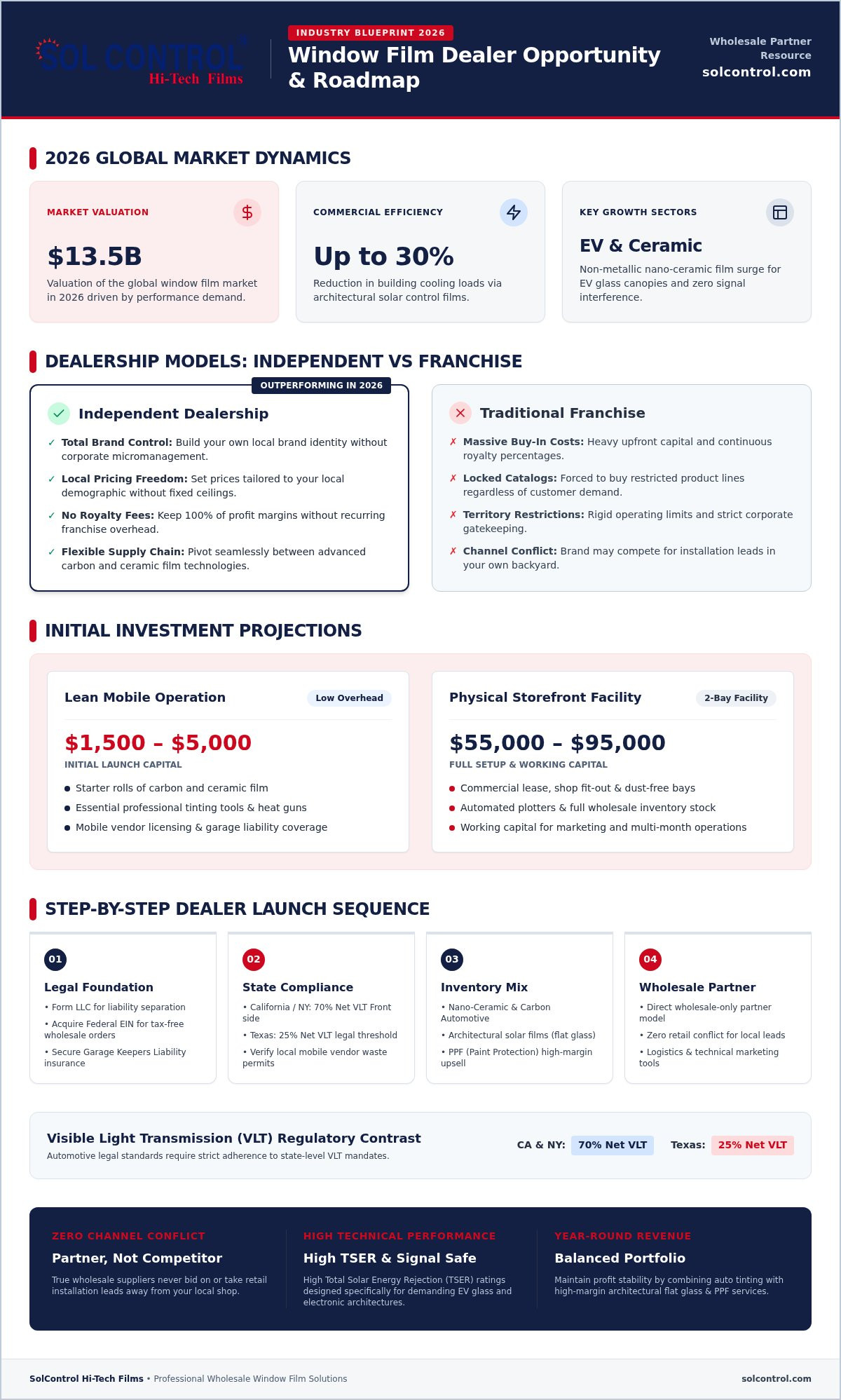
The global window film market has reached a valuation of $13.5 billion in 2026, yet many ambitious entrepreneurs are still being locked out by the restrictive authorization requirements of legacy brand gatekeepers. You've likely felt the frustration of trying to become a window film dealer only to be met with massive buy-in costs or inconsistent film quality from unverified online sources. It's a common challenge for those who want to offer premium service without sacrificing their independence or their profit margins.
This guide provides a professional, step by step roadmap to launching your own dealership with confidence and precision. We'll show you how to bypass the corporate red tape while securing high performance carbon and ceramic inventory at true wholesale rates. From navigating legal setup to utilizing professional marketing support, you'll learn exactly how to build a business that looks established and authoritative from day one. We're here to provide the technical expertise and logistics support you need to turn your ambition into a scalable, high performing reality.
Key Takeaways
Understand the 2026 market shift toward independent dealerships and the high-margin potential of modern ceramic and carbon films.
Learn the specific legal requirements and tax documentation needed to become a window film dealer and unlock professional wholesale accounts.
Discover how to balance your inventory between automotive and architectural films to maximize year-round revenue and client diversity.
Gain a roadmap for using social proof and niche marketing to establish your brand authority and compete effectively against local franchises.
Identify the advantages of a "partner, not competitor" wholesale model that supports your growth with professional tools and marketing materials.
Evaluating the Window Film Dealer Opportunity in 2026
The global window film market has reached a valuation of approximately $13.5 billion in 2026. This growth isn't just a trend; it's a response to a fundamental shift in how consumers view energy efficiency and vehicle protection. If you're looking to become a window film dealer, you're stepping into an industry where technical performance matters more than ever. Today's customers look for high Total Solar Energy Rejection (TSER) ratings and long-term durability. This demand creates a stable environment for new businesses to thrive.
Market Trends Shaping the Industry
The rise of electric vehicles (EVs) has changed the game for automotive tinting. These cars have large glass canopies and sensitive electronics that require non-metallic nano-ceramic films to prevent signal interference. Beyond the road, the architectural sector is booming. Commercial property managers are choosing solar control films to reduce cooling loads by up to 30% rather than opting for expensive window replacements. We also see Paint Protection Film (PPF) becoming a standard high-margin upsell for any professional shop. These diverse revenue streams ensure that your business remains profitable throughout every season.
Independent vs. Authorized Dealer Models
Choosing your business model is a critical first step. While "Big Brand" franchises offer name recognition, they often impose restrictive requirements and ongoing royalty fees that eat into your bottom line. The independent dealer model is currently outperforming traditional franchises because it offers total flexibility. You can build your own brand identity and set pricing that reflects your local market. Understanding window film technology and applications allows you to select the best products for your customers without corporate interference. You aren't locked into one manufacturer's catalog; you can pivot as technology advances.
A wholesale-only partner like SolControl is essential for this independent path. We provide access to premium automotive window film, architectural rolls, and professional tools without competing for your installation leads. This partnership reduces your overhead and gives you the logistical support of a major market player. You get the benefits of a global supply chain while maintaining the freedom of a local business owner. It's about having the right resources to look established from your very first install.
Step 1: Establishing Your Business Foundation and Legal Requirements
Before you pick up a squeegee or heat gun, you must build a legitimate corporate structure. Choosing between an LLC and a Sole Proprietorship is your first major decision. Most professionals prefer an LLC because it separates personal assets from business liabilities, which is vital when handling high-value vehicles. You can follow the SBA guide to starting a business to ensure you've covered every registration step and acquired the necessary local permits. Once your entity is registered, you must obtain a Federal Tax ID (EIN). This number is essential for opening wholesale accounts and purchasing professional-grade inventory tax-free.
Licensing and Regulatory Compliance
Compliance is a cornerstone of your reputation when you become a window film dealer. Automotive tint laws are strictly enforced and vary by state. For instance, states like California and New York mandate a 70% net Visible Light Transmission (VLT) on front side windows. Conversely, southern states like Texas allow for 25% VLT. You must also secure garage keepers' liability insurance. This coverage is critical; it protects your business if a customer's car is damaged while in your shop or during a mobile install. If you plan to operate a mobile unit, verify if your local jurisdiction requires a specific mobile vendor license or has environmental restrictions on waste film disposal.
Business Planning and Financial Projections
Financial clarity prevents early burnout and guides your growth. A lean mobile operation in 2026 typically requires an initial investment between $1,500 and $5,000, covering tools and starter rolls. If you're aiming for a physical storefront, budget between $55,000 and $95,000 for a two-bay facility and working capital. Your 12-month growth plan should account for recurring film costs and equipment upgrades as your volume increases. Setting competitive labor rates is equally vital. Professional automotive installs currently average around $375 per vehicle, while commercial architectural rates often range from $5.00 to $15.00 per square foot depending on the film's technical specs.
Finally, establish your digital footprint immediately. Claim your Google Business Profile and verify your service area so local customers can find you. Combining this visibility with a reliable supply of automotive window film and professional tools ensures you look established from day one. This foundation allows you to focus on mastering the craft while your business structure handles the professional weight of the industry.
Step 2: Selecting Premium Inventory and Professional Installation Tools
You've built your legal foundation. Now you need the physical assets to deliver results. When you become a window film dealer, your inventory selection directly impacts your reputation and your margins. You shouldn't rely on cheap, unbranded rolls from generic online marketplaces. They lack the technical durability and clarity your clients expect. Professional shops in 2026 focus on high-performance materials that offer quantifiable benefits and long-term stability.
Material Science: Carbon vs. Ceramic vs. PPF
Educating customers on performance metrics is your best sales tool. Carbon films offer a sleek matte finish and excellent heat rejection without signal interference. However, nano-ceramic films remain the gold standard. They provide the highest Total Solar Energy Rejection (TSER) and Infrared (IR) rejection. For new vehicle owners, paint protection film is a critical upsell that guards against physical road debris. Following the standards and educational resources provided by the International Window Film Association helps you explain these technical differences to your customers with professional authority.
The Professional Installer's Tool Kit
Precision requires more than just a steady hand. Your starter kit should include commercial-grade heat guns, stainless steel Olfa knives, and a variety of specialized hard cards. Selecting professional PPF installation tools like high-quality squeegees and dedicated slip solutions ensures a bubble-free finish. As you scale, investing in a computer-controlled film plotter is a game-changer. It reduces film waste and eliminates the liability risk of cutting directly on a customer's glass. This technology allows you to complete more installs in less time while maintaining a factory-perfect fit.
Don't overlook architectural films. While automotive work is steady, architectural solar control films provide massive year-round revenue. They help residential and commercial clients lower energy bills, which is a major selling point in 2026. Wholesale pricing is the only way to stay profitable as you become a window film dealer in a competitive landscape. Sourcing these materials through a dedicated wholesale partner ensures you maintain the 60% to 80% gross profit margins typical of successful shops. This strategy allows you to offer premium ceramic options while remaining highly competitive in your local market.
Step 3: Marketing Your Services and Building a Client Base
Once your shop is equipped and your business is legally registered, your focus must shift to lead generation. To successfully become a window film dealer, you need a marketing strategy that targets both immediate consumer needs and long-term commercial contracts. Many new dealers make the mistake of trying to be everything to everyone at once. Instead, identify a primary niche where you can build local authority, whether that's high-end automotive restyling or large-scale energy retrofitting.
Social proof is your most persuasive asset. High-resolution photos and videos of your installations provide the visual evidence customers need to trust your craftsmanship. Don't just show the finished car; show the heat lamp demonstrations that prove your ceramic film's infrared rejection. Networking with local car dealerships and property management firms can also provide a steady stream of referrals. Your wholesale distributor often provides marketing materials, such as performance brochures and sample swatches, which allow you to look like an industry leader from your very first sales pitch.
Digital Marketing for Local Visibility
Most customers start their search with "window tinting near me." Optimizing your Google Business Profile with specific keywords and service areas is non-negotiable. Running targeted social media ads during peak summer months can capture homeowners looking for heat relief. Email marketing is another effective tool; use it to send seasonal reminders or maintenance tips to your existing client base. This keeps your brand top-of-mind and encourages the referrals that are essential for sustainable growth as you become a window film dealer in your community.
B2B Sales Strategies for Architectural Film
Selling to commercial building owners requires a different approach. You aren't just selling aesthetics; you're selling return on investment. Pitching architectural window film as a solution for energy savings and tenant comfort is highly effective. You can also position these products as safety and privacy upgrades for corporate offices or government facilities. Learning how to bid on large-scale contracts involves understanding technical specifications and being able to calculate long-term energy bill reductions for the client.
Building a client base takes time, but starting with professional-grade support makes the process significantly smoother. You don't have to build your marketing assets from scratch. Access the tools and materials you need through a SolControl wholesale partnership today and start scaling your local presence.
Scaling Your Business with SolControl as Your Wholesale Partner
Scaling a successful business requires more than just technical skill; it requires a reliable and non-competitive supply chain. When you decide to become a window film dealer, one of the most significant hurdles is finding a supplier that doesn't compete for your local installation leads. Many "Big Brand" manufacturers operate their own retail centers or sell direct-to-consumer. SolControl is different. We maintain a strictly wholesale-only model. This means we are your partner, not your competitor. Every resource we provide is designed to help you capture more of your local market while maintaining your independence.
The SolControl Advantage
Margin protection is a core benefit of our partnership. By providing direct wholesale pricing on every roll, we ensure you keep the high gross profit margins that define a healthy shop. You gain immediate access to a comprehensive catalog of automotive window film, architectural solutions, and advanced technology like windshield protection and ceramic coatings. Our logistics network is built for speed and flexibility. We offer national US shipping with no massive minimum order requirements. This allows you to manage your cash flow effectively while keeping the inventory you need on hand for every job.
How to Get Started Today
The path to professional growth is straightforward. You can set up your wholesale account in minutes, immediately gaining access to our full suite of professional tool kits and marketing materials. These materials act as a "business-in-a-box," providing the brochures and swatches you need to look established from your very first consultation. We recommend starting with sample rolls of our most popular carbon and ceramic films to experience the shrinkability and clarity for yourself. Joining our network connects you with a national community of high-performance film professionals who prioritize quality and precision. When you become a window film dealer with the right support, you aren't just starting a job; you're building a scalable asset for the future.
Launch Your Independent Window Film Business in 2026
Launching a window film business in 2026 offers immense potential for entrepreneurs who prioritize technical excellence and strategic partnerships. Success in this industry depends on more than just installation skill; it requires a legitimate legal foundation, a deep understanding of nano-ceramic performance, and a marketing strategy that captures both automotive and architectural clients. By choosing the independent dealer model, you retain the freedom to build your own brand while maximizing your profit margins without the burden of franchise royalties.
As you prepare to become a window film dealer, remember that your choice of distributor is your most important strategic decision. You need a partner that supports your growth rather than competing for your local leads. SolControl provides the logistics and technical resources necessary to help you scale efficiently. With national US shipping, a comprehensive inventory of high-performance films, and professional marketing materials, we offer a complete business-in-a-box solution for independent shops.
Take the first step toward professional ownership today. Apply for a Wholesale Account with SolControl to access premium inventory and dedicated support. Your future as an industry leader starts with the right foundation and the right partner by your side.
Frequently Asked Questions
Do I need a special license to become a window film dealer?
You generally need a standard business license and a Federal Tax ID (EIN) to become a window film dealer. These documents allow you to register your entity and open wholesale accounts with professional distributors. While there isn't a national "tinting license," you must comply with state-specific Visible Light Transmission (VLT) laws. Professional accreditation from organizations like the IWFA can also enhance your credibility and technical expertise in the eyes of high-end clients.
What is the average startup cost for a window tinting business in 2026?
Startup costs in 2026 vary based on your business model. A lean mobile operation typically requires an initial investment between $1,500 and $5,000 for tools and initial film rolls. Establishing a professional two-bay storefront generally requires between $55,000 and $95,000 to cover leasing, branding, and specialized equipment like film plotters. These figures represent the capital needed to look established and competitive from your first day of operation.
Can I start a window film business as a mobile service?
You can certainly start as a mobile service to minimize initial overhead while testing the market. This model allows you to travel to customers' homes or dealerships, reducing the need for an expensive commercial lease. However, you must maintain strict environmental controls to prevent dust and debris from contaminating the film during installation. Mobile dealers also need a reliable vehicle and a portable kit of high-quality tools to maintain professional standards on the go.
How much can a window film dealer make per year?
Annual revenue for a window film business depends on your volume and service mix. Independent operators or mobile shops often average between $75,000 and $150,000 in gross revenue during their first year. Established storefronts with multiple bays and staff can generate between $250,000 and $800,000 or more annually. Diversifying into high-margin services like nano-ceramic installs and architectural retrofitting is key to maximizing your yearly earnings as you grow your reputation.
What is the difference between an authorized dealer and an independent dealer?
Authorized dealers are tied to a specific manufacturer, which often involves royalty fees and strict operational requirements. Independent dealers have the freedom to select the best films from various sources and build their own unique brand identity. This independent path typically offers higher profit margins and more flexibility in pricing. By partnering with a wholesale-only distributor, independent dealers can access premium carbon and ceramic films without the restrictions of a corporate franchise model.
How do I choose the best wholesale window film supplier?
The best wholesale supplier acts as a partner rather than a competitor. You should prioritize distributors that don't operate their own installation centers, ensuring they don't compete with you for local leads. Look for a supplier that offers national US shipping, a comprehensive catalog of automotive and architectural films, and professional marketing support. Reliability in logistics and access to specialized tools are also essential for maintaining a steady workflow and meeting customer deadlines.
Is paint protection film (PPF) harder to sell than window tint?
Selling paint protection film (PPF) isn't necessarily harder, but it requires a different value proposition. While window tint focuses on heat rejection and privacy, PPF is marketed as a critical investment for preserving a vehicle's resale value against road debris. It's an excellent high-margin upsell for new car owners. Successful dealers often bundle PPF with ceramic window tint packages to provide a total protection solution that increases the average invoice size significantly.
What tools are absolutely essential for a new tint shop?
A professional starter kit must include a commercial-grade heat gun, stainless steel Olfa knives with carbon blades, and a variety of specialized squeegees. You'll also need hard cards for edge work, slip solution sprayers, and prep scrapers to ensure the glass is perfectly clean. As you scale and become a window film dealer with higher volume, investing in a computer-controlled film plotter becomes essential to reduce material waste and increase your installation speed.